
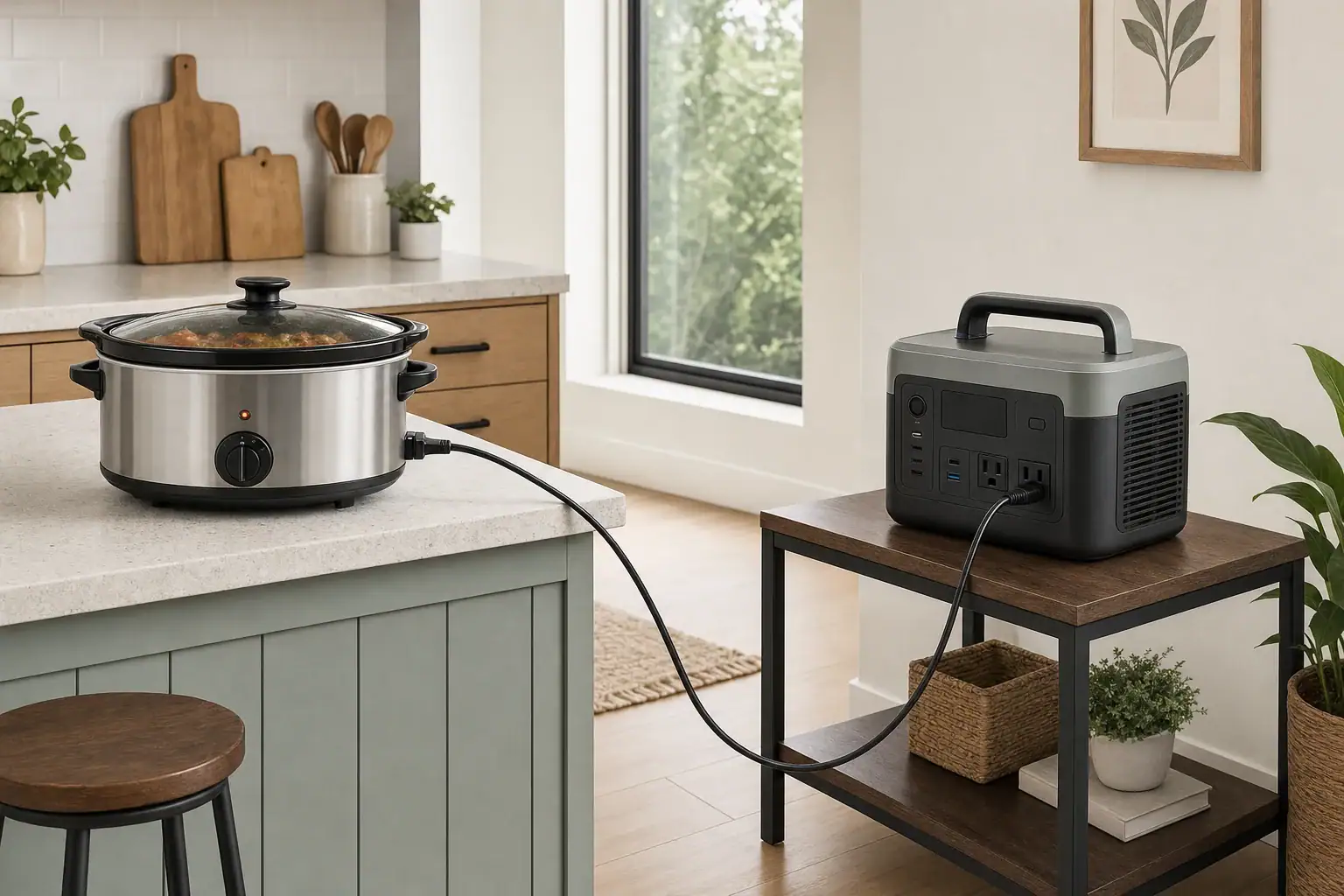
Quick answer: A portable power station can run a slow cooker when its continuous AC output can handle the cooker and any other connected loads, and its usable energy can cover the complete recipe. Use the cooker’s rating label and, ideally, a measured full-session energy reading rather than relying on inverter watts alone.
How to size a portable power station for a slow cooker
Starting a slow cooker is only one part of the decision. A portable power station for a slow cooker needs sufficient continuous AC output in watts (W) while the appliance operates and sufficient energy in watt-hours (Wh) for the entire cooking session.
Gather these four details before using the setup:
- Cooker wattage: Find the rating label and the manual for the exact appliance. Hamilton Beach says wattage information for its slow cookers is on the rating label; label location can vary by manufacturer. See its slow-cooker FAQ.
- Complete powered time: Include all cooking time and any warm period you intend to power.
- Continuous AC output: The station’s continuous AC rating must be sufficient for the cooker’s required load plus every other load operating from that inverter at the same time.
- Usable AC energy: Check the station’s rated battery capacity in Wh and any manufacturer-published usable AC energy or efficiency information. Rated battery Wh is not automatically the energy delivered at an AC outlet because conversion and the station’s own operation use energy.
Watts and watt-hours are separate measurements. Watts describe the rate at which power is delivered; watt-hours describe energy used over time. For example, the model-specific EcoFlow DELTA 2 manual lists a battery capacity and a continuous AC-output specification separately. Those figures apply only to that model, but the distinction applies to every station comparison.
Calculate a planning capacity
If you must plan from a constant load assumption and a manufacturer-stated AC efficiency, use this conservative planning equation:
Required rated battery capacity (Wh) = assumed cooker watts × cooking hours ÷ AC efficiency
Enter efficiency as a decimal: 90% becomes 0.90. Do not subtract efficiency again if the manufacturer instead publishes usable energy available from its AC outlets; compare the cooker’s required AC energy directly with that figure.
| Recipe duration | Required rated battery capacity |
|---|---|
| 4 hours | watts × 4 ÷ efficiency |
| 6 hours | watts × 6 ÷ efficiency |
| 8 hours | watts × 8 ÷ efficiency |
| 10 hours | watts × 10 ÷ efficiency |
Illustrative calculation only: Assume a cooker draws a constant 200W, the recipe requires 8 hours, and the station has a stated 85% AC efficiency:
200W × 8 hours ÷ 0.85 = 1,882Wh
This is an assumption-based planning result, not a typical slow-cooker consumption figure or a guaranteed runtime. A cooker may not draw its nameplate wattage continuously, and actual available energy can vary by station, load, temperature, battery condition, and protection limits. Leave a margin rather than treating a calculation as an exact cutoff.
Measure a full recipe for a better estimate
A compatible plug-in energy meter can show instantaneous watts and accumulated kilowatt-hours (kWh) for a normal recipe. Record the highest observed wattage for the output check and the complete session energy for capacity planning. Multiply kWh by 1,000 to convert it to Wh.
For example, a meter reading of 0.72kWh equals 720Wh of AC load energy. If the station provides only a rated battery capacity and a stated AC efficiency, divide 720Wh by that efficiency to estimate the required rated battery capacity. This is a unit-conversion example, not a measured or typical slow-cooker result.
A household meter may not capture every brief peak. Check the cooker and power-station manuals for compatibility requirements. The station’s short-duration surge rating does not replace an adequate continuous AC rating.
Does low use less total energy than high?
Do not assume that a lower setting always uses fewer watt-hours over a full recipe. Hamilton Beach says that, for its models, low uses fewer watts but takes longer to reach the cooked temperature. Crock-Pot says its low and high settings can take different amounts of time to reach simmer. See the Hamilton Beach FAQ and Crock-Pot FAQ.
Neither statement establishes which setting uses less total energy for every cooker and recipe. Appliance controls, food quantity, heat loss, setting changes, and cooking duration all affect full-session energy use. Measuring your usual recipe is the most reliable way to compare settings.
What to do if an outage interrupts slow cooking
Food safety depends on whether cooking was complete and whether someone was present. The USDA Food Safety and Inspection Service advises the following:
- If someone is home when the power fails, immediately finish unfinished food using another cooking method.
- If nobody was home during the outage, discard the food even if it appears cooked.
- If cooking was complete, food may remain safe in the unpowered slow cooker for up to two hours.
Do not decide that a partially cooked meal is safe to resume after an outage of unknown duration based on appearance or warmth. For outage use, a battery plan is most dependable when it can cover the full intended recipe without an uncertain interruption.
Safe setup checklist
- Add all simultaneous loads connected to the station’s AC inverter.
- Confirm both continuous output capacity and available energy; passing one check does not confirm the other.
- Use the cooker’s intact factory cord and plug. Never backfeed a wall outlet or improvise home-panel wiring.
- Follow both manuals for ventilation, clearances, moisture, temperature, extension-cord use, and any appliance compatibility requirements.
- Keep the power station dry, away from steam and spills, and clear of blocked cooling openings.
- Check the exact power-station model for current recalls. The CPSC battery-safety page identifies UL 2743 as a voluntary standard for portable power packs; a safety standard does not establish appliance runtime.
- Test the full setup with a normal recipe before depending on it during an outage.
Related guide: Surge Watts vs Running Watts: How to Size a Portable Power Station
A suitable station is therefore not defined by inverter watts alone. It must support the cooker’s actual load for the entire cooking session, and a full-session measurement provides the most useful runtime estimate when the appliance manual does not provide one.
Related guides
Browse this topic →

- Beginner-friendly sizing, runtime & specs
- Solar & charging (MPPT, fast charging, cables)
- Batteries (LiFePO4, cycles, care & storage)
- Safety, cold-weather performance, real-world tips
More in Home / Appliances
See all →Keep reading
About this site
Portable Energy Lab publishes practical, independent guides about portable power—clear sizing, safe use, and real-world expectations.
Affiliate disclosure
Some links on this site may be affiliate links. If you buy through these links, we may earn a small commission at no extra cost to you. This helps support our content. Read our affiliate disclosure.