
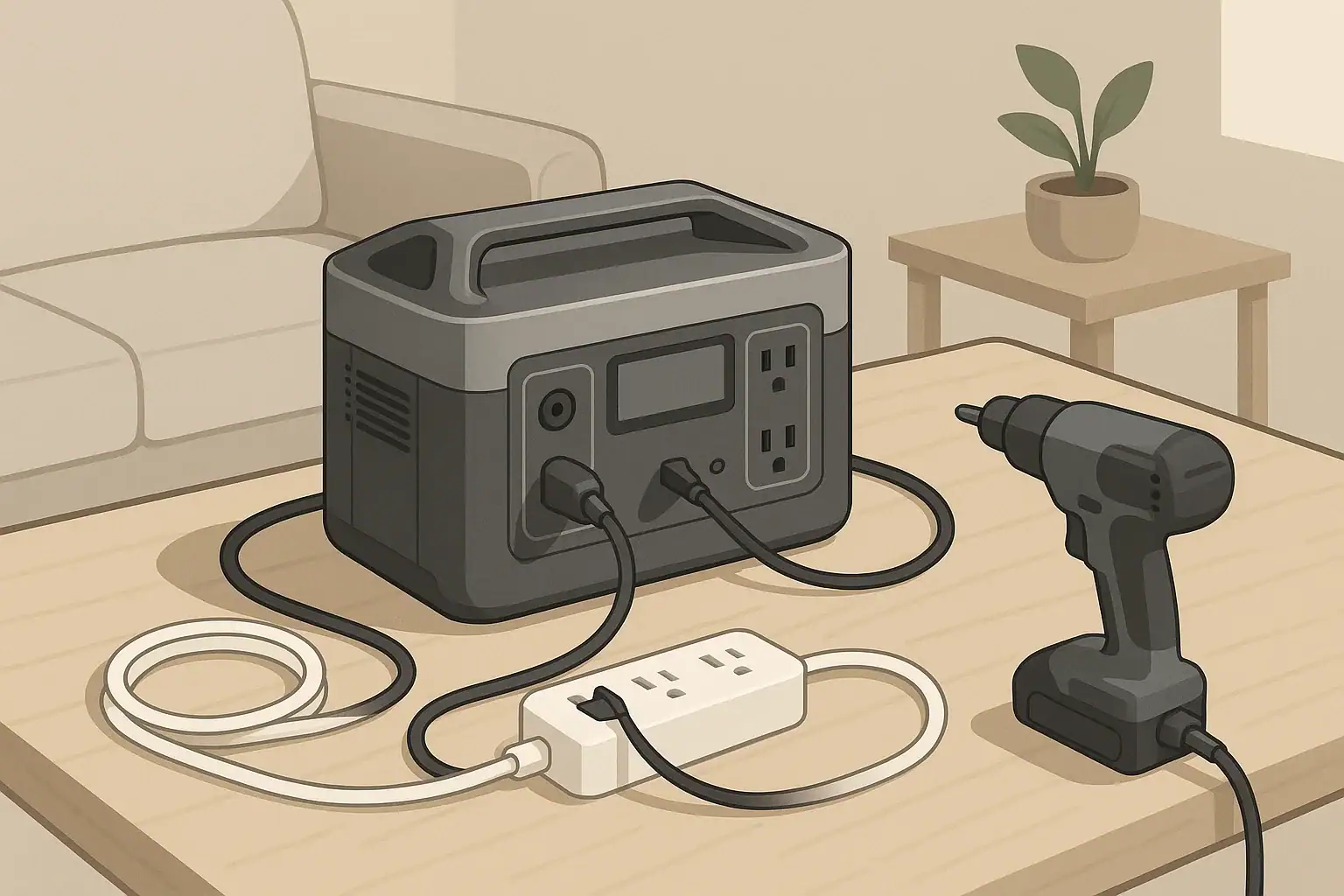
GFCI outlets on portable power stations usually trip because of small leakage currents, damaged cords, or motor surges that look like a ground fault to the safety circuit. In other words, the power station is cutting power because it thinks some current is escaping the normal path and could shock someone, even when the device appears to work fine on a wall outlet.
Understanding GFCI tripping on power stations helps you tell the difference between a real electrical problem and a nuisance trip. That is essential when you rely on a power station for power tools, refrigerators, sump pumps, or electronics during outages, camping, or jobsite work.
This guide explains what GFCI protection actually does inside a portable power station, how it interacts with watts, surge loads, extension cords, and moisture, and what to check when it keeps shutting off. You will see practical examples, simple troubleshooting steps, and the key specs to look for when you choose or upgrade a power station for GFCI-sensitive loads.
What GFCI Tripping Means on Portable Power Stations
A ground-fault circuit interrupter (GFCI) constantly compares the current on the hot wire with the current on the neutral wire. If it detects even a small difference, it assumes that current is leaking somewhere else (often through a person or a damp surface) and shuts off power in a fraction of a second.
On a portable power station, a GFCI trip usually shows up as:
- AC output suddenly turning off while the battery still shows plenty of charge
- A fault or “GFCI” indicator on the display, often with no overload warning
- The need to press a reset button or power the AC output back on
This is different from a low-battery shutdown or overload shutdown. GFCI trips are about where the current is going, not how much you are using overall. Common triggers include:
- Power tools and compressors with worn insulation or internal leakage
- Long, thin, or damp extension cords that provide leakage paths to ground
- Multiple electronic chargers whose tiny leakage currents add up
- Waveform differences between inverter power and utility power
Because many power stations combine an inverter, GFCI, and overload protection in one compact unit, it can be confusing when everything shuts down at once. Learning to recognize a GFCI trip helps you decide whether you are dealing with a safety issue (damaged equipment, moisture) or an operational issue (load size, cord choice, or inverter limits).
Key Concepts: How GFCI Protection and Power Station Limits Interact
Three ideas explain most GFCI tripping behavior on portable power stations: power (watts), surge behavior, and leakage current.
Watts, surge watts, and runtime basics
Every power station has two AC output limits:
- Continuous watts – what the inverter can deliver steadily
- Surge watts – what it can deliver briefly during startup
Many tools and appliances pull 2–3 times their normal running watts when they first start. A 400-watt rated fridge compressor may briefly demand 800–1,000 watts. If the surge capability is too low, the inverter may shut down or sag in voltage, which can indirectly contribute to GFCI trips or overload errors.
Battery capacity is usually given in watt-hours (Wh). That tells you how long you can run a given load, but not whether the inverter and GFCI can handle it safely at all. Inverter efficiency (often around 85–90%) also means the battery has to supply more watts than your devices actually use at the outlets.
Leakage current and GFCI sensitivity
A GFCI does not care how many watts you use. It trips when the difference between hot and neutral exceeds a small threshold. That difference, called leakage current, can come from:
- Moisture on plugs, outlets, or cords
- Filters inside power supplies that intentionally bleed tiny currents
- Damaged insulation inside a tool or appliance
- Long cable runs with higher capacitance to nearby surfaces
On a house circuit, leakage from several devices is spread out over a larger system. On a compact inverter with only one or two outlets, the same combined leakage can reach the GFCI threshold more quickly, especially when several chargers and power supplies are plugged in together.
How these pieces combine in real use
In practical terms, you want to know whether a shutdown was caused by watts (overload), temperature (thermal), or leakage (GFCI). The table below summarizes the differences and what they usually look like on a power station.
| Shutdown type | Main cause | Typical timing | What you usually see |
|---|---|---|---|
| GFCI trip | Leakage current or ground fault | Instant, often at startup or when a device is plugged in | AC cuts out suddenly, battery still charged; GFCI/fault indicator lights |
| Overload (watts) | Total load exceeds continuous or surge rating | Instant or within a few seconds of turning on a big load | Overload warning; unit may beep and shut off when tool starts |
| Low-battery cutoff | Battery voltage falls below safe limit | After minutes or hours of use | Battery gauge low; unit may warn before shutting down |
| Thermal shutdown | Inverter or battery overheats | After running near maximum load, especially in hot spaces | Fan runs hard; sometimes a temperature icon or derated output first |
Real-World Examples of GFCI Tripping and Power Use
Seeing how specific tools and appliances behave on a power station makes GFCI tripping easier to understand and prevent.
Example 1: Corded drill on a midsize power station
Imagine a corded drill labeled 6 amps at 120 volts (about 720 watts). On light duty, it may draw far less. But when you start the drill under load or if the bit binds, the motor can momentarily pull well above 720 watts.
On a power station rated for 800 watts continuous with modest surge capability:
- The drill may run fine at low speed or no-load.
- The moment you bore into a dense stud, the startup surge plus load can cause a brief voltage dip.
- If the drill cord is long, thin, or slightly damaged, small leakage currents can appear.
The result can be a GFCI trip or overload shutdown right when you squeeze the trigger hard. The same drill may seem to work “better” on a household outlet because the building circuit may have more surge headroom and different grounding characteristics.
Example 2: Small air compressor during an outage
A compact air compressor might list 8 amps (around 960 watts) but surge several times higher when the motor starts against tank pressure. On a dedicated household circuit with a standard GFCI receptacle, it might start reliably.
On a similarly sized power station:
- The motor surge can exceed the inverter’s surge rating.
- The compressor’s internal wiring or motor windings may leak a tiny current to its metal frame.
- Moisture in a garage or driveway can provide a path for that leakage to ground.
The GFCI sees this as a potential shock hazard and trips. From the user’s perspective, it feels like the power station is “too sensitive,” but it is actually reacting to conditions that are less noticeable on a building circuit.
Example 3: Electronics and chargers on a small station
Consider a setup with a laptop charger, two phone chargers, a camera battery charger, and a small LED desk lamp. None of these loads are big, and the total watts may be well under 200.
However, many modern power supplies and LED drivers include filters that intentionally leak a tiny current to ground. One charger alone is not a problem. Five or six together on a small inverter can push the combined leakage above the GFCI threshold.
The result is a seemingly random GFCI trip, even though the wattage is low and nothing appears wrong. Unplugging one or two chargers often stops the nuisance tripping.
Example 4: Mixed household loads in a short blackout
During a short outage, a typical home setup on a portable power station might include:
- Refrigerator (compressor motor)
- Wi-Fi router and modem
- Laptop
- Two or three LED lamps
The total running watts are within the station’s rating. But when the fridge compressor cycles on, the surge combines with the leakage currents from all the small power supplies and the resistance of any extension cords. That can lead to either an overload shutdown or a GFCI trip, depending on which limit the system hits first.
Common Mistakes and Troubleshooting Cues
Most recurring GFCI tripping on power stations comes down to a few predictable mistakes. Systematically checking for them usually solves the problem without disabling any safety features.
Typical user mistakes
- Undersizing the power station – Choosing a unit whose continuous and surge ratings are too close to the running wattage of the largest tool or appliance.
- Ignoring startup surge – Assuming a 600-watt device is fine on a 600-watt inverter, leaving no headroom for 2–3x startup current.
- Using long, thin extension cords – Running 50–100 feet of light-duty cord that increases resistance, voltage drop, and leakage paths.
- Mixing many small chargers on one outlet – Stacking multiple phone, camera, and laptop chargers that add up to significant leakage current.
- Operating in damp or dirty conditions – Using the station or cords on wet ground, in dew, or with dirty connectors that trap moisture.
- Assuming every trip is a “bad” GFCI – Resetting and retrying without inspecting the tool, cord, or environment for real faults.
Step-by-step troubleshooting approach
When a tool or appliance trips the GFCI on your power station, work through these steps:
- Confirm it is a GFCI trip. Check whether the display or indicator shows a fault separate from overload or low battery. If the battery is still well charged, suspect GFCI or thermal issues first.
- Test the device alone. Unplug everything else and plug only the suspect device directly into the power station with no extension cord. If it runs without tripping, the problem may be combined leakage from multiple devices or a bad cord.
- Swap cords and reduce length. Replace long or thin cords with a shorter, heavier one. If the GFCI stops tripping, the original cord may have damage or too much leakage.
- Check for moisture and dirt. Inspect plugs, outlets, and cord ends for condensation, mud, or corrosion. Let them dry completely and clean them carefully before retrying.
- Compare behavior on another GFCI source. If the same tool trips a different GFCI-protected outlet, the tool itself may have internal leakage and should be inspected or replaced.
- Review load size versus ratings. If trips occur only under heavy load or at startup, you may be near the inverter’s surge or continuous limits, even if the nameplate wattage seems acceptable.
The table below shows common patterns and likely causes you can use as a quick diagnostic reference.
| What you notice | Most likely cause | First things to check |
|---|---|---|
| Trips only when one specific tool runs | Internal leakage or insulation wear in that tool | Try tool on another GFCI outlet; inspect cord and housing for damage |
| Trips only outdoors or in damp weather | Moisture on cords, plugs, or surfaces | Dry all connectors; keep cords off wet ground; use shorter runs |
| Trips when several chargers are plugged in together | Combined leakage from multiple power supplies | Unplug some chargers; spread loads across different outlets or circuits |
| Trips when a motor starts, even though watts look okay | Startup surge plus small leakage pushes system over the edge | Check surge rating; reduce other loads; use a heavier extension cord |
| Trips after long use in a hot area | Heat increasing sensitivity of protection circuits | Improve ventilation; lower the load; allow the unit to cool |
Safety Basics: Placement, Cords, Heat, and GFCI
GFCI protection is one part of a broader safety strategy when using portable power stations. Good placement, cable management, and operating habits reduce both real hazards and nuisance trips.
Dry, stable placement
- Set the power station on a stable, level surface.
- Keep it away from standing water, wet grass, puddles, or snow.
- Avoid placing it directly under open windows, awnings, or areas where rain or condensation can drip onto outlets.
Ventilation and heat control
- Leave several inches of clearance around all sides and above the unit.
- Do not cover the power station with blankets, clothing, or gear while it is running or charging.
- In hot weather or enclosed spaces, consider reducing the load to keep internal temperatures lower and reduce the chance of thermal shutdowns.
Extension cords and accessories
- Use cords rated for the current your tools require, with heavier gauge wire for higher loads or longer runs.
- Keep cords as short as practical to reduce resistance, voltage drop, and leakage paths.
- Inspect cords regularly for cuts, crushed insulation, or loose plugs. Replace damaged cords rather than taping over faults.
- Avoid daisy-chaining multiple power strips or adapters, which can complicate grounding and increase leakage.
Respecting GFCI protection
- Never defeat the ground pin on plugs or use adapters that bypass grounding.
- Do not attempt to modify or bypass the GFCI function inside the power station.
- If a particular tool or appliance repeatedly trips GFCI protection on any source, treat that as a sign it needs inspection or replacement.
- For complex setups, such as tying a power station into an RV or building electrical system, consult a qualified electrician.
Maintenance and Storage for Reliable Operation
Good maintenance and storage practices help your power station deliver stable power and reduce unexpected trips or shutdowns over its lifetime.
Battery care and long-term storage
- Avoid leaving the battery at 0% for long periods; recharge after use.
- For seasonal storage, keep the state of charge in a moderate range rather than fully full or empty.
- Top up the battery every few months to offset self-discharge.
Environmental conditions
- Store the unit in a dry, temperature-controlled space whenever possible.
- Avoid prolonged exposure to extreme heat or freezing temperatures, which can shorten battery life and affect GFCI behavior.
- Let a cold-soaked unit warm up to a moderate temperature before applying heavy loads.
Regular inspections
- Check AC outlets and ports for debris, corrosion, or looseness.
- Keep ventilation grills free of dust and pet hair to maintain airflow.
- Inspect frequently used cords and tools, especially those that have caused GFCI trips in the past.
- If your unit provides error codes or status lights, learn what the main indicators mean so you can distinguish GFCI trips from overload or low-battery conditions.
Testing key appliances on the power station once or twice a year, under controlled conditions, is a simple way to confirm compatibility, check for nuisance trips, and verify that battery capacity still meets your needs.
Practical Takeaways and Specs to Look For
Managing GFCI tripping on portable power stations is about matching the right hardware to your loads and using it in a way that respects how GFCI protection works. Once you understand that GFCI trips are triggered by leakage current rather than total watts, it becomes easier to separate real hazards from avoidable nuisance trips.
In everyday use, you can think in terms of three questions:
- Is my power station large enough for the running and surge loads I want to power?
- Are my cords, environment, and devices creating extra leakage or moisture paths?
- Am I maintaining and storing the unit in a way that keeps it reliable over time?
Specs to look for when choosing or upgrading a power station
When you plan to run GFCI-sensitive loads such as power tools, pumps, or mixed household devices, pay close attention to these specifications and features:
- Continuous AC output (watts) – Choose a rating that comfortably exceeds the combined running watts of your largest planned loads, not just by a few watts.
- Surge or peak output (watts) – Look for enough surge capacity to handle 2–3x the running wattage of motor loads like fridges, compressors, and pumps.
- Number and type of AC outlets – More outlets can help spread out chargers and reduce combined leakage on a single receptacle.
- GFCI protection on outlets – Note which outlets are GFCI-protected and how the unit indicates a GFCI trip versus an overload or low-battery event.
- Inverter type and efficiency – A high-quality inverter with good efficiency can reduce heat and voltage sag, which may help minimize nuisance trips.
- Operating temperature range – Check that the unit is rated for the conditions where you plan to use it (garage, workshop, RV, or outdoor environments).
- Battery capacity (Wh) – Ensure there is enough energy to run your critical loads for the duration you expect, while remembering that usable capacity is lower than the raw rating due to inverter losses.
- Thermal management – Fans, vents, and thermal protections help keep the unit safe under continuous load; good cooling can also reduce sensitivity to trips at high temperatures.
- Status indicators and error codes – Clear icons or messages for GFCI, overload, and low battery make troubleshooting much easier in the field.
With the right combination of specs, careful cord choices, and basic maintenance, you can keep GFCI protection working for your safety while significantly cutting down on nuisance trips that interrupt your work, travel, or backup power plans.
Frequently asked questions
Which specs and features should I prioritize when buying a portable power station to reduce GFCI tripping?
Prioritize continuous AC output and surge/peak watt ratings so the inverter can handle both running loads and motor startup surges. Also look for multiple outlets to spread chargers, clear GFCI/ fault indicators, good inverter efficiency, and robust thermal management. These features together reduce nuisance trips and make troubleshooting easier.
Why do multiple chargers and small electronics cause a power station GFCI to trip?
Many modern chargers and LED drivers leak a tiny amount of current to ground as part of their filtering. When several are plugged into the same compact inverter, the combined leakage can exceed the GFCI threshold even though total wattage is low. Unplugging or spreading chargers across outlets usually resolves the issue.
Is using long, thin extension cords a common cause of GFCI trips on power stations?
Yes. Long, undersized cords increase resistance and can develop higher leakage to nearby surfaces, and they worsen voltage drop during surges. Using a shorter, heavier-gauge cord reduces these effects and often stops nuisance GFCI trips.
Can motor startup surges make a power station’s GFCI trip even if the running watts are within limits?
Motor startup surges can cause voltage sag and stress on the inverter, which may interact with protection circuits and contribute to a GFCI trip or overload shutdown. Choosing a station with adequate surge capacity and reducing other concurrent loads helps prevent those startup-related trips.
Is it safe to disable or bypass the GFCI on a portable power station to stop nuisance trips?
No. Bypassing or defeating GFCI protection creates a real electric shock hazard and is unsafe. If nuisance trips persist, troubleshoot cords, devices, and environmental moisture, or consult a qualified electrician rather than disabling safety features.
How can I test whether a GFCI trip indicates a real fault or just a nuisance trip?
Isolate the suspect device by unplugging everything else and test it directly on the station without extension cords; if it still trips other GFCI outlets, the device likely has internal leakage. Also inspect for moisture, swap cords with a known-good heavy gauge cord, and observe the station’s fault indicators to distinguish leakage from overload or thermal shutdowns.
Related guides
Browse this topic →

- Beginner-friendly sizing, runtime & specs
- Solar & charging (MPPT, fast charging, cables)
- Batteries (LiFePO4, cycles, care & storage)
- Safety, cold-weather performance, real-world tips
More in Safety
See all →- Childproofing a Portable Power Station at Home: Cables, Heat, Buttons, and Pets
- Can You Take a Portable Power Station on a Plane? Battery Limits and Safer Travel Planning
- What to Do If a Portable Power Station Gets Wet
- Portable Power Station Fire Safety Checklist for Apartments
- UL 2743 Certification Explained for Portable Power Stations
Keep reading
About this site
Portable Energy Lab publishes practical, independent guides about portable power—clear sizing, safe use, and real-world expectations.
Affiliate disclosure
Some links on this site may be affiliate links. If you buy through these links, we may earn a small commission at no extra cost to you. This helps support our content. Read our affiliate disclosure.