
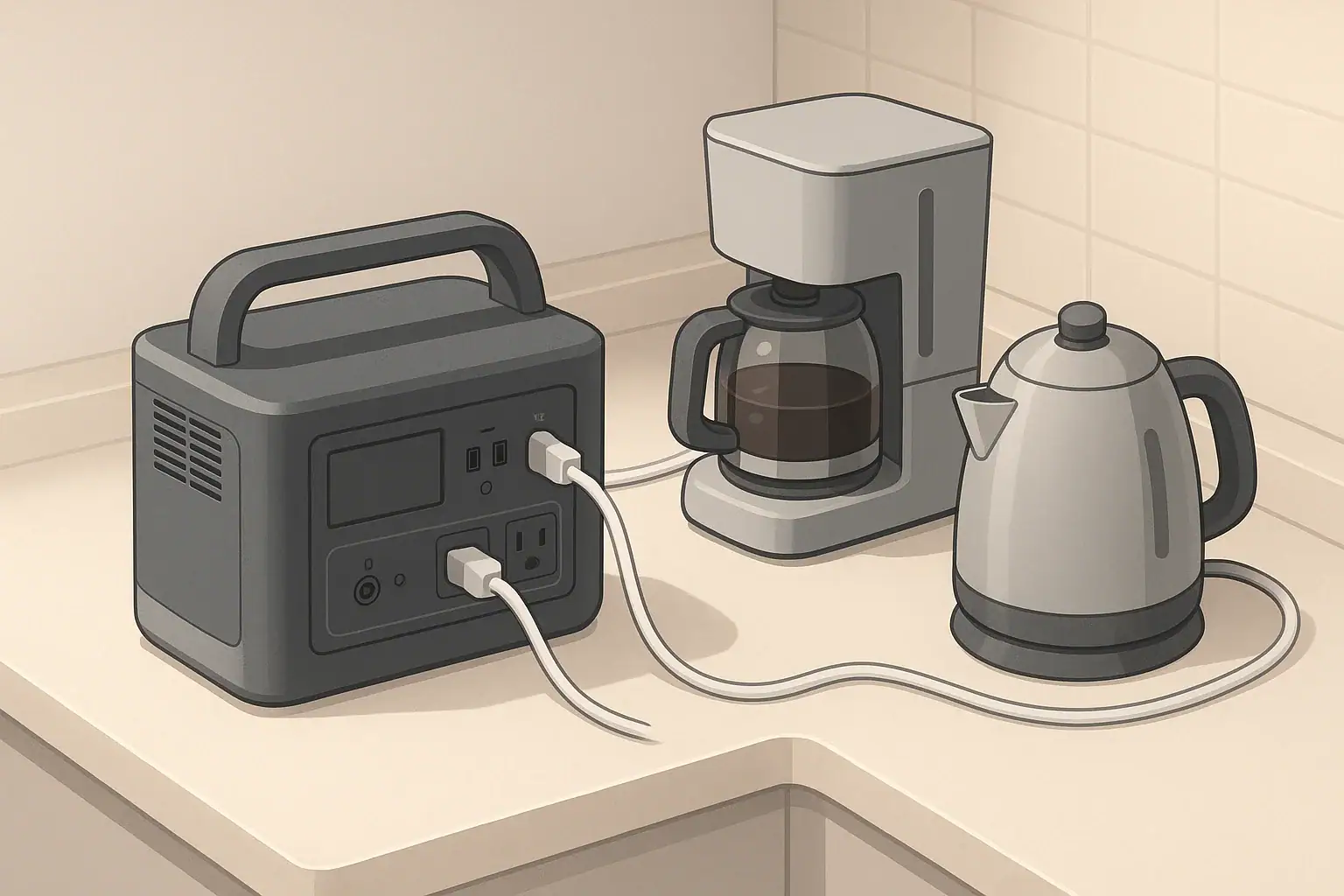
Yes, a portable power station can run a coffee maker, electric kettle, or induction cooktop if its AC inverter can supply the appliance’s wattage and the battery has enough usable watt-hours for the job.
The catch is that these are heating appliances, not light-duty electronics. A phone charger may use 10 to 30 watts, while a kettle or induction burner can demand 1,200 to 1,800 watts in seconds. That difference is why a station with a large battery can still shut down if the inverter is too small.
For practical off-grid cooking, camping, van travel, or outage backup, the goal is to match three things: the appliance’s running watts, the station’s continuous AC output, and the energy needed for each brew, boil, or meal.
What powering these heating appliances really means
Powering a coffee maker, kettle, or induction cooktop from a battery means converting stored DC battery energy into household-style AC power. The appliance does not care whether the power comes from a wall outlet or a portable power station, but it does require enough voltage, current, and stability to operate normally.
These appliances matter because they are some of the highest-demand items people try to use during outages and travel. Coffee and hot water are short-duration needs, so they can be realistic with a mid-size power station. Induction cooking is more demanding because it can run at high wattage for longer periods, especially when boiling, searing, or cooking for more than one person.
The most important distinction is between stored energy and output power. Battery capacity tells you how much energy is available over time. Inverter output tells you how much power can be delivered right now. A station can have enough energy to make coffee in theory but still fail if the coffee maker’s heating element exceeds the inverter’s continuous rating.
This is also why the same power station may run one appliance well and struggle with another. A compact 700-watt drip coffee maker may be easy. A 1,500-watt kettle may push the station to its limit. A single-burner induction cooktop may work on medium but trip protection on high.
Key concepts: watts, watt-hours, inverter limits, and losses
Start with watts. Watts measure how much power the appliance draws at a given moment. A label that says 1,200 W means the appliance can draw about 1,200 watts when heating. For a portable power station, the AC inverter’s continuous watt rating should be higher than that number, preferably with a margin of 15 to 25 percent for real-world variation.
Next, look at watt-hours. Watt-hours describe stored energy. A 1,000 Wh unit does not necessarily deliver a full 1,000 Wh to an AC appliance because the inverter and battery management system use some energy along the way. A reasonable planning estimate is that 80 to 90 percent of rated capacity may be usable for AC loads, depending on the unit, load size, temperature, and age of the battery.
Surge rating is less important for heating elements than it is for compressors or pumps, but it still matters. Coffee makers with pumps, electronic controls, or thermostats may momentarily draw above their average rating. Induction cooktops can also pulse power as they regulate temperature. If a power station shuts off immediately at startup, the surge or continuous limit may have been exceeded.
Use this simple planning formula: appliance watts multiplied by hours of use equals watt-hours consumed before losses. Then add about 10 to 20 percent for inverter and system losses. For example, a 1,200-watt kettle running for 5 minutes uses 1,200 × 0.083, or about 100 Wh before losses. In practice, plan for roughly 110 to 125 Wh from the battery.
| Appliance or use case | Typical running draw | Minimum AC inverter to consider | Practical battery range | What to expect |
|---|---|---|---|---|
| Small drip coffee maker | 600 to 900 W | 1,000 W | 500 to 1,000 Wh | Good fit for occasional brewing if no other large loads are running. |
| Large drip or single-serve brewer | 900 to 1,400 W | 1,500 W | 800 to 1,500 Wh | Works best with inverter headroom because pumps and heaters may cycle. |
| Compact electric kettle | 800 to 1,200 W | 1,500 W | 800 to 1,500 Wh | Short, heavy draw; usually practical for hot water on a mid-size station. |
| Full-size electric kettle | 1,200 to 1,500 W | 1,800 W | 1,000 to 2,000 Wh | Often near the limit of smaller power stations. |
| Induction cooktop on low or medium | 500 to 1,000 W | 1,500 W | 1,000 to 2,000 Wh | Useful for simmering, reheating, oatmeal, rice, and simple meals. |
| Induction cooktop on high | 1,200 to 1,800 W | 2,000 W or higher | 1,500 to 3,000 Wh | Best for larger systems; high heat drains a battery quickly. |
Real-world examples: coffee, hot water, and induction cooking
A simple drip coffee maker is often the easiest of the three. If it draws 800 watts while heating and the brew cycle lasts 10 minutes, the raw energy use is about 133 Wh. After losses, plan on about 150 Wh. A 1,000 Wh station with roughly 850 Wh usable for AC loads could handle several brew cycles, though not if it is also running a refrigerator, heater, or other large appliance.
A single-serve coffee brewer may look small but can draw 1,200 to 1,400 watts while heating water. It may run for only a few minutes, so total energy use can be modest, but the inverter still needs to tolerate the peak draw. If your unit has a 1,000-watt AC output, this type of brewer may overload it even though one cup would not use much battery.
An electric kettle is efficient for hot water because it heats only what you pour in. A 1,200-watt kettle boiling one liter for about 5 minutes uses around 100 Wh before losses. If you only need enough water for instant coffee, tea, or oatmeal, boiling half a liter may take less time and use much less energy. Filling the kettle to the maximum every time is one of the fastest ways to waste battery capacity.
Induction cooking is practical when you manage heat settings. Boiling a full pot of water on high may demand 1,500 watts or more and run long enough to use several hundred watt-hours. However, simmering soup, reheating food, or cooking eggs at 600 to 900 watts can be reasonable. A 20-minute session at 900 watts uses about 300 Wh before losses, so it can consume a large share of a mid-size station.
If you want a realistic meal plan, think in tasks. One morning routine might include one coffee brew at 150 Wh, one kettle boil at 120 Wh, and 15 minutes of induction cooking at a moderate 800 watts, or about 230 Wh after losses. Together that could approach 500 Wh. On a 1,000 Wh station, that is not a small load; it is roughly half a useful charge in one breakfast period.
Common mistakes and troubleshooting cues
The most common mistake is buying for watt-hours only. A 1,500 Wh battery sounds large, but if the AC inverter is rated for only 600 watts, it will not run most kettles or induction cooktops. Always check AC output first for high-wattage appliances, then use battery capacity to estimate how long the appliance can run.
Another mistake is running several heating appliances at the same time. A coffee maker and kettle running together may exceed 2,000 watts. Add an induction cooktop and the load can climb far beyond what many portable power stations can deliver. Even if the station does not shut down immediately, high combined loads create more heat, more fan noise, more voltage stress, and faster battery drain.
Confusing display readings can also lead to wrong assumptions. A station may show plenty of battery remaining but still beep and shut down because the inverter is overloaded. Conversely, when charging and discharging at the same time, the battery percentage may barely move because incoming power is being consumed by the appliance as fast as it arrives.
Use the symptoms below to narrow down likely causes before assuming the power station or appliance is defective.
| Symptom | Likely cause | What to try first |
|---|---|---|
| Station shuts off as soon as appliance starts | Inverter overload or startup spike | Use a lower-watt appliance or a station with higher continuous output. |
| Cooktop works on low but not high | High setting exceeds inverter rating | Cook at medium power and allow more time. |
| Battery drains much faster than expected | Wattage, runtime, or losses were underestimated | Track watt-hours used per task and reduce water volume or cook time. |
| Fans run loudly and output stops after several minutes | Thermal protection from sustained heavy load | Improve ventilation, reduce load, and let the unit cool. |
| Charging seems slow during cooking | Appliance is consuming incoming power | Pause cooking while charging or expect slower net battery gain. |
Safety basics for high-heat appliances
High-heat appliances should be treated as serious loads. Place the power station on a stable, dry, level surface with open space around its vents. Do not put it behind a kettle, beside a hot pan, or under cabinets where heat and steam can collect. Batteries and inverters perform best when they can stay cool.
Keep liquids away from the power station. Coffee makers and kettles create splashes, condensation, and steam. Induction cooking can involve boiling water or hot oil. Position the appliance far enough away that a spill will not run into outlets, ports, vents, or display panels.
Cords matter. Plug high-wattage appliances directly into the station when possible. If an extension cord is necessary, use a short, heavy-duty cord rated for the current. Avoid thin household cords, damaged plugs, coiled cords under load, and daisy-chained power strips. Warm plugs, discoloration, or a burning smell are warning signs to stop immediately.
Do not cover the power station to reduce fan noise. Fan noise under a heavy kettle or induction load is normal because the inverter is shedding heat. Blocking airflow may cause shutdowns or create unsafe temperatures. Also avoid operating power equipment in standing water, heavy rain, or very damp conditions unless the full setup is specifically designed and protected for that environment.
Maintenance, storage, and long-term reliability
A portable power station that is expected to handle coffee, hot water, or cooking should be tested before an outage or trip. Run the actual coffee maker, kettle, and cooktop settings you plan to use, then record the wattage and watt-hours shown on the display if available. Real measurements are more useful than appliance labels because thermostats, water volume, and cooking settings change the load.
For storage, most lithium power stations prefer a moderate state of charge rather than sitting empty or completely full for months. A common practical range is around 40 to 60 percent for long-term storage, with a top-off before storm season, camping season, or planned travel. Follow the unit’s manual if it specifies a different range.
Temperature has a large effect on reliability. Avoid storing the unit in a hot vehicle, direct summer sun, or a freezing shed for long periods. Cold batteries may deliver less power and may charge slowly or not at all until warmed. If you plan to use induction cooking in cold weather, keep the unit indoors or insulated until it is needed, then give it ventilation during use.
Inspect the station and cords periodically. Look for cracked insulation, loose receptacles, bent prongs, melted plastic, or debris in vents. Clean the exterior with a dry or slightly damp cloth while the unit is off and unplugged. Do not open the case or attempt internal repairs, because battery packs and inverter components can remain hazardous even when the unit appears off.
Practical takeaways and specs to look for
Related sizing, appliance, and backup-power guides can be added here when planning a complete setup.
The practical answer is simple: coffee makers and kettles are usually realistic on a properly sized portable power station, while induction cooktops require more output and more careful energy planning. If the appliance draws more watts than the inverter can supply, it will not work reliably. If the appliance runs too long, it will drain the battery quickly even when the inverter is large enough.
For small daily comfort needs, choose efficient routines. Brew one pot instead of keeping a warming plate on for an hour. Boil only the water you need. Use induction at medium power and lid-covered cookware when possible. These habits reduce watt-hours without giving up hot drinks or basic meals.
Specs to look for before buying or pairing equipment:
- Continuous AC output: Match this to the appliance’s running watts with realistic headroom.
- Surge rating: Helpful for brewers with pumps and for appliances that cycle abruptly.
- Battery capacity in watt-hours: Use this to estimate how many brews, boils, or cooking sessions are possible.
- Usable AC capacity: Plan for conversion losses instead of assuming the full rated Wh is available.
- AC outlet rating: Confirm that the outlet itself supports the load, not just the battery pack.
- Thermal design: Look for clear ventilation requirements and expect fans under heavy loads.
- Pass-through behavior: If charging while cooking matters, verify whether output is limited during charging.
- Display data: A live wattage and watt-hour display makes testing and planning much easier.
- Extension cord compatibility: Use only cords rated for the appliance’s current draw.
- Storage guidance: Check recommended charge range and temperature limits for long-term readiness.
Before relying on a setup, perform a full test at home. Brew coffee, boil your usual amount of water, and cook a simple meal on the exact settings you expect to use. Note whether the station stays stable, how loud the fans get, and how many watt-hours each task consumes. That test will tell you more than a label ever will.
With the right inverter size, enough usable watt-hours, safe cord practices, and realistic cooking habits, a portable power station can handle coffee, hot water, and simple induction cooking without guesswork.
Induction cooktop compatibility checks
For a portable induction cooktop, compare its highest selectable wattage with the power station’s continuous AC output and leave margin for other active loads. Some cooktops pulse between full power and off at lower settings, so a low displayed setting does not always mean a perfectly steady low draw. Test each intended setting while watching the station for overload or temperature warnings.
Confirm cookware compatibility and use a short, correctly rated cord only when the manuals allow it. A built-in or hardwired induction cooktop is not a normal plug-in load and should not be adapted to a portable station without a system specifically designed and installed for that purpose.
Frequently asked questions
What size portable power station do I need for a coffee maker, kettle, or induction cooktop?
The right size depends on both inverter output and battery capacity. For coffee makers and kettles, the inverter should exceed the appliance’s running watts with some headroom, while induction cooktops usually need even more continuous output. Battery capacity in watt-hours determines how many brews, boils, or cooking sessions you can complete before recharging.
Can a 1,000-watt power station run a kettle or induction cooktop?
Usually not for full-size models. Many kettles and induction cooktops draw 1,200 watts or more, which can exceed a 1,000-watt inverter even if the battery is large. A smaller kettle or low-power cooking setting may work, but the appliance label and inverter rating should be checked first.
What specs matter most when powering these appliances?
The most important specs are continuous AC output, surge rating, and battery capacity in watt-hours. For heating appliances, continuous output is often the limiting factor, while watt-hours determine runtime. It also helps to check usable AC capacity, outlet rating, and whether the unit limits output during charging.
What is the most common mistake people make with high-watt appliances?
The most common mistake is focusing on battery size and ignoring inverter output. A large battery can still fail to run a kettle or cooktop if the AC inverter is too small. Another frequent issue is running multiple heating appliances at once and exceeding the station’s total output.
Is it safe to use a portable power station with a kettle or induction cooktop?
It can be safe if the station is used within its electrical limits and kept in a dry, well-ventilated area. Keep liquids away from the unit, use properly rated cords, and do not block the cooling vents. If the station or cords become hot, smell burnt, or shut down repeatedly, stop using the setup and reassess the load.
How can I make a portable power station last longer while cooking?
Use only the amount of water or heat time you need, and avoid keeping appliances on high longer than necessary. Induction cooking at medium power with a lid can reduce energy use, and boiling smaller water volumes saves a lot of watt-hours. Turning off warming plates and avoiding simultaneous high-watt loads also helps preserve battery life.
Related guides
Browse this topic →
- Beginner-friendly sizing, runtime & specs
- Solar & charging (MPPT, fast charging, cables)
- Batteries (LiFePO4, cycles, care & storage)
- Safety, cold-weather performance, real-world tips
More in Home / Appliances
See all →Keep reading
About this site
Portable Energy Lab publishes practical, independent guides about portable power—clear sizing, safe use, and real-world expectations.
Affiliate disclosure
Some links on this site may be affiliate links. If you buy through these links, we may earn a small commission at no extra cost to you. This helps support our content. Read our affiliate disclosure.