
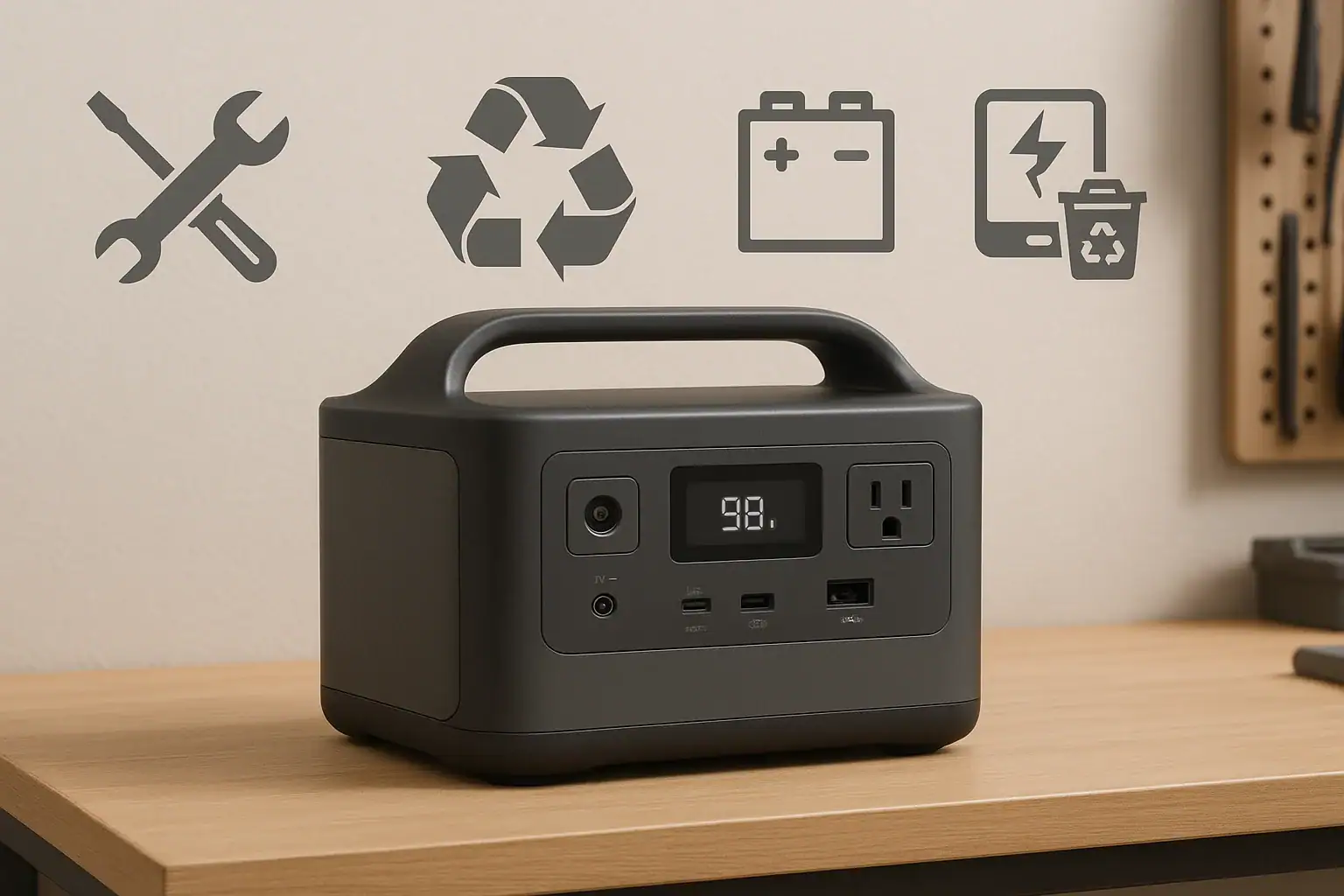
Portable power stations can be sustainable, but their true impact depends on how they are designed, used, repaired, and recycled. Battery chemistry, lifespan, charging habits, and e-waste handling all influence how eco-friendly these devices really are. When people search for terms like battery cycle life, depth of discharge, inverter efficiency, solar charging input, and battery degradation, they are often trying to understand if a portable power station is a greener alternative to fuel generators or just another source of electronic waste.
This article explains what makes a portable power station more or less sustainable, how repairability and recycling work in practice, and what you can do to reduce e-waste over the full lifecycle. You will learn how different battery types affect longevity, which specs matter most for environmental impact, and how to use and store your system to extend runtime and lifespan while keeping waste to a minimum.
Understanding Sustainability for Portable Power Stations
For portable power stations, sustainability means minimizing environmental impact from manufacturing through end-of-life, while still delivering reliable, usable power. It is not just about whether the unit can be charged with solar panels or has a high watt-hour rating. True sustainability combines energy efficiency, long battery life, repairability, safe recycling, and responsible e-waste management.
Portable power stations are essentially compact battery energy storage systems with built-in inverters and multiple output ports. They replace or supplement gas generators for backup power, camping, off-grid work, and mobile living. Their sustainability profile depends on several key factors:
- Battery chemistry and lifespan: Different chemistries, such as lithium iron phosphate (LiFePO4) and other lithium-ion types, have different cycle life, safety, and resource implications.
- Repairability and modularity: Whether components like fans, inverters, and ports can be serviced or replaced instead of discarding the entire unit.
- Charging sources and efficiency: How efficiently the unit converts grid or solar input into stored energy, and how much is lost as heat.
- End-of-life pathways: Availability of battery recycling and safe disposal to prevent hazardous e-waste.
This matters because portable power stations concentrate valuable and sometimes hazardous materials in a single device. A long-lived, repairable unit that can be recycled at the end of its life is far more sustainable than a short-lived, sealed device that ends up in a landfill after a few years of use.
How Portable Power Stations Work and Where Sustainability Fits In
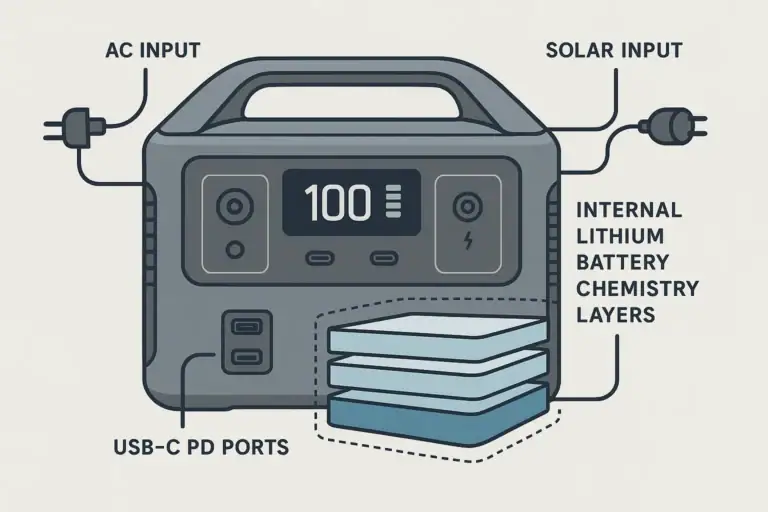
To understand sustainability, it helps to know the basic architecture of a portable power station. Inside the case are several subsystems that each affect efficiency, durability, and recyclability.
Battery pack: This is the core energy storage, typically measured in watt-hours (Wh). Lithium-based batteries dominate because of their high energy density. Some chemistries prioritize long cycle life and thermal stability, while others focus on compact size and lower cost. The number of full charge and discharge cycles the battery can handle before dropping to around 80% of its original capacity is a key sustainability metric.
Battery management system (BMS): The BMS monitors cell voltage, current, temperature, and state of charge. It prevents overcharge, over-discharge, and overheating. A robust BMS extends battery life, improves safety, and reduces the risk of premature failure that would send the device to recycling or disposal early.
Inverter and DC converters: The inverter converts DC battery power into AC output. DC converters provide regulated DC outputs like USB-A, USB-C PD, and 12 V ports. Their efficiency determines how much stored energy actually reaches your devices. Higher inverter efficiency means fewer losses and better real-world runtime from the same battery capacity.
Charging circuits: These manage input from wall outlets, vehicle sockets, or solar panels. Input limits, such as maximum watts from solar or AC, affect how quickly you can recharge and how well the device pairs with renewable sources. Efficient charging reduces wasted energy and heat, both of which influence sustainability.
Enclosure and components: The housing, cooling fans, and connectors are typically made from plastics and metals. Durable, standardized parts are easier to repair and recycle than fragile, proprietary components.
From a sustainability standpoint, the key questions are: How long will the battery and electronics last under typical use? Can worn parts be replaced? How efficient is the system at converting and delivering power? And when it finally reaches end-of-life, can the materials be recovered rather than discarded?
| Component | Sustainability Role | Example Values |
|---|---|---|
| Battery pack | Determines lifespan, capacity, and resource use | 500–3,000+ cycles, 300–2,000 Wh |
| Battery management system | Protects cells, extends usable life | Over/under-voltage, temperature, and current protection |
| Inverter | Affects energy conversion efficiency | 85–94% typical AC efficiency |
| Charging input | Supports renewable sources and charge speed | 100–1,200 W AC, 100–800 W solar |
| Enclosure and ports | Durability and ease of repair | Replaceable fans, standard connectors |
Real-World Sustainability: Use Cases, Repairability, and E-Waste Outcomes
Sustainability becomes clear when you look at how portable power stations are actually used and what happens when something goes wrong. Different scenarios create very different environmental footprints.
Occasional emergency backup at home
For many households, a portable power station sits idle most of the time and only runs during outages. In this case, the unit may experience relatively few full cycles over its life. The main sustainability challenges are:
- Battery aging in storage: Even without heavy use, lithium batteries slowly degrade, especially if stored fully charged or in high heat.
- Underutilized resources: A large-capacity battery that rarely cycles may not deliver its full potential energy throughput before aging out.
- End-of-life disposal: If owners are not aware of recycling options, these units may be discarded with general waste.
In this use case, sustainability improves when owners periodically top up and lightly cycle the unit, store it correctly, and plan for recycling once capacity becomes noticeably reduced.
Frequent off-grid or RV use
For off-grid living, RV travel, or work sites, portable power stations may cycle daily. This can actually be more sustainable if the unit is paired with solar panels and built for long cycle life.
- High utilisation: The battery delivers more total kilowatt-hours over its lifetime, making better use of the resources that went into manufacturing.
- Repairability matters more: Fans, ports, and inverters see more wear. If these parts are replaceable, the overall system can stay in service far longer.
- Solar integration: Efficient solar charging reduces reliance on fossil-fuel generators, especially if the inverter and MPPT controller are well matched.
Here, sustainability improves with robust thermal management, conservative depth-of-discharge settings, and the ability to service high-wear components.
Shared and community power applications
Some communities use portable power stations as shared assets for events, tool libraries, or resilience hubs. This concentrates usage in fewer units, which can be positive if the devices are durable and repairable.
- Pooling resources: Fewer units are needed overall, reducing total manufacturing impact.
- Centralized maintenance: A responsible owner or organization can manage charging, storage, and repairs more systematically.
- Structured end-of-life: When a unit reaches the end of its useful life, it is more likely to be routed through proper e-waste channels.
What happens when they fail?
When a portable power station stops working, the sustainability outcome depends heavily on diagnostics and repair options:
- Minor issues: Failed fans, broken ports, or damaged cables are relatively simple to address if the device is designed for service and replacement parts are available.
- Battery degradation: When capacity drops significantly, some designs allow battery module replacement, while others require replacing the entire unit.
- Complete failure: If the device is non-repairable or support is unavailable, it typically enters the e-waste stream.
Where formal recycling channels exist, the battery pack and metals can often be recovered. Where they do not, devices may be stockpiled, exported, or landfilled, increasing environmental risk. This is why design for disassembly, clear labeling, and standardized components are so important for long-term sustainability.
Common Sustainability Mistakes and Early Warning Signs
Many users unintentionally shorten the life of their portable power stations or create unnecessary e-waste through a few common habits. Recognizing these patterns can help preserve both the device and the environment.
Over-discharging and running at the edge of capacity
Repeatedly draining the battery close to 0% state of charge, especially under high loads, can accelerate degradation. Signs this is happening include noticeably reduced runtime at the same load, faster voltage sag, and the inverter shutting down more often under peak demand.
To improve sustainability, aim to avoid routine deep discharges if possible. Keeping typical usage between roughly 20% and 80% of capacity, when practical, can significantly extend cycle life and delay end-of-life recycling.
Storing fully charged in hot environments
Leaving a portable power station at 100% charge in a hot vehicle, garage, or shed for long periods is one of the fastest ways to age the battery. Warning signs include the case feeling warm even when idle, rapid capacity loss over months, and the fan running more often during charging.
A more sustainable practice is to store the unit in a cool, dry place at a moderate state of charge, then top it up before use. This reduces chemical stress inside the cells and extends the time before the device becomes e-waste.
Ignoring early performance changes
Small issues often appear before complete failure. These can include:
- USB or DC ports that intermittently cut out under light loads
- Fans that become noisy or fail to spin up under load
- AC output that occasionally trips off even within rated watts
If these are ignored, users may discard the unit as “dead” even when simple repairs or servicing could restore function. Documenting symptoms, checking user documentation, and consulting qualified service providers can keep a device in operation longer.
Mixing incompatible chargers and loads
Using non-approved charging sources or consistently running loads that exceed surge or continuous watt ratings can stress components. Repeated overloads may damage the inverter or connectors, leading to premature retirement of the unit. Watching for frequent overload alarms, hot connectors, or discolored plugs can help you intervene early.
Disposal without considering recycling
Finally, many portable power stations are thrown away with regular trash when their performance declines. This is a missed opportunity to recover valuable materials and avoid environmental contamination. Even if repair is not feasible, seeking out e-waste collection points or battery-specific recycling programs is far more sustainable than landfilling.
Safety and Environmental Risk Basics
Sustainability and safety are closely linked. A portable power station that is used or stored unsafely is more likely to fail early, become hazardous waste, or cause damage that leads to premature disposal.
Battery safety and thermal management
Modern lithium-based batteries are generally safe when used within their design limits, but they can be damaged by extreme heat, physical impact, or severe overcharge and over-discharge. Good designs include temperature sensors, current limiting, and automatic shutdowns. From a sustainability perspective, these protections reduce the risk of fires and extend the usable life of the cells.
Users can support this by:
- Avoiding prolonged operation in direct sun or enclosed, unventilated spaces
- Not covering cooling vents or fans during use
- Allowing the unit to cool if the case feels excessively hot
Safe charging practices
Using appropriate chargers and staying within specified input limits helps prevent stress on internal components. For solar charging, matching panel wattage and voltage to the unit’s input specifications avoids overheating and extends electronics life. When using vehicle charging, avoid damaged cables and connectors that may overheat and create localized failure points.
Load management and surge handling
Every portable power station has continuous and surge watt ratings. Sustained overloading or repeatedly starting heavy inductive loads (like some power tools or compressors) at or above surge limits can strain the inverter. This can lead to early failure and, ultimately, more e-waste. Paying attention to startup wattage and spreading loads over time supports both safety and sustainability.
End-of-life safety
When a unit is no longer usable, it should be handled as electronic waste, not general trash. Damaged or swollen batteries should not be punctured, crushed, or exposed to open flame. Instead, they should be routed to qualified e-waste or battery recycling facilities. This reduces the risk of fires in waste streams and keeps hazardous materials out of soil and water.
For any uncertainty around damaged units, especially after impacts, floods, or fires, it is wise to consult a qualified professional or local hazardous waste authority before attempting to move or transport the device.
Maintenance, Storage, and Extending Lifespan to Reduce E-Waste
Good maintenance and storage practices are some of the most effective ways to make a portable power station more sustainable. Extending service life means fewer units manufactured, transported, and ultimately recycled or discarded.
Battery-friendly charging habits
While portable power stations are designed to be user-friendly, small adjustments in how you charge can have a big impact on longevity:
- Avoid constant 100% storage: For long-term storage, a moderate charge level is easier on the battery than full charge.
- Limit frequent full discharges: Occasional deep cycles are fine, but daily use that drains to near-empty will shorten life compared with shallower cycles.
- Use appropriate charge rates: Very fast charging generates more heat. When time allows, using moderate input power is gentler on the system.
Environmental storage conditions
Heat and moisture are two of the biggest enemies of electronics and batteries. To reduce premature failure:
- Store the unit in a cool, dry location away from direct sunlight.
- Avoid leaving it in vehicles or sheds that experience extreme temperatures.
- Keep the device off bare concrete floors where moisture fluctuations can be higher.
Periodic function checks
If you use a portable power station mainly for emergencies, it is easy to forget about it until an outage. A more sustainable approach is to:
- Test the unit every few months with a light load.
- Verify that ports, displays, and fans operate as expected.
- Recharge to a healthy level after testing.
This helps catch small issues early, when they may be easier to address, and ensures that the unit is ready when needed instead of being replaced prematurely.
Cleaning and physical care
Dust and debris can block vents and stress cooling systems, while rough handling can damage internal connections. Wiping down the exterior, keeping vents clear, and transporting the unit in a protective case or secured position all contribute to a longer service life.
Planning for end-of-life and recycling
Sustainability includes planning for when the battery has lost too much capacity for your needs. At that point:
- Consider whether the unit can still serve lower-demand roles, such as charging small devices.
- Investigate local e-waste and battery recycling options early, so you know where to take it when needed.
- Retain documentation and labels that identify battery type, which can help recyclers handle it properly.
Thoughtful end-of-life planning ensures that valuable metals and materials are recovered and that hazardous components do not contribute unnecessarily to environmental pollution.
| Practice | Recommended Approach | Potential Benefit |
|---|---|---|
| Storage charge level | Moderate state of charge for long-term storage | Helps preserve capacity over several years |
| Storage temperature | Cool, dry indoor environment | Reduces chemical aging and corrosion |
| Usage pattern | Avoid daily deep discharges when possible | Increases usable cycle count |
| Periodic testing | Function check every 3–6 months | Identifies issues before complete failure |
| Recycling plan | Identify local e-waste options in advance | Improves end-of-life material recovery |
Related guides: Portable Power Station Buying Guide • Battery Cycle Life Explained: What “Cycles” Really Mean • Inverter Efficiency Explained: Why Your Runtime Is Shorter Than Expected
Practical Takeaways and Specs to Look For in Sustainable Portable Power Stations
Sustainable portable power stations are not defined by a single feature. Instead, they balance robust design, long battery life, efficient power conversion, and clear pathways for repair and recycling. As you evaluate options or plan how to use an existing unit, focus on how many years and cycles of reliable service you can realistically expect, and what will happen to the device when it no longer meets your needs.
In practice, sustainability often comes down to three questions: How efficiently does the unit turn input energy into usable output? How long will the battery and electronics last under your actual usage pattern? And how easy will it be to repair or recycle the system at the end of its life? Thinking through these questions before purchase and throughout ownership can significantly reduce environmental impact.
Specs to look for
- Battery chemistry and cycle life: Look for lithium chemistries with several hundred to a few thousand cycles at typical depth of discharge; this increases total energy delivered over the device’s life.
- Usable capacity (Wh) vs. your load: Choose a watt-hour rating that comfortably supports your typical runtime without daily deep discharges; oversizing slightly can reduce stress and extend lifespan.
- Inverter efficiency and continuous watt rating: Higher efficiency (for example, above the mid-80% range) and a continuous watt rating well above your usual load mean less wasted energy and fewer overload events.
- Solar and DC charging input limits: Adequate solar and DC input wattage (such as a few hundred watts or more for larger units) allows effective use of renewable sources, improving long-term sustainability.
- Thermal management and ventilation: Visible vents, temperature monitoring, and controlled fan operation help keep internal components within safe limits, reducing early failures.
- Port durability and variety: A mix of AC, 12 V, and USB-C PD ports with solid connectors reduces the need for adapters and lowers the risk of damage that would shorten device life.
- Design for repairability: Indications that fans, ports, or other high-wear parts can be serviced or replaced increase the likelihood that the unit will be repaired instead of discarded.
- Clear safety and recycling information: Labels, documentation, and support that describe battery type, handling precautions, and recycling guidance make it easier to manage the device responsibly at end-of-life.
- Standby consumption and idle behavior: Lower self-discharge and efficient standby mode mean less wasted energy over months of storage or light use.
By prioritizing these characteristics and combining them with careful use, storage, and eventual recycling, portable power stations can play a meaningful role in reducing dependence on fossil-fuel generators while limiting their own contribution to e-waste.
Frequently asked questions
Which specifications and features should I prioritize when choosing a sustainable portable power station?
Prioritize battery chemistry and cycle life, usable watt-hours relative to your needs, inverter efficiency, and supported charging inputs (AC and solar). Also look for good thermal management, low standby consumption, and indications of repairability and clear recycling information to maximize lifetime environmental value.
What is a common user mistake that shortens a portable power station’s lifespan?
One common mistake is storing the unit fully charged in hot conditions or routinely running it to near zero state of charge; both accelerate chemical degradation. Periodic light cycling, storing at a moderate state of charge, and avoiding high heat will help preserve capacity.
Are portable power stations safe to use indoors and around people?
Portable power stations are generally safe when used according to manufacturer guidelines: keep them ventilated, avoid extreme temperatures, and do not subject them to physical damage. Damaged or swollen batteries should be treated as hazardous and handled by qualified recyclers or hazardous waste authorities.
Can batteries or modules be replaced to avoid throwing away the whole unit?
Some designs have replaceable battery modules or serviceable components, while others are sealed and require whole-unit replacement. Check documentation and service options before purchase; if replacement is not possible, plan for proper recycling at end of life.
How should I dispose of or recycle a portable power station when it reaches end of life?
Do not place these units in general trash; instead, take them to an authorized e-waste or battery recycling facility or a municipal hazardous waste collection. Retaining documentation that identifies the battery type can help recyclers process the unit safely and recover valuable materials.
How can I best pair a portable power station with solar panels for sustainable use?
Match the panel voltage and current to the unit’s input specifications and use an MPPT charge controller if available to maximize efficiency. Avoid oversizing solar inputs beyond the device limits, keep panels clean, and prefer moderate charging rates when possible to reduce heat stress on the battery and electronics.
Related guides
Browse this topic →

- Beginner-friendly sizing, runtime & specs
- Solar & charging (MPPT, fast charging, cables)
- Batteries (LiFePO4, cycles, care & storage)
- Safety, cold-weather performance, real-world tips
More in Maintenance
See all →- Where to Store a Portable Power Station at Home: Heat, Humidity, and Access
- How App Control and Smart Charging Affect Portable Power Station Battery Health
- How to Maintain a Portable Power Station
- How Long Do Portable Power Stations Last?
- When to Replace Cables and Adapters: Signs of Wear and Overheating
Keep reading
About this site
Portable Energy Lab publishes practical, independent guides about portable power—clear sizing, safe use, and real-world expectations.
Affiliate disclosure
Some links on this site may be affiliate links. If you buy through these links, we may earn a small commission at no extra cost to you. This helps support our content. Read our affiliate disclosure.