
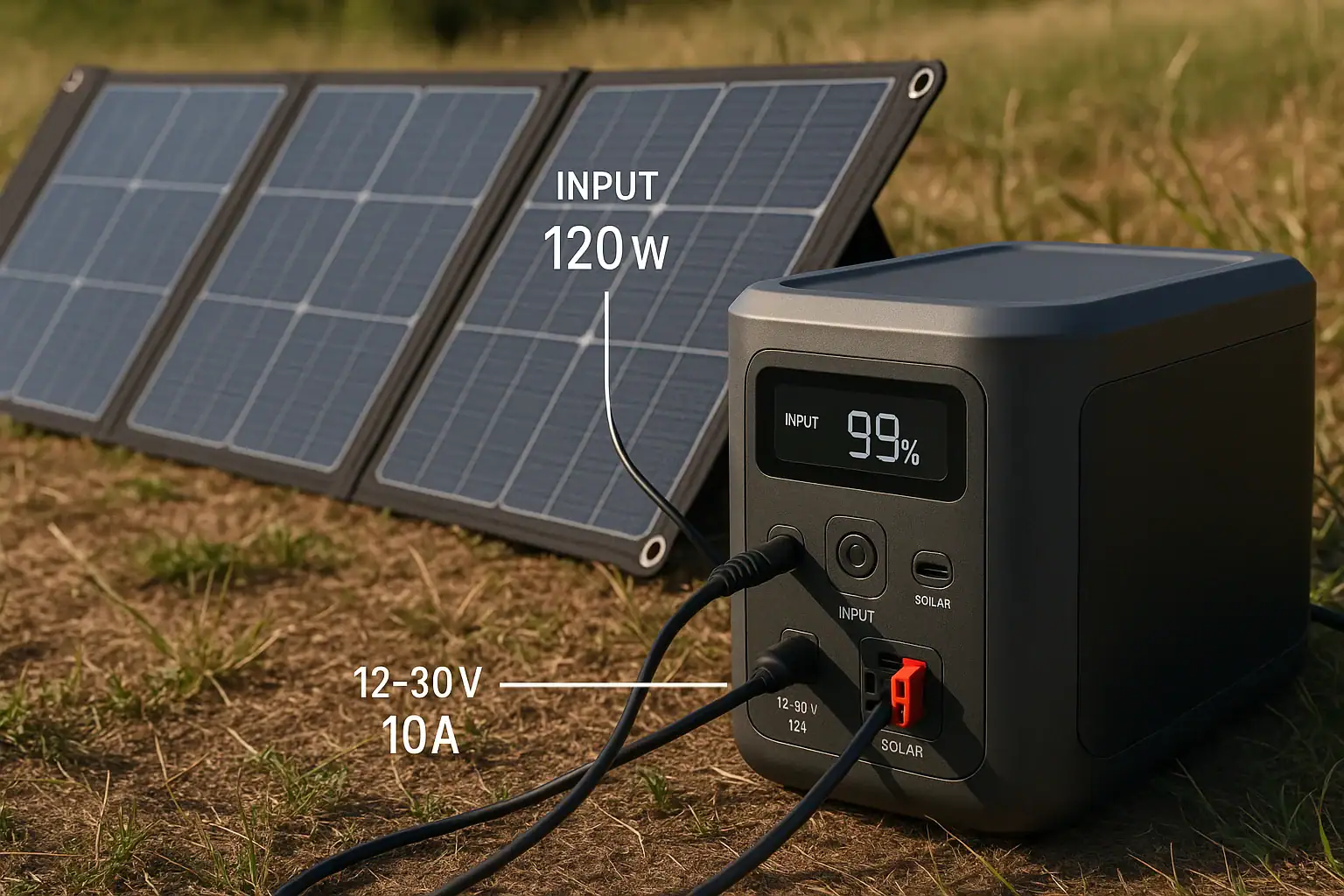
Yes, you can charge a portable power station with solar panels as long as the voltage, wattage, and connectors are compatible. Matching the solar input rating, charge controller limits, and DC input range is what makes solar charging safe and efficient. Many users search for terms like solar generator, MPPT input, charge rate, recharge time, and off-grid runtime because they want to know how to size panels correctly and avoid damage.
Using solar to recharge a portable power station is one of the most effective ways to stay powered during camping, RV trips, power outages, or off-grid work. But not every panel will work with every unit, and the actual charging speed often differs from the advertised solar watts. Understanding how solar charging works, what specs matter, and the most common mistakes will help you get predictable performance and protect your equipment.
What It Means to Charge a Portable Power Station with Solar and Why It Matters
Charging a portable power station with solar panels means using sunlight, converted to DC electricity by the panels, to refill the internal battery through the power station’s solar or DC input. Instead of plugging into a wall outlet, you plug compatible solar panels into the unit and let the built-in charge controller manage the process.
This matters because solar charging directly affects how independent you can be from the grid. The right solar setup can:
- Extend runtime during long camping trips or outages
- Reduce how often you need to use a wall outlet or vehicle charger
- Lower the total cost of ownership over time by using free sunlight
- Provide quieter, cleaner power compared with fuel-based generators
However, there are limits. Every portable power station has a maximum solar input wattage and a safe input voltage range. If your panels are undersized, charging will be slow and your runtime will suffer. If your panels are oversized, or wired incorrectly, you can trigger protection circuits or potentially damage the equipment.
Knowing the basic terms used in solar charging helps you match gear correctly:
- Battery capacity (Wh): How much energy the power station can store.
- Solar input wattage (W): The maximum charging power the unit can accept from solar.
- Input voltage range (V): The safe DC voltage window the solar input expects.
- Charge controller type: Often MPPT (more efficient) or PWM (simpler, less efficient).
- Connectors: Commonly DC barrel, Anderson-style, or multi-pin ports.
When these pieces line up, solar charging is straightforward, repeatable, and safe.
How Solar Charging a Portable Power Station Actually Works
Solar panels generate DC power based on sunlight intensity, panel size, and temperature. That raw DC power is sent into the portable power station’s solar or DC input, where an internal charge controller regulates voltage and current to safely charge the battery.
Here are the key concepts that determine whether your setup works well:
Voltage and input range
Every portable power station lists an acceptable DC input voltage range, such as 12–30 V or 10–60 V. Your solar panel or solar array must produce a voltage that stays within this range during normal operation. Too low, and the unit will not start charging. Too high, and it may shut down or, in extreme cases, be damaged.
Panel labels show an open-circuit voltage (Voc) and a voltage at maximum power (Vmp). The charge controller usually operates around Vmp. When wiring panels in series, voltages add; in parallel, voltage stays the same but current increases. This is why series wiring can easily overshoot the maximum input voltage if not planned correctly.
Wattage and charge rate
The power station also lists a maximum solar input wattage, such as 100 W, 200 W, or 400 W. Even if you connect more panel wattage than this, the unit will typically limit the actual charge rate to its internal maximum. For example, a 300 W array connected to a 200 W input will usually be capped at about 200 W in ideal conditions.
Real-world solar output is usually 60–80% of the panel’s rated watts due to angle, shading, heat, and clouds. This means a 200 W panel might only deliver 120–160 W most of the day. Your charge time estimates should be based on realistic, not theoretical, output. Bifacial solar panels may add useful output when the rear side receives reflected light and the station can accept the extra power.
Charge controller (MPPT vs PWM)
The charge controller is the component inside the portable power station that manages solar charging. Two common types are:
- MPPT (Maximum Power Point Tracking): Actively adjusts voltage and current to extract more power from the panels, especially at higher voltages and in variable conditions.
- PWM (Pulse Width Modulation): Simpler and cheaper, but typically less efficient, especially when panel voltage is much higher than battery voltage.
Most modern power stations use MPPT because it shortens charge times and makes better use of high-voltage solar arrays within the allowed input range.
Connectors and adapters
Solar panels often come with MC4 connectors, while portable power stations may use barrel plugs, Anderson-style ports, or proprietary connectors. Adapters are commonly used to bridge this gap. The key is to maintain correct polarity (positive to positive, negative to negative) and stay within the voltage and current ratings of both the cables and the input port.
In normal use, you simply connect the panel to the power station, place the panel in direct sun, and the display will show input watts. If the unit stays within its voltage and wattage limits, the process is automatic.
| Component | Typical Spec | Role in Solar Charging |
|---|---|---|
| Portable power station battery | 300–1500 Wh | Stores energy from solar input |
| Solar input wattage limit | 60–400 W | Caps maximum solar charge rate |
| Input voltage range | 10–30 V or 12–60 V | Defines safe panel/array voltage |
| Solar panel rating | 60–200 W per panel | Determines potential solar output |
| Charge controller type | MPPT or PWM | Regulates charging efficiency |
Real-World Examples of Charging a Portable Power Station with Solar Panels
Understanding real-world scenarios helps translate specs into practical expectations. Here are a few illustrative examples of how solar charging works with different setups.
Small weekend camping setup
Imagine a compact portable power station with a 300 Wh battery and a solar input limit of 100 W at 12–30 V. You pair it with a single 100 W folding panel that has a Vmp around 18 V.
- In strong midday sun, the panel might deliver 70–80 W.
- At 80 W, fully charging 300 Wh (from empty) could take roughly 4–5 hours of good sun, not counting efficiency losses.
- In mixed clouds or partial shade, average input might drop to 30–50 W, stretching charge time to most of the day.
This setup works well for charging phones, cameras, and a small laptop, plus running LED lights at night, as long as you get several hours of sun each day.
Medium off-grid workstation
Now consider a 700–1000 Wh portable power station with a 200–300 W solar input limit and an MPPT controller. You connect two 100–150 W panels, either in parallel or series depending on the required voltage range.
- In good conditions, the array might average 150–220 W into the power station.
- Recharging 800 Wh from 20% to 100% (about 640 Wh) could take around 3–5 hours of strong sun.
- This can support a laptop, monitor, router, and small DC appliances during the day while still refilling the battery for evening use.
This type of setup is common for remote work, van life, or longer boondocking trips where reliable daily solar input is expected.
Larger emergency backup scenario
For home backup or extended outages, you might use a 1500–2000 Wh unit with a 400–600 W solar input limit. A solar array of three to four 150–200 W panels is typical.
- In sustained sun, you might see 300–450 W of actual charging power.
- Recovering 1200 Wh of used energy could take 3–5 hours of good sun, assuming efficient MPPT charging.
- This can support essentials like a refrigerator (intermittently), lights, communications gear, and small medical devices.
In this situation, balancing loads with available solar is critical. You may decide to run high-draw devices only during peak sun, allowing the battery to refill.
What happens in poor conditions
Real-world solar charging is highly dependent on weather, panel orientation, and shading:
- Overcast skies can cut solar input to 10–30% of rated wattage.
- Low winter sun angles reduce daily energy harvest even in clear weather.
- Partial shading (like a tree shadow across one panel) can dramatically drop output, especially in series-wired arrays.
In these cases, a portable power station may barely gain charge or simply slow down its rate of discharge while powering loads. Planning for less-than-ideal conditions is essential when sizing both your battery and solar array.
Common Mistakes and Troubleshooting When Charging with Solar Panels
Many issues with solar charging come from mismatched specs, unrealistic expectations, or minor setup errors. Recognizing the most common problems can save time and frustration.
No charging or very low input watts
If your portable power station shows 0–5 W from solar, consider these causes:
- Insufficient sunlight: Panels not in direct sun, heavy clouds, or shading will reduce output. Try repositioning the panels toward the sun and removing shadows.
- Incorrect connectors or polarity: If an adapter is wired backward, the unit may not charge and may trigger protection. Verify positive and negative leads match the input markings.
- Voltage below minimum input: Some units will not start charging until panel voltage reaches a certain threshold. Early morning or late afternoon sun may be too weak.
- Loose or corroded connections: Check all cable connections for firm seating and visible damage.
Unit shuts off or shows an error when panels are connected
This often points to voltage or wattage issues:
- Input voltage too high: Panels wired in series may exceed the maximum voltage rating. Reconfigure in parallel or reduce the number of panels.
- Short-term overcurrent: A very large array may cause a brief surge above the unit’s input rating, triggering protection. The controller may then limit power, but repeated trips can be a warning sign.
- Incorrect port used: Some power stations have separate DC and solar inputs with different limits. Make sure you are using the designated solar/DC input according to the labeling.
Charging is much slower than expected
Slow charging is usually a mix of environmental and configuration factors:
- Panel angle and orientation: Panels lying flat or not aimed at the sun will underperform. Tilting them toward the sun can significantly increase wattage.
- High temperatures: Panels lose efficiency as they heat up. On hot days, expect lower output even in full sun.
- Long or undersized cables: Thin or very long cables can cause voltage drop, reducing effective power at the input.
- Simultaneous heavy loads: If you are running high-wattage devices while charging, the net battery gain will be lower than the solar input suggests.
When to seek professional help
If you repeatedly see error codes, overheating, or unexplained shutdowns when using solar, it may be time to consult the manufacturer’s documentation or a qualified electrician familiar with low-voltage DC systems. This is especially important if you are combining multiple panels or using custom wiring beyond simple plug-and-play adapters.
Safety Basics for Solar Charging Portable Power Stations
Charging a portable power station with solar panels is generally safe when you stay within published limits and use appropriate cables and connectors. Still, there are important safety considerations to keep in mind.
Respect voltage and wattage limits
The most important safety rule is to keep your solar array within the unit’s specified input voltage range and wattage limit. Exceeding either can cause:
- Automatic shutdowns or error codes
- Overheating of internal components
- Potential long-term damage to the charge controller
Always calculate the combined voltage of panels in series and the combined wattage of the array before connecting it to your power station.
Use appropriate cables and connectors
Use cables rated for the maximum current and voltage they will carry. Undersized or damaged cables can overheat, melt insulation, or cause short circuits. Avoid makeshift wiring or exposed conductors. Adapters should be purpose-built for DC solar use, with clear polarity markings.
Avoid water and extreme environments
While many solar panels are weather-resistant, most portable power stations are not designed to sit in rain, snow, or standing water. Keep the power station in a dry, ventilated area, and avoid placing it directly on hot surfaces or in enclosed spaces where heat can build up.
Do not modify internal components
Opening a portable power station to alter the battery pack, bypass protection circuits, or change internal wiring can be dangerous and typically voids warranties. High-energy lithium batteries require carefully engineered protections that should not be altered by end users.
Know when to involve a professional
If you plan to integrate a portable power station into a larger electrical setup, such as an RV system or cabin wiring, do not attempt to interface it directly with breaker panels or household circuits on your own. For anything beyond using the built-in outlets and DC ports, consult a qualified electrician who understands both AC and DC systems.
Maintaining Your Solar Charging Setup and Storing Your Power Station
Proper maintenance of both the portable power station and the solar panels will keep your system charging reliably and extend its service life.
Panel care and positioning
Dirty or scratched panels can lose a noticeable amount of output. To maintain performance:
- Wipe panels periodically with a soft cloth and mild, non-abrasive cleaner.
- Avoid harsh scrubbing or sharp tools that can damage the surface.
- Check hinges, stands, and mounting hardware for wear if you frequently fold or move the panels.
When in use, position panels to minimize shading and adjust their angle a few times a day if possible to follow the sun. Even small improvements in orientation can add up over long charge sessions.
Power station battery health
Portable power stations typically use lithium-based batteries that benefit from moderate use and proper storage:
- Avoid leaving the battery at 0% for long periods; recharge after deep discharges.
- For long-term storage, many manufacturers recommend storing around 30–60% charge.
- Keep the unit in a cool, dry place away from direct sunlight and extreme temperatures.
Regularly cycling the battery (using and recharging it every few months) can help maintain capacity and keep the internal management system calibrated.
Cable and connector inspection
Solar charging relies on a chain of connections. Periodically inspect:
- MC4 connectors and adapters for cracks, discoloration, or loose locking tabs.
- Barrel plugs and DC ports for bent pins or debris.
- Cables for cuts, kinks, or crushed sections.
Replace any damaged components promptly. Poor connections can cause intermittent charging, heat buildup, or arcing.
Storage with solar panels
When not in use, store folding or portable panels in a dry location, ideally in their protective case if provided. Avoid stacking heavy objects on top of them, as this can damage cells or wiring. Coil cables loosely rather than tightly wrapping them, which can stress conductors over time.
| Item | Maintenance Action | Suggested Frequency |
|---|---|---|
| Solar panel surface | Clean dust and debris | Every 1–3 months or after dirty conditions |
| Connectors and cables | Inspect for wear or damage | Every 3–6 months |
| Power station battery | Charge/discharge cycle | Every 2–3 months in storage |
| Storage environment | Check for dryness and moderate temperature | Ongoing |
| Panel mounting/stands | Tighten and check stability | Every few deployments |
Related guides: How Many Solar Watts Do You Need to Fully Recharge in One Day? • MC4, Anderson, DC Barrel: Solar Connectors and Adapters Explained • How to Read Solar Panel Specs for Power Stations: Voc, Vmp, Imp, and Why It Matters
Practical Takeaways and Specs to Look for in Solar-Ready Power Stations
Charging a portable power station with solar panels is not only possible but often the most flexible way to stay powered off-grid. The key is matching your battery capacity, solar input rating, and panel array so that daily energy harvested from the sun covers your expected use with some margin for bad weather.
In practice, that means:
- Choosing a battery size that can comfortably support your must-have devices for at least a day.
- Selecting solar panels that can realistically refill a large portion of that capacity during available daylight.
- Ensuring the power station’s solar input voltage and wattage limits are compatible with your panel configuration.
- Using quality cables and connectors, and keeping everything clean and well maintained.
When you understand how specs translate into real-world performance, you can design a system that delivers predictable charge times and reliable runtime without guesswork.
Specs to look for
- Battery capacity (Wh): Look for a capacity that covers at least 1–2 days of your essential loads (for example, 300–600 Wh for light use, 1000+ Wh for heavier use). This determines how long you can run devices between charges.
- Maximum solar input wattage (W): Aim for a solar input that is at least 25–50% of the battery capacity in watts (e.g., 200–400 W input for an 800 Wh unit). Higher input allows faster recovery after heavy use or cloudy days.
- Solar/DC input voltage range (V): A wider range such as 12–30 V or 12–60 V offers more flexibility in panel wiring (series vs parallel) and supports longer cable runs without exceeding limits.
- Charge controller type (MPPT vs PWM): MPPT is preferable for most users because it typically provides 10–30% better solar harvesting, especially with higher-voltage panels and variable conditions.
- Supported connector types: Check for common DC ports (such as barrel or Anderson-style) and compatibility with standard solar connectors via adapters. This simplifies panel selection and reduces the need for custom wiring.
- Display and monitoring features: A clear screen showing real-time solar input watts, battery percentage, and estimated time to full charge makes it easier to adjust panel positioning and manage loads.
- Operating temperature range: Look for units that can safely charge in a moderate temperature window (for example, roughly 32–104°F / 0–40°C). This helps protect the battery when charging outdoors.
- Pass-through charging behavior: If you plan to run devices while charging from solar, check that the unit supports this and understand whether it prioritizes loads or battery charging. This affects how quickly the battery refills.
- Protection and safety features: Overvoltage, overcurrent, and temperature protections on the solar input are important for preventing damage from miswired panels or extreme conditions.
By focusing on these specifications and understanding how they interact, you can confidently pair a portable power station with the right solar panels and build a reliable, efficient off-grid power solution.
Frequently asked questions
Which specifications and features matter most when selecting a power station for solar charging?
Key specs are battery capacity (Wh), maximum solar input wattage, and the acceptable input voltage range because they determine how much solar energy the unit can accept and store. Also consider the charge controller type (MPPT vs PWM), connector compatibility, and monitoring features to make matching panels and troubleshooting easier.
Why won’t my portable power station start charging or shows very low input when connected to panels?
Common causes include insufficient sun or poor panel orientation, panel voltage below the unit’s minimum threshold, incorrect connector polarity, or loose/corroded connections. Check sun exposure, verify wiring and polarity, and measure panel voltage to isolate the issue.
Is it safe to charge a portable power station with solar panels?
Yes, it is generally safe if you stay within the power station’s specified voltage and wattage limits, use appropriate cables and connectors, and keep the unit dry and ventilated. Avoid modifying internal components and consult documentation or a qualified technician for persistent errors.
How should I size solar panels to reasonably recharge my power station in one day?
A practical approach is to size solar input at roughly 25–50% of the battery capacity in watts and then account for real-world losses (panels often deliver 60–80% of rated watts). Also factor in average peak sun hours for your location so the array can deliver the needed energy during available daylight.
Can I run devices from the power station while it is charging from solar?
Many units allow pass-through operation, but heavy loads can consume much of the solar input and slow or prevent net battery charging. Check the unit’s pass-through policy and monitor input and output watts to avoid overloading the system.
Related guides
Browse this topic →
- Beginner-friendly sizing, runtime & specs
- Solar & charging (MPPT, fast charging, cables)
- Batteries (LiFePO4, cycles, care & storage)
- Safety, cold-weather performance, real-world tips
More in Charging
See all →- Can You Daisy-Chain Portable Power Stations? Why It Usually Isn’t a Good Idea
- USB-C Input vs AC Input on Portable Power Stations: Which Charging Method Makes Sense?
- Car Alternator Charging vs Cigarette Lighter Charging: What Changes for Power Stations?
- Charging a Portable Power Station From an RV Outlet: 12V, 24V, and Safety Limits
- Fast AC Charging vs Battery Longevity: Should You Use Turbo Mode Every Time?
Keep reading
About this site
Portable Energy Lab publishes practical, independent guides about portable power—clear sizing, safe use, and real-world expectations.
Affiliate disclosure
Some links on this site may be affiliate links. If you buy through these links, we may earn a small commission at no extra cost to you. This helps support our content. Read our affiliate disclosure.