
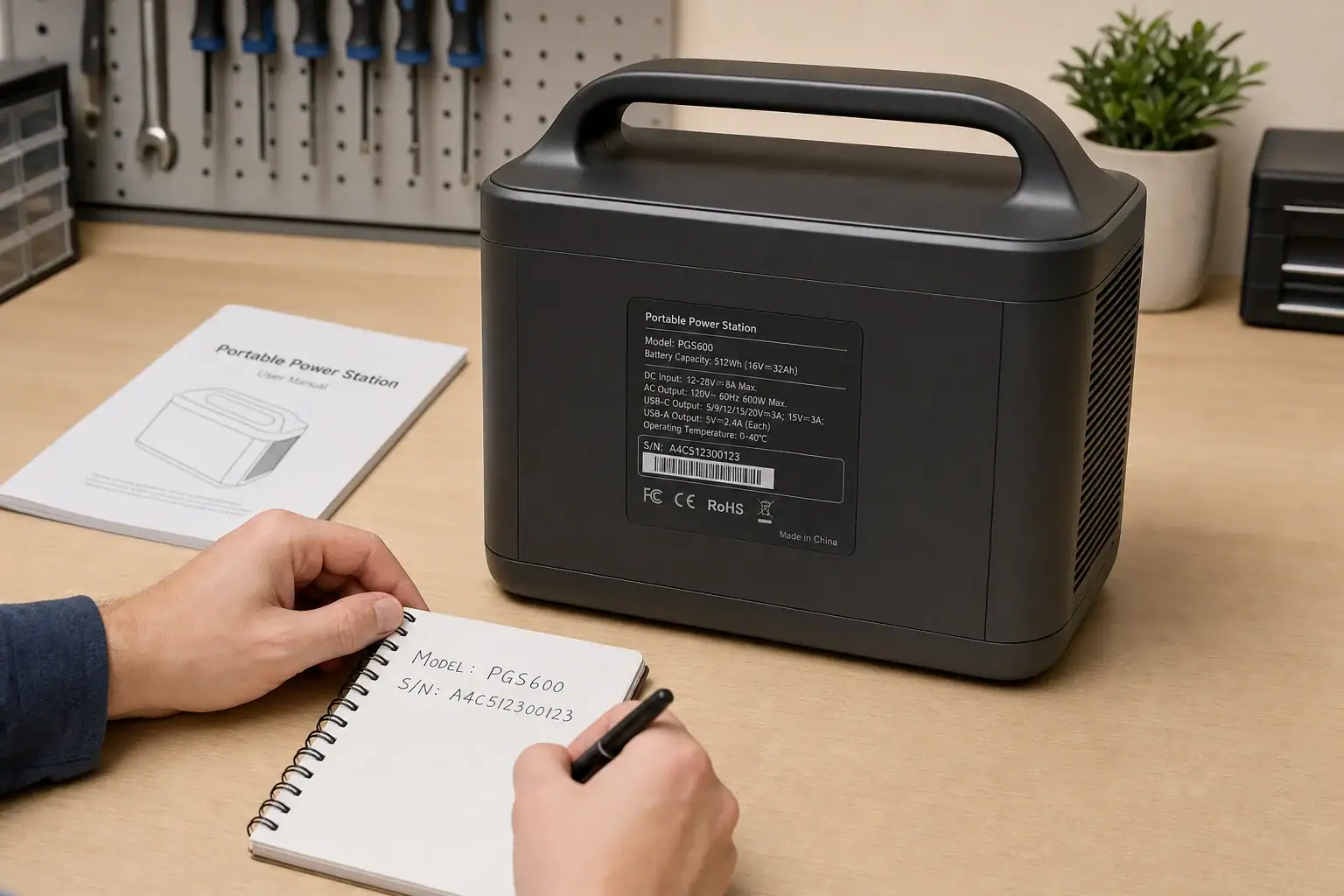
To check whether a portable power station was recalled, find its exact model number and serial number, then compare them with current notices in the official government recall database for your country and on the manufacturer’s official support or recall page. Match every detail—including production dates, serial-number ranges, battery versions, and included accessories—because a recall may affect only part of a product line.
If your unit appears to be included, stop using and charging it and follow the recall notice exactly. Do not open the enclosure, remove internal cells, ship the unit, or discard it in household trash unless the manufacturer or the appropriate authority specifically instructs you to do so.
Record the product identifiers
Disconnect the power station from loads and charging sources if it is safe to do so. Without opening the enclosure, photograph or write down the identifying information printed on its exterior label. Look for:
- Manufacturer name
- Full product name
- Model or type number
- Serial number
- Manufacturing date, date code, or batch number
- Battery or hardware revision, if listed
- Model numbers for the AC adapter, expansion battery, or other included components
The retail name alone is not enough. Products that look identical may use different batteries, electronics, or production runs. Conversely, one affected design may have been sold under more than one name. If the label is unreadable, check the original box, receipt, order history, registration record, or manufacturer app, but treat app data as secondary to the physical identifiers when both are available.
Search official recall sources
In the United States, search the current Consumer Product Safety Commission recall database and the manufacturer’s official website. The federal recall portal may also help identify which agency handles a product. Outside the United States, use the current product-safety recall database maintained by your national or regional government.
Search several terms rather than relying on one query:
- The manufacturer name and exact model number
- The product name plus “recall”
- The serial or batch prefix, if the database supports it
- “Portable power station,” “solar generator,” or “battery generator”
- The model number of the charger or expansion battery
Also check the manufacturer’s current safety-notice and support pages. A company notice may provide a serial-number checker or more precise eligibility instructions than a short database summary. Verify that any message, form, phone number, or return label actually comes from the manufacturer or the government agency identified in the official notice.
Match the scope of the notice carefully
Finding the same product name does not automatically mean your unit is recalled. Compare the notice with your product point by point:
- Model: Match the complete identifier, including suffixes and regional variants.
- Serial or batch range: Check all characters and leading zeros.
- Manufacturing window: Do not confuse the production date with your purchase date or the date the recall was announced.
- Sales region or seller: Some notices cover specific markets or distribution channels.
- Affected component: The recall may apply only to an adapter, cable, expansion battery, or battery module rather than the entire station.
- Remedy: Confirm whether the notice calls for inspection, repair, replacement, refund, or another manufacturer-controlled process.
If the notice is unclear or your serial number is missing, contact the manufacturer through the contact details in the official recall notice. Provide photographs of the exterior label and proof of purchase if requested. Do not assume an unlisted serial number is safe when the label is incomplete or the product’s history is uncertain.
What to do if the power station is included
- Stop operating and charging it, unless the official notice gives different immediate instructions.
- Disconnect accessories and loads only if doing so presents no immediate risk.
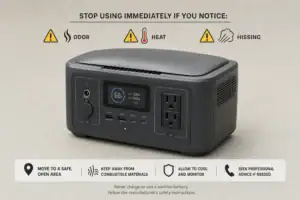
- Keep people and combustible materials away from a unit that is unusually hot, swollen, leaking, hissing, smoking, or emitting a strong odor. Do not touch or move a smoking or burning battery; leave the area and contact emergency services.
- Follow the manufacturer’s recall process for storage, packaging, transport, repair, replacement, or refund.
- Keep copies of the notice, serial-number photograph, correspondence, and shipment or remedy confirmation.
Lithium-battery shipping and disposal are regulated and can vary by battery condition, carrier, and jurisdiction. A recalled or damaged power station may not be accepted through ordinary parcel service or routine battery recycling. Follow the current recall instructions and verify any transport or disposal requirements with the manufacturer, carrier, and relevant local authority.
If no recall appears
No search result is not proof that a unit has no safety issue. Recheck spelling and model variants, search included battery accessories separately, and ask the manufacturer to confirm the serial number in writing if you remain uncertain. Used products deserve extra attention because labels may be missing and prior recall messages may have gone to the original owner.
Stop using the power station and seek manufacturer guidance if it shows swelling, overheating, smoke, leakage, damaged ports, repeated protective shutdowns, or an unusual odor—even when no recall is listed. A defect affecting one unit can exist without a broader recall.
Keep future recall checks simple
Save a photograph of the product label, purchase record, and current owner’s manual. Register the product with the manufacturer if registration is available, but continue to rely on official recall databases and current manufacturer notices rather than assuming registration guarantees notification. Recheck those sources before selling, donating, transporting, or resuming use of a unit that has been stored for a long time.
Related guides
Browse this topic →
- Beginner-friendly sizing, runtime & specs
- Solar & charging (MPPT, fast charging, cables)
- Batteries (LiFePO4, cycles, care & storage)
- Safety, cold-weather performance, real-world tips
More in Safety
See all →- Can You Take a Portable Power Station on a Plane? Battery Limits and Safer Travel Planning
- What to Do If a Portable Power Station Gets Wet
- Portable Power Station Fire Safety Checklist for Apartments
- UL 2743 Certification Explained for Portable Power Stations
- Lithium Battery Safety Myths vs Reality: What Actually Causes Incidents
Keep reading
About this site
Portable Energy Lab publishes practical, independent guides about portable power—clear sizing, safe use, and real-world expectations.
Affiliate disclosure
Some links on this site may be affiliate links. If you buy through these links, we may earn a small commission at no extra cost to you. This helps support our content. Read our affiliate disclosure.