
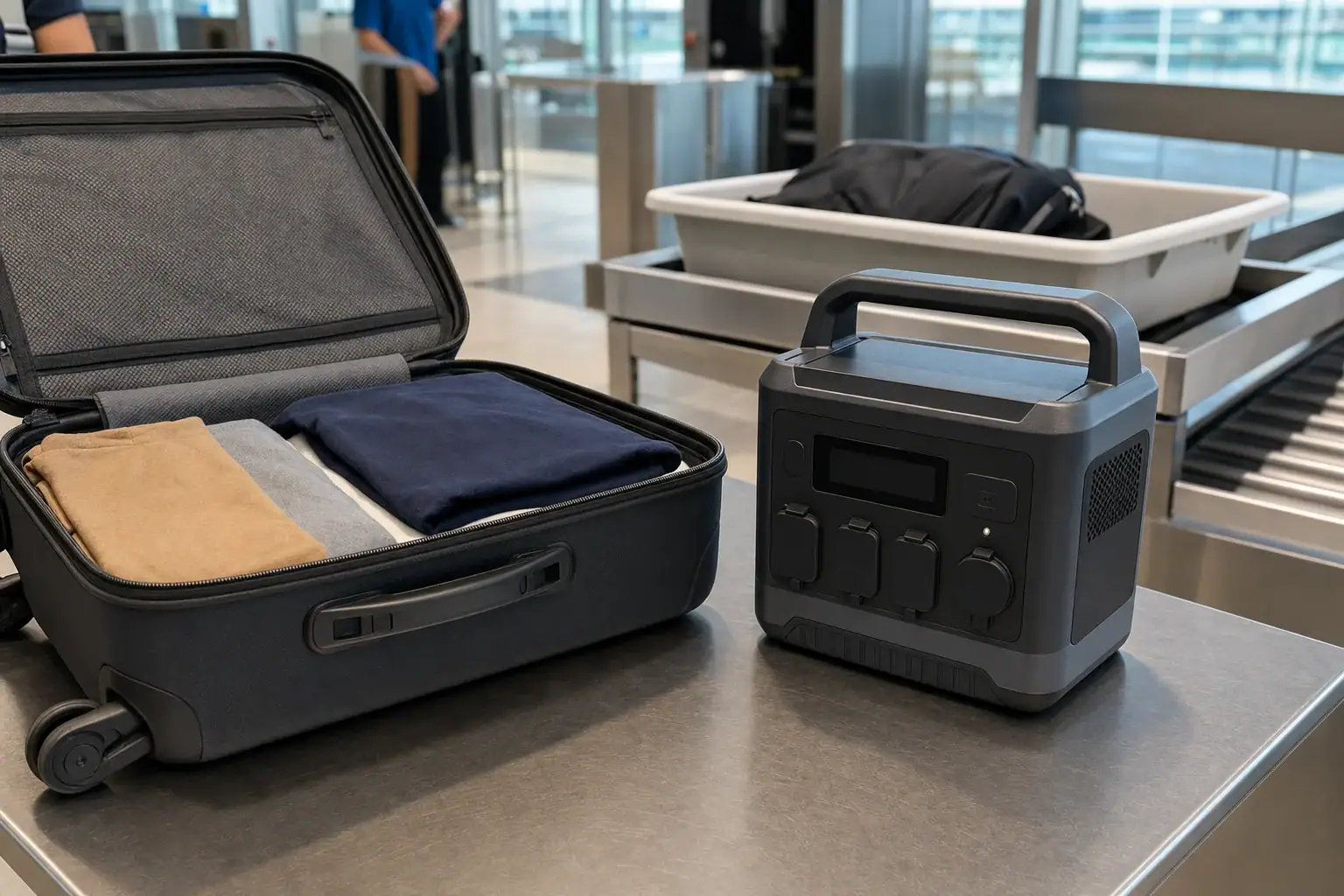
You can take some small portable power stations on a plane, but most larger models exceed passenger lithium battery limits and cannot travel in carry-on or checked baggage. Eligibility depends mainly on battery capacity in watt-hours, whether airline approval is required, and how the battery terminals are protected.
For many passenger flights, lithium-ion batteries rated at no more than 100 Wh can usually travel in carry-on baggage. Batteries from 101 to 160 Wh may be accepted only with airline approval, often with quantity restrictions. Units above 160 Wh are generally prohibited from ordinary passenger baggage. Carry-on rules, checked baggage restrictions, battery labels, and local aviation requirements can all affect the final decision.
Because a portable power station is commonly treated like a power bank or spare lithium battery, its AC output watts and surge watts do not determine whether it can fly. Check the watt-hour rating before booking, confirm the operating airline’s policy, and leave time to choose another power source if the unit is too large.
What the airline battery limit means and why it matters
Air travel restrictions focus on the amount of energy stored in a lithium battery. That capacity is stated in watt-hours, abbreviated Wh. It is different from the inverter’s continuous output rating, such as 300 W, and from its surge rating. A 300-watt power station could contain a battery below 100 Wh, while another unit with the same output could store several hundred watt-hours.
Portable power stations are often treated as spare batteries because their primary purpose is to provide stored electrical energy. Spare lithium batteries and power banks generally belong in carry-on baggage, where smoke, heat, or damage can be noticed more quickly. Placing a power station in checked baggage does not make an oversized battery acceptable.
Rules vary by country, airline, route, aircraft, and battery chemistry. A commonly used passenger framework allows lithium-ion batteries up to 100 Wh in carry-on baggage without advance airline approval. Batteries above 100 Wh but not exceeding 160 Wh may require approval, and airlines commonly limit passengers to two spare batteries in that range. Batteries over 160 Wh are generally handled as regulated cargo rather than normal passenger baggage.
These thresholds are not a guarantee of acceptance. An airline may apply a stricter policy, and security personnel may reject a damaged, recalled, poorly labeled, or suspicious device. Codeshare trips also require checking the policy of each operating carrier rather than relying only on the company that sold the ticket.
How watt-hours and airline classifications work
The most reliable number is the Wh rating printed on the power station’s compliance label, battery label, manual, or specification sheet. If only voltage and amp-hours are shown, watt-hours can be estimated with the formula Wh = nominal volts × amp-hours. A battery labeled 12.8 V and 8 Ah, for example, stores about 102.4 Wh.
Use nominal battery voltage rather than AC outlet voltage. Multiplying capacity by 120 V AC produces an incorrect result because 120 V describes inverter output, not the internal battery. Likewise, milliamp-hours must be converted to amp-hours by dividing by 1,000 before completing the calculation.
Some marketing materials list capacity in milliamp-hours at a cell voltage, while the case lists a different nominal pack voltage. Calculations based on inconsistent values may be misleading. For airport screening, a clear manufacturer-applied Wh marking is preferable to a passenger’s handwritten conversion.
Battery chemistry does not usually remove the need to check stored energy. Many power stations use lithium iron phosphate cells, while others use different lithium-ion chemistries. Lithium iron phosphate may offer favorable cycle life and thermal characteristics, but it is still a lithium-ion battery for typical passenger baggage classification.
| Battery example | Calculated capacity | Typical planning implication |
|---|---|---|
| 12 V × 7 Ah | 84 Wh | Often within the basic carry-on threshold, subject to airline review |
| 12.8 V × 8 Ah | 102.4 Wh | May require advance airline approval |
| 12.8 V × 10 Ah | 128 Wh | May fit the approval range and quantity restrictions |
| 25.6 V × 10 Ah | 256 Wh | Generally too large for ordinary passenger baggage |
Real-world portable power station travel examples
A compact 88 Wh unit
A traveler has a clearly labeled 88 Wh power station with protected ports and no visible damage. Its capacity falls below the commonly used 100 Wh threshold. It may be permitted in carry-on baggage, but the traveler should still verify airline rules because size, device type, route, or local requirements may create additional restrictions.
A 144 Wh unit on a multicarrier itinerary
A 144 Wh power station falls within the commonly recognized 101–160 Wh approval range. The passenger should obtain approval from every operating airline before departure and keep the confirmation accessible. Acceptance by the first airline does not automatically bind a connecting carrier, and approval does not override security screening.
A 300 Wh camping power station
A 300 Wh model is above the usual passenger baggage ceiling. Removing it from checked baggage and carrying it into the cabin does not solve the problem. Practical alternatives include renting a compliant power source at the destination, shipping it through a qualified dangerous-goods service, or using fixed electrical service where available.
A unit with no readable capacity label
Even a physically small power station can be delayed or refused if screening staff cannot confirm its battery rating. A specification saved on a phone may help explain the device, but it may not replace a legible label on the product. Travelers should resolve missing or contradictory capacity information before reaching the airport.
Common mistakes and troubleshooting cues before departure
Checking output watts instead of battery watt-hours is the most frequent mistake. Output ratings describe what the inverter can power. Aviation limits are primarily concerned with stored battery energy, so locate the Wh value rather than relying on continuous or surge watts.
Assuming checked baggage has a higher allowance is another common error. Power banks and spare lithium batteries are generally restricted to carry-on baggage. A gate-checked bag should have the power station removed before the bag enters the aircraft hold.
Confusing airline approval with automatic permission can create problems at check-in. Approval generally means the airline has agreed to consider a battery in the 101–160 Wh range. The device must still meet packing, condition, quantity, security, and jurisdictional requirements.
Relying on a rounded marketing number may also cause uncertainty. If a listing says approximately 100 Wh but the product label says 102 Wh, plan around the labeled value. A rating just above 100 Wh may move the unit into an approval category.
Warning signs that require a different travel plan include swelling, cracked housing, chemical odor, unusual heat, damaged ports, liquid exposure, loose internal parts, or an active safety recall. Do not attempt to discharge, open, repair, or relabel a questionable battery to make it acceptable for flight.
If the airline’s written policy is unclear, provide the exact chemistry, Wh rating, model identifier, dimensions, and intended packing method when requesting guidance. Ask whether approval must be documented and whether each operating carrier must provide it.
High-level safety basics for flying with stored energy
Carry the power station in a way that prevents crushing, impact, and unintended activation. A fitted case or padded section of a carry-on can protect the housing, but the unit should remain accessible if security personnel request inspection. Do not pack heavy objects where they can press switches or damage the display.
Protect exposed terminals and ports from contact with coins, keys, cables, or other conductive objects. Use fitted port covers when available and keep loose accessories separate. The power station should be switched off rather than left in standby, and wireless charging surfaces should not be able to activate accidentally.
Do not use or charge a power station during flight unless the operating airline explicitly permits it. Cabin outlets may have low power limits, and charging policies can differ from rules for transporting the battery. Never connect a power station to an aircraft outlet in an attempt to run high-load appliances.
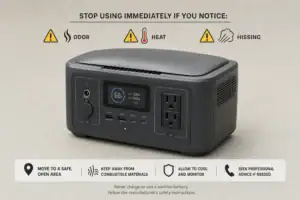
If a unit becomes hot, emits an odor, swells, smokes, leaks, or makes unusual sounds, stop using it and notify airline personnel immediately. Do not hide the device, place it in a confined bin without reporting it, or handle a smoking battery unnecessarily. Follow crew instructions.
Shipping an oversized unit is not the same as mailing an ordinary consumer item. Large lithium batteries may require regulated packaging, documentation, labeling, and a carrier authorized to handle dangerous goods. A qualified shipping provider should determine whether a particular battery can be transported.
Storage and maintenance before and after air travel
Inspect the housing, display, switches, ports, and charging cable well before departure. Confirm that the battery holds charge normally without overheating or producing unexpected errors. A device that behaves abnormally at home should not be taken onto an aircraft.
Follow the manufacturer’s storage guidance for state of charge. A moderate charge level is often suitable for storage, but travelers should not deliberately drain a unit to zero in the belief that capacity limits no longer apply. Aviation classification is based on the battery’s rated capacity, not its current charge percentage.
Keep the power station in a dry, temperature-controlled location before the trip. Avoid leaving it in a hot vehicle, exposed to direct sun, or in freezing conditions for extended periods. Allow a cold unit to return to room temperature before charging so condensation and low-temperature charging do not create avoidable risks.
After travel, check for impact damage and confirm that ports remain clean and secure. For long-term storage, review the unit periodically and recharge it according to its documentation. Excessive self-discharge, swelling, persistent error codes, or unusual heat are reasons to stop using the battery and consult an authorized service provider.
| Travel stage | Condition to verify | Safer planning response |
|---|---|---|
| Several days before departure | Readable Wh label and normal operation | Confirm airline policy and request approval if applicable |
| While packing | Power off, protected ports, undamaged case | Place accessibly in padded carry-on storage |
| At the gate | Carry-on may be checked | Remove the power station before surrendering the bag |
| After arrival | No impact, swelling, heat, or charging errors | Stop use and seek qualified support if damage is suspected |
Related guides: Portable Power Station Watt-Hours Explained • Portable Power Station vs Power Bank • Portable Power Station Buying Guide
Practical takeaways and specs to look for
Start with the battery’s printed watt-hour rating. A unit at or below 100 Wh is generally the easiest category for passenger travel, while a unit from 101 to 160 Wh may require advance approval and may be subject to quantity limits. A power station above 160 Wh will usually require a non-passenger alternative.
Confirm requirements directly with every operating airline shortly before travel because policies and enforcement practices can change. Keep approval records and product information available, but do not assume documentation guarantees acceptance. If the trip depends on portable electricity for medical or accessibility equipment, contact the airline’s assistance team early because separate procedures may apply.
Specs to look for
- Battery capacity: Look for a clearly printed rating such as 80–99 Wh when routine air travel is important; capacity determines the main passenger battery category.
- Nominal voltage and amp-hours: Look for both values, such as 12.8 V and 7 Ah, so the Wh rating can be cross-checked when needed.
- Battery chemistry: Look for an identified chemistry such as lithium iron phosphate or another lithium-ion type; clear identification helps with airline questions and safe handling.
- Compliance labeling: Look for durable, legible labels showing Wh, voltage, model information, and relevant test markings; unclear labels can delay screening.
- Physical power switch: Look for a recessed or guarded control that resists accidental activation while packed.
- Port protection: Look for fitted covers or a case that shields USB, DC, and AC interfaces from metal objects and impact.
- Battery management protections: Look for overcurrent, overvoltage, short-circuit, and temperature protection; these controls reduce foreseeable electrical hazards.
- Operating and storage temperature ranges: Look for published ranges, such as charging above freezing and storage below extreme vehicle temperatures; this supports safer handling before and after travel.
- Size and weight: Look for dimensions that fit securely in an accessible carry-on compartment; battery permission does not override the airline’s baggage limits.
For frequent flyers, a clearly labeled sub-100 Wh unit is usually simpler to plan around than a larger power station. Travelers who need substantially more runtime should arrange destination power, rental equipment, or compliant dangerous-goods shipping rather than risk confiscation or a missed flight.
Frequently asked questions
Can you take a portable power station on a plane in carry-on luggage?
Some portable power stations may be allowed in carry-on luggage if their lithium battery capacity is within the airline’s permitted watt-hour limit. Units at or below 100 Wh are commonly the simplest category, while 101–160 Wh models may require prior airline approval. Check the policy of every operating airline before travel.
Can a portable power station go in checked baggage?
Portable power stations and other spare lithium batteries generally should not be packed in checked baggage. They are typically required to remain in carry-on baggage when permitted because cabin crew can respond more quickly to a battery incident. If a carry-on bag must be gate-checked, remove the power station first.
What specs and features matter when choosing a portable power station for flying?
The most important specification is the battery’s clearly printed watt-hour rating, not the AC output or surge-watt rating. A legible label showing Wh, voltage, model information, and battery chemistry can help during airline inquiries and security screening. A protected power switch, covered ports, and an undamaged case also support safer packing.
Is it a mistake to use the power station’s watt output to determine whether it can fly?
Yes. The inverter output rating indicates how much power a device can supply, while airline battery restrictions focus mainly on stored energy measured in watt-hours. A low-output unit can still exceed the battery limit, and a higher-output unit may have a battery that falls within it.
Do airlines allow portable power stations between 100 Wh and 160 Wh?
Many airlines may allow lithium batteries above 100 Wh and up to 160 Wh only with advance approval, often subject to quantity limits. Approval practices vary by airline, route, and country, so obtain confirmation before departure. Security screening personnel may still inspect or decline a device that is damaged, poorly labeled, or otherwise unsuitable.
How should a portable power station be packed safely for a flight?
Switch the unit off, protect its ports and terminals from metal objects, and place it in an accessible padded area of carry-on baggage. Do not travel with a unit that is swollen, leaking, hot, cracked, recalled, or behaving abnormally. If the device shows signs of overheating or damage during travel, notify airline personnel immediately.
Related guides
Browse this topic →
- Beginner-friendly sizing, runtime & specs
- Solar & charging (MPPT, fast charging, cables)
- Batteries (LiFePO4, cycles, care & storage)
- Safety, cold-weather performance, real-world tips
More in Safety
See all →- Childproofing a Portable Power Station at Home: Cables, Heat, Buttons, and Pets
- What to Do If a Portable Power Station Gets Wet
- Portable Power Station Fire Safety Checklist for Apartments
- UL 2743 Certification Explained for Portable Power Stations
- Lithium Battery Safety Myths vs Reality: What Actually Causes Incidents
Keep reading
About this site
Portable Energy Lab publishes practical, independent guides about portable power—clear sizing, safe use, and real-world expectations.
Affiliate disclosure
Some links on this site may be affiliate links. If you buy through these links, we may earn a small commission at no extra cost to you. This helps support our content. Read our affiliate disclosure.