
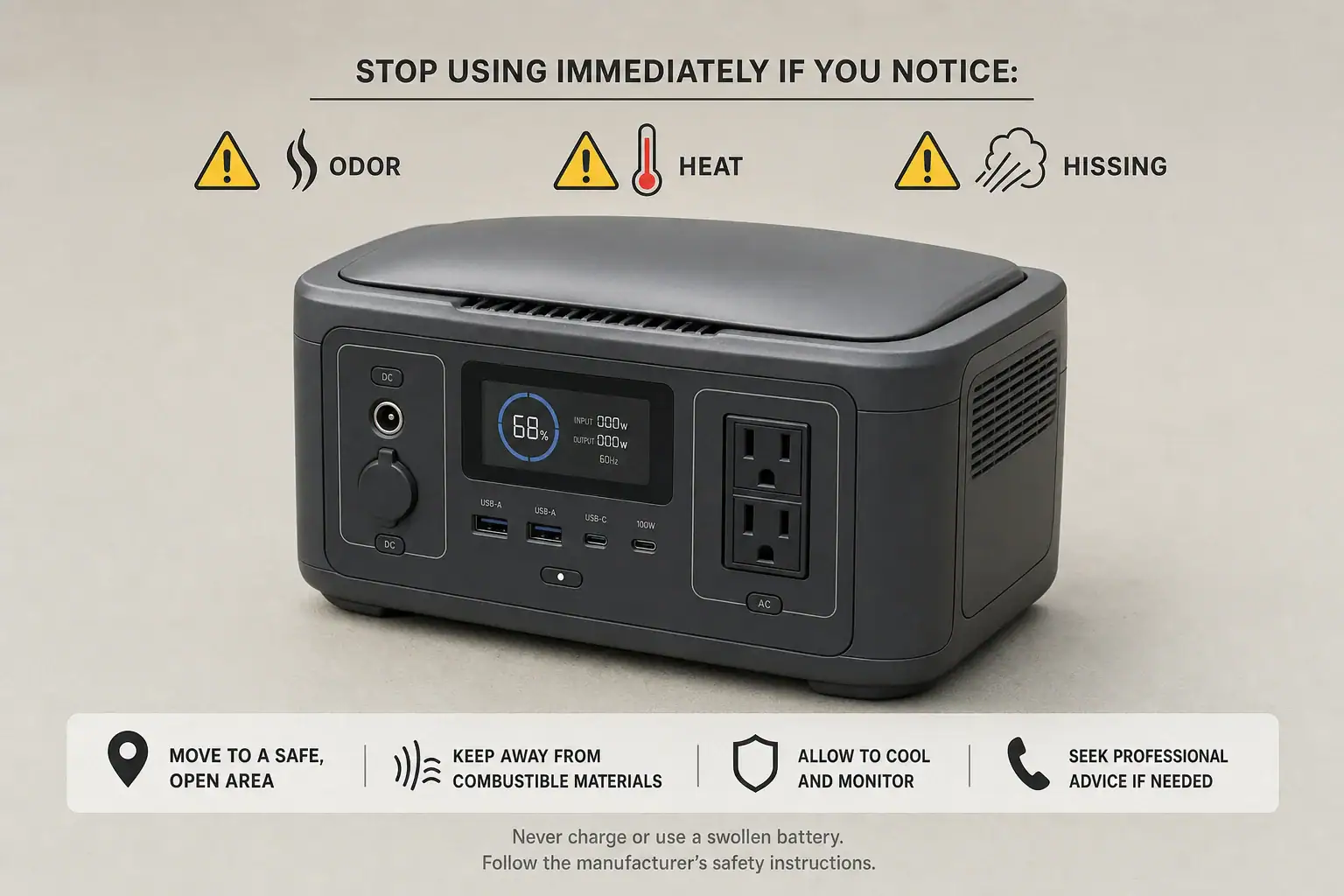
If a portable power station battery swells, smells, or hisses, stop using and charging it immediately, keep people away, and contact emergency services if it is hot, smoking, or actively venting.
A swollen battery, unusual chemical smell, or hissing battery can indicate internal cell damage, battery venting, or the early stages of thermal runaway. These are not normal operating conditions and should not be addressed by opening the enclosure, pressing a bulge flat, or attempting another charge cycle.
If the unit is cool and stable, disconnect external cables only when that can be done without touching a deformed, hot, leaking, or smoking area. Do not approach or move a unit that is rapidly heating, making loud venting sounds, or producing smoke. Leave the area, avoid inhaling fumes, and call emergency services. A damaged power station generally requires professional evaluation and disposal rather than continued use.
1. What Swelling, Odor, and Hissing Mean
Portable power stations typically contain lithium-ion battery cells, monitoring electronics, an inverter, and charging hardware inside one enclosure. A change in the enclosure’s shape or an unexpected sound or odor can mean that one or more cells are producing heat or gas because of internal damage or decomposition.
Swelling occurs when gas accumulates inside a cell or battery assembly. The outer case may bow, seams may separate, buttons may become misaligned, or a flat surface may no longer sit level. Even a small new bulge is significant because a healthy enclosure should not be pushed outward by the battery.
Unusual odor may be described as sweet, solvent-like, metallic, fruity, sharp, or similar to nail-polish remover. Odor descriptions are subjective, so any new chemical smell coming from the unit should be treated as abnormal. Do not lean over the power station or sniff vents to identify it.
Hissing, popping, or crackling can indicate gas escaping through a cell vent, internal arcing, or rapidly progressing failure. A normal cooling fan produces steady airflow or a smooth mechanical sound; it should not sound like pressurized gas, frying, or repeated pops.
These warning signs matter because a damaged cell can move from a stable condition to intense heating with little notice. The battery management system may disconnect electrical current, but it cannot reverse physical cell damage or guarantee that a compromised cell will remain cool.
2. How Battery Failure Can Progress
Battery cells store energy through controlled chemical reactions. Crushing, puncture, manufacturing defects, severe heat, internal contamination, overcharging, or aging can damage the thin separator between internal layers. If that separator fails, an internal short circuit may generate heat faster than the pack can release it.
Early signs can include an unexplained state-of-charge change, localized warmth, reduced runtime, charging interruptions, error messages, or a new odor. Gas generation may then cause swelling or venting. In a serious event, rising temperature can accelerate chemical reactions and affect neighboring cells. This self-heating chain reaction is called thermal runaway.
The built-in battery management system normally monitors cell voltage, current, and temperature. It can stop charging or shut down output when readings leave its programmed range. Fuses, thermal sensors, flame-resistant barriers, and spacing can add protection. However, no electronic protection can make a physically damaged pack safe to recharge.
The immediate response depends on what the unit is doing. A cool, silent unit with slight deformation still needs to be retired from service. A hot, hissing, leaking, or smoking unit is an active emergency. In that situation, distance and evacuation are more important than saving the equipment or unplugging every cable.
| Observed condition | Possible meaning | Appropriate response |
|---|---|---|
| Slight new bulge; unit is cool and silent | Gas generation or internal mechanical damage | Do not charge or use; isolate access and arrange professional disposal |
| New chemical odor without visible smoke | Electrolyte vapor or another overheated component | Move away, ventilate from a safe location, and avoid further operation |
| Hissing, popping, rapid heating, or smoke | Active venting or possible thermal runaway | Evacuate, call emergency services, and do not approach |
| Fan noise only during a heavy load | Potentially normal cooling operation | Remove the load if concerned and check whether the sound stops without other warning signs |
3. Real-World Warning Sign Examples
A case that no longer sits flat
A power station stored for several months may rock on a level floor or show a widening seam. It may still turn on and report a normal charge percentage. That display does not prove the cells are healthy. The correct response is to leave it off, prevent accidental use, and arrange guidance from the manufacturer, seller, or a qualified battery recycling facility.
An odor noticed during charging
A new solvent-like smell may appear near the unit while it is connected to AC or solar charging. If it is safe to do so without approaching heat, smoke, deformation, or leaking material, power can be disconnected at the remote source or wall outlet. People should then leave the immediate area. Charging must not be restarted to see whether the smell returns.
Hissing after an impact
A unit dropped from a vehicle or shelf may look mostly intact but begin hissing or growing warm. Internal cells can be damaged without obvious external cracks. Do not pick it up, place it in a vehicle, or carry it through a building. Keep others away, evacuate if the sound continues or smoke appears, and contact emergency services.
Heat after a high-power load
Warm exhaust air and fan noise can be normal when an inverter supplies a demanding appliance. Warning cues include one unusually hot spot, a case that remains hot after shutdown, acrid odor, swelling, crackling, or smoke. If those cues are absent, the issue may be ordinary cooling or an overload shutdown. If any are present, treat the unit as damaged rather than testing it with a smaller appliance.
4. Common Mistakes and Troubleshooting Cues
A frequent mistake is assuming that the battery management system makes every failure harmless. Protection circuits reduce risk, but they do not repair crushed separators, contaminated cells, electrolyte leaks, or damage caused by extreme temperatures.
- Restarting or recharging the unit: Additional current can increase heat in a compromised cell. Do not perform a test charge after swelling, venting, leakage, or a chemical odor.
- Opening the enclosure: This can expose energized conductors, damaged cells, and irritating or flammable material. Internal inspection and pack replacement are not appropriate user troubleshooting steps.
- Pressing, puncturing, or clamping a bulge: Mechanical pressure can rupture a cell or trigger an internal short circuit.
- Putting an active unit in a sealed container: A venting battery can release heat and gas. Confinement may allow pressure and flammable vapor to accumulate.
- Transporting it in a passenger vehicle: A damaged battery can worsen in transit and expose occupants to heat or fumes. Ask the appropriate waste or emergency authority how it should be handled.
- Confusing fan noise with hissing: A fan usually has a consistent whir and may change speed with load. Venting may sound sharp, irregular, or pressurized and may accompany odor, heat, or deformation.
- Using the display as proof of safety: A normal voltage or battery percentage does not reveal every internal defect.
Troubleshooting should be limited to observation from a safe distance and review of the operating history. Note whether the unit was recently dropped, exposed to water, left in a hot vehicle, charged below freezing, overloaded, or stored at full charge in heat. Do not recreate the event to confirm the cause.
5. High-Level Safety Response
Stop using the power station as soon as any credible warning sign appears. Tell nearby people not to touch it, keep children and pets away, and avoid breathing fumes. If the unit is connected to a source or appliance, disconnect it only when the connection can be reached safely without moving over or beside the battery.
For smoke, flames, rapid heating, loud hissing, repeated popping, or visible vapor, leave the area and call emergency services. Close a door behind you when practical, but do not delay evacuation to move the unit, retrieve belongings, or fight the fire. Battery fires can reignite after appearing to stop, so professional assessment is important.
If the unit is cool, silent, and not leaking, place access controls around it and seek handling instructions from a qualified battery recycler, hazardous-waste program, or the product’s support provider. Moving even a stable-looking damaged battery carries risk. Do not place it in household trash, curbside recycling, or a general battery collection box without approval.
A person exposed to smoke, vapor, or leaking material should move to fresh air and seek medical or poison-control guidance. Avoid touching residue. If contact occurs, follow local medical advice and the safety information supplied with the product. Electrical work involving building circuits, transfer equipment, or damaged outlets should be handled by a qualified electrician.
6. Maintenance and Storage That Reduce Risk
Prevention starts with temperature control and physical protection. Store the power station in a dry, ventilated place away from direct sun, heaters, combustible clutter, and locations where it can fall or be struck. Do not leave it in a parked vehicle, attic, or other area that can become extremely hot.
Follow the specified charging temperature range. Many lithium-based batteries should not accept a charge below freezing, even though they may be able to power a load at somewhat lower temperatures. A model with low-temperature charge cutoff provides an important automatic safeguard, but the user should still allow a cold unit to warm gradually and remain dry before charging.
For long storage, a partial state of charge is generally preferable to leaving the battery empty or at 100 percent for months. An illustrative target is about 40 to 60 percent, checked every three to six months, unless the product instructions specify otherwise. Use the supplied or electrically compatible charging equipment and keep vents unobstructed.
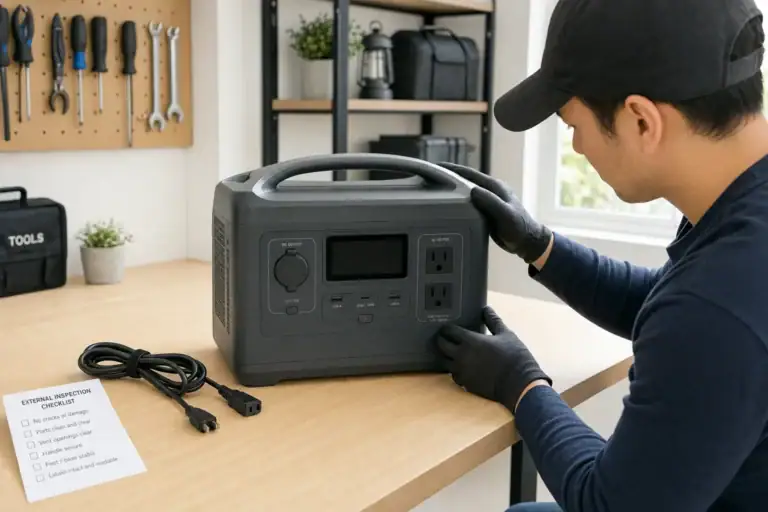
Inspect the case, seams, ports, and cable ends before use. Retire the unit after serious impact, water intrusion, unexplained overheating, or recurring protection errors until it has been professionally evaluated. Record purchase details and operating history so age, cycles, and prior incidents can be considered if a problem develops.
| Storage factor | Illustrative practice | Reason |
|---|---|---|
| State of charge | About 40% to 60% for extended storage | Reduces prolonged stress from very high or very low charge |
| Inspection interval | Every 3 to 6 months | Helps identify discharge, case changes, corrosion, or odor early |
| Room conditions | Roughly 50°F to 77°F when practical | Moderate temperatures generally slow battery aging |
| Clearance | Several inches around cooling vents during operation | Supports airflow and limits heat buildup |
Related guides: Portable Power Station Fire Safety Checklist for Apartments • Where to Store a Portable Power Station at Home: Heat, Humidity, and Access • UL 2743 Certification Explained for Portable Power Stations • Lithium Battery Safety Myths vs Reality: What Actually Causes Incidents
7. Practical Takeaways and Specs to Look For
Swelling, chemical odor, or hissing should end normal use of a portable power station. Do not rely on a reset, successful startup, or normal charge display as evidence that the pack is safe. Avoid opening, puncturing, compressing, or repeatedly testing it. For an active event, prioritize distance, evacuation, and emergency assistance. For a stable but damaged unit, obtain approved disposal or professional evaluation instructions.
When comparing a future portable power station, capacity and inverter output are not the only relevant measurements. Battery chemistry, protective controls, temperature monitoring, enclosure design, warranty terms, and clear end-of-life support can affect both practical safety and long-term ownership.
Specs to look for
- Battery chemistry: Look for clearly identified cell chemistry, such as lithium iron phosphate or another documented lithium-ion type; this helps evaluate cycle life, thermal characteristics, weight, and expected use.
- Battery management system: Look for stated overvoltage, undervoltage, overcurrent, short-circuit, and overtemperature protection; multiple monitored conditions provide broader automatic shutdown coverage.
- Temperature sensors: Look for pack and charging temperature monitoring rather than a single general enclosure sensor; broader sensing can identify abnormal heat sooner.
- Low-temperature charge cutoff: Look for automatic charging suspension near 32°F, with an operating range clearly listed; charging cold lithium cells can cause lasting internal damage.
- Operating temperature range: Look for separate charging, discharging, and storage ranges, such as charging around 32°F to 104°F; separate limits make safe seasonal use easier to plan.
- Cycle-life rating: Look for a stated capacity threshold after a defined number of cycles, such as 2,000 to 3,000 cycles to about 80 percent capacity; this is more informative than a cycle number alone.
- Safety testing documentation: Look for named battery, transport, and electrical safety test standards supported by accessible documentation; specific test identification is more useful than a general claim of certification.
- Enclosure and ventilation design: Look for protected vents, stable feet, impact-resistant construction, and clear airflow requirements; sound mechanical design helps manage heat and accidental contact.
- Warranty and disposal support: Look for several years of battery coverage plus written procedures for damaged-unit handling and recycling; clear support matters when a battery cannot be shipped or discarded normally.
No specification eliminates all battery risk. Safe placement, temperature-aware charging, periodic inspection, appropriate loads, and immediate retirement after serious warning signs remain essential throughout the power station’s service life.
Frequently asked questions
Is portable power station battery swelling dangerous?
Yes. Portable power station battery swelling indicates abnormal gas generation or internal damage and should be treated as a potential safety hazard. Stop using and charging the unit, and seek disposal or evaluation guidance from an approved battery-handling provider.
What should I do if my portable power station is hissing or smells like chemicals?
Move people away from the unit and avoid inhaling fumes. If it is hot, smoking, actively venting, or making loud hissing or popping sounds, evacuate and contact emergency services rather than attempting to move or inspect it.
Can I charge a swollen portable power station battery one more time to test it?
No. Test charging is a common mistake because additional current can increase heating in a damaged cell. A normal display reading or a successful startup does not confirm that the battery is safe.
Can a swollen power station battery be repaired?
A consumer should not attempt to repair, open, compress, or replace cells in a swollen power station battery. The unit generally requires professional evaluation, manufacturer guidance, or approved hazardous-waste and battery-recycling handling.
How do I safely dispose of a damaged portable power station?
Contact the manufacturer, a qualified battery recycler, or a local hazardous-waste program for instructions before transporting the unit. Do not place a damaged power station in household trash, curbside recycling, or an unattended battery collection box unless the receiving program specifically approves it.
What safety features should I look for in a portable power station?
Look for documented battery chemistry, a battery management system with overcurrent and overtemperature protection, pack and charging temperature sensors, and low-temperature charge cutoff. Clear operating limits, named safety-testing documentation, durable enclosure design, and written damaged-battery disposal support are also important features.
Related guides
Browse this topic →

- Beginner-friendly sizing, runtime & specs
- Solar & charging (MPPT, fast charging, cables)
- Batteries (LiFePO4, cycles, care & storage)
- Safety, cold-weather performance, real-world tips
More in Safety
See all →- Can You Take a Portable Power Station on a Plane? Battery Limits and Safer Travel Planning
- What to Do If a Portable Power Station Gets Wet
- Portable Power Station Fire Safety Checklist for Apartments
- UL 2743 Certification Explained for Portable Power Stations
- Lithium Battery Safety Myths vs Reality: What Actually Causes Incidents
Keep reading
About this site
Portable Energy Lab publishes practical, independent guides about portable power—clear sizing, safe use, and real-world expectations.
Affiliate disclosure
Some links on this site may be affiliate links. If you buy through these links, we may earn a small commission at no extra cost to you. This helps support our content. Read our affiliate disclosure.