
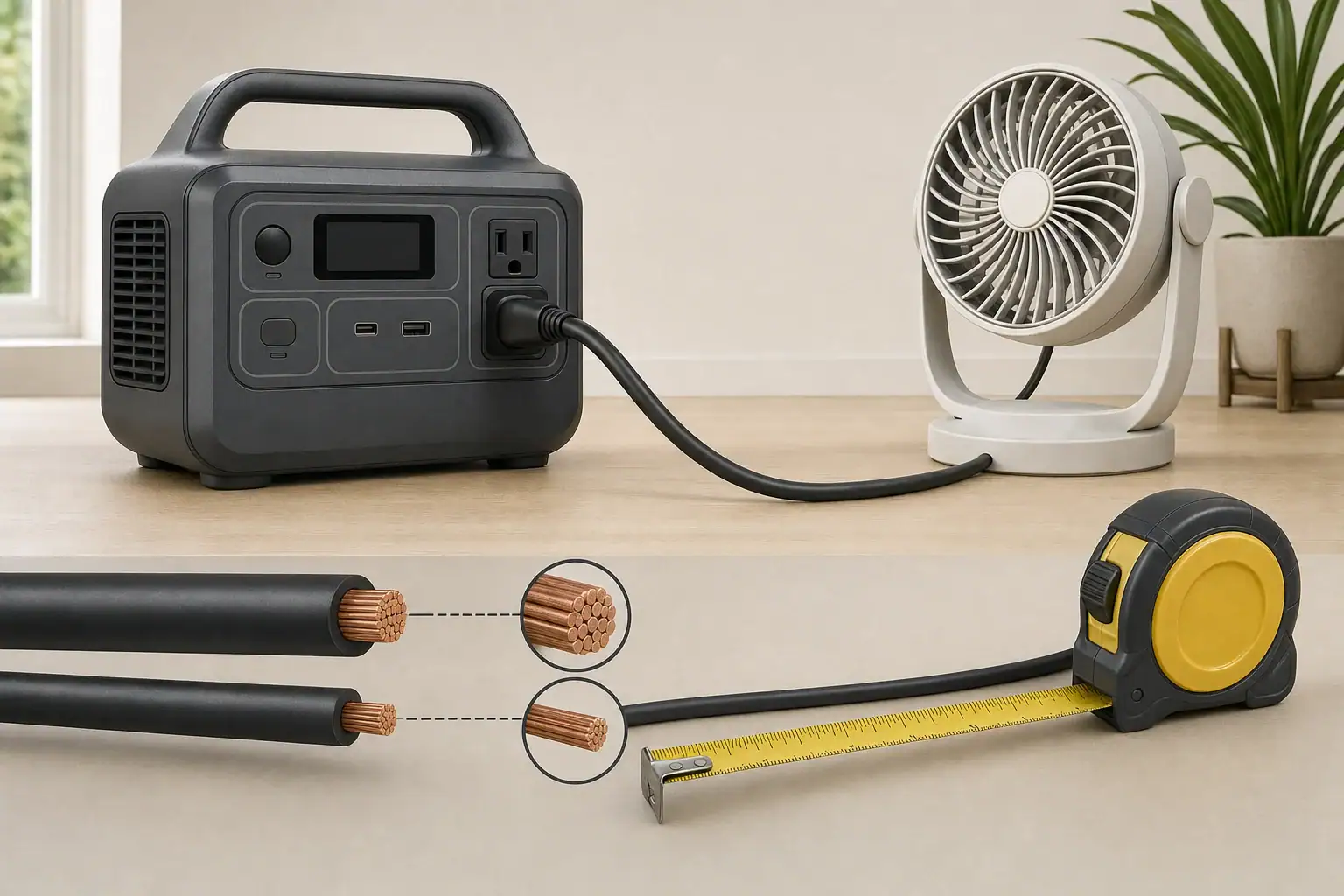
Quick answer: For AC extension cord voltage drop with portable power stations, use the appliance nameplate amps first. Choose the shortest listed cord whose printed rating covers the load, then check gauge and length with a voltage-drop calculation. Lower AWG numbers generally mean larger conductors and less calculated drop.
AC extension cord voltage drop: gauge, length, and load
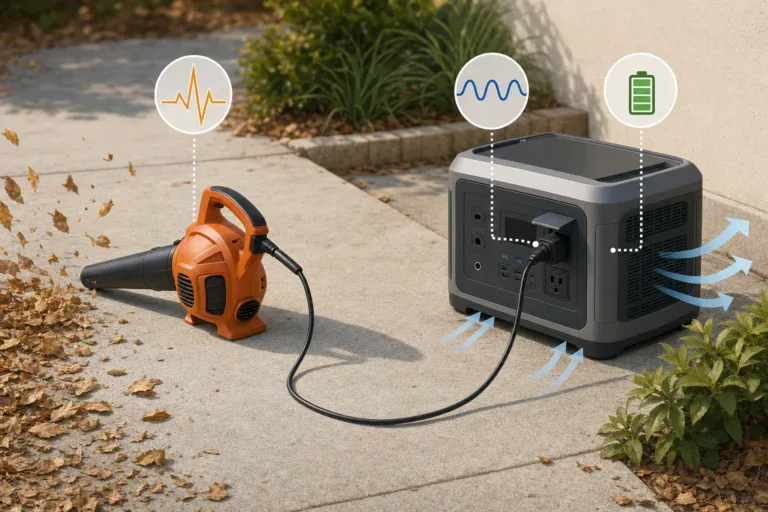
An extension cord has to meet three separate limits: the appliance demand, the cord’s printed rating, and the portable power station’s AC-output limits. Wire gauge and length affect voltage drop, but a favorable calculation does not make an underrated cord or power station suitable.
For a 120 V setup, use the table below as a conservative planning check based on a 3% calculated voltage-drop target. It assumes copper conductors at a 20°C reference temperature and the stated current flowing continuously. It is not an ampacity table, a legal limit, or a guarantee that every appliance will operate correctly.
| Assumed load | 16 AWG | 14 AWG | 12 AWG | 10 AWG |
|---|---|---|---|---|
| 600 W / 5 A | 90 ft | 143 ft | 226 ft | 360 ft |
| 1,200 W / 10 A | 45 ft | 71 ft | 113 ft | 180 ft |
| 1,500 W / 12.5 A | 36 ft | 57 ft | 91 ft | 144 ft |
| 1,800 W / 15 A | 30 ft | 48 ft | 75 ft | 120 ft |
How to use the table: Select a practical cord shorter than the listed length, then confirm its printed current or wattage rating covers the appliance. Also confirm the station’s continuous AC-output rating, any receptacle-specific limit, and its total output shared with other connected loads.
The calculation uses copper resistance values of approximately 4.02, 2.52, 1.59, and 0.9988 ohms per 1,000 feet for 16, 14, 12, and 10 AWG respectively at 20°C, from the NIST Copper Wire Tables. Actual cord assemblies can differ because conductor temperature, stranding, plugs, receptacles, and contact condition add variables.
Find the appliance current before choosing a cord
Use the appliance nameplate input amperage when it is available. Read the appliance manual as well, particularly if it gives extension-cord instructions or identifies a startup requirement.
For single-phase AC, the relationship is:
watts = volts × amps × power factor
Dividing watts by 120 V is therefore a useful estimate only for a load with power factor near 1. For example, a hypothetical 1,200 W resistance load at 120 V draws about 10 A. Motors and electronic power supplies can have a power factor below 1, so their real watts alone may not reveal current. The DOE Electrical Science handbook explains the relationship among true power, apparent power, and power factor.
If power factor or starting current is unknown, do not invent a multiplier. Use the appliance nameplate and manual. A motor may draw more current while starting, but the amount and duration depend on the specific appliance.
Calculate AC extension cord voltage drop
For a two-conductor 120 V load circuit, an idealized calculation is:
voltage drop = 2 × one-way length (ft) × current (A) × resistance (ohms per 1,000 ft) ÷ 1,000
The factor of two accounts for the outgoing and return conductors. Convert the result to a percentage with:
drop percentage = voltage drop ÷ supply voltage × 100
Illustrative calculation: 1,200 W resistance load on a 50-foot cord
Assumptions: 120 V station output, power factor near 1, 10 A load current, a 50-foot one-way cord length, and the NIST 20°C reference resistance. This is a calculation, not a measurement of a particular cord or station.
- 16 AWG:
2 × 50 ft × 10 A × 4.02 ohms/1,000 ft ÷ 1,000 = 4.02 V. That is about4.02 ÷ 120 × 100 = 3.35%. - 12 AWG:
2 × 50 ft × 10 A × 1.59 ohms/1,000 ft ÷ 1,000 = 1.59 V. That is about1.59 ÷ 120 × 100 = 1.33%.
Under these assumptions, the 12 AWG cord has less calculated drop than the 16 AWG cord. Neither result establishes the cord’s allowable current rating; the cord’s own printed marking remains controlling.
Check the appliance, cord, and power station separately
- Appliance: Check nameplate amps, operating voltage, and manufacturer instructions. Do not assume that a station can start a motorized appliance just because its listed running watts fit.
- Cord: Check the printed current or wattage rating, conductor gauge, jacket marking, and indoor or outdoor designation. Select a listed cord appropriate for the environment and inspect it before use.
- Power station: Check the exact model’s continuous AC-output rating, total shared-output limit, surge specification, receptacle limits, and displayed warnings or fault indicators.
The DOE Electrical Safety handbook identifies conductor gauge, cord length, intended use, inspection, environmental markings, and NRTL listing as relevant cord-selection considerations.
Power-station specifications are model-specific. For example, the EcoFlow DELTA user manual lists AC specifications and protection functions for that model only. Do not transfer those values to another station. A station’s surge rating also does not authorize operation above its continuous rating.
When a shorter or heavier cord may help
A cord may be worth investigating when an appliance runs directly from the station but not through the cord, a motor struggles to start, lights dim markedly under load, or a shutdown appears only with the extension cord connected. These signs do not prove voltage drop: overload, startup demand, temperature protection, a low battery, appliance protection, or a damaged connection can also be involved.
Use a controlled direct-versus-cord check
- Disconnect other AC loads. Note the station battery level and any displayed fault indication.
- If the appliance manufacturer permits it, connect the appliance directly to the station and observe whether it operates normally.
- Repeat with the extension cord, without changing the appliance or station settings.
- If the issue occurs only with the cord, inspect its printed rating, length, gauge, plugs, and receptacle fit. A shorter appropriately rated cord or a lower-AWG listed cord can reduce calculated drop.
- Stop using the cord if insulation is damaged or if there are bent contacts, discoloration, an abnormal odor, arcing, or an unusually hot plug or connector.
Do not repeatedly reset an overload or protection fault without identifying the cause. Follow the appliance and station manuals for model-specific warnings and service guidance.
Watts, watt-hours, and runtime
Watts (W) describe instantaneous load and help determine whether the station and cord can support an appliance. Watt-hours (Wh) describe stored energy and are used for runtime planning.
A simple Wh ÷ W result is an idealized estimate, not a promised AC runtime. Inverter operation and cord resistance consume some energy, and results vary with the station, load, cord, connections, and operating conditions.
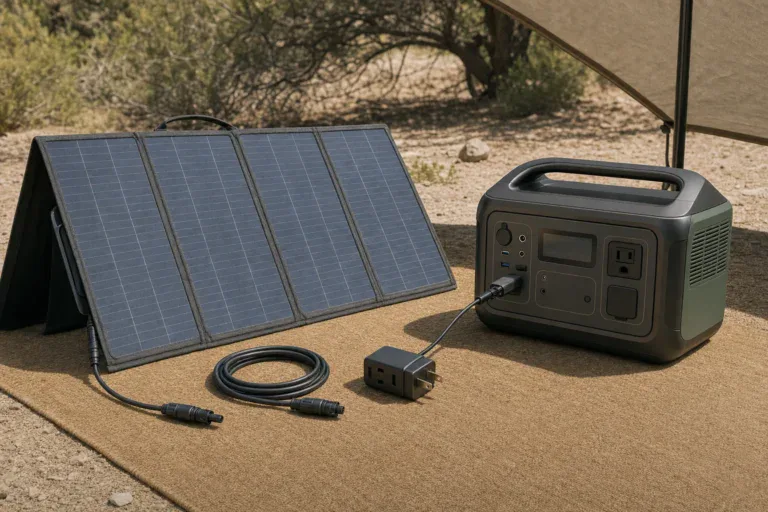
This article covers cords connected to a power station’s AC receptacle. Solar-extension cables are DC equipment with different voltage, current, connector, polarity, and compatibility requirements; select them only according to the solar source and power-station manuals.
Bottom line
Start with nameplate amps, verify the printed ratings of the appliance, cord, and power station separately, and calculate drop for the intended one-way cord length. When two cords meet all applicable ratings, the shorter cord or the one with the lower AWG number will generally have less calculated voltage drop.
Related guides
Browse this topic →
- Beginner-friendly sizing, runtime & specs
- Solar & charging (MPPT, fast charging, cables)
- Batteries (LiFePO4, cycles, care & storage)
- Safety, cold-weather performance, real-world tips
More in Safety
See all →- Can You Take a Portable Power Station on a Plane? Battery Limits and Safer Travel Planning
- What to Do If a Portable Power Station Gets Wet
- Portable Power Station Fire Safety Checklist for Apartments
- UL 2743 Certification Explained for Portable Power Stations
- Lithium Battery Safety Myths vs Reality: What Actually Causes Incidents
Keep reading
About this site
Portable Energy Lab publishes practical, independent guides about portable power—clear sizing, safe use, and real-world expectations.
Affiliate disclosure
Some links on this site may be affiliate links. If you buy through these links, we may earn a small commission at no extra cost to you. This helps support our content. Read our affiliate disclosure.