
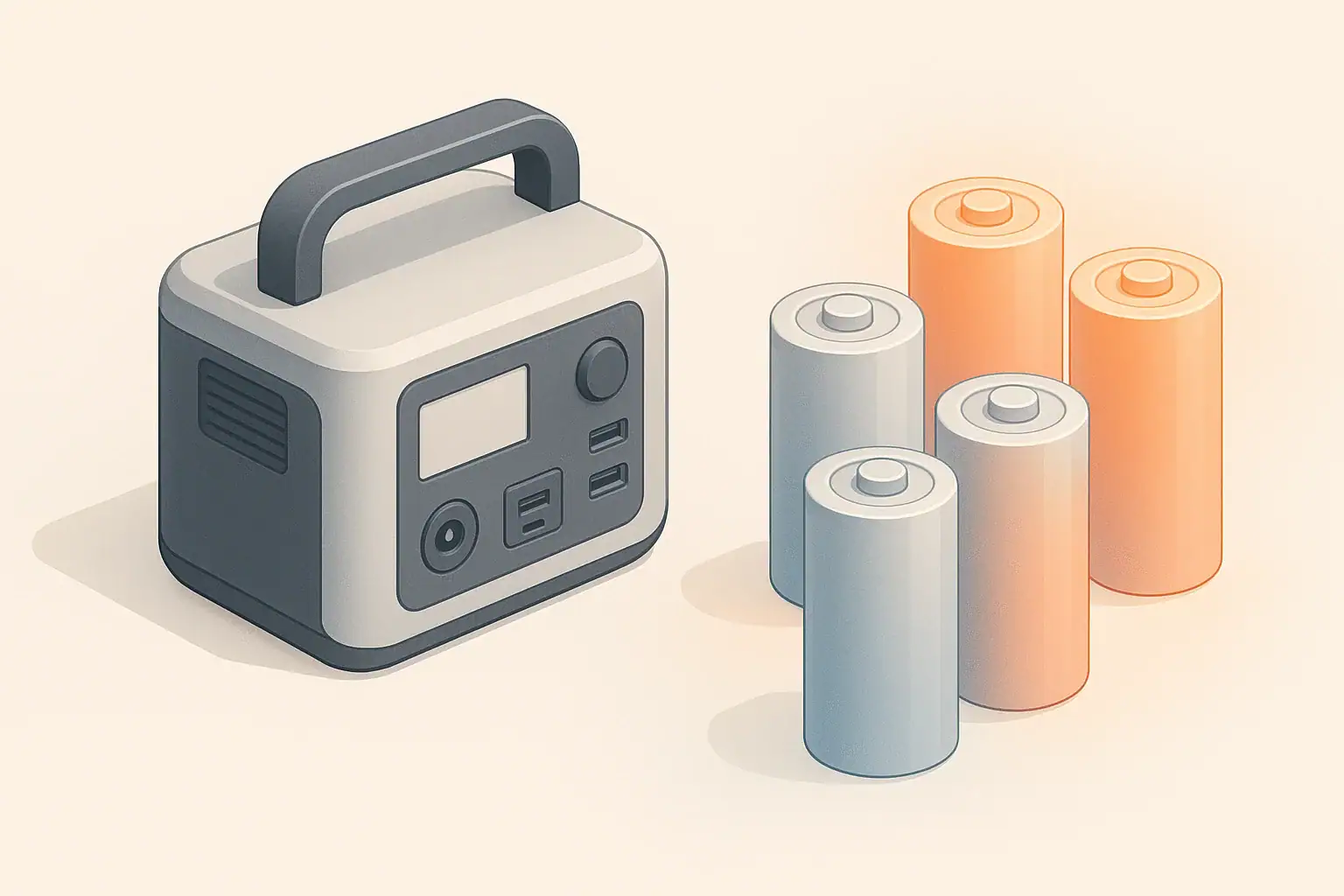
Battery capacity drops in cold and heat because temperature changes how efficiently the battery’s chemistry can move ions and deliver power. In cold weather, reactions slow down and internal resistance rises, so you cannot access all the stored energy; in high heat, the battery may deliver power but ages faster and may throttle output to protect itself.
For portable power stations, that means the “rated” watt-hours on the label are a best-case number measured at moderate temperature, not a guarantee in real-life weather. A 1,000 Wh unit might behave like 600–800 Wh on a freezing morning or after years of hot storage in a vehicle. Understanding this gap between rated and usable capacity is essential for planning runtimes for fridges, CPAP machines, laptops, lights, and other off-grid loads.
This guide explains why capacity changes with temperature, what you can realistically expect in winter and summer, and how to adjust your setup to get more reliable runtime. You will see simple rules of thumb, real-world examples, and a checklist of specs to pay attention to when comparing portable power stations.
What capacity drop means and why it matters
When people say a portable power station “loses capacity” in the cold or “drains faster” in hot weather, they are talking about usable capacity: how many watt-hours you can actually draw before the unit shuts off. The total chemical energy inside the battery has not disappeared; the battery management system is limiting how much of it can be safely used under those conditions.
Manufacturers rate batteries at a specific temperature (often around room temperature) and a specific discharge rate. Out in the real world, your battery faces cold mornings, hot cars, and fluctuating loads from devices that cycle on and off. Each of these factors changes how much of the rated watt-hours you can access during that discharge.
This matters because runtime planning depends on capacity. If you assume a 1,000 Wh power station will always deliver 1,000 Wh, you may undersize your system for winter camping, emergency backup, or RV travel. In practice, you need to plan for conversion losses, temperature effects, and battery aging so that critical loads—like medical devices or refrigeration—keep running even when conditions are not ideal.
Thinking in terms of a capacity range instead of a single number is the key shift. The same power station might give you 850 Wh on a mild day, 650 Wh on a freezing night, and 750 Wh after years of hot storage. Building that variability into your expectations and sizing decisions is the most practical way to avoid surprises.
Key concepts: power vs energy, chemistry, and temperature effects
To understand why battery capacity in cold and heat changes, it helps to separate a few basic ideas: power vs energy, how battery chemistry works, and how temperature affects internal resistance.
Power vs energy
- Power (W) is how fast energy is used at any moment. A 100 W light uses power twice as fast as a 50 W light.
- Energy (Wh) is how much total work the battery can do. A 1,000 Wh battery could, in theory, power a 100 W device for 10 hours (1,000 ÷ 100).
Your portable power station’s capacity rating is in watt-hours, but the outlets have watt limits. High power draws (near the inverter’s maximum watts) stress the battery more and make temperature effects more obvious.
Battery chemistry in brief
- Inside the battery, ions move through an electrolyte between the positive and negative electrodes.
- When you draw power, ions move in one direction and electrons flow through your devices.
- Temperature changes how easily ions move and how much resistance they encounter.
How cold affects capacity
- Cold temperatures slow ion movement and increase internal resistance.
- Voltage drops more quickly under load, so the battery “looks” empty to the management system even though some energy remains.
- The battery management system may reduce maximum output power or shut down earlier to protect the cells.
Result: in cold weather, you can often only access 60–80% of the energy you would get at room temperature, especially with high-wattage loads.
How heat affects capacity
- Warm batteries can deliver current more easily in the short term, so they may appear to perform well.
- However, high temperatures accelerate chemical side reactions that permanently reduce capacity over time.
- The battery management system may slow charging or reduce output to avoid overheating.
Result: in heat, you may see normal runtime today but faster long-term capacity loss over months and years.
Other real-world losses
- Conversion losses: Turning DC battery power into AC for household outlets wastes energy as heat in the inverter.
- Standby and electronics: Displays, fans, and the control electronics consume power even with light loads.
- Safety buffer: Many systems keep a small reserve at the top and bottom of the state-of-charge range to protect the cells, so “0%” and “100%” on the display do not represent the full chemical capacity.
| Rated battery size | Conditions and load | Typical planning usable capacity | Notes |
|---|---|---|---|
| 1,000 Wh | Room temperature, mostly DC loads, light to moderate power draw | 800–900 Wh | Assumes 10–20% lost to conversion and safety buffers |
| 1,000 Wh | Below freezing, moderate AC load | 600–750 Wh | Cold plus inverter losses significantly reduce runtime |
| 1,000 Wh | Room temperature, near-maximum inverter load | 650–800 Wh | High current increases internal losses and heat |
| 1,000 Wh (aged) | After many cycles and hot storage, room temperature | 650–800 Wh | Permanent capacity loss from long-term heat and cycling |
Using a planning range instead of the label number makes your runtime estimates more realistic, especially in cold or hot environments.
Real-world examples of capacity drop in cold and heat
Numbers feel abstract until you see how they affect actual devices. The examples below use a 1,000 Wh portable power station to illustrate what happens in different temperatures and with different loads.
Example 1: Laptop and small electronics
Assume a combined load of 60 W (laptop, router, and phone charging).
- Room temperature (around 70°F): Plan on about 850 Wh usable. Runtime ≈ 850 Wh ÷ 60 W ≈ 14 hours.
- Cold garage (20°F): Plan on about 650 Wh usable. Runtime ≈ 650 Wh ÷ 60 W ≈ 10–11 hours.
- Hot interior (100°F) with a newer battery: Usable capacity might still be around 800 Wh, but repeated use in this heat will slowly lower that number over time.
From the user’s perspective, the same setup that easily runs through a workday in spring may fall short in winter unless you warm the unit or add extra capacity.
Example 2: Small refrigerator or cooler
Assume a fridge that averages 80 W over time (cycling on and off).
- Room temperature: 850 Wh usable → about 10–11 hours of average runtime.
- Cold conditions: 650 Wh usable → about 8 hours of average runtime.
- After years of hot storage: even at room temperature, you might only get 700 Wh, or about 8.5–9 hours.
For food safety or medication storage, that difference can decide whether you need a bigger battery, a second unit, or a plan to recharge during longer outages.
Example 3: High-wattage space heater
Assume a 1,000 Wh power station running a 600 W electric heater.
- Simple math: 1,000 Wh ÷ 600 W ≈ 1.7 hours. This is the theoretical maximum.
- More realistic at room temperature: 750 Wh usable at high discharge → 750 ÷ 600 ≈ 1.2–1.3 hours.
- Cold environment: 600–650 Wh usable at high discharge → roughly 1.0–1.1 hours.
High loads exaggerate temperature effects because they pull current quickly, increasing voltage sag and triggering protective shutdown sooner.
Example 4: CPAP machine overnight
Assume a CPAP drawing 40 W on average, used for 8 hours.
- Energy needed: 40 W × 8 h = 320 Wh.
- Room temperature: Even a 500 Wh unit with 400 Wh usable should handle this.
- Cold cabin: If usable capacity drops to 60–70% (300–350 Wh), a 500 Wh unit is now borderline, especially if other loads share the battery.
This is why people relying on medical devices often choose larger capacity than the math suggests, or keep the power station in a warmer part of the room.
Common mistakes and troubleshooting cues
Many “bad battery” complaints are actually normal behavior under cold or hot conditions. Recognizing the patterns can save time and worry.
Mistake 1: Assuming the label watt-hours are always available
Planning runtimes using the rated capacity without accounting for temperature, inverter losses, or aging leads to disappointment. If you design your setup so that you need nearly 100% of the label capacity just to get through the night, cold weather or an older battery will quickly expose that margin as too thin.
Mistake 2: Ignoring temperature limits for charging
Most batteries should not be charged when very cold or very hot. If you notice charging slowing or stopping at partial charge on a freezing morning or in a hot vehicle, the system is likely protecting itself. For troubleshooting, move the unit to a moderate environment, wait for it to warm or cool, and try again.
Mistake 3: Misreading the state-of-charge display
Percentage readings are estimates based on voltage and past behavior. In cold weather, voltage drops faster under load, so the percentage can fall quickly and the unit may shut down even though it still shows a non-zero value. After warming up, the percentage may jump or behave more normally. This is not necessarily a calibration failure; it is the chemistry reacting to temperature.
Mistake 4: Overloading the inverter in cold weather
Running close to the inverter’s continuous rating is more likely to cause shutdowns when it is cold because internal resistance is higher. If the power station clicks off when a large appliance starts, try:
- Reducing the total load (unplug non-essential devices).
- Starting high-surge devices one at a time.
- Warming the unit closer to room temperature before heavy use.
Mistake 5: Storing the unit fully charged in heat
Leaving a portable power station at 100% charge in a hot environment—such as a trunk or shed in summer—accelerates permanent capacity loss. Months later, users notice shorter runtimes and blame a “defective” battery when the main issue was storage conditions.
| Symptom | Likely cause | Quick checks |
|---|---|---|
| Unit shuts off early in cold weather | High internal resistance and voltage sag triggering protection | Warm the unit, reduce load, and test again at room temperature |
| Charging pauses at partial state of charge | Battery temperature outside recommended charging range | Move to a moderate environment and resume charging later |
| Runtime much shorter than last season | Capacity fade from age and/or hot storage | Compare runtime at similar temperature with lighter loads |
| Fans running constantly in warm room | Inverter and battery working near thermal limits | Improve ventilation, reduce load, or move to a cooler spot |
| Display percentage drops quickly under load | Cold-induced voltage drop or heavy current draw | Test with a smaller load and/or at a warmer temperature |
Working through these checks helps distinguish normal temperature-related behavior from true faults that may require professional service.
Safety basics around temperature, placement, and loads
Temperature that reduces capacity can also affect safety. While modern portable power stations include multiple protections, basic habits make them safer and more reliable.
Placement and ventilation
- Place the unit on a stable, dry, non-flammable surface.
- Keep vents clear on all sides so cooling air can flow freely.
- Avoid direct sun, heaters, stoves, or other strong heat sources.
- In cold conditions, avoid setting the unit directly on ice, metal, or concrete; a thin insulating pad can reduce temperature swings at the battery pack.
Managing heat during use
- Do not cover the power station with blankets, bags, or clothing while it is charging or discharging.
- If the case feels very hot or the fan runs continuously, reduce the load and allow the unit to cool.
- Avoid operating at maximum rated power for long periods in hot rooms or vehicles; this combination is hard on the battery and electronics.
Cords, extension leads, and connected devices
- Use cords rated for the current your devices will draw; undersized or damaged cords can overheat.
- Inspect cords for cuts, frays, or crushed insulation before use.
- Avoid tightly coiling extension cords under heavy load, as this can trap heat.
- Spread high-wattage devices across outlets rather than stacking them on a single adapter or strip.
High-level electrical protection
- Use outlets with ground-fault protection when operating near damp areas.
- Do not attempt to modify the internal wiring or bypass safety features.
- If you intend to connect a portable power source to building wiring, consult a qualified electrician and follow local codes.
Paying attention to temperature, ventilation, and load limits not only preserves capacity but also reduces the risk of overheating or equipment damage.
Maintenance and storage for better long-term capacity
How you store and maintain a portable power station has a large influence on how much capacity it will still have after a few years, especially if it regularly sees cold winters or hot summers.
State of charge for storage
- Avoid storing the battery long-term at 0% or 100%.
- For multi-month storage, a mid-range state of charge (for example, around half to three-quarters full) is often a good compromise.
- Check the charge level every few months and top up if it has dropped significantly.
Temperature during storage
- Store in a cool, dry place away from direct sun and heat sources.
- Avoid long-term storage in vehicles, attics, or sheds that can reach very high temperatures.
- Very cold storage is usually less harmful than hot storage, but always warm the unit toward room temperature before charging or heavy use.
Periodic testing and inspection
- Every few months, plug in a small, known load (such as a light or fan) and confirm the unit powers it normally.
- Listen for unusual noises from fans and feel for hot spots during operation.
- Check that vents are free of dust and debris.
- Look for any swelling, cracks, or damage to the case; if you see these, stop using the unit and seek professional guidance.
These habits help keep runtime predictions closer to reality and reduce the chance of a surprise failure during an outage or trip.
Practical takeaways and specs to look for
Temperature will always affect battery capacity, but you can plan around it. Think of your portable power station as having a usable capacity range that shrinks in the cold, slowly declines with age, and is affected by how hard you push the inverter. Build margin into your system so that critical loads still run when conditions are worst, not just when they are ideal.
In practice, that means assuming less than the rated watt-hours in winter, avoiding long-term storage in high heat, and choosing models with features that handle temperature extremes more gracefully.
Quick rules of thumb for everyday use
- At room temperature, assume you can use roughly 80–90% of the rated watt-hours with moderate loads.
- Below freezing, plan on losing roughly 20–40% of usable capacity unless you keep the unit warm.
- Expect shorter runtime when running near the inverter’s maximum wattage.
- Keep the unit out of closed, sun-heated spaces whenever possible.
- Let a cold battery warm toward room temperature before fast charging or heavy discharging.
Specs to look for when comparing portable power stations
To handle capacity drop in cold and heat more effectively, pay attention to these specifications and design details:
- Battery capacity (Wh) vs your loads: Calculate your daily energy needs and add margin for temperature losses and aging.
- Continuous and surge inverter ratings (W): Ensure both are comfortably above the starting and running watts of your largest devices, especially in cold climates.
- Recommended operating temperature range: Check that the discharge and charge ranges match your intended environment (for example, winter camping or hot garages).
- Low-temperature charging protections: Look for systems that prevent charging when the battery is too cold and resume automatically when safe.
- High-temperature protections and cooling: Fans, vents, and thermal limits help prevent overheating in summer or under heavy loads.
- Efficiency and DC output options: Using DC ports for compatible devices reduces conversion losses and stretches runtime, especially when capacity is already reduced by cold.
- Cycle life and expected capacity retention: Specifications that indicate how much capacity remains after a certain number of cycles give you a sense of long-term performance.
- Accurate, stable state-of-charge display: A clear percentage readout and remaining-time estimate, while not perfect, make it easier to adjust for temperature and load changes.
Combining realistic expectations about battery chemistry with careful attention to these specs will help you choose and use portable power stations that perform more predictably in both cold and hot conditions.
Frequently asked questions
What specs and features most affect a portable power station’s performance in cold and heat?
Key specs include the recommended operating temperature range, low-temperature charging protection, and thermal management (fans, vents, and thermal cutoffs). Inverter continuous and surge ratings matter too because high discharge rates increase internal losses; DC output options and overall efficiency also help reduce conversion losses in extreme temperatures.
How much capacity loss should I expect in freezing or very hot conditions?
In cold conditions you can commonly lose 20–40% of usable capacity depending on discharge rate and temperature; heavy loads make the loss worse. High ambient heat may not reduce short-term runtime as much, but it accelerates permanent capacity fade over months or years if the unit is stored hot.
Can I safely charge or use a power station in freezing temperatures?
Most power stations restrict charging below their recommended minimum temperature to protect the cells, so charging may pause or not start in freezing conditions. Discharging is generally possible but with reduced usable capacity; warming the unit to a moderate temperature before charging is the safest approach.
Is storing a power station fully charged in a hot car harmful?
Yes. Keeping a battery at high state-of-charge in a hot environment speeds up chemical degradation and reduces long-term capacity. For multi-week or -month storage, keep the unit partially charged (around 40–70%) and in a cool, shaded location if possible.
What common mistakes lead people to think their battery is failing?
Typical mistakes include assuming the label watt-hours are always available, charging in temperatures outside the recommended range, and misreading state-of-charge under load. Storage at high temperature and frequent operation near the inverter’s limits also cause capacity loss that can be mistaken for sudden failure.
How should I manage safety when using portable batteries in extreme temperatures?
Keep the unit well ventilated, avoid direct sunlight or proximity to heat sources, and do not cover the case while charging or discharging. Follow the manufacturer’s operating-temperature guidelines, reduce heavy loads if the unit feels hot or fans run continually, and store the battery in a cool, dry place when not in use.
Related guides
Browse this topic →
- Beginner-friendly sizing, runtime & specs
- Solar & charging (MPPT, fast charging, cables)
- Batteries (LiFePO4, cycles, care & storage)
- Safety, cold-weather performance, real-world tips
More in Battery
See all →- Low-Temperature Charging Protection in LiFePO4 Power Stations Explained
- Portable Power Station Expansion Batteries: When Extra Capacity Makes Sense
- Lithium-Ion vs LiFePO4 Batteries Explained
- LiFePO4 vs Lithium-Ion in Cold Weather: Which Holds Up Better?
- Best Storage Charge Percentage: 40% vs 60% vs 80% for Different Battery Chemistries
Keep reading
About this site
Portable Energy Lab publishes practical, independent guides about portable power—clear sizing, safe use, and real-world expectations.
Affiliate disclosure
Some links on this site may be affiliate links. If you buy through these links, we may earn a small commission at no extra cost to you. This helps support our content. Read our affiliate disclosure.