
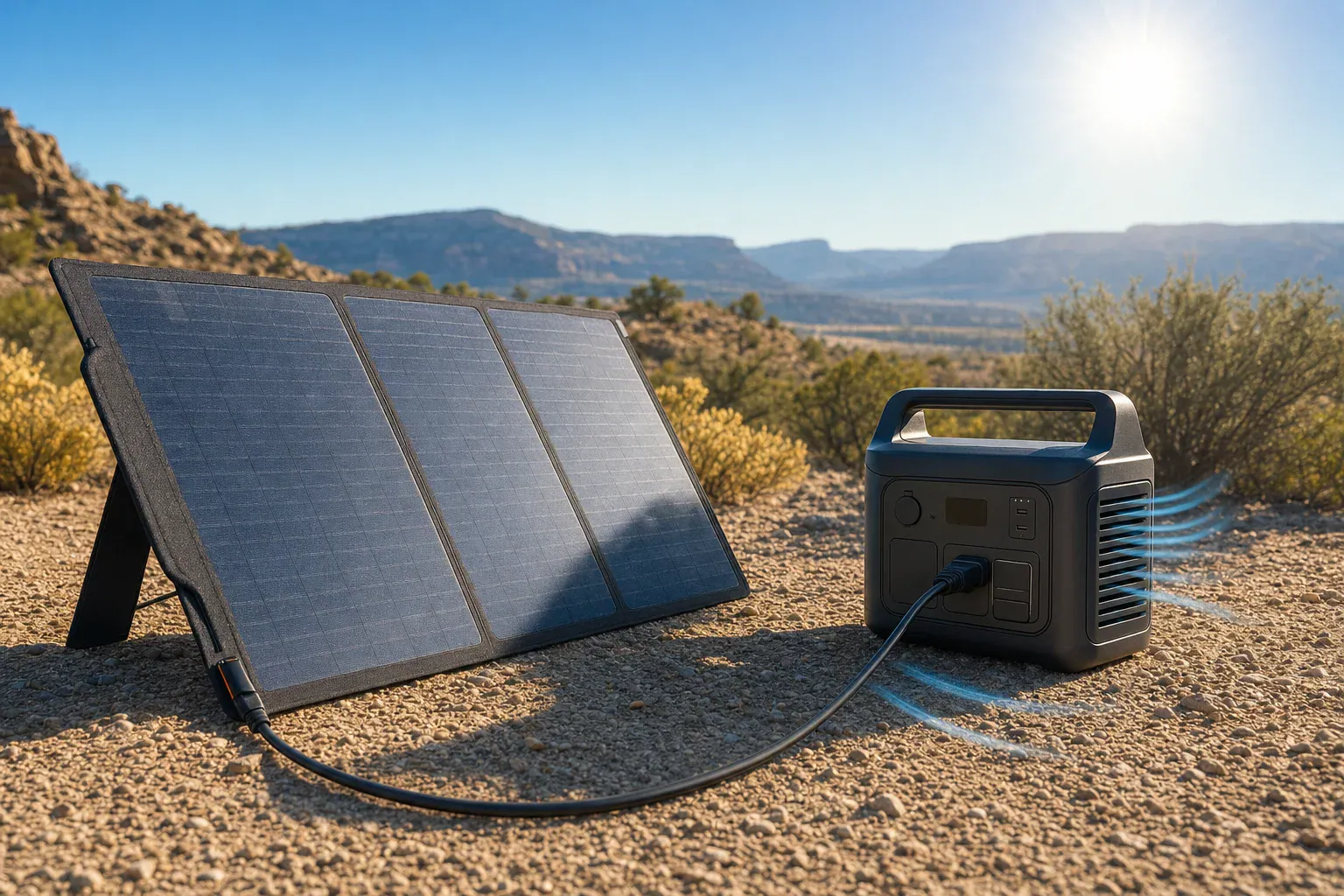
Quick answer: Solar panel rated watts are a maximum-power rating measured under standardized test conditions, not guaranteed charging input. Real charging output varies with sunlight, panel temperature, orientation, cabling, and the power station’s permitted solar voltage, current, wattage, and battery-charging behavior.
What do solar panel rated watts mean?
Solar panel rated watts describe the panel’s maximum-power rating under defined test conditions. They are an instantaneous power value, not a promise that the panel will continuously deliver that number of watts to a portable power station.
Standard test conditions use irradiance of 1,000 watts per square meter and a solar-cell temperature of 25°C (77°F), according to the U.S. Department of Energy. They also specify an Air Mass 1.5 solar spectrum. NREL notes that these standardized conditions are useful for ratings but “do not represent actual operating conditions” (NREL PDF).
Outdoor conditions and the equipment connected to the panel differ from those rating conditions. As a result, a lower number on a station display is not, by itself, evidence that the panel is defective.
Keep watts, displayed input, and watt-hours separate
| Number | What it means | Do not confuse it with |
|---|---|---|
| Panel rated power (W) | The nameplate maximum under its specified test conditions. | A guaranteed field charging rate. |
| Panel-terminal power (W) | Voltage multiplied by current at the panel terminals at a particular moment. | The station display unless the manufacturer says it measures there. |
| Displayed charging input (W) | Power reported by the station at its own model-specific measurement point. | A laboratory measurement of panel output. |
| Battery capacity or energy (Wh) | An amount of energy stored or transferred over time. | Instantaneous charging power. |
Watts and watt-hours are different units. If input remained at 100 W for two hours, the energy reaching that measurement point would be 200 Wh. That does not necessarily mean the battery stored exactly 200 Wh: the station’s charging electronics, battery-management behavior, and any active loads can affect stored energy or the displayed net result.
Why the station may show less than the panel rating
The charging path is panel → cable and connectors → the station’s solar charge controller → battery. The power accepted by the station is limited by the power available from the panel under current conditions and by the station’s documented input requirements.
- Sunlight intensity, shading, panel aim, and cell temperature can change the power available from the panel.
- Cables, connectors, and the approved system configuration can affect the charging path.
- The station may have a permitted PV voltage range, maximum input current, and maximum solar-input wattage.
- The station may reduce charging under some battery-state or temperature conditions.
For example, the EcoFlow DELTA 2 manual lists solar charging at 500 W maximum and requires panel output voltage to remain within 60 V (manufacturer manual). Those are limits for that model, not general limits for all power stations.
A larger panel therefore does not guarantee an equally large displayed input. More importantly, wattage alone is not a compatibility check. Consult the station manual before connecting any panel or array, and do not exceed its stated PV voltage limit.
Specifications to compare before connecting solar
| Specification | What it describes | What to check |
|---|---|---|
| Panel Pmax | Nameplate maximum power. | Use it as a standardized rating, not an output promise. |
| Panel Vmp | Voltage near rated maximum-power operation. | Check the station can operate with the panel at this voltage. |
| Panel Imp | Current near rated maximum-power operation. | Compare with the station’s stated input-current limit. |
| Panel Voc | Open-circuit voltage. | Confirm the manufacturer-approved configuration remains within the station’s maximum PV voltage requirement. |
| Station PV input range and maximum voltage | What the solar charge controller accepts. | Follow the manual’s stated range and maximum for the exact model. |
| Station maximum PV current and watts | Input acceptance ceilings. | Treat them as ceilings, not predicted charging results. |
| Connector and polarity | Physical and electrical connection details. | Use manufacturer-approved cables and adapters; a fitting connector is not proof of compatibility. |
On a panel data sheet, Pmax is usually close to Vmp × Imp, subject to rounding and the stated test conditions. For a fuller explanation of these labels, see How to Read Solar Panel Specs for Power Stations. If the voltage, current, polarity, or approved configuration cannot be verified, do not connect the equipment until the manufacturer confirms compatibility.
Is there a standard percentage of rated output?
No universal percentage is supported for portable solar panels and power stations. A fixed rule such as “expect 80%” hides differences in sunlight, temperature, placement, cables, panel design, station limits, battery state, and the location of the display measurement.
One manufacturer’s documentation illustrates why conditions matter. EcoFlow says actual generation from its specific 130 W rigid panel can vary with irradiance, temperature, shading, installation angle, cables, system configuration, and degradation (manufacturer manual). That statement and that panel’s specifications should not be generalized to every portable panel.
An illustrative rated-watts comparison
Assumptions for illustration only: A compatible panel is rated at 200 W. A power station shows 120, 125, 130, 125, 128, and 122 W at five-minute intervals over 30 minutes. These invented readings are not expected results for a 200 W panel.
Average displayed input:
(120 W + 125 W + 130 W + 125 W + 128 W + 122 W) ÷ 6 = 125 W
Observed displayed-input ratio for this one session:
125 W ÷ 200 W × 100 = 62.5%
If the 125 W average held for 0.5 hours, energy at the station’s reported input point would be:
125 W × 0.5 h = 62.5 Wh
This is a documented observation of one hypothetical setup, not a universal conversion from rated watts to real output. It also does not establish the increase in usable battery capacity.
How to measure your charging output safely
- Read the panel label or manual and record Pmax, Vmp, Imp, and Voc.
- Read the station manual and record its accepted PV voltage range, maximum PV voltage, maximum input current, maximum solar watts, connector, and polarity requirements.
- Use only a manufacturer-approved or documented compatible panel, cable, adapter, and configuration. Do not exceed the station’s stated PV voltage limit.
- For a clearer observation, disconnect optional output loads so appliance use does not complicate the displayed input.
- Record the battery state. Avoid interpreting a reading near full charge as the panel’s maximum capability if the station is reducing charging.
- Place the panel securely in an unshaded location with rear airflow. Adjust its aim without handling exposed conductors.
- After the reading settles, log displayed solar input every five minutes for 30 minutes.
- Add the readings and divide by the number of readings to find the average displayed input. Divide that average by panel rated watts only as a setup-specific comparison.
- Record the date, time, location, cloud conditions, panel orientation, battery state, and any temperature information available.
- When retesting, change one factor at a time, such as panel orientation or cable length.
Label the result as displayed station input unless the manufacturer identifies exactly where and how the number is measured. If cable length is part of the comparison, see Solar Extension Cables and Voltage Drop.
Do inverter ratings affect solar charging watts?
No. A station’s continuous AC output and surge ratings apply to the inverter and connected AC loads. They are separate from the station’s solar-input rating. A power station can have a high AC output rating and a much lower maximum solar-input rating.
Surge power is short-duration load support, not additional solar charging capacity. Solar charging enters the station as DC power; using stored energy through an AC outlet adds an inverter conversion stage. See Inverter Efficiency Explained for why input energy should not be assumed to equal AC energy delivered to a load.
Bottom line
Use solar panel rated watts to identify a standardized maximum-power class, not to predict one guaranteed charging number. Verify voltage, current, wattage, connector, polarity, and approved configuration first. Then measure and document your station’s displayed input under your own conditions instead of relying on a universal percentage.
Related guides
Browse this topic →
- Beginner-friendly sizing, runtime & specs
- Solar & charging (MPPT, fast charging, cables)
- Batteries (LiFePO4, cycles, care & storage)
- Safety, cold-weather performance, real-world tips
More in Solar
See all →- Solar Charging on Cloudy Days: What Output Can a Portable Power Station Expect?
- How Many Portable Solar Panels Do You Need for a 1,000Wh Power Station?
- Solar Adapter Polarity Mistakes: How to Avoid Reverse-Polarity Charging Problems
- Portable Solar Panel Waterproof Ratings: What Rain, Dew, and Splash Resistance Mean
- Can You Charge a Portable Power Station Through a Window With Solar Panels?
Keep reading
About this site
Portable Energy Lab publishes practical, independent guides about portable power—clear sizing, safe use, and real-world expectations.
Affiliate disclosure
Some links on this site may be affiliate links. If you buy through these links, we may earn a small commission at no extra cost to you. This helps support our content. Read our affiliate disclosure.