
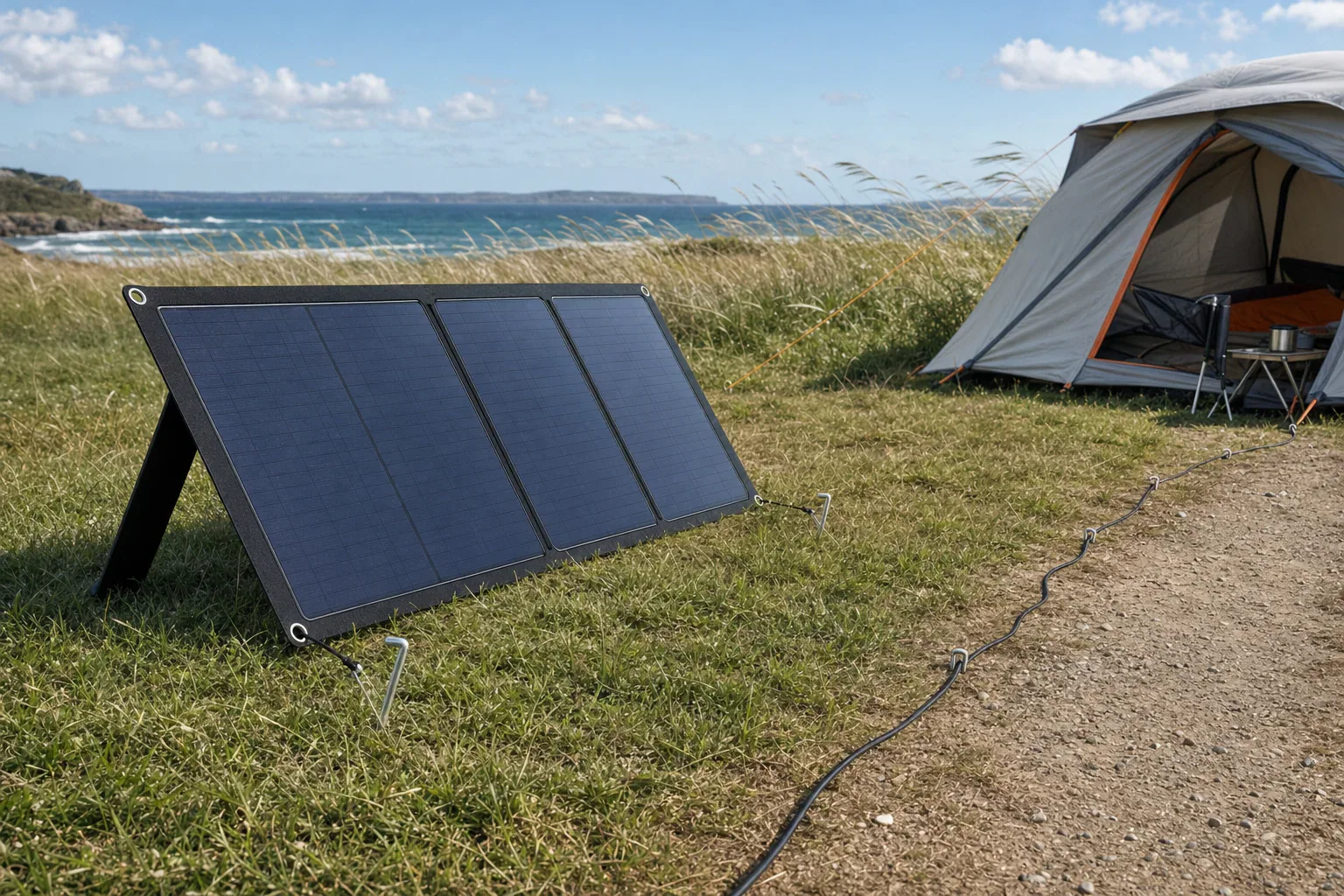
Quick answer: Secure portable solar panels in wind only at attachment points named by the exact panel or stand manual. Use approved stakes on suitable penetrable ground; on pavement, use only a manufacturer-specified ballast or stand system. Keep the charging cable out of walkways, and stow the panel at the first sign of movement or loosening.
Check the panel, forecast, and site before deployment
There is no universal wind speed at which every portable solar panel is safe. Folding panels, flexible blankets, framed suitcase panels, kickstands, grommets, and stands can have very different instructions and load limits. If the manufacturer does not publish a limit for the exact panel and configuration, treat the limit as unknown rather than estimating one from the panel’s size or weight.
Read the instructions for the panel and for any separate stand, stakes, hooks, straps, or ballast kit before setting up. Attachment permissions are model-specific. For example, the Predator 100-watt panel manual directs users to put its included anchors through kickstand grommets and to avoid setup on windy or stormy days. EcoFlow’s 45-watt panel documentation identifies preset holes for hooks. Neither instruction authorizes putting a restraint through fabric, around a hinge, or across the solar surface. See the Predator panel manual and EcoFlow 45W panel documentation.
Check the local forecast immediately before setup and keep checking it while charging. Consider forecast gusts as well as sustained wind. The National Weather Service defines a forecast gust as the maximum three-second wind within a two-minute interval, measured at 10 meters. That describes forecast terminology; it is not a portable-panel survival rating and cannot predict wind at a particular campsite or patio. See the National Weather Service definitions.
Finally, confirm what the site allows. Campgrounds and public land can limit stakes, lines, and equipment placement. The National Park Service cautions that stakes and lines can become trip hazards in high-traffic areas and advises visitors to check the rules for the specific campground. Keep all equipment inside the permitted area, and do not attach a panel to a tree, site fixture, or other support unless both the site operator and the equipment maker allow it. See the NPS campsite guidance.
How to secure portable solar panels in wind by panel type and surface
The restraint must suit both the panel’s approved attachment feature and the surface below it. If either part is missing from the manufacturer’s instructions, choose a more sheltered authorized location or pack the panel away.
| Panel format | Surface | Appropriate restraint | Cable route | Pack-away trigger |
|---|---|---|---|---|
| Folding panel with designated kickstand grommets or stake loops | Penetrable soil | Use manufacturer-supplied or approved stakes through the identified points, plus any restraint the manual requires. | Leave slack at the connector, then route toward the edge of the occupied area. | A stake loosens, the stand lifts, the panel shifts, or the manual excludes the conditions. |
| Folding panel with a manufacturer-approved ballast strap or stand | Pavement or other impenetrable surface | Use only the specified attachment points, ballast location, and ballast amount. The required weight is unknown unless the manufacturer states it. | Follow the pavement edge where practical and protect an unavoidable crossing only with a suitable, site-permitted cable protector. | Ballast moves, a strap slips, or the panel creeps or pivots. |
| Panel with designated clipping or hanging points | Permitted rail, mesh, or support | Use approved hooks or straps through the designated points only when the panel maker and site operator both permit the support. | Leave enough connector slack that normal support movement cannot pull on the plug. | The support moves, the attachment abrades, or the cable becomes taut. |
| Framed suitcase panel with no approved anchor points | Any surface | Do not drill, clamp, or tie around an arbitrary part of the frame. Relocate to an authorized sheltered location or stow it. | Use the shortest practical route that stays out of traffic and does not stretch the cable. | Any lifting, rocking, sliding, or increasing exposure. |
| Flexible blanket or fabric-backed panel without a stated restraint method | Any surface | Deploy only as the manual describes. Do not add concentrated loads to fabric, seams, or cells. | Keep connectors and leads away from walking lanes and folding edges. | Flapping, folding, seam tension, or movement toward a sharp surface. |
Soft ground: use only intended stake points
On suitable penetrable ground, place approved stakes through the specific loops or grommets identified in the manual. A nearby hole, carrying handle, fabric edge, or hinge is not automatically a wind-load attachment point. Keep stakes and any lines out of footpaths and within the area where they are allowed.
Recheck the setup when wind or ground conditions change. Soil that initially feels firm can soften after rain or crumble around a stake. If a stake starts working loose, do not keep tightening an increasingly unstable arrangement; take the panel down.
Pavement: use an authorized ballast system or stow the panel
Stakes are not an option on pavement, rock, or other impenetrable surfaces. Use ballast only if the panel or stand manufacturer specifies a compatible system, its attachment points, where ballast belongs, and the required amount. A specialized solar-array deployment guide may provide detailed ballast instructions, but its quantities must not be transferred to an unrelated consumer panel. The Solar Stik deployment guide, for example, uses different procedures for penetrable and impenetrable surfaces for the system it covers.
Never place weights on solar cells, laminated sections, junction boxes, cables, folding hinges, or other parts not identified as ballast points. If no hard-surface restraint method is documented for the exact equipment, do not improvise one.
Where restraints may attach without damaging the panel
Use only features the exact product instructions identify for staking, clipping, hanging, strapping, or mounting. Depending on the model, approved features may include:
- Kickstand grommets or stake loops
- Preset hanging holes
- Named clipping points
- Approved holes in a stand or frame
- Manufacturer-specified ballast straps
Do not treat a handle, hinge, seam, frame rail, or convenient opening as an anchor simply because a cord fits through or around it. Do not drill new holes, pierce fabric, add unapproved clamps, or run a restraint across the active face of the panel. Wind loading can damage photovoltaic modules even when they do not blow away; the U.S. Department of Energy notes that pressure loading can contribute to cell microcracking or glass fracture in engineered PV systems. This explains the hazard mechanism, not a wind rating for portable panels. See the DOE severe-weather PV guidance.
Route solar cables to reduce snags and trip hazards
The charging lead is an electrical connection, not a tether. Do not use it to hold the panel in place or leave it taut enough that a small panel movement pulls on a connector, junction box, charge controller, or power station. For broader connector and cable care, see Solar Safety Basics: Cables, Heat, and Preventing Connector Melt.
- Choose the equipment location first. Place the compatible power station or charge controller where the approved cable reaches without crossing the main walking route.
- Leave limited connector slack. The lead should not be tight, but excess cable should not form a snagging pile.
- Use the perimeter when practical. Route behind the panel and along the edge of the occupied area rather than through tent entrances, between chairs, or across access routes.
- Avoid pinch and abrasion points. Keep the cable away from kickstand feet, hinges, sharp edges, doors, and vehicle tires. DOE notes that PV wiring rubbing against sharp edges can develop electrical faults.
- Protect unavoidable crossings correctly. If site rules allow it, use a cable protector suited to the cable and expected foot traffic. Do not hide a cable under a loose rug or leave it where it cannot be seen.
- Inspect again after repositioning. Changing panel angle or moving the power equipment can remove connector slack or put a cable back into a walkway.
Stop-condition checklist: when to pack the panel away
Do not wait for a particular wind number unless the manufacturer gives one for the exact panel and configuration. Any one of these observable conditions is enough reason to end the setup:
- The manual says to avoid the current or forecast conditions.
- Stormy or hazardous weather is approaching.
- A panel edge, kickstand, hook, or support begins lifting.
- The panel rocks, creeps, pivots, flaps, folds, or repeatedly changes angle.
- A stake loosens, ballast shifts, or a strap slips or abrades.
- A connector or cable becomes taut, pinched, scuffed, or exposed to a sharp edge.
- The panel could move into a road, neighboring site, fire ring, tent, or occupied area.
- The setup conflicts with site rules or cannot be monitored as the product instructions require.
Follow the product instructions for shutdown, disconnection, folding, and storage. Pull connectors by their intended housings rather than by the cable, and do not fold the panel over trapped cables or connectors.
A stable setup should remain reversible
A safe temporary setup should come apart without crushed cells, stretched seams, damaged frames, or abandoned stakes and lines. If the panel has no approved restraint method for the surface and conditions, packing it away is safer than trying to overpower the wind with improvised hardware.
Related guides
Browse this topic →
- Beginner-friendly sizing, runtime & specs
- Solar & charging (MPPT, fast charging, cables)
- Batteries (LiFePO4, cycles, care & storage)
- Safety, cold-weather performance, real-world tips
More in Solar
See all →- Solar Generator With Panels Included: 7 Checks Before Buying
- Solar Panel Rated Watts vs. Real Charging Output
- How to Clean Portable Solar Panels Without Damage
- Solar Charging on Cloudy Days: What Output Can a Portable Power Station Expect?
- How Many Portable Solar Panels Do You Need for a 1,000Wh Power Station?
Keep reading
About this site
Portable Energy Lab publishes practical, independent guides about portable power—clear sizing, safe use, and real-world expectations.
Affiliate disclosure
Some links on this site may be affiliate links. If you buy through these links, we may earn a small commission at no extra cost to you. This helps support our content. Read our affiliate disclosure.