
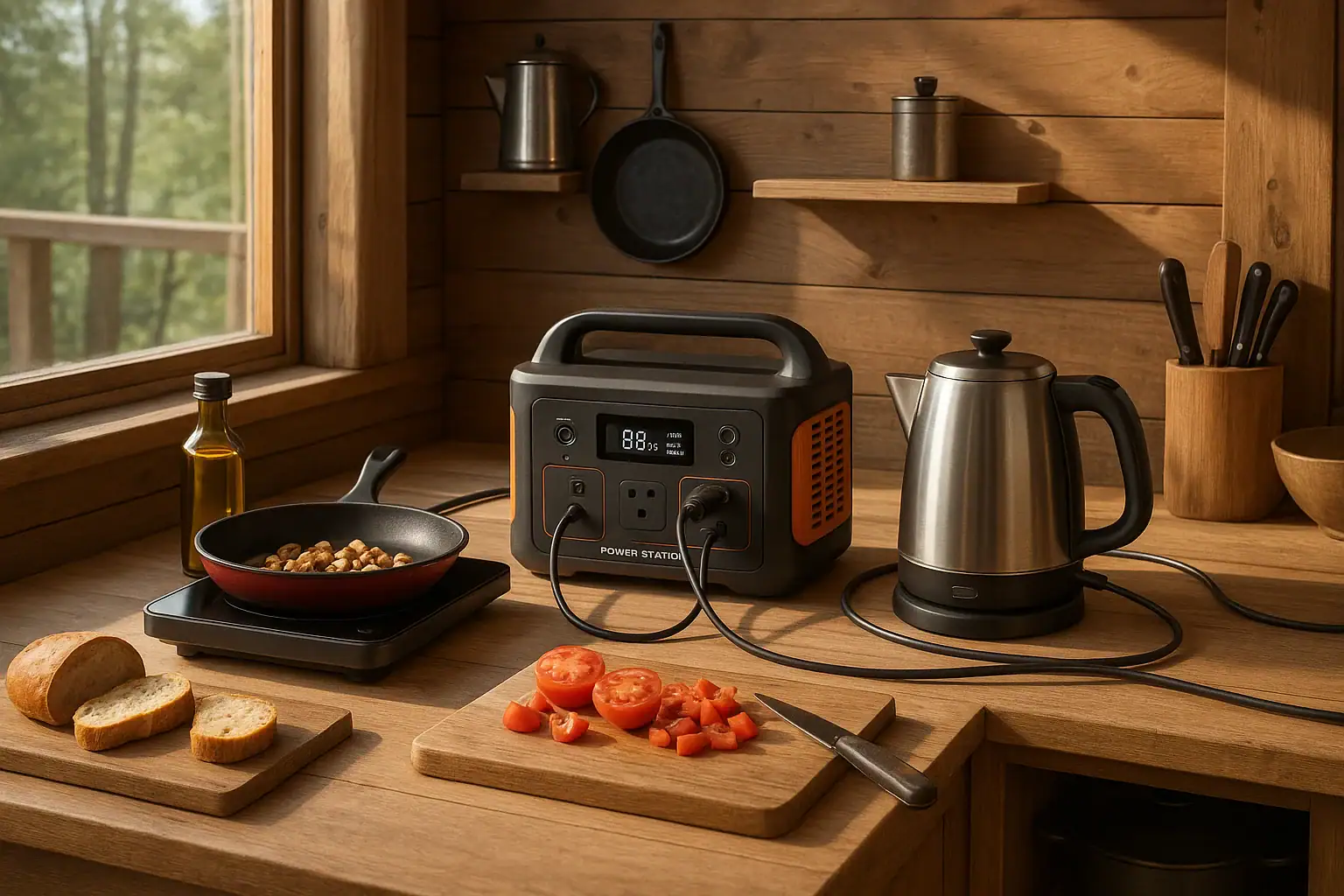
Off-grid cooking with electricity is practical for low and medium-power appliances, but full electric stoves and ovens usually demand more watts and watt-hours than a typical portable power setup can deliver. The key is matching your portable power station’s capacity, inverter watts, surge watts, and input limit to the real power draw and runtime you need for cooking.
People search terms like “can a power station run an induction cooktop,” “electric stove wattage,” “runtime calculator,” and “off-grid kitchen power” because they want clear limits, not guesses. Once you understand wattage, cooking time, and battery capacity, you can decide which devices are realistic and which will drain your system too fast.
This guide explains how electric cooking off-grid actually works, what’s efficient, what usually isn’t, and which specs matter when you’re planning a battery-based cooking setup in a van, cabin, RV, or emergency kit.
What Off-Grid Electric Cooking Really Means and Why It Matters
Off-grid electric cooking means preparing food using electricity from batteries, solar, or generators without relying on a wired utility grid. In practice, most people use a portable power station, solar panels, and sometimes a backup fuel generator. The portable power station’s inverter converts DC battery power to AC power for plug-in cooking appliances.
This matters because cooking is one of the highest energy uses in any household. A typical electric stove burner or oven can easily draw 1,000–2,000 watts or more, and that load might run for 20–60 minutes at a time. For a portable power station, that can drain a battery pack surprisingly fast.
Understanding what’s practical off-grid helps you:
- Choose cooking methods that match your battery capacity and inverter rating.
- Avoid tripping overload protection or shutting down your power station mid-meal.
- Size your solar and battery system realistically for daily meal prep.
- Decide when to use electric cooking versus propane, butane, or other fuels.
Instead of asking “Can I run X appliance?” it’s more useful to ask “How long can I run this appliance, and what trade-offs does it create for the rest of my power needs?”
Key Power Concepts for Off-Grid Electric Cooking
To know what’s realistic, you need a few core concepts: watts, watt-hours, inverter capacity, surge watts, and duty cycle. These terms directly affect whether your portable power station can handle a specific cooking device.
Watts and Watt-Hours
Watts (W) measure power at a specific moment. A 1,000 W induction burner uses 1,000 watts while it’s running at full power.
Watt-hours (Wh) measure energy over time. A 1,000 Wh battery can, in theory, power a 1,000 W device for about one hour (ignoring losses). In real life, inverter and conversion losses usually reduce usable energy by 10–20%.
Basic estimate:
Runtime (hours) ≈ Battery capacity (Wh) ÷ Appliance draw (W)
Example: 1,200 Wh battery ÷ 800 W cooker ≈ 1.5 hours of continuous full-power use.
Inverter Continuous and Surge Watts
The inverter rating on a portable power station sets the upper limit for what you can plug in.
- Continuous watts: The maximum power the inverter can supply steadily, such as 1,000 W or 2,000 W.
- Surge watts: A short burst the inverter can handle for startup spikes, often 1.5–2x the continuous rating.
Some cooking devices, especially those with motors or compressors (like some electric grills with fans), may need a brief surge to start. Purely resistive heaters (many hot plates, kettles) usually draw near their rated watts without a big surge.
Duty Cycle and Temperature Control
Many electric cooking appliances cycle on and off rather than running at full power continuously. This is the duty cycle. A 1,000 W cooktop might average 500–700 W over time if it cycles to maintain a set temperature.
That means actual energy use can be lower than a simple “max watts × total time” estimate, but you should always plan using the worst-case (max watt) draw to avoid overloading your inverter.
Input Limit and Recharging
The input limit is how fast your power station can recharge from solar, wall, or a vehicle. For cooking, this matters because you’re often drawing a lot of energy in a short time.
- If you cook for 30–60 minutes at high power, you’ll want enough solar or generator input to replace that energy before the next meal.
- A low input limit means you can cook electrically, but you may not be able to sustain that routine every day without running out of stored energy.
AC vs. DC Cooking Loads
Some cooking-related loads (like 12 V fridges or low-watt kettles) can run directly from DC, which is more efficient than converting to AC. However, most high-wattage cooking tools are AC-only and must use the inverter, which adds conversion losses and stresses the system more.
| Cooking device | Typical power draw (W) | Notes |
|---|---|---|
| Small induction burner (single zone) | 800–1,500 | Highly efficient, needs compatible cookware |
| Electric hot plate | 800–1,500 | Simple resistive load, slow to heat and cool |
| Electric kettle | 800–1,500 | Short runtime, very practical for boiling water |
| Compact toaster oven | 1,000–1,500 | Heats air and metal, moderate efficiency |
| Full-size electric oven | 2,000–3,500 | Generally impractical for small power stations |
Practical Examples: What Electric Cooking Works Off-Grid and What Doesn’t
Once you understand watts and watt-hours, you can evaluate specific cooking methods. Some are well-suited to portable power stations; others are only realistic with large, permanent battery banks or generator support.
What’s Typically Practical
- Electric kettles: Boiling water is one of the most practical electric cooking tasks. A 1,000 W kettle might run for 3–6 minutes to boil water for coffee, tea, or instant meals. Even a modest battery can handle a few boils per day.
- Small single-burner induction cooktops: At 600–1,200 W, these are efficient because they transfer heat directly to the pot. Short cooking tasks like stir-fries, eggs, or pasta are feasible, especially if you keep power below max and limit total cook time.
- Low-watt rice cookers: Many compact rice cookers use 300–700 W and run for 20–40 minutes. They’re energy-efficient for grains and one-pot meals, making them a favorite for battery-based setups.
- Slow cookers at low settings: Some slow cookers draw 150–250 W on low. They run for many hours, so total energy use can still be high, but the low power draw is gentle on the inverter. This works best with a large battery and steady solar input.
- Small air fryers or toaster ovens (short sessions): Quick 10–20 minute runs at 800–1,200 W can be viable if you plan your energy budget and don’t run them back-to-back.
What’s Usually Impractical for Portable Power Stations
- Full-size electric ranges and ovens: These often require 2,000–3,500 W or more and may need 240 V circuits. A typical portable power station cannot safely or efficiently run them for more than a very short time, if at all.
- Multiple high-watt burners at once: Running two or three 1,000+ W burners simultaneously can overload the inverter or drain the battery extremely fast. Off-grid setups usually rely on one high-watt appliance at a time.
- Long baking sessions: Baking at 1,000–1,500 W for an hour or more can consume most of a mid-size battery’s capacity in one go. This is better suited to large, fixed systems or generator support.
Balancing Cooking With Other Loads
In off-grid life, cooking is only one part of your energy use. You may also be powering refrigeration, lighting, laptops, fans, or pumps. A realistic plan considers:
- How many watt-hours per day you can harvest (solar, generator, vehicle charging).
- How many watt-hours your non-cooking loads require.
- How much “room” is left for cooking without draining your battery too deeply.
Many people end up using a hybrid approach: electric for quick, high-efficiency tasks (like boiling water or quick frying) and gas or other fuels for long, high-heat cooking.
Common Mistakes and Troubleshooting When Cooking Off-Grid With Electricity
Even with a capable portable power station, it’s easy to run into overloads, short runtimes, or inconsistent performance. Most problems trace back to a few predictable mistakes.
Underestimating Total Energy Use
A frequent issue is focusing only on watts and ignoring time. For example, a 1,000 W hot plate might seem manageable, but if you run it for 45 minutes twice a day, that’s 1,500 Wh per day just for that one burner—more than many portable stations can reliably supply and recharge daily.
Troubleshooting cue: If your battery empties faster than expected, track how long each cooking device runs, then multiply by its watt rating to estimate daily watt-hours.
Overloading the Inverter
Plugging in a 1,500 W hot plate and a 1,200 W air fryer at the same time into a 1,500 W inverter is a recipe for overload. The power station may shut down or throw an error.
Troubleshooting cue: If your power station turns off when you start cooking, check the combined watt draw on its display. Keep total load under about 80–90% of the inverter’s continuous rating to avoid nuisance trips.
Ignoring Startup Surges
Some appliances briefly pull more power at startup than their label suggests. While many cooking appliances are resistive and don’t surge much, those with motors, fans, or compressors can.
Troubleshooting cue: If an appliance never starts and the station flashes overload immediately, the startup surge may exceed the surge watt rating, even if the running watts are within limits.
Running the Battery Too Low
Regularly draining a battery to near 0% to finish cooking can shorten its lifespan and leave you without power for essentials.
Troubleshooting cue: If your state of charge is often below 10–20% after meals, re-evaluate your cooking methods, reduce power settings, or increase your storage and charging capacity.
Not Accounting for Inverter Losses
Inverter and conversion losses mean you never get the full rated watt-hours out of a battery when using AC cooking appliances. Planning as if you have 10–20% less than the label capacity gives more realistic expectations.
Troubleshooting cue: If your calculated runtime is consistently longer than real-world results, add a 15–20% buffer in your math to account for losses and inefficiencies.
Safety Basics for Electric Cooking Off-Grid
Cooking with electricity off-grid may feel safer than open flames, but it still involves high currents, hot surfaces, and confined spaces. A few high-level safety practices can reduce risk.
Electrical Safety and Load Management
- Stay within ratings: Never exceed your portable power station’s continuous or surge watt ratings. Repeated overloads can stress components and cause shutdowns.
- Use appropriate cords: Avoid thin, damaged, or coiled extension cords that can overheat under high loads. Use short, heavy-gauge cords rated for more than the maximum current you expect.
- Avoid daisy-chaining: Plug high-watt appliances directly into the power station’s AC outlets instead of stacking power strips or adapters.
Heat, Ventilation, and Fire Risk
- Stable surfaces: Place hot plates, induction cookers, and toaster ovens on stable, heat-resistant surfaces away from flammable materials like curtains, paper towels, and bedding.
- Ventilation: Even without combustion, cooking generates steam, oil vapor, and heat. In vans, RVs, and cabins, use windows, fans, or vents to reduce condensation and overheating.
- Supervision: Avoid leaving electric cooking devices unattended, especially in small spaces or near combustible materials.
Moisture and Device Protection
- Keep electronics dry: Position the power station away from sinks, splashes, and steam. Moisture can damage outlets and electronics.
- Allow cooling: Inverters and batteries generate heat under load. Ensure vents are unobstructed and give the unit time to cool after heavy cooking sessions.
When to Consult a Professional
If you are integrating a large battery bank, inverter, or generator into a cabin or RV electrical system, consult a licensed electrician or qualified RV technician. They can ensure wiring, breakers, and grounding are appropriate for high cooking loads without creating shock or fire hazards.
| Safety area | Key concern | High-level best practice |
|---|---|---|
| Electrical load | Overloading inverter or cords | Keep total watts below 80–90% of ratings |
| Heat | Burns and fire risk | Use stable, heat-resistant surfaces and keep clearances |
| Ventilation | Overheating and moisture | Ventilate small spaces during and after cooking |
| Placement | Water and steam exposure | Keep power station away from sinks and splashes |
Related guides: Portable Power Station Buying Guide • Powering a Coffee Maker, Kettle, or Induction Cooktop: What Works and Why • How to Estimate Runtime for Any Device: A Simple Wh Formula + 5 Worked Examples
Practical Takeaways and Key Specs to Look For in an Off-Grid Cooking Setup
Off-grid electric cooking is most successful when you design your meals around your energy system, not the other way around. Focus on short, efficient tasks—boiling water, quick pan cooking, compact toaster or air fryer sessions—and avoid long, high-power baking or multiple burners at once unless you have a large, well-designed battery and charging system.
Think in terms of daily energy budget: how many watt-hours you can store and replenish, and how much you are willing to allocate to cooking versus refrigeration, lighting, and electronics. Many people find a hybrid approach works best: electric for convenience and precision, and non-electric fuels for long or high-heat cooking.
Specs to look for
- Battery capacity (Wh) – Aim for enough capacity to cover your highest-demand meal plus other loads, often 800–2,000 Wh for light to moderate cooking. More capacity gives longer runtimes and flexibility.
- Inverter continuous watts – Choose an inverter that comfortably exceeds your highest single cooking load, typically 1.3–1.5x your biggest appliance wattage. This prevents overloads when devices cycle or spike.
- Surge watt rating – Look for surge capacity at least 1.5–2x the continuous rating if you plan to run appliances with motors or fans. This helps ensure reliable startup without tripping protection.
- AC output efficiency – Systems with efficient inverters waste less energy as heat. Higher efficiency (often 85–90%+ under typical loads) translates into longer actual runtimes for the same battery size.
- Solar and AC input limit (W) – Higher input limits (for example, 300–800 W or more) let you recharge quickly between meals, especially important if you cook daily or multiple times per day.
- Number and type of AC outlets – Multiple grounded outlets make it easier to plug in different cooking tools without unsafe adapters. Ensure each outlet can handle the current of your typical appliances.
- Display and monitoring – A clear display showing real-time watts, state of charge, and estimated runtime helps you avoid overloads and manage your cooking sessions more precisely.
- Thermal management and fan noise – Good cooling design helps the inverter handle sustained cooking loads without derating or shutting down. Quiet, effective fans are important in small living spaces.
- Cycle life and depth-of-discharge tolerance – A battery chemistry and design that tolerates frequent deep discharges (within the manufacturer’s guidelines) is valuable if you regularly use a large share of capacity for cooking.
By matching these specs to your actual cooking habits—how often you cook, what you cook, and where your energy comes from—you can build an off-grid electric kitchen that is both practical and sustainable over the long term.
Frequently asked questions
Which specs and features matter most when choosing a power station for off grid electric cooking?
Focus on battery capacity (Wh) for runtime, inverter continuous and surge watt ratings for what you can run, and the solar/AC input limit for how quickly you can recharge. Also consider inverter efficiency, outlet types, and thermal management to ensure reliable performance under cooking loads.
Can a portable power station run an induction cooktop, and how long will it last?
Many single-zone induction cooktops draw 600–1,500 W and can run from a capable power station if the inverter supports the continuous and surge watts. Runtime depends on battery Wh and duty cycle; estimate runtime by dividing battery Wh by the cooktop draw and include a 10–20% buffer for conversion losses.
What common mistake causes short runtimes or shutdowns when cooking off-grid?
People often underestimate total energy use by ignoring cook time and inverter losses, or they try to run multiple high-watt appliances at once. Check combined watt draw, account for runtime, and avoid exceeding roughly 80–90% of the inverter’s continuous rating to prevent unexpected shutdowns.
How can I safely manage heat and electrical load when cooking in a van or RV?
Keep appliances on stable, heat-resistant surfaces, provide ventilation to remove steam and heat, and keep the power station away from splashes. Stay within inverter and cord ratings, supervise cooking, and consult a professional for fixed wiring or high-load installations.
Is a hybrid approach (electric plus gas) a practical way to cook off-grid?
Yes; a hybrid approach uses electric for short, efficient tasks like boiling water or quick frying and gas or other fuels for long, high-heat cooking. This balances convenience and energy limitations while reducing daily battery demand.
How do I estimate how long a specific cooking appliance will run on my battery?
Divide your usable battery capacity in Wh by the appliance’s watt draw to get a basic runtime estimate, then subtract 10–20% for inverter/conversion losses. Track real-world duty cycles (appliance on/off behavior) to refine the estimate for typical cooking tasks.
Recommended next:
- Portable Power Stations for Apartments
- Portable Power Stations for RV and Motorhomes
- Can a Portable Power Station Run a Microwave? What to Check Before You Try
- Can a Portable Power Station Run a Space Heater? Realistic Limits
- Can a Portable Power Station Run an Air Conditioner? Sizing and Expectations
- Powering a Coffee Maker, Kettle, or Induction Cooktop: What Works and Why
- More in Home / Appliances →
Related guides
Browse this topic →
- Beginner-friendly sizing, runtime & specs
- Solar & charging (MPPT, fast charging, cables)
- Batteries (LiFePO4, cycles, care & storage)
- Safety, cold-weather performance, real-world tips
More in Beginners
See all →- Camping Power Planning: A Simple Energy Budget for a Weekend
- Remote Work Power Kit: Keeping Laptop, Monitor, and Internet Running
- Portable Power Stations for Photography and Drone Charging: A Field Guide
- Portable Power Stations for CPAP and Medical Devices: What to Look For
- What’s in the Box? Essential Cables and Adapters You May Need
Keep reading
About this site
Portable Energy Lab publishes practical, independent guides about portable power—clear sizing, safe use, and real-world expectations.
Affiliate disclosure
Some links on this site may be affiliate links. If you buy through these links, we may earn a small commission at no extra cost to you. This helps support our content. Learn more.