
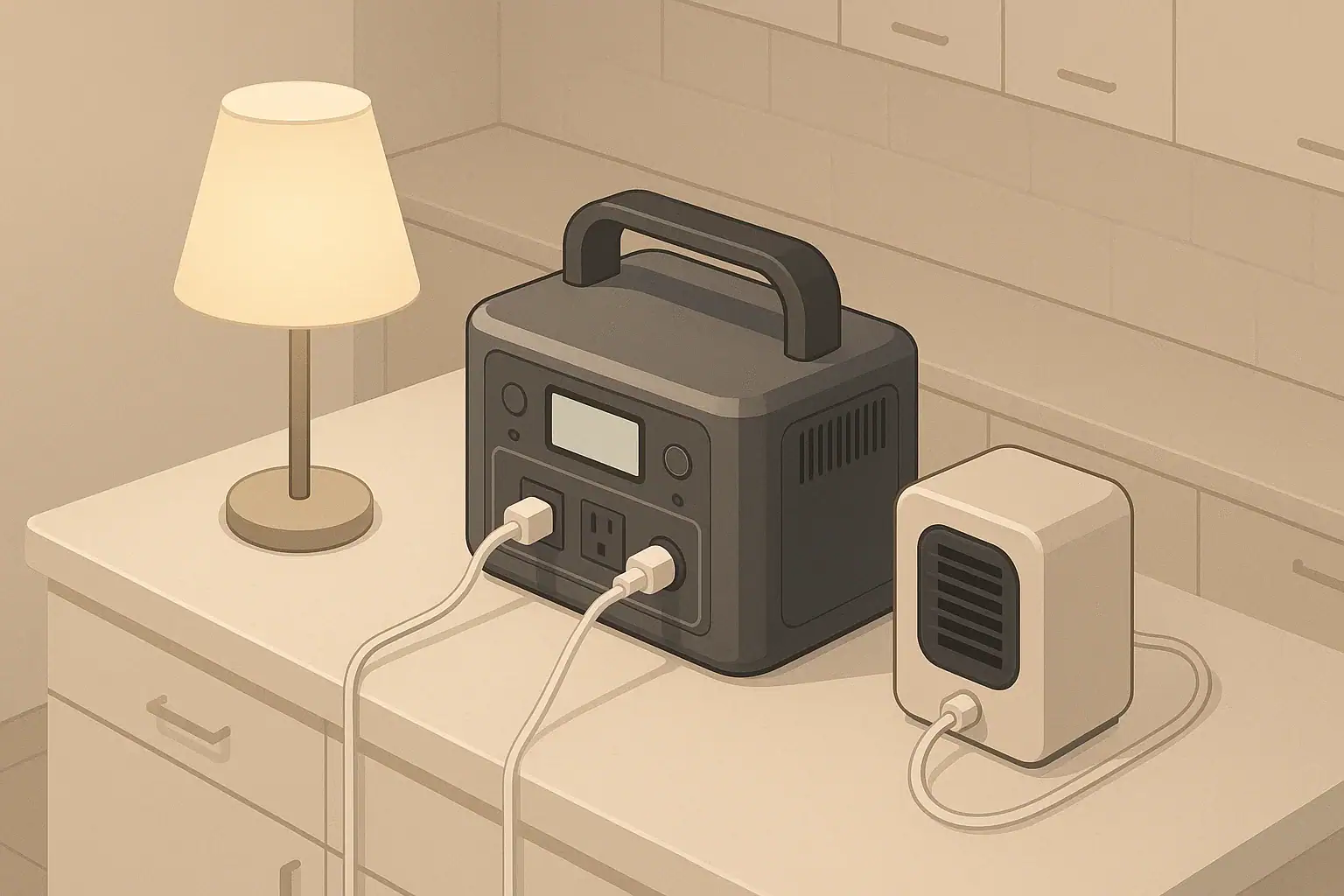
A portable power station can run emergency lighting efficiently when you pair it with low-wattage LED lights and size the battery for the number of hours you need. For most homes, this means using the station to power a few priority lights, not every fixture in the house.
This setup is quiet, indoor-friendly, and practical for blackouts, storm outages, apartment power failures, and temporary backup lighting. Instead of relying on candles, disposable batteries, or a fuel generator, you use stored battery energy to run LED lamps, USB lights, lanterns, or small light strips.
The key is simple planning: know how many watts your lights use, estimate usable watt-hours from the power station, and decide which rooms actually need illumination. A modest battery can provide many hours of emergency light if the load is efficient and the setup is tested before an outage.
What portable power station emergency lighting means
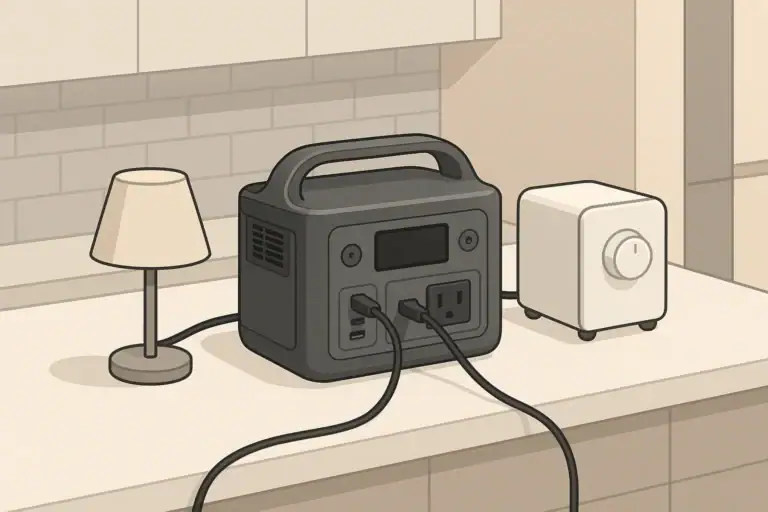
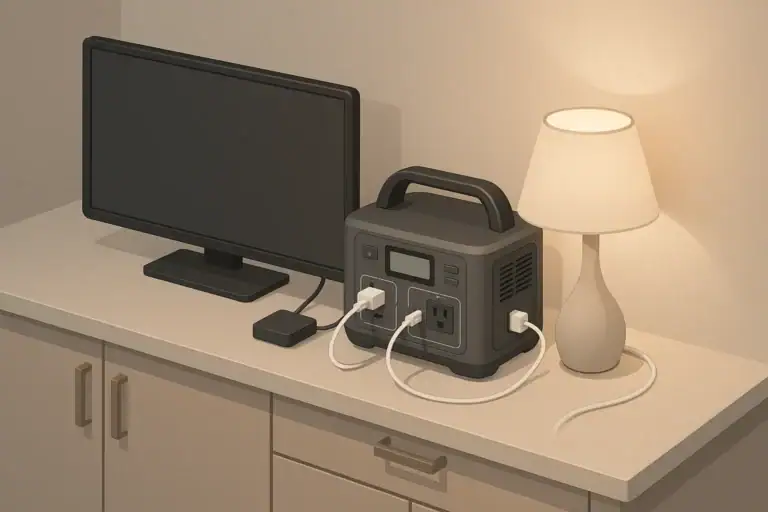
Portable power station emergency lighting means using a rechargeable battery unit as the power source for lights when grid power is unavailable. The lights may plug into 120-volt AC outlets, USB ports, USB-C ports, or DC outputs, depending on the type of light and the outputs available on the power station.
The main advantage is control. A portable power station lets you choose where power goes, how bright the lighting should be, and how long the stored energy needs to last. In a short outage, you may only need a lamp in the living room and a small light in the bathroom. In a longer outage, you may rotate lights between rooms and use low-power pathway lighting overnight.
Emergency lighting matters because darkness creates avoidable risk. People trip over furniture, misread medication labels, struggle with breakers or flashlights, and drain phone batteries using them as lights. A planned lighting setup keeps walkways visible and leaves phones available for communication.
Portable power stations are especially well matched to LED lighting because LEDs consume very little power compared with older incandescent bulbs. One 8-watt LED bulb can provide useful room light, while a small USB lamp may use only 2 to 5 watts. That low draw is why even a compact power station can be useful for lighting when it might be too small for heating, cooking, or large appliances.
How to size and run efficient emergency lights
The basic sizing formula is straightforward: usable watt-hours divided by total lighting watts equals estimated runtime in hours. Watts measure how fast your lights use energy. Watt-hours measure how much stored energy the battery has available.
For a conservative estimate, do not assume every rated watt-hour is available at the outlet. AC lighting requires the power station to convert battery DC power into household AC power, and that conversion uses energy. For AC loads, planning around 70 to 85 percent of rated capacity is reasonable. DC and USB lights may be more efficient because they avoid the inverter, though ports and adapters still have some losses.
For example, a 300 Wh power station running three 8 W LED bulbs has a 24 W lighting load. If you assume 75 percent usable capacity, you have about 225 Wh available. Divide 225 Wh by 24 W, and the estimate is about 9.4 hours if all three bulbs stay on continuously. If you only run one or two bulbs at a time, the same battery can last much longer.
Continuous watt rating is usually not a problem for LED lighting because the load is small. Surge rating is more important for motors and compressors, not simple lights. Still, it is important to add up everything plugged in at the same time, including phone chargers, radios, routers, or small fans, because those loads reduce the energy left for lighting.
| Lighting setup | Total load | 300 Wh station at 75 percent usable | 600 Wh station at 75 percent usable | Best use case |
|---|---|---|---|---|
| One USB task light | 3 W | About 75 hours | About 150 hours | Reading, sink, bedside, desk |
| One LED bulb or lantern | 8 W | About 28 hours | About 56 hours | Single room or tent-style area light |
| Two LED bulbs | 16 W | About 14 hours | About 28 hours | Main room plus hallway |
| Three LED bulbs | 24 W | About 9 hours | About 18 hours | Living area, bathroom, kitchen task light |
| Four brighter lamps | 40 W | About 5.5 hours | About 11 hours | Several active rooms for one evening |
| Minimal night pathway lights | 5 W | About 45 hours | About 90 hours | Overnight safety lighting |
These numbers are planning estimates, not guarantees. Runtime changes with battery age, temperature, inverter efficiency, display settings, and whether the power station has an idle draw while outputs are enabled.
Real-world emergency lighting setups
A practical emergency lighting plan starts with zones. Choose one gathering room, one bathroom route, one kitchen or food-prep area, and any stairs or hallway that must remain visible. The goal is not to recreate normal lighting. The goal is to make movement and basic tasks safe.
In a small apartment, a good setup might be one 8 W LED lamp in the living area, one 3 W USB light near the kitchen counter, and a 1 to 2 W nightlight or LED strip for the bathroom route. If all of those run together, the load may be only 12 to 13 W. On a 300 Wh station with a conservative usable estimate, that can cover a long evening and still leave reserve capacity.
In a larger home, a realistic plan might use a portable LED lantern in a central room, a low-wattage lamp in the kitchen, and a small light positioned near the stairs. If the total draw is 25 to 35 W, a 500 to 700 Wh station can often cover one night of active lighting when used carefully. Turning off rooms that are not occupied makes a bigger difference than buying brighter lights.
For families, it helps to assign lights by purpose. One area light stays with the group. One small lamp is used for bathroom trips. One task light is for cooking, checking equipment, or reading instructions. This avoids the common problem of scattering every light across the house and then letting them run unattended.
For overnight use, dim lights are often more useful than bright lights. A 2 W to 5 W pathway light can prevent falls without wasting energy or disrupting sleep. Bright lamps should be reserved for active tasks such as preparing food, managing medical equipment that is safe to run from the selected station, or inspecting a breaker area.
Common mistakes and troubleshooting cues
The most common mistake is using too much light. During an outage, people often plug in regular lamps with unnecessarily bright bulbs and leave them on for hours. Replacing one 60 W incandescent bulb with an 8 W LED can cut lighting energy use by more than 85 percent while still providing useful illumination.
Another mistake is relying on the power station display without doing a real test. Percentage displays can be helpful, but they are not precise runtime meters. Test your actual lights for one or two hours and note the percentage drop. That gives a better sense of how your setup behaves.
If a power station turns off while running a tiny light, the load may be too low for the output mode. Some units shut down AC or DC outputs when they detect very little draw. A small USB light may work better than an AC nightlight, or you may need to use a different output setting if the station provides one.
| Problem | Likely cause | What to check | Practical fix |
|---|---|---|---|
| Battery drains faster than expected | Inverter losses or extra devices plugged in | Total watts on display and all active ports | Use fewer AC loads, switch to USB lights, unplug idle chargers |
| Station shuts off with one small light | Minimum load or auto-sleep behavior | Output mode and manual settings | Use a compatible USB or DC light, or add a small necessary load |
| Light flickers or adapter buzzes | Incompatible dimmer, weak adapter, or poor cable | Dimmer type, cable condition, adapter rating | Try a non-dimming LED, replace the cable, avoid overloaded adapters |
| Extension cord feels warm | Undersized cord, coiled cord, or damaged insulation | Cord rating, length, and placement | Use a properly rated cord, uncoil it, and replace damaged cords |
| Charging slows during outage use | Heat, limited input source, or battery management limits | Input watts, output watts, unit temperature | Reduce load, improve ventilation, allow cool-down time |
| Lights are too bright overnight | Using task lights as pathway lights | Brightness level and placement | Use lower-lumen lights, dim modes, or indirect placement |
Also watch for hidden loads. A router, speaker, rechargeable flashlight dock, or power strip with indicators may not draw much individually, but several small loads can reduce runtime. During a long outage, every watt matters.
Safety basics for indoor emergency lighting
Portable power stations are generally suitable for indoor battery backup because they do not burn fuel while operating. Even so, they are still electrical devices with lithium-based or other rechargeable battery chemistry, so they should be used with care.
Place the power station on a stable, dry, hard surface with ventilation openings clear. Do not cover it with blankets, place it on bedding, or push it into a tight cabinet while it is powering lights. If the unit feels unusually hot, smells abnormal, makes unexpected noises, or shows an error warning, disconnect nonessential loads and follow the manufacturer instructions.
Keep cords out of walkways whenever possible. Emergency lighting should reduce fall risk, not add tripping hazards. Route cords along walls, use only cords in good condition, and avoid pinching them in doors or running them under rugs. A cord hidden under a rug can overheat or become damaged without being noticed.
Moisture is a major safety concern. Keep the power station, plugs, adapters, and extension cord connections away from sinks, tubs, wet basement floors, rain, and snow. For bathrooms or kitchens, it is usually safer to place the power station in a dry adjacent area and run an appropriate light into the space rather than placing the battery unit near water.
Do not connect a portable power station directly to home wiring unless the system is specifically designed and installed for that purpose by a qualified professional. For emergency lighting, the safer simple approach is to plug individual lights directly into the station or into a properly rated extension cord or power strip used within its limits.
Maintenance, storage, and outage readiness
A portable power station is only useful for emergency lighting if it is charged and easy to find. Store it in a cool, dry indoor location, not in a hot attic, damp garage corner, or vehicle exposed to seasonal extremes. Heat can accelerate battery aging, and deep discharge during long storage can reduce reliability.
Check the state of charge every few months. Many owners prefer keeping an emergency unit at a moderate to high state of charge so it is ready for outages, while still following the storage guidance for the specific battery. If the unit has a storage mode or recommended charge range, use it.
Keep the lighting kit together. Store the power station, charging cable, USB lights, compact LED lamps, extension cord, and any adapters in one reachable place. During a blackout, searching through drawers for the correct cable wastes time and phone battery.
Test the setup at least twice a year. Plug in the exact lights you plan to use, run them for a short period, and confirm that the power station stays on. Make sure everyone in the household knows which lights are priority lights and which should be left off to conserve energy.
If you plan to recharge during an extended outage, practice the charging method before you need it. Wall charging is simple when grid power returns. Vehicle charging may be slow and should be done with attention to the vehicle battery and ventilation. Solar charging depends heavily on panel size, sunlight, weather, and placement, so do not assume a small panel will fully recharge a large battery in one short winter day.
Practical takeaways and specs to look for
The best emergency lighting setup is simple, efficient, and realistic. Use LED lights, keep the total wattage low, and direct light where people actually move or work. A few well-placed low-power lights can be more useful than one very bright lamp in the wrong room.
Before an outage, write down your basic lighting plan: central room, bathroom path, kitchen task area, and stair or hallway safety light. Add the wattage of each light and compare it with the usable capacity of the power station. If the numbers look too tight, reduce brightness, choose USB lighting, or plan to rotate lights instead of running everything continuously.
Do not size a power station for lighting alone if you also expect it to charge phones, run internet equipment, operate a fan, or support medical-related devices. Those loads should be added separately, and essential medical needs should follow professional and manufacturer guidance rather than rough emergency-lighting estimates.
Specs to look for checklist
- Battery capacity in watt-hours: Choose enough capacity for your lighting hours after allowing for efficiency losses.
- Low idle consumption: A station with less wasted standby power can be better for small lighting loads.
- Multiple output types: AC, USB-A, USB-C, and DC outputs give more options for efficient lights.
- Clear display: Input watts, output watts, and battery percentage help you manage runtime during an outage.
- Useful low-load behavior: Check whether the unit can keep USB or DC outputs active for small lights without shutting off unexpectedly.
- Appropriate continuous watt rating: Lighting rarely needs much wattage, but extra margin helps if you also charge devices.
- Practical recharge options: Wall, vehicle, and solar input compatibility can matter during longer interruptions.
- Safe physical design: Look for stable placement, protected ports, ventilation clearance, and clear operating instructions.
- Manageable weight: A unit used for lighting should be easy to move to the safest central location.
- Included or compatible cables: Make sure you have the charging and output cables your lighting plan requires.
For most households, portable power station emergency lighting works best as a focused backup system: one central area light, one task light, and one or two low-power pathway lights. With efficient LEDs, realistic runtime estimates, safe cord placement, and regular storage checks, a power station can keep essential spaces visible through many common outages.
Frequently asked questions
How long can a portable power station run emergency lights?
Runtime depends on the battery’s watt-hour capacity, the total wattage of the lights, and whether you use AC or DC outputs. Small LED lights can run for many hours because they use very little power. A realistic estimate should also account for inverter losses and any other devices drawing power at the same time.
What specs matter most for portable power station emergency lighting?
Battery capacity in watt-hours, low idle power use, and efficient output options matter most. USB and DC ports are often better for small lights because they avoid some inverter losses. A clear display and enough continuous output headroom also help you manage multiple lights during an outage.
What is the biggest mistake people make with emergency lighting?
The most common mistake is using lights that are much brighter than needed and leaving them on continuously. That can drain the battery quickly without improving safety. A better approach is to use low-wattage LED lights and keep them focused on walkways and task areas.
Is it safe to use a portable power station indoors for lights?
Yes, portable power stations are generally suitable for indoor use because they do not produce exhaust while operating. Even so, they should be placed on a stable, dry surface with good ventilation and kept away from water. Cords should be routed carefully to avoid tripping hazards and damage.
Can I power regular lamps with a portable power station?
Yes, if the lamp and bulb are compatible with the station’s output and the total wattage stays within limits. However, regular lamps with inefficient bulbs will drain the battery much faster than LED alternatives. For emergency use, low-wattage LED bulbs or USB lights are usually the better choice.
Why does my power station shut off when I use a very small light?
Some power stations have a minimum-load or auto-sleep feature that can turn outputs off when the draw is too low. This is more common with tiny lights or very efficient loads. Switching to a different output type, such as USB or DC, may solve the problem.
Related guides
Browse this topic →
- Beginner-friendly sizing, runtime & specs
- Solar & charging (MPPT, fast charging, cables)
- Batteries (LiFePO4, cycles, care & storage)
- Safety, cold-weather performance, real-world tips
More in Home / Appliances
See all →Keep reading
About this site
Portable Energy Lab publishes practical, independent guides about portable power—clear sizing, safe use, and real-world expectations.
Affiliate disclosure
Some links on this site may be affiliate links. If you buy through these links, we may earn a small commission at no extra cost to you. This helps support our content. Read our affiliate disclosure.