
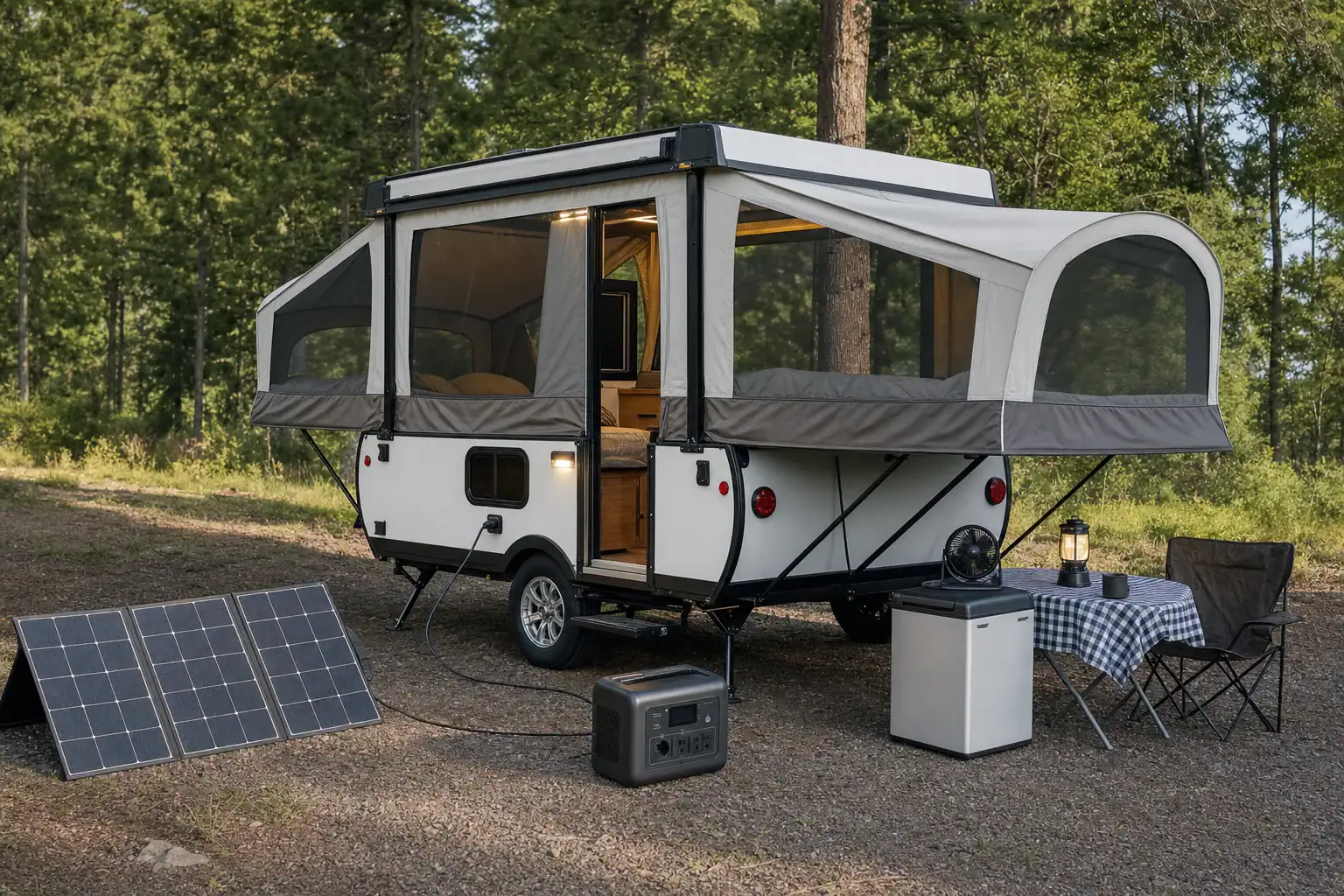
A portable power station for a pop-up camper should usually provide enough battery capacity for overnight lights, fans, device charging, and refrigerator operation while leaving a reserve for unexpected demand. The correct size depends on watt-hours, running watts, surge watts, appliance duty cycle, and the number of hours between charging opportunities.
For many campers, a mid-capacity unit can handle basic 12-volt loads, but refrigerators and furnace blowers can raise daily energy use substantially. A reliable plan starts by measuring each load rather than sizing from appliance labels alone. It also accounts for inverter loss, cold weather, battery reserve, and solar input limit.
Recharge planning is equally important. Solar panels may cover daytime consumption in good weather, while vehicle or shore-power charging can restore energy faster and more predictably. The goal is not simply to buy the largest battery available, but to balance runtime, output capability, recharge speed, weight, and camping habits.
1. What a Pop-Up Camper Power Station Needs to Do
A portable power station combines a rechargeable battery, charge controller, DC outputs, USB ports, and usually an AC inverter. In a pop-up camper, it can serve as a self-contained source for small appliances without running a generator or permanently changing the camper’s electrical system.
Capacity is stated in watt-hours, or Wh. A 1,000 Wh battery theoretically stores enough energy to supply 100 watts for 10 hours. Actual usable energy is lower because the inverter, wiring, electronics, temperature, and battery management system consume or limit some of that energy. Planning around roughly 80% to 90% of rated capacity is often more realistic, especially when AC outlets are used.
Output is stated in watts. Continuous output indicates what the station can sustain, while surge output describes its brief ability to start motors and compressors. Capacity determines approximate runtime; output determines whether a device can start and operate at all. A station can have ample energy capacity yet still be unable to start a refrigerator with a high compressor surge.
This distinction matters because camper loads vary. LED lights draw little power, roof or clip-on fans draw a moderate amount, and refrigerators range from efficient 12-volt compressor models to AC units with significant startup demand. Furnace blowers, heated blankets, coffee makers, and cooking appliances can change the calculation quickly.
2. Calculate Lights, Fans, Fridge, and Daily Energy Use
Estimate daily consumption by multiplying each device’s watts by its hours of operation. For cycling appliances, multiply by the approximate percentage of time they actually run. Add the results to obtain watt-hours per day.
For example, four 3-watt LED lights used for five hours consume 60 Wh. A 20-watt fan used for eight hours consumes 160 Wh. A 45-watt compressor fridge that runs 40% of the day consumes about 432 Wh: 45 watts multiplied by 24 hours and then by 0.40. Device charging might add another 50 to 100 Wh.
Fridge type requires special attention. An efficient 12-volt compressor refrigerator usually cycles on and off, with consumption affected by outdoor temperature, thermostat setting, ventilation, food temperature, and how often the door opens. An AC mini fridge also cycles but requires the inverter to remain active, adding conversion and idle losses.
A three-way absorption refrigerator behaves differently. Its 12-volt heating element may draw continuously and can consume far more battery energy than expected. The 12-volt mode is often associated with travel use when a suitable charging source is available, not long periods of stationary battery operation. Propane operation must follow the refrigerator and camper manufacturers’ ventilation and safety instructions.
After totaling daily consumption, add a reserve of about 15% to 30%. A camper estimated to use 800 Wh per day may therefore call for roughly 1,000 to 1,300 Wh of rated capacity for one day between dependable recharges. More reserve is useful in cold weather, under cloudy skies, or when the fridge is essential.
| Load | Assumed use | Daily energy |
|---|---|---|
| Four LED lights | 12 W for 5 hours | 60 Wh |
| Ventilation fan | 20 W for 8 hours | 160 Wh |
| 12 V compressor fridge | 45 W at 40% duty cycle | 432 Wh |
| Phones and small electronics | Mixed charging | 80 Wh |
| Conversion and reserve allowance | Approximately 20% | 146 Wh |
| Estimated total | One day | 878 Wh |
3. Real-World Pop-Up Camper Power Examples
Basic overnight setup
A simple setup with LED lights, two phone charges, and a small fan may consume 200 to 350 Wh overnight. A power station in the 500 to 700 Wh range can often cover this use with a reasonable reserve. If charging is available every day, extra capacity may not be necessary.
Lights, fan, and compressor fridge
A camper running LED lights, a ventilation fan, electronics, and a compact 12-volt compressor fridge may use 700 to 1,000 Wh per day. A station rated around 1,000 to 1,500 Wh provides a more practical buffer, although hot weather or frequent fridge access can push consumption higher.
Cool-weather camping with a furnace blower
A propane furnace still needs electricity for its blower and controls. A blower drawing 35 watts for six total hours consumes 210 Wh. Added to a 750 Wh base load, this brings the day close to 1,000 Wh before reserve and conversion losses. Longer winter nights and reduced battery performance can increase the required capacity.
Short high-wattage appliance use
A 1,000-watt coffee maker used for six minutes consumes about 100 Wh, which is manageable from an energy perspective. However, the inverter must support at least its operating wattage. Electric kettles, heaters, hair dryers, and cooking appliances can draw 1,200 to 1,800 watts or more, placing much greater demands on output and battery capacity. Heating with propane or another approved camper heat source is generally more energy-efficient than using a battery-powered resistance heater.
These examples are planning estimates, not guarantees. A plug-in energy meter can measure AC appliances, while a suitable DC power meter can help assess 12-volt loads. Measuring the refrigerator over a full day gives more useful information than observing its draw for only a few minutes.
4. Common Sizing Mistakes and Troubleshooting Cues
Confusing watts with watt-hours: Watts describe power at a moment in time; watt-hours describe energy used over time. A 60-watt fridge does not automatically require a 60 Wh battery. If it averages 30 watts across 24 hours, it uses about 720 Wh per day.
Ignoring compressor surge: If the fridge clicks, attempts to start, and then stops, the inverter may lack sufficient surge capability. An overloaded station may also display an error or shut off its AC output. Verify both continuous and surge ratings, and avoid adding other heavy loads during compressor startup.
Leaving the inverter on unnecessarily: An active AC inverter can consume energy even when the appliance is not running. Direct 12-volt operation may reduce conversion loss when the fridge and power station use compatible, manufacturer-approved connections.
Assuming rated capacity is fully usable: A battery marked 1,000 Wh will not normally deliver all 1,000 Wh at the outlet. Low temperatures, inverter losses, high discharge rates, and protective shutdown thresholds reduce delivered energy.
Expecting rated solar output all day: A 200-watt panel rarely produces 200 watts from sunrise to sunset. Shade, clouds, heat, panel angle, cable loss, and the station’s solar input limit affect collection. If the station accepts only 150 watts, adding more panel wattage may help in weak sun but will not make the input exceed that limit.
Overlooking refrigerator ventilation: Poor airflow around a compressor fridge increases runtime. A warm fridge loaded with room-temperature food also uses much more energy initially. Pre-cooling food and the refrigerator from a dependable power source can reduce the first day’s battery demand.
If runtime is unexpectedly short, check actual appliance energy use, ambient temperature, inverter idle draw, fridge duty cycle, and whether the station began fully charged. A sudden shutdown under a heavy load points more often to an output or surge issue than to insufficient total capacity.
5. Portable Power Station Safety Basics
Keep the power station dry, stable, and protected from direct rain, condensation, and standing water. Do not place it against bedding, tent fabric, or other materials that block cooling vents. Avoid sealed compartments where heat can accumulate.
Use cables and adapters approved for the station and the connected appliance. Damaged connectors, loose DC plugs, undersized extension cords, or coiled cords carrying high current can overheat. Stop using any component that becomes unusually hot, smells burned, sparks, swells, or shows physical damage.
Do not backfeed a camper receptacle or household circuit through a homemade cable. Connecting a station to a camper’s built-in electrical system may involve grounding, converter, polarity, and transfer considerations. Use an inlet or connection method specifically designed for the purpose, and consult a qualified electrician or RV technician when compatibility is uncertain.
A power station does not make combustion appliances safe indoors. Fuel-burning heaters, stoves, and generators create carbon monoxide and require their own approved placement, ventilation, and detection practices. A generator should remain outdoors at the distance and orientation specified by its manufacturer.
Follow the power station’s permitted charging temperature range. Many lithium batteries restrict charging below freezing even when discharge remains possible. Internal battery management may provide protection, but it should not replace appropriate storage and operating conditions.
6. Recharge Planning, Maintenance, and Storage
A sustainable recharge plan compares daily energy use with energy restored. If the camper consumes 800 Wh per day, the charging methods should reliably return about that amount, plus conversion losses. Solar alone may work in sunny, open campsites, but a second option is valuable during shade or poor weather.
Solar production can be estimated with peak-sun hours. A 200-watt array receiving four effective peak-sun hours has a theoretical yield of 800 Wh. After controller, temperature, cable, and orientation losses, perhaps 550 to 700 Wh may reach the battery. This may offset much of a modest daily load without guaranteeing a full recharge.
AC wall or campground shore-power charging is generally the fastest predictable method if the station supports high input. Vehicle charging through a standard 12-volt accessory outlet is typically slower. Higher-power alternator-based charging equipment must be designed for the vehicle, power station, wiring, and circuit protection; professional installation may be appropriate.
For routine care, keep vents clean, inspect cables, update settings only as directed by the manufacturer, and periodically verify that all outputs function. Avoid storing the station completely depleted. For long-term storage, use the state-of-charge range and inspection interval specified by its manufacturer, commonly a partial charge with periodic checks. Store it in a dry, moderate-temperature location away from direct sunlight and ignition sources.
Before a trip, fully test the planned load combination. Run the fridge, fan, lights, and chargers together long enough to observe peak output and hourly energy use. This trial reveals problems while shore power is still available.
| Recharge method | Typical input example | Approximate energy in 4 hours | Main limitation |
|---|---|---|---|
| Folding solar array | 100 to 200 W variable | 250 to 700 Wh | Weather, shade, and panel angle |
| Standard vehicle outlet | 80 to 120 W | 320 to 480 Wh | Slow charging and outlet limits |
| Higher-power vehicle charging | 300 to 600 W | 1,200 to 2,400 Wh | Requires compatible equipment and installation |
| AC wall or shore power | 500 to 1,200 W | 2,000 to 4,800 Wh | Requires access to an AC source |
Related guides: Camping Power Planning: A Simple Energy Budget for a Weekend • RV Basics: Using a Power Station for 12V Loads and “House Power” • Charging From a Car: What’s Safe, What’s Slow, and What Can Break • Portable Solar Panels vs Fixed Panels: Which Is Better for a Power Station?
7. Practical Takeaways and Specs to Look For
Start with a 24-hour energy budget for the actual camper equipment. Add at least 15% to 30% for losses and reserve, then multiply by the number of days expected between dependable recharges. Confirm that continuous and surge output can support every planned load combination.
For light-only camping, several hundred watt-hours may be sufficient. A setup that includes a compressor fridge commonly benefits from about 1,000 Wh or more, depending on climate and recharge access. Furnace use, long stays, medical equipment, or heavy AC appliances justify additional capacity and backup charging options.
Specs to look for
- Battery capacity: Look for roughly 500 to 700 Wh for basic overnight loads or 1,000 to 1,500 Wh for a fridge-based daily setup; capacity largely determines runtime.
- Continuous AC output: A range around 1,000 to 1,800 watts supports many small camper appliances; it must exceed the combined running load.
- Surge output: Look for a short-duration rating comfortably above refrigerator or motor startup demand, often 1.5 to 3 times running watts; this helps prevent startup shutdowns.
- 12-volt regulated output: Confirm compatible voltage, connector type, and current capacity, such as 10 to 15 amps where appropriate; direct DC operation can reduce inverter losses.
- Solar input range: Check maximum watts, voltage window, current limit, and connector compatibility; an input around 200 to 500 watts can make daytime recovery more practical.
- AC recharge rate: Inputs around 500 to 1,200 watts can restore a mid-size battery within a useful campground window; faster charging reduces downtime when outlets are available.
- Vehicle charging capability: Compare standard 12-volt charging with supported higher-power options; this matters when driving is the most dependable recharge opportunity.
- Battery cycle life: Look for a stated capacity-retention benchmark after roughly 2,000 or more cycles if the station will see frequent use; longer cycle life improves service longevity.
- Cold-temperature protection: Charging cutoff or battery warming features help protect cells in freezing conditions; this is important for early- and late-season camping.
- Weight and portability: Units around 25 to 45 pounds are easier for many campers to move than larger systems; capacity is only useful if the station can be transported and positioned safely.
The best choice is the one that covers measured daily consumption, starts the largest appliance, and can be recharged under realistic campsite conditions. A written power budget and a pre-trip test provide a more dependable result than relying on battery capacity alone.
Frequently asked questions
What size portable power station do I need for a pop-up camper?
For lights, phone charging, and a small fan, a 500 to 700 Wh unit may be enough for a typical overnight stay. A camper using a 12-volt compressor fridge often needs roughly 1,000 to 1,500 Wh for a day of use, depending on weather, appliance duty cycle, and recharge access. Build in a 15% to 30% energy reserve rather than planning to use the full rated capacity.
Can a portable power station run a refrigerator in a pop-up camper?
Yes, provided the station has enough usable watt-hours for the refrigerator’s daily consumption and enough continuous and surge output for startup. Efficient 12-volt compressor refrigerators are generally more battery-friendly than AC models because they avoid inverter losses. A three-way absorption refrigerator on 12-volt electric mode can use substantial power and may not be suitable for extended battery-only operation.
What portable power station specs matter most for camping?
Prioritize usable battery capacity in watt-hours, continuous AC output, motor-starting surge output, and compatible 12-volt DC ports. Also compare solar input limits, AC recharge speed, vehicle-charging options, cold-temperature charging protection, and unit weight. The best specifications depend on the actual loads and how reliably the station can be recharged between camping days.
What is the most common mistake when sizing a camper power station?
A common mistake is confusing watts with watt-hours or relying only on an appliance’s label. A refrigerator may draw a certain wattage while running but cycle on and off throughout the day, so its total daily energy use can be much higher or lower than a short observation suggests. Measuring loads over realistic use periods provides a more dependable estimate.
How long does solar take to recharge a portable power station at camp?
Recharge time depends on panel output, available sunlight, panel angle, temperature, shading, and the station’s maximum solar input. A 200-watt solar array can theoretically collect 800 Wh in four peak-sun hours, but real delivered energy is often lower because of system and weather losses. Solar is most reliable when paired with a backup option such as shore power or vehicle charging.
Is it safe to use a portable power station inside a pop-up camper?
It can be safe when the station is kept dry, stable, ventilated, and used with undamaged, correctly rated cables and approved adapters. Do not block cooling vents, use homemade backfeed cords, or connect it to built-in camper wiring unless the connection method is designed for that purpose. Keep fuel-burning appliances and generators separate from the power station and follow their carbon monoxide and ventilation requirements.
Related guides
Browse this topic →
- Beginner-friendly sizing, runtime & specs
- Solar & charging (MPPT, fast charging, cables)
- Batteries (LiFePO4, cycles, care & storage)
- Safety, cold-weather performance, real-world tips
More in Beginners
See all →- Charging an Electric Wheelchair or Mobility Scooter From a Portable Power Station
- Portable Power Station for a Gaming PC: Runtime, Load Spikes, and UPS Considerations
- Portable Power Station for a Shed or Outbuilding: Lights, Chargers, and Security
- Portable Power Station for a Boat: 12V Loads, Salt Air, and Safer Storage
- Portable Power Station for a Small Jobsite: Tool Battery Chargers and Work Lights
Keep reading
About this site
Portable Energy Lab publishes practical, independent guides about portable power—clear sizing, safe use, and real-world expectations.
Affiliate disclosure
Some links on this site may be affiliate links. If you buy through these links, we may earn a small commission at no extra cost to you. This helps support our content. Read our affiliate disclosure.