
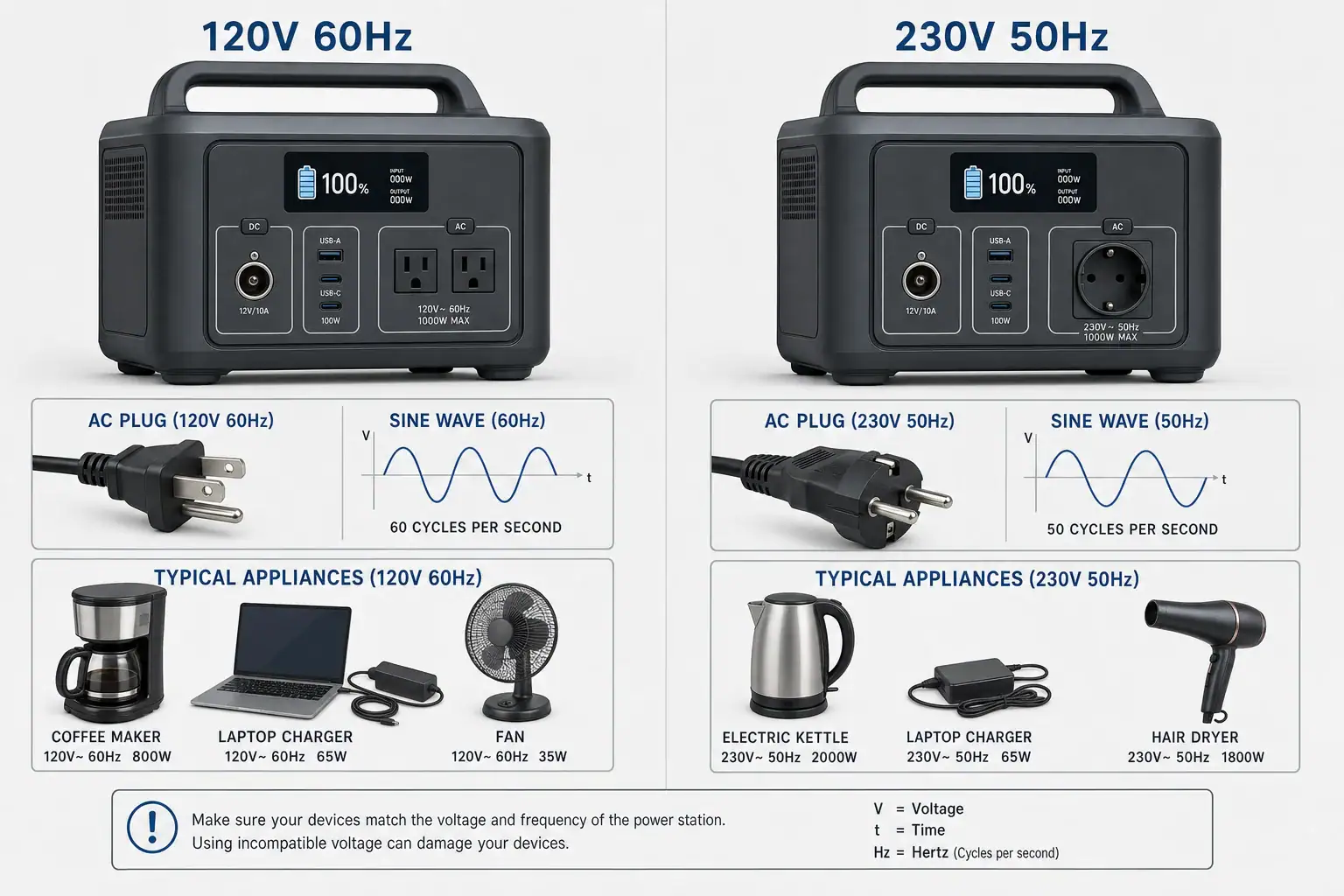
A 120V appliance generally needs a 120V portable power station, while a 230V appliance generally needs a 230V model unless the appliance label explicitly supports both voltage ranges. Plug shape alone does not establish compatibility, and a simple travel adapter does not convert voltage or frequency.
The main specifications to compare are AC output voltage, plug type, 50Hz vs 60Hz frequency, continuous watts, surge watts, and pure sine wave output. You should also check whether the device has a fixed-voltage input or a universal input such as 100–240V, 50/60Hz. These details determine whether an appliance will start, operate correctly, and remain within its intended electrical range.
Regional naming can be confusing. Labels such as 110V, 115V, and 120V usually describe the same general voltage class, while 220V, 230V, and 240V commonly describe another. However, those terms are not permission to ignore the actual equipment label. Always match the stated operating range and required frequency before connecting a load.
What 120V and 230V Mean and Why the Difference Matters
The voltage rating describes the nominal AC voltage produced by the power station’s inverter. A 120V unit is primarily intended for appliances from regions that use roughly 100–120V service, while a 230V unit serves equipment designed for approximately 220–240V. North American household receptacles commonly supply about 120V at 60Hz. Many countries in Europe, Africa, Asia, and Oceania commonly use about 230V at 50Hz, although regional exceptions exist.
Voltage matters because electrical equipment is designed around a specific input range. Supplying a fixed 120V device with 230V can cause immediate damage, overheating, or fire. Supplying a fixed 230V device with 120V may prevent it from starting, make a motor stall, or cause a heating appliance to produce much less heat. Protection circuits may shut down, but they should not be treated as a substitute for correct matching.
The power station’s battery capacity does not determine its AC voltage. Two stations can each store 1,000 watt-hours yet provide different outlet voltages, frequencies, power limits, and receptacles. Capacity mainly influences runtime; the inverter specifications determine whether the load is electrically compatible.
How Voltage, Plugs, Frequency, and Wattage Work Together
Four separate checks are necessary: voltage, frequency, plug configuration, and power demand. First, the appliance voltage range must include the station’s output. Second, its frequency rating must accept the selected 50Hz or 60Hz output. Third, the plug must physically and electrically match the receptacle. Fourth, running and starting demand must remain within the inverter’s limits.
Voltage ranges and universal inputs
Many laptop chargers, phone chargers, camera chargers, and other switch-mode power supplies are labeled 100–240V, 50/60Hz. Such a label generally means the charger can accept either voltage system without a voltage converter, provided the plug connection is suitable. An appliance labeled only 120V 60Hz or 230V 50Hz is not universal.
Plug shape is not voltage conversion
A passive plug adapter only changes the physical connection. It does not turn 230V into 120V, change 50Hz into 60Hz, increase wattage, or create a different grounding arrangement. Universal-style receptacles can accept multiple plug shapes, but their output still has one specified voltage.
Frequency and motor behavior
Frequency is the number of AC cycles per second. Resistive loads such as basic heaters are often less sensitive to frequency, but motors, pumps, compressors, clocks, turntables, and timing circuits may depend on it. A motor intended only for 60Hz can run hotter or at a different speed on 50Hz. Pure sine wave output improves waveform quality, but it does not make the wrong frequency compatible.
Running watts and starting watts
Continuous output covers sustained demand. Surge output covers brief startup demand from compressors, pumps, and motors. A refrigerator drawing 150 running watts might require several times that amount for a fraction of a second. Both values must fit the power station’s ratings, even when voltage and frequency match.
| Characteristic | 120V-class output | 230V-class output | Compatibility question |
|---|---|---|---|
| Common nominal labels | 110V, 115V, 120V | 220V, 230V, 240V | Does the appliance input range include the actual output? |
| Common frequency | Often 60Hz | Often 50Hz | Is the appliance rated for 50Hz, 60Hz, or both? |
| Typical current at 1,200W | About 10A | About 5.2A | Are the outlet and inverter rated for the required current? |
| Plug connection | Regional 120V receptacle | Regional 230V receptacle | Is the plug correct without defeating grounding? |
| Universal-input charger | Often compatible | Often compatible | Does its label state 100–240V, 50/60Hz? |
Real-World Compatibility Examples
Universal laptop charger
Consider a 65W laptop charger labeled 100–240V, 50/60Hz. It can generally operate from either a 120V 60Hz station or a 230V 50Hz station. The remaining issue is the plug connection. A properly rated adapter or compatible detachable cord may solve the physical mismatch, but the charger’s full label should still be checked.
Fixed-voltage coffee maker
A 1,000W coffee maker labeled 120V 60Hz should not be connected to 230V. On a suitable 120V station, the inverter must provide at least the coffee maker’s sustained load with reasonable headroom. If the station has a 1,000W continuous limit, another simultaneous load could trigger an overload even though the voltage matches.
Refrigerator or portable freezer
A compressor appliance may list modest running consumption but require a much higher startup surge. A 120V 60Hz refrigerator needs matching output unless its label states a broader range. A station with 500W continuous output may still fail to start a 150W refrigerator if its short surge capability is insufficient or too brief.
230V motorized appliance on 120V
A fixed 230V pump connected to 120V may not start and could remain stalled. A plug adapter cannot correct this. A properly sized voltage conversion device may address voltage in some cases, but it does not necessarily correct frequency, startup current, grounding, or protection compatibility. Motor applications require particular caution.
Dual-frequency device with fixed voltage
An appliance marked 230V 50/60Hz accepts either frequency but still requires approximately 230V. Conversely, a label reading 100–240V 50Hz accepts a wide voltage range but does not automatically approve 60Hz. Every part of the rating must match.
Common Mistakes and Troubleshooting Cues
A frequent mistake is selecting a station by plug appearance. A receptacle may physically accept a plug while supplying the wrong voltage. Another is assuming that all electronics are universal input. Chargers often are, but heaters, kitchen appliances, power tools, medical equipment, and motor loads frequently are not.
- The appliance does not turn on: Check whether AC output is enabled, then compare voltage and frequency labels. Also verify that the station is not in overload, low-battery, or temperature protection.
- The station shuts off during startup: The appliance may have a surge demand above the inverter’s peak rating, even if its running watts appear acceptable.
- A motor hums, slows, or becomes unusually warm: Disconnect it. The voltage, frequency, waveform, or surge capability may be unsuitable.
- A clock or turntable runs at the wrong speed: Its timing may depend on AC frequency, making 50Hz and 60Hz operation meaningfully different.
- A charger works abroad but another appliance does not: The charger may support 100–240V and 50/60Hz, while the other appliance has a fixed input.
- An overload occurs below the advertised wattage: Other outlets may share the same inverter limit, the load may have a high inrush current, or the inverter may be reducing output because of heat.
When diagnosing a mismatch, read the appliance nameplate rather than relying on its country of purchase. The useful line normally lists input voltage, frequency, watts, or amps. If watts are not shown, an approximate resistive-load calculation is volts multiplied by amps, but motors and electronic loads can have additional startup and power-factor considerations.
Safety Basics for AC Output Compatibility
Never connect a fixed 120V appliance to 230V or assume protection circuitry will prevent damage. Do not alter plugs, remove grounding pins, bypass protective devices, or use damaged adapters. Extension cords and adapters should be rated for the voltage, current, environment, and grounding needs of the connected equipment.
Portable power station grounding and neutral arrangements can differ from household utility power. Some stations use a floating neutral, and some appliances, protective devices, or vehicle charging equipment may reject that arrangement. Do not create improvised neutral-ground bonds. Consult the station instructions, the appliance manufacturer, or a qualified electrician when grounding behavior matters.
Keep the station dry, ventilated, and away from combustible materials. Do not operate it in an enclosed space if it is being charged by a fuel-powered generator located nearby; fuel-powered equipment must remain outdoors and safely separated because of carbon monoxide risk. Observe outlet current limits as well as the station’s total wattage limit.
Connecting a portable station to building wiring involves additional shock, fire, and backfeed hazards. Use only an approved installation designed for the application and evaluated by a qualified electrician. A household receptacle should never be used as an improvised inlet.
Maintenance and Storage for Reliable AC Compatibility
Voltage compatibility does not usually change during storage, but settings and connection accessories can. If a station allows 50Hz or 60Hz selection, confirm the setting after firmware changes, resets, long storage, or travel. Do not change frequency while a sensitive appliance is operating.
Inspect AC receptacles, detachable cords, and plug adapters for looseness, discoloration, bent contacts, cracking, or heat damage. Replace damaged accessories rather than trying to repair or reshape energized parts. Keep labels legible so output voltage and frequency can be identified without guesswork.
Store the battery within the temperature and state-of-charge range given by its documentation. For many lithium-based systems, moderate temperatures and a partial charge are preferable to prolonged storage completely full or empty. Recharge periodically if standby consumption causes the level to fall. Before relying on the station for backup power, test it with a known compatible load and verify that the intended adapters and cords are present.
| Check | Example interval | What to verify | Why it matters |
|---|---|---|---|
| Output setting | Before each use or after a reset | Correct 120V or 230V mode and 50Hz or 60Hz setting | Prevents accidental mismatches |
| Plug and cord inspection | Before travel or backup use | No cracks, loose pins, discoloration, or heat damage | Reduces shock and overheating risk |
| Battery level | Every 2–4 months in storage | Charge remains within the recommended storage range | Preserves readiness and battery health |
| Compatible-load test | Every 3–6 months | AC output remains stable under a modest known load | Finds problems before an outage |
Related guides: Portable Power Station Buying Guide • Surge Watts vs Running Watts: How to Size a Portable Power Station • Pure Sine Wave vs Modified Sine Wave: Does It Matter for a Portable Power Station? • Portable Power Station Basics: Outputs, Inputs, and What the Numbers Mean
Practical Takeaways and Specs to Look For
Start with the appliance nameplate. Match voltage first, frequency second, plug and grounding configuration third, and wattage requirements fourth. A universal-input label can make travel easier, but it must explicitly include both the station’s voltage and frequency. Treat plug adapters as mechanical interfaces only.
Allow capacity and output headroom for real-world operation. Battery watt-hours influence runtime, while continuous and surge watts determine whether the inverter can support the load. Because inverter conversion and internal consumption use energy, runtime will be shorter than a simple battery-capacity division suggests.
Specs to look for
- AC output voltage: Look for a fixed 120V or 230V output, or a clearly documented selectable design; it must match the appliance’s stated input range.
- Output frequency: Look for 50Hz, 60Hz, or selectable 50/60Hz operation; this matters for motors, clocks, compressors, and frequency-sensitive electronics.
- Continuous AC output: Choose a rating above the combined sustained load, such as 1,200W for an expected 900W load; headroom reduces nuisance overloads and heat stress.
- Surge output: Look for a peak rating and its duration, such as 2,000W for one to several seconds; motors and compressors can draw several times their running power at startup.
- Waveform: Look for pure sine wave AC with clearly stated voltage regulation; a clean waveform is preferable for sensitive electronics, audio equipment, and motor loads.
- Receptacle and plug type: Confirm that outlets match the intended region and preserve required grounding; physical fit should not depend on unsafe or overloaded adapters.
- Battery capacity: Compare usable watt-hours, with examples ranging from roughly 300Wh for light electronics to 2,000Wh or more for longer backup loads; capacity primarily determines runtime.
- Per-outlet and total current limits: Check both ratings, such as 10A per outlet and a separate shared inverter maximum; one outlet may reach its limit before total advertised watts are used.
- Protection and status information: Look for overload, overtemperature, short-circuit, and low-voltage protection plus readable fault indicators; clear warnings make compatibility problems easier to identify.
The safest purchasing approach is to list every intended appliance and record its voltage, frequency, running watts, and likely startup demand. Compare those requirements with the station’s full AC specifications rather than relying on capacity, plug appearance, or a single headline wattage figure.
Frequently asked questions
Can I use a 120V appliance with a 230V portable power station?
Only if the appliance label states that its input range includes 230V, such as 100–240V. A fixed-voltage 120V appliance should not be connected to a 230V outlet because it can be damaged. A plug adapter changes physical fit only and does not reduce voltage.
Can a travel plug adapter make a 230V power station safe for 120V devices?
No. A basic travel adapter does not convert voltage, frequency, or available power. It can allow an incompatible appliance plug to fit a receptacle, so the appliance nameplate must be checked before connecting it.
What specs should I compare before buying a portable power station for international use?
Compare the AC output voltage and frequency with every appliance you plan to run, then check continuous watts, surge watts, outlet current limits, plug type, and grounding requirements. A selectable 50Hz/60Hz setting may be useful, but it does not make a fixed-voltage appliance compatible. Also verify whether the unit provides pure sine wave output for sensitive electronics or motor loads.
Do 50Hz and 60Hz matter for portable power stations?
Yes, especially for motors, compressors, clocks, turntables, and equipment with frequency-sensitive timing. Many chargers labeled 50/60Hz can use either frequency, but a device marked for only one frequency may operate incorrectly or overheat on the other. Check the complete input rating rather than voltage alone.
Why does a power station overload when the appliance uses fewer running watts than its rating?
Some appliances draw a brief startup surge that is much higher than their listed running power. Compressors, pumps, and motor-driven tools are common examples. The station’s surge rating, surge duration, shared outlet limits, battery level, and temperature can all affect whether the load starts successfully.
What are the basic safety rules when using a portable power station abroad?
Use only appliances whose voltage and frequency ratings match the station output, and keep grounding intact. Do not modify plugs, defeat safety pins, or use damaged cords or adapters. Keep the station dry and ventilated, and use a qualified electrician for any connection to building wiring.
Related guides
Browse this topic →
- Beginner-friendly sizing, runtime & specs
- Solar & charging (MPPT, fast charging, cables)
- Batteries (LiFePO4, cycles, care & storage)
- Safety, cold-weather performance, real-world tips
More in Beginners
See all →- Portable Power Station for a Gaming PC: Runtime, Load Spikes, and UPS Considerations
- Portable Power Station for a Pop-Up Camper: Lights, Fans, Fridge, and Recharge Plan
- Portable Power Station for a Shed or Outbuilding: Lights, Chargers, and Security
- Portable Power Station for a Boat: 12V Loads, Salt Air, and Safer Storage
- Portable Power Station for a Small Jobsite: Tool Battery Chargers and Work Lights
Keep reading
About this site
Portable Energy Lab publishes practical, independent guides about portable power—clear sizing, safe use, and real-world expectations.
Affiliate disclosure
Some links on this site may be affiliate links. If you buy through these links, we may earn a small commission at no extra cost to you. This helps support our content. Read our affiliate disclosure.