
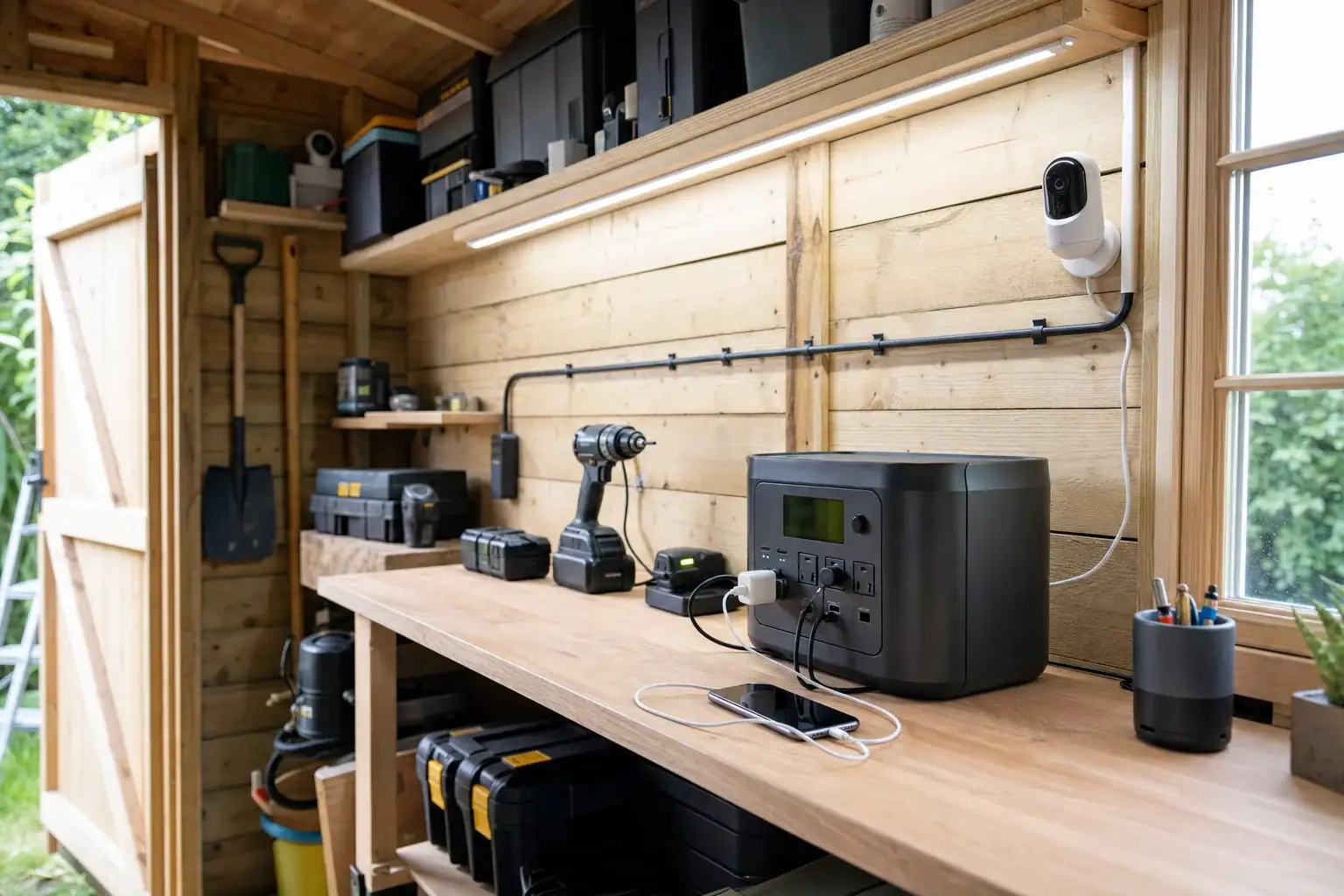
A portable power station can safely run shed lights, device chargers, and low-power security equipment when its battery capacity and output match the loads. The main specifications are watt-hours, continuous watts, surge watts, inverter efficiency, and expected runtime.
For many sheds and detached outbuildings, a battery generator is simpler than installing permanent electrical service, especially when power is needed only occasionally. It can support LED lighting, USB charging, cordless-tool chargers, cameras, routers, and selected small tools without the noise or exhaust of a fuel-powered generator.
The correct size depends on how many watts each device uses and how long it must operate. Security systems create a continuous load, while lights and chargers are usually intermittent. Temperature, inverter idle draw, battery reserve, and solar input can also change real-world results. A power station should be treated as a portable energy source, not as a substitute for compliant permanent wiring.
What a Portable Power Station Does in a Shed
A portable power station combines a rechargeable battery, charge controller, output ports, and usually an AC inverter in one enclosure. It stores energy from a wall outlet, vehicle socket, or compatible solar panels and then supplies power without combustion.
In a shed, workshop, barn, or detached garage, it can provide temporary or semi-regular power where utility wiring is unavailable. Common loads include LED lamps, phones, tablets, radios, cordless-tool batteries, Wi-Fi or cellular equipment, and security cameras. Larger models may operate selected power tools, but their output and starting-surge requirements must be checked carefully.
This matters because capacity and output describe different limits. Battery capacity, measured in watt-hours, affects how long equipment can run. Output, measured in watts, determines which equipment can start and operate. A station with substantial capacity can still shut down if a tool exceeds the inverter rating. Conversely, a high-output unit may have a short runtime if its battery is small.
A portable station is most practical for isolated loads plugged directly into its outlets. It should not be connected to a building circuit, receptacle, electrical panel, transfer device, or improvised backfeed cable. Permanent shed wiring should be designed and installed by a qualified electrician.
Capacity, Output, and Runtime Explained
Start by listing every device, its running wattage, and its daily operating time. Energy use is calculated as watts multiplied by hours. A 10-watt light used for five hours consumes about 50 watt-hours. Two such lights would consume about 100 watt-hours over the same period.
Advertised battery capacity is not the same as energy delivered to a device. The inverter and internal electronics consume power, and battery management systems preserve some capacity. For rough planning, divide required energy by an assumed efficiency of about 0.80 to 0.90. A 200-watt-hour load might therefore require roughly 225 to 250 watt-hours of rated capacity. Adding a 15% to 25% reserve helps account for cold weather, aging, and unexpected use.
Continuous output must exceed the total wattage of devices operating at once. Surge output covers short starting peaks from motors, compressors, and some power supplies. LED lights and USB chargers usually have modest peaks, while saws, pumps, and shop vacuums may briefly demand much more than their listed running wattage.
AC output also has an idle load because the inverter consumes energy whenever it is active. For a small security camera or router, direct USB or regulated DC output can sometimes provide longer runtime. However, the voltage, connector, polarity, and current requirement must match the device exactly.
| Typical shed load | Example running power | Example daily use | Approximate energy |
|---|---|---|---|
| Two LED lights | 16 watts total | 4 hours | 64 watt-hours |
| Phone charging | 10 watts average | 2 hours | 20 watt-hours |
| Security camera | 8 watts | 24 hours | 192 watt-hours |
| Wireless router | 10 watts | 24 hours | 240 watt-hours |
| Tool-battery charger | 120 watts | 1 hour | 120 watt-hours |
Real-World Shed Power Examples
Basic lighting and phone charging
Suppose two LED lamps draw 16 watts together and operate for four hours. They use 64 watt-hours. A phone charger averaging 10 watts for two hours adds 20 watt-hours, bringing the load to 84 watt-hours. After conversion losses and a reasonable reserve, approximately 120 to 150 watt-hours of rated battery capacity could cover one typical session. More capacity would provide flexibility for longer evenings or additional devices.
Camera and network connection
An 8-watt camera and 10-watt router create an 18-watt continuous load. Over 24 hours, they consume about 432 watt-hours before losses. Depending on conversion efficiency and inverter idle draw, actual battery demand could approach 500 watt-hours per day. A nominal 1,000-watt-hour station may therefore provide less than two full days if no charging source is available.
Continuous security use also requires a recharge plan. Solar production varies with season, shade, panel angle, and weather. A panel’s rated output is rarely sustained all day, so daily solar harvest matters more than the panel’s peak wattage. Critical security equipment should not rely on optimistic solar estimates alone.
Charging tools and operating equipment
A cordless-tool charger drawing 120 watts for one hour uses about 120 watt-hours, plus conversion losses. Running the charger alongside lights and security equipment increases both total output and daily energy use. A corded saw or shop vacuum may require 700 to 1,500 running watts and a higher starting surge. Both ratings must fit within the station’s limits, and the resulting runtime may be brief even with a large battery.
Common Sizing Mistakes and Troubleshooting Cues
One common mistake is adding device wattages without considering operating time. Wattage determines output demand, but watt-hours determine runtime. Another is assuming every watt-hour printed on the enclosure will reach the load. Conversion losses, cold batteries, inverter overhead, and automatic shutdown thresholds reduce usable energy.
- The station shuts off when a tool starts: The startup surge may exceed the inverter limit, even if the listed running wattage appears acceptable.
- Runtime is much shorter than calculated: Check for hidden loads, inverter idle consumption, cold conditions, high charger losses, or devices drawing more than their labels suggest.
- A camera or router turns off overnight: Continuous consumption may be higher than expected, or an energy-saving feature may disable the output when the detected load is low.
- A tool battery charges slowly: The charger may be receiving reduced AC output, or a USB-C device may not support the available Power Delivery profile.
- Solar charging underperforms: Shade, poor orientation, heat, clouds, cable loss, or an input voltage and current mismatch may be limiting collection.
- The unit will not charge in winter: Battery protection may block charging below its allowed temperature range. Warm the complete unit naturally in a dry location rather than applying concentrated heat.
A plug-in power meter can help measure AC loads when used according to its instructions and within its rating. For security equipment, observe consumption over a full day because night vision, infrared lighting, wireless transmission, and recording activity can change demand.
Safety Basics for Sheds and Outbuildings
Keep the power station dry, stable, and protected from direct sunlight, roof leaks, condensation, metal dust, and flammable materials. Maintain the ventilation clearances specified for the unit. Although a battery power station produces no combustion exhaust during use, its electronics and battery can generate heat.
Use intact cords rated for the connected load and environment. Avoid daisy-chained power strips and tightly coiled extension cords carrying substantial current. Damp locations may require ground-fault protection and weather-resistant equipment. A portable power station’s outlets do not automatically make every connected setup suitable for outdoor or wet use.
Do not open the enclosure, alter the battery, bypass protection systems, or improvise adapters. Stop using a unit that is swollen, cracked, unusually hot, wet, leaking, or producing an abnormal odor. Isolate it from combustible materials if this can be done safely, and follow local guidance for damaged lithium batteries.
Never use a male-to-male cord or connect the station to a shed receptacle to energize building wiring. If fixed lighting, permanently mounted receptacles, grounding work, or connection to utility-supplied circuits is needed, consult a qualified electrician.
Maintenance and Storage in an Unconditioned Shed
Sheds often experience greater temperature swings, humidity, dust, and pest activity than a home. These conditions can accelerate battery aging or contaminate cooling vents. A dry, moderate-temperature storage location is preferable, particularly during freezing winters or very hot summers.
For extended storage, follow the manufacturer’s specified state of charge. A midrange charge level, often around 40% to 60%, is commonly used for lithium battery storage, but designs vary. Check the display every few months and recharge if the level has fallen substantially. Leaving the battery empty for months can allow self-discharge to reach a protective shutdown state.
Charging temperature is especially important. Some battery chemistries can discharge below freezing but should not be charged there unless the system includes suitable low-temperature protection or heating. Move the station to a permitted temperature range and allow time for the battery itself to acclimate before charging.
Periodically inspect ports, plugs, cables, cooling openings, and the case. Remove surface dust without opening the enclosure. Test important security loads under realistic conditions so a failed cable, changed setting, or reduced battery capacity is discovered before an outage.
| Maintenance item | Practical interval | What to check |
|---|---|---|
| Charge level | Every 2 to 3 months in storage | Unexpected self-discharge or very low capacity |
| Case and ports | Before each use | Damage, moisture, debris, or discoloration |
| Cables | Before each use | Loose plugs, cracked insulation, or heat damage |
| Runtime test | Several times per year | Whether essential loads operate for the expected period |
| Storage environment | Seasonally | Excessive heat, freezing conditions, condensation, or pests |
Related guides: Backup Power for Security Cameras and Wi-Fi: Sizing a 24/7 Setup • Surge Watts vs Running Watts: How to Size a Portable Power Station • Portable Power Station for Power Tools: Drills, Saws, and Battery Chargers • Long-Term Storage Best Practices: Charge Level, Temperature, and Schedule
Practical Takeaways and Buying Specifications
For occasional lighting and charging, a modest-capacity station may be sufficient. Always-on cameras and networking equipment need considerably more energy because they run through the night and during periods when solar charging may be unavailable. Power tools are primarily an output challenge, although repeated use can also drain the battery quickly.
Calculate watt-hours for a complete day, account for conversion losses, and add reserve capacity. Then confirm that continuous and surge output can support every device that may run simultaneously. For critical security, consider how long the system must operate without sun or access to grid charging.
Specs to look for
- Battery capacity: Look for roughly 300 to 500 watt-hours for light intermittent use or 800 to 1,500 watt-hours for longer security runtime; capacity determines how long loads can operate.
- Continuous AC output: Choose a rating above the combined simultaneous load, such as 300 to 600 watts for chargers and lights or 1,000 watts or more for selected tools; this prevents overload shutdowns.
- Surge output: Look for short-duration capacity around 1.5 to 2 times expected motor startup demand; this helps tools, pumps, and other inductive loads start reliably.
- Low-load behavior and inverter draw: Check whether AC outlets remain active with loads below about 10 watts and how much power the inverter consumes; this is important for cameras and routers.
- USB and regulated DC outputs: Look for suitable USB-C PD profiles, such as 45 to 100 watts, and correctly regulated DC ports; direct outputs can reduce conversion losses.
- Battery chemistry and cycle rating: Compare expected retained capacity after approximately 1,000 to 3,000 cycles and review temperature behavior; this affects service life and suitability for regular use.
- Recharge input: Look for enough AC or solar input to replace a normal day’s use, such as 200 to 400 watts for medium systems; faster replenishment reduces downtime.
- Solar compatibility: Confirm the accepted voltage range, current limit, connector type, and maximum input wattage; mismatched panels may charge slowly or not at all.
- Operating temperature range: Check separate charging and discharging ranges and look for low-temperature charge protection; an unconditioned shed may exceed safe battery limits.
- Pass-through and transfer behavior: For security loads, check whether charging and output can operate together and whether a transfer delay could reboot equipment; not every power station functions as an uninterruptible power supply.
The best fit is not necessarily the unit with the largest battery. It is the one whose usable capacity, output limits, ports, charging options, low-load behavior, and temperature protections match the shed’s actual loads and operating schedule.
Frequently asked questions
What size portable power station do I need for shed lights and charging?
Calculate the watt-hours used by each device by multiplying its wattage by the hours it will run, then add the results. For occasional LED lights and phone charging, a smaller unit may be adequate, but adding 15% to 25% reserve capacity helps account for conversion losses and unexpected use.
How long will a portable power station run a security camera in a shed?
Runtime depends on the camera’s actual average wattage, whether it uses infrared night vision, and the power station’s usable battery capacity. An 8-watt camera uses about 192 watt-hours over 24 hours before inverter losses, so a higher-capacity unit is generally needed for multi-day operation.
What specs and features matter most for a portable power station for a shed?
Compare usable battery capacity in watt-hours, continuous AC output, surge output, recharge input, and the ports required by the equipment. For cameras and routers, also check low-load shutdown behavior, inverter idle consumption, pass-through operation, and the allowed charging and discharging temperatures.
What is the most common mistake when sizing a shed power station?
A common mistake is looking only at wattage and not at how long each device runs. Wattage determines whether the station can support the load at one time, while watt-hours determine runtime; conversion losses and a capacity reserve also need to be included.
Can a portable power station safely power a shed?
It can safely power individual devices plugged directly into its outlets when the loads, cords, environment, and manufacturer instructions are suitable. Keep the unit dry and ventilated, use undamaged appropriately rated cables, and do not connect it to fixed shed wiring or a receptacle.
Can I run power tools from a portable power station in a shed?
Some tools can run from a sufficiently powerful station, but both the tool’s running watts and startup surge must stay within the inverter ratings. High-draw tools such as saws, pumps, and shop vacuums can drain the battery quickly even when the station can start them.
Related guides
Browse this topic →
- Beginner-friendly sizing, runtime & specs
- Solar & charging (MPPT, fast charging, cables)
- Batteries (LiFePO4, cycles, care & storage)
- Safety, cold-weather performance, real-world tips
More in Beginners
See all →- Charging an Electric Wheelchair or Mobility Scooter From a Portable Power Station
- Portable Power Station for a Gaming PC: Runtime, Load Spikes, and UPS Considerations
- Portable Power Station for a Pop-Up Camper: Lights, Fans, Fridge, and Recharge Plan
- Portable Power Station for a Boat: 12V Loads, Salt Air, and Safer Storage
- Portable Power Station for a Small Jobsite: Tool Battery Chargers and Work Lights
Keep reading
About this site
Portable Energy Lab publishes practical, independent guides about portable power—clear sizing, safe use, and real-world expectations.
Affiliate disclosure
Some links on this site may be affiliate links. If you buy through these links, we may earn a small commission at no extra cost to you. This helps support our content. Read our affiliate disclosure.