
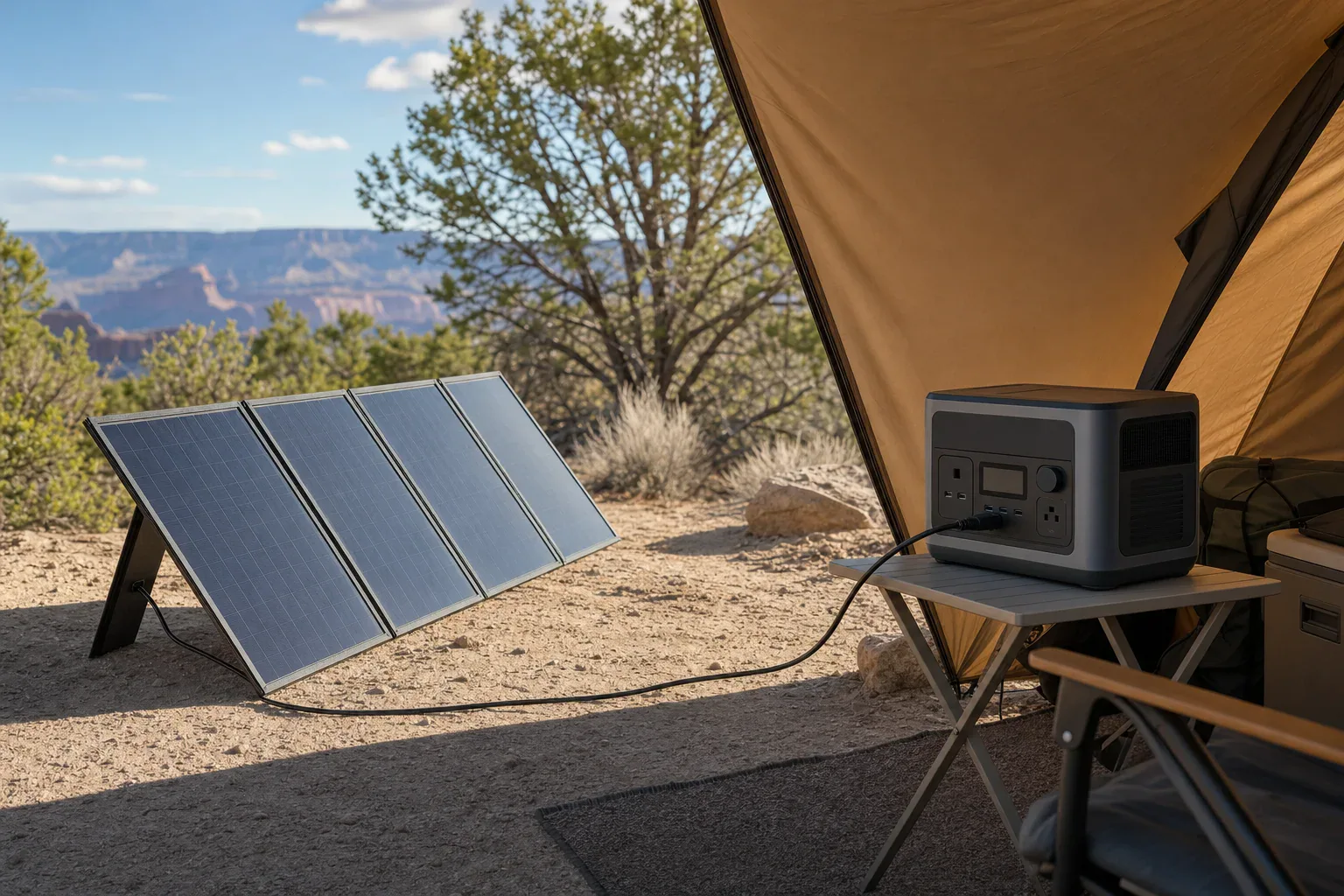
Quick answer: Choose portable solar panels by starting with the power station manual. Confirm the panel’s open-circuit voltage, operating current, rated power, connector, polarity, and any adapter fit the station’s published solar-input limits. Then compare folded size, weight, supports, cable routing, and weather instructions for every component.
Choose a compatible panel in this order
- Read the power station label and manual. Record the solar or DC input voltage range, maximum input voltage, maximum current, maximum input power, port designation, polarity diagram, and any approved cable or adapter.
- Check the panel voltage ratings. Compare its operating voltage and open-circuit voltage (Voc) with the station documentation. Voc must remain below the station’s stated maximum input voltage.
- Check current as the manual directs. Compare the panel’s operating current (Imp), and short-circuit current (Isc) where the station specifies it, with the applicable station limit.
- Check the watt ceiling. Do not assume a panel rated above the station’s published solar-input wattage is acceptable unless the exact station manual permits that arrangement.
- Verify the whole connection path. Match the connector family, dimensions, polarity, cable, and adapter approval—not merely a plug that appears to fit.
- Choose manageable capacity. Among electrically compatible options, select wattage you can carry, store, aim, and keep deployed.
- Review setup and exposure limits. Compare folded dimensions, weight, kickstands, anchor points, cable length, and the separate weather instructions for the panel, connectors, adapter, and station.
Which ratings must match on portable solar panels?
Panel wattage alone does not establish compatibility. The station and panel labels describe different sides of the charging connection, so compare every value required by the manufacturer.
Voltage: Voc and Vmp
Open-circuit voltage (Voc) is the voltage a panel produces with no load connected. Treat the station’s maximum input voltage as a firm ceiling unless the manufacturer gives different written instructions. Jackery’s third-party-panel guidance, for example, tells users to keep panel Voc and current within the listed station input limits and warns that excessive voltage can prevent charging or damage the product. The connector details on that page apply only to the listed Jackery models, but the label-reading method is useful for any brand. See Jackery’s third-party solar-panel guidance.
Voltage at maximum power (Vmp) is the panel voltage at its rated maximum-power point. Use the station manual’s instructions to determine how its solar-input operating range applies to Vmp. Do not substitute a generic rule for model-specific documentation.
Current: Imp and Isc
Current at maximum power (Imp) is operating current at the rated maximum-power point. Short-circuit current (Isc) is a separate rating measured under short-circuit conditions. Check which value the station manufacturer tells you to compare with its current limit. If a station specifies a maximum short-circuit current, include Isc in the check.
A controller may limit available current in some approved configurations, but that does not make every oversized panel safe. Whether a station permits a panel array above its rated wattage is model-specific. If the exact manual does not authorize the configuration, do not assume it is allowed. See Overpaneling Explained: Can You Connect Bigger Solar Panels Than the Input Limit?.
Maximum input power
The station’s maximum solar-input wattage is separate from its AC outlet rating. Continuous and surge output describe what the station can power, not which solar panel it can accept. A larger panel may be permitted on some models when voltage and current remain within separately stated limits, but only the exact manufacturer guidance can confirm that.
How much portable solar-panel wattage is useful?
After excluding incompatible options, choose the largest panel capacity that you can realistically transport, store, position, and secure within the station manufacturer’s limits. A higher nameplate rating is not automatically more useful if the folded panel does not fit the vehicle, needs more clear ground than is available, or is too awkward to set up consistently.
A panel’s watt rating is a laboratory-condition rating, not a promise of field output. The U.S. Department of Energy states that PV module ratings use standard test conditions of 1,000 watts per square meter of irradiance and a 25°C cell temperature. Sun angle, season, clouds, shading, and cell temperature can change actual production. See the Department of Energy’s PV performance guidance and how shading and angle affect solar charging.
Illustrative calculation: If a 500 Wh battery received a constant 100 W at its input, 500 Wh ÷ 100 W = 5 hours. This is only an idealized energy baseline, not a charge-time prediction. Sunlight changes, the battery’s state of charge, temperature, the station’s charging behavior, and conversion losses all affect the result.
Use-case decision table
| Use case | Prioritize | Likely compromise |
|---|---|---|
| Emergency preparedness at home | Higher compatible wattage, quick deployment, and practical cable reach | More weight and storage volume |
| Car camping | Folded size, carrying handles, and stable adjustable supports | Less charging capacity than a bulkier array |
| Frequent carrying | Weight, folded dimensions, and simple setup | Slower recovery of a larger station |
| RV or base camp | Stable placement, adjustable angle, and secure cable routing | Bulkier equipment and a larger deployment area |
| Wet or dusty locations | Explicit exposure limits for every component | A need to keep the station and connections in their approved environment |
Label-reading compatibility checklist
On the power station
- Solar or DC input voltage range and maximum input voltage
- Maximum input current and any separate short-circuit-current limit
- Maximum solar-input wattage
- Input-port name, connector dimensions, and polarity diagram
- Approved adapter, cable, and multi-panel requirements
On the panel or its datasheet
- Rated power in watts
- Voc, Vmp, Imp, and Isc
- Connector manufacturer and exact connector family
- Output polarity
- Folded and unfolded dimensions, weight, cable length, supports, and anchor points
- Exposure and storage restrictions for the panel and attached junctions
If a required value is absent, ask the manufacturer for documentation for the exact model. Do not infer polarity or electrical ratings from a connector’s appearance.
Why connector fit is not enough
Two plugs can appear to mate while differing in polarity, dimensions, contact design, or approved use. This matters with barrel connectors that share similar outer dimensions and with products described broadly as “MC4 compatible.”
Stäubli states that PV connector certification applies to specified connector families and warns against cross-mating connectors from different manufacturers merely because they are described as compatible. Use only combinations approved by the panel, cable, adapter, and station manufacturers. See Stäubli’s cross-mating guidance.
An adapter changes the physical connection; it does not make incompatible voltage, current, or polarity safe. Verify its input and output connector designations, polarity, and electrical rating. Never reverse polarity, alter a cable, or force a connector.
A worked compatibility check
This example demonstrates how to compare published specifications for one panel and one power station. It is not a universal wiring recommendation.
Jackery’s U.S. Explorer 500 V2 documentation lists a 16–60 V solar input, a 10.5 A limit, a 200 W maximum, and a DC8020 input port. The SolarSaga 100 JS-100C manual lists 100 W, Voc of 24.8 V, Vmp of 20 V, Imp of 5 A, and Isc of 5.6 A. See the Explorer 500 V2 specifications and the SolarSaga 100 JS-100C manual.
- Vmp: 20 V is within the published 16–60 V input range.
- Voc: 24.8 V is below the published 60 V maximum.
- Imp: 5 A is below the published 10.5 A limit.
- Panel rating: 100 W is below the published 200 W maximum.
These published values show that one panel is within the station’s listed electrical limits. The connection still must use the port and cable path approved for those exact models. Adding panels or changing adapters requires a new check against the manufacturer’s configuration instructions.
Portability and durability features that matter
Folded dimensions and weight: Compare the actual storage space and carrying distance. “Portable” does not establish that a panel is practical for walking, car transport, or stationary use.
Supports and adjustment: Integrated kickstands can simplify aiming. Compare their adjustment range, setup steps, and stability on the surfaces where you will use them. Use only manufacturer-approved anchor points and follow the product instructions when weather conditions change.
Cable management: Choose a cable length that permits safe placement without stretched leads, sharp bends, pinched insulation, or strain at the plugs. Keep connectors out of walking paths and off surfaces where they can be contaminated or damaged.
Weather instructions: A rating or claim for the panel surface does not automatically apply to its connectors, adapter, or power station. Review each component separately. The SolarSaga 100 manual, for example, warns against incomplete connector engagement and soaking that specific panel; those restrictions are not a weather rating for other products.
Checks before every charging session
- Inspect the panel, cable insulation, contacts, and adapter for damage or contamination.
- Confirm that contacts are clean and dry, polarity is correct, and connectors are fully seated.
- Route cables without crushing, sharp bends, trip hazards, or strain at the plugs.
- Place the panel in unobstructed sun while keeping the station within its own temperature and weather limits.
- Follow the manuals’ specified connection, disconnection, and shutdown sequence.
- Check the exact station model for safety notices or recalls before use.
Keep a compatibility record
Save the station manual, panel datasheet, and adapter instructions together. Record exact model numbers, voltage window, maximum voltage, applicable current limit, watt limit, connector, polarity, and approved adapter. This record makes later replacement of a cable or panel safer than relying on appearance, memory, or a generic compatibility claim.
Related guides
Related guides
Browse this topic →
- Beginner-friendly sizing, runtime & specs
- Solar & charging (MPPT, fast charging, cables)
- Batteries (LiFePO4, cycles, care & storage)
- Safety, cold-weather performance, real-world tips
More in Solar
See all →Keep reading
About this site
Portable Energy Lab publishes practical, independent guides about portable power—clear sizing, safe use, and real-world expectations.
Affiliate disclosure
Some links on this site may be affiliate links. If you buy through these links, we may earn a small commission at no extra cost to you. This helps support our content. Read our affiliate disclosure.