
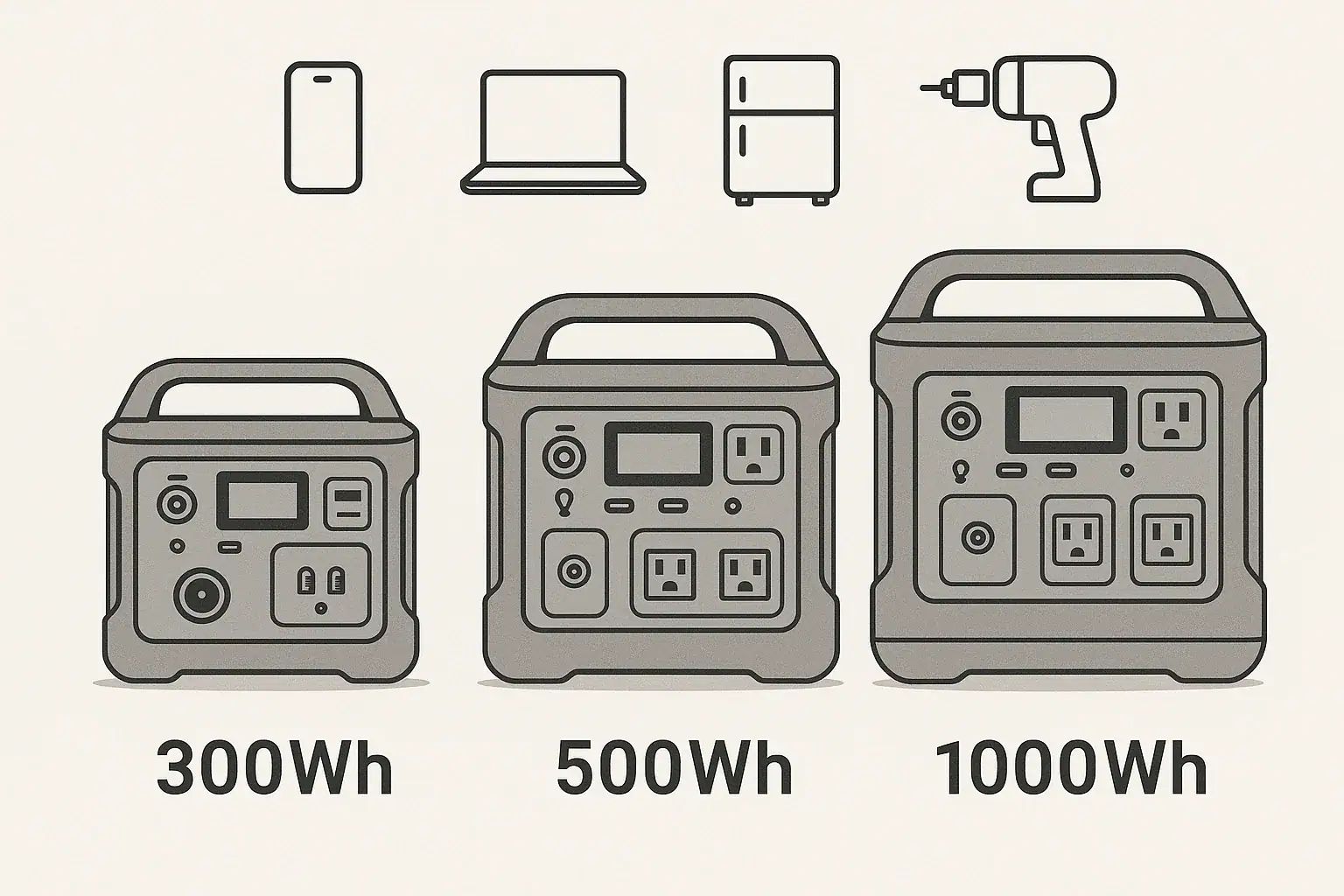
300Wh, 500Wh, and 1000Wh portable power stations mainly differ in how long they can run your devices and what loads they can realistically support. In practice, capacity affects runtime, recharge time, weight, and how many devices you can power at once. When people search for terms like runtime calculator, watt-hour capacity, surge watts, or off-grid backup, they are really asking: how big does my battery need to be for my specific use case?
This guide explains 300Wh vs 500Wh vs 1000Wh in plain language, then walks through real-world examples such as camping, CPAP backup, laptops, fridges, and small power tools. You will see how watt-hours, inverter efficiency, and continuous vs surge watts all interact so you can estimate runtime and avoid overloading. By the end, you will know which capacity range fits your needs today—and which specs to prioritize if you later compare different portable power stations.
Understanding 300Wh, 500Wh, and 1000Wh: What Capacity Really Means
Watt-hours (Wh) measure how much energy a portable power station can store. A 300Wh unit can theoretically deliver 300 watts for one hour, 150 watts for two hours, and so on. A 500Wh model stores more energy, and a 1000Wh model roughly doubles that again.
In simple terms:
- 300Wh: Suited for light loads and short trips—phones, cameras, small lights, and a laptop for part of a day.
- 500Wh: A mid-range option—better for overnight use, running more devices at once, or powering small appliances briefly.
- 1000Wh: A larger battery bank—suitable for longer runtimes on fridges, CPAP machines, or multiple laptops and lights.
Actual runtime depends on load wattage, inverter efficiency, and how far the battery is discharged. Most portable power stations use an inverter to convert DC battery power to AC; this conversion is not 100% efficient, so real-world runtimes are lower than simple math suggests.
Capacity matters because it determines:
- How long you can run critical devices (runtime).
- How many devices you can power at once without draining the battery too quickly.
- How often you need to recharge from wall outlets, solar panels, or vehicle DC ports.
- Weight and size—the higher the capacity, generally the bulkier the unit.
Choosing between 300Wh, 500Wh, and 1000Wh is about matching stored energy to your typical daily consumption and backup needs, not just picking the biggest number.
How Capacity, Watts, and Runtime Work Together
To compare 300Wh vs 500Wh vs 1000Wh meaningfully, it helps to understand how watt-hours, watts, and runtime interact.
Basic runtime estimate (ignoring losses):
Runtime (hours) ≈ Battery capacity (Wh) ÷ Device load (W)
Real use is more complex because of inverter efficiency and battery management systems. A more realistic quick rule is:
Usable Wh ≈ Rated Wh × 0.8 (assuming around 80% overall efficiency and some reserve capacity).
So, approximate usable energy:
- 300Wh → about 240Wh usable
- 500Wh → about 400Wh usable
- 1000Wh → about 800Wh usable
Example: A 60W laptop charger on a 500Wh unit:
- Usable energy ≈ 400Wh
- Runtime ≈ 400Wh ÷ 60W ≈ 6.6 hours of continuous charging
Key concepts that affect your choice:
- Continuous output (W): The maximum power the inverter can supply continuously. A 300Wh unit might provide 200–300W continuous, while a 1000Wh unit can often support 800–1200W or more, depending on design.
- Surge or peak watts: Short bursts for starting motors or compressors. Even if capacity is high, low surge watts can prevent starting devices like fridges or some power tools.
- Input limits: How fast the station can recharge from AC, car DC, or solar. Larger batteries (1000Wh) usually take longer to refill, especially if the input wattage is modest.
- Depth of discharge: Many systems reserve some capacity to protect the battery, so you rarely get 100% of the rated Wh.
The right capacity is the one that gives you enough usable watt-hours for your daily or overnight loads, within the continuous and surge watt limits of the power station.
| Rated Capacity | Approx. Usable Wh* | Typical Continuous Output Range | Est. Runtime @ 60W Load |
|---|---|---|---|
| 300Wh | ~240Wh | 150–300W | ~4 hours |
| 500Wh | ~400Wh | 300–600W | ~6.5 hours |
| 1000Wh | ~800Wh | 600–1200W | ~13 hours |
Real-World Use Cases: 300Wh vs 500Wh vs 1000Wh
Looking at specific scenarios makes it easier to choose between 300Wh, 500Wh, and 1000Wh. These examples assume around 80% usable capacity and typical device wattages.
Light travel, day hikes, and short work sessions (300Wh)
- Phones and small devices: A modern smartphone battery is roughly 10–15Wh. With 240Wh usable in a 300Wh unit, you could get 10–15 full phone charges, plus some extra for lights.
- Laptop and camera: A 60W laptop plus a 10W camera charger might draw ~70W. Estimated runtime: 240Wh ÷ 70W ≈ 3.4 hours of continuous charging.
- LED lighting: Two 5W LED lights (10W total) could run for 240Wh ÷ 10W ≈ 24 hours.
A 300Wh power station works well for single-day events, light vanlife work sessions, or as a compact backup for small electronics.
Weekend camping and basic home backup (500Wh)
- CPAP machine (with DC adapter, ~40W average): 400Wh usable ÷ 40W ≈ 10 hours. Many users can get a full night or more, depending on settings and humidifier use.
- Laptop + phone charging + lights: Suppose 60W laptop + 10W phone + 10W lights = 80W. Runtime: 400Wh ÷ 80W ≈ 5 hours of continuous use, often enough for an evening’s work and entertainment.
- Small cooler or mini-fridge: A very efficient 60W average-draw cooler might run ~6.5 hours. Real fridges cycle on and off, so practical runtime can be longer, but 500Wh is still better for short-term rather than multi-day refrigeration.
A 500Wh unit is a versatile mid-size option for weekend camping, short power outages, or portable work setups where you need more headroom than a 300Wh can offer.
Longer outages, RV use, and heavier loads (1000Wh)
- Household fridge: A modern fridge may average 80–150W over time. With 800Wh usable, a realistic runtime might be 5–8 hours, depending on efficiency and how often the compressor cycles. It is not full-house backup, but it can bridge shorter outages.
- Multiple laptops and devices: Two 60W laptops + 20W of phones and lights ≈ 140W. Runtime: 800Wh ÷ 140W ≈ 5.7 hours continuous, often enough for a full workday when usage is intermittent.
- CPAP plus other loads: A 40W CPAP overnight plus intermittent phone and light use is more comfortable on 1000Wh, especially for multi-night trips or unreliable grid power.
- Small power tools: Occasional use of a 300–500W tool is more realistic on a 1000Wh unit with a higher continuous and surge rating, though it is still not a substitute for a full jobsite power source.
If your priority is extended runtime for essential loads—fridge, CPAP, work electronics, or a small entertainment setup—a 1000Wh power station offers significantly more flexibility than 300Wh or 500Wh.
Common Capacity Mistakes and How to Avoid Them
Many capacity frustrations come from misunderstandings about watt-hours and real-world power draw. Here are frequent pitfalls when choosing between 300Wh, 500Wh, and 1000Wh.
- Confusing watts with watt-hours: Watts measure power at a moment; watt-hours measure energy over time. A 300W device can run on a 300Wh battery, but only for about an hour at best, not all day.
- Ignoring inverter efficiency: Assuming the full rated Wh is available leads to optimistic runtime expectations. Planning with 70–80% of rated capacity is more realistic.
- Overlooking continuous output limits: A 1000Wh unit with a 500W inverter cannot run a 900W appliance, no matter how big the battery is. Capacity and inverter rating must both be adequate.
- Underestimating surge watts: Devices with motors or compressors (fridges, some pumps, some tools) can need 2–3× their running watts to start. A 500Wh power station with low surge capacity may fail to start them even if average watts look fine.
- Stacking too many small loads: Multiple chargers, routers, and lights can add up. A 500Wh unit that seems large on paper can drain fast if total draw is 200–300W for several hours.
- Not accounting for recharge opportunities: For solar or vehicle charging, smaller capacities (300Wh or 500Wh) may refill fully during a day of sun, while a 1000Wh unit may not, depending on panel wattage and input limits.
Troubleshooting cues that suggest you chose the wrong capacity:
- Battery drops from full to empty in a few hours at your typical use—consider stepping up from 300Wh to 500Wh or from 500Wh to 1000Wh.
- Devices shut off when they start up, even though running watts seem within limits—check surge ratings and consider a larger, higher-output unit.
- You regularly hit low-battery warnings before night is over—your daily consumption is higher than the stored energy; a capacity upgrade or reduced load is needed.
Carefully listing your devices and estimating their wattage and runtime before purchasing is the best way to avoid these issues.
Safety Basics When Using Different Capacity Sizes
Regardless of whether you choose a 300Wh, 500Wh, or 1000Wh power station, the core safety principles remain the same. Higher capacity increases the amount of stored energy, so it is important to use and manage it responsibly.
- Stay within rated output limits: Never exceed the continuous or surge watt ratings of the AC, DC, or USB outputs. Overloading can trigger protection circuits or cause overheating.
- Allow ventilation: Place the power station on a stable surface with adequate airflow. Avoid covering vents or enclosing the unit in tight spaces, especially at higher loads.
- Avoid extreme temperatures: High heat accelerates battery wear and can trigger thermal protection; deep cold can temporarily reduce capacity. Follow the manufacturer’s recommended operating ranges.
- Use compatible chargers and cables: Match input voltage and current ratings. For DC and solar inputs, only use supported profiles and connectors to avoid damage.
- Keep away from moisture: Even rugged units are vulnerable to water intrusion. Protect from rain, splashes, and condensation, particularly when using AC outlets.
- Do not open or modify the unit: Internal components store significant energy. Repairs, modifications, or battery replacements should be handled by qualified professionals or authorized service providers.
- Be cautious with high-power appliances: Larger capacity (like 1000Wh) may tempt use with space heaters or kettles. These devices often exceed safe continuous output or drain the battery extremely quickly.
Following these high-level practices helps ensure that whichever capacity you choose, you use it within its safe operating envelope.
| Capacity Class | Typical Use | Common Load Range | Key Safety Focus |
|---|---|---|---|
| 300Wh | Small electronics, lights | 10–150W | Prevent overload from unexpected high-watt devices |
| 500Wh | CPAP, laptops, small appliances | 50–300W | Ventilation and managing multiple simultaneous loads |
| 1000Wh | Fridge, multi-device setups | 100–800W | Heat buildup and staying within inverter limits |
Related guides: Portable Power Station Buying Guide • How to Estimate Runtime for Any Device • How Many Solar Watts Do You Need to Fully Recharge in One Day?
Maintenance and Storage Considerations by Capacity Size
Good maintenance habits extend the life of any portable power station, but capacity influences how you approach storage, cycling, and recharging.
- Periodic cycling: All sizes benefit from being used and recharged periodically. Lightly cycling a 300Wh, 500Wh, or 1000Wh unit every 1–3 months helps keep battery management systems active and healthy.
- Storage charge level: Many lithium-based systems last longer when stored partially charged (often around 40–60%), rather than at 0% or 100%. Check your manual for specific guidance.
- Self-discharge over time: Larger capacities like 1000Wh can take longer to recharge if allowed to sit discharged. Before storms, trips, or expected outages, top up the battery so full capacity is available.
- Charging sources and time: A 300Wh unit may recharge in a few hours from a standard AC adapter, while a 1000Wh unit can take significantly longer at the same input wattage. For solar, match panel power and available sunlight to the battery size you choose.
- Temperature-controlled storage: Store all capacity sizes in cool, dry environments. Prolonged exposure to high heat (for example, in a closed vehicle in summer) can permanently reduce capacity.
- Keep connectors clean: Dust and oxidation on AC, DC, and USB ports can cause poor connections or intermittent charging. Periodically inspect and gently clean connectors as recommended by the manufacturer.
- Monitor firmware and indicators: Some units provide state-of-charge, cycle count, or health indicators. Regularly checking these can help you notice early signs of capacity loss or charging issues.
Whether you own a compact 300Wh unit for occasional use or a 1000Wh system for backup, consistent maintenance and thoughtful storage can preserve usable capacity for years.
Putting It All Together: Which Capacity Should You Choose?
Choosing between 300Wh, 500Wh, and 1000Wh comes down to your devices, how long you need to run them, and how often you can recharge.
- Choose around 300Wh if you mainly charge phones, cameras, and a laptop for short periods, want a lightweight option, and have frequent access to recharging.
- Choose around 500Wh if you need overnight capability for a CPAP, more comfortable runtimes for laptops and lights during camping, or a compact backup for brief outages.
- Choose around 1000Wh if you want longer runtimes for fridges, multi-device work setups, or several nights of essential loads without constant recharging.
Always start by estimating your daily watt-hour usage. List your devices, note their wattage, and multiply by the hours you expect to run them. Then match that total to a capacity tier with some safety margin.
Specs to look for
- Battery capacity (Wh): Look for 250–350Wh for light use, 400–700Wh for mid-range, and 800–1200Wh for heavier or multi-day needs. This determines how long your devices can run.
- Continuous AC output (W): Aim for at least 200–300W for 300Wh units, 300–600W for 500Wh, and 600–1200W for 1000Wh class. Ensures your typical loads can run without tripping protection.
- Surge/peak watts: Seek surge ratings roughly 1.5–2× the continuous output if you plan to run fridges, pumps, or tools. This helps start inductive loads without shutdowns.
- AC, DC, and USB port mix: Ensure enough outlets for your devices (for example, 1–2 AC outlets, multiple USB-A, and at least one USB-C PD port). The right mix avoids overloading a single port.
- Input charging power (W): For 300Wh, 60–150W input can recharge in a few hours; for 1000Wh, 200–400W or more is helpful. Higher input reduces downtime between uses.
- Battery chemistry and cycle life: Compare typical cycle life ranges (for example, 500–2500 cycles to 80% capacity). Longer cycle life is valuable if you use the station frequently.
- Weight and portability: 300Wh units may weigh under 10 lb, 500Wh around 10–20 lb, and 1000Wh often 20–30 lb or more. Consider how far and how often you will carry it.
- Display and monitoring: A clear screen with remaining percentage, estimated runtime, and input/output watts helps you manage capacity and avoid surprises.
- Operating temperature range: Check that the specified range matches your climate and intended use (for example, cold-weather camping or hot garages).
- Built-in protections: Look for overcurrent, overvoltage, short-circuit, and temperature protections. These features safeguard both the power station and your devices.
By focusing on these specs and understanding how 300Wh, 500Wh, and 1000Wh capacities translate into real runtimes, you can select a portable power station that fits your actual use case instead of relying on guesswork.
Frequently asked questions
Which specs and features should I prioritize when comparing 300Wh, 500Wh, and 1000Wh power stations?
Prioritize battery capacity (Wh) for runtime, continuous AC output (W) for the types of devices you plan to run, and surge watts for motor-starting loads. Also consider input charging power, port mix (AC, DC, USB-C), cycle life, weight, and built-in protections like overcurrent and thermal limits.
What is a common mistake people make when estimating runtime?
A frequent mistake is confusing watts with watt-hours and assuming 100% of rated Wh is usable. Plan using a realistic usable Wh (often 70–80% of rated capacity) and check inverter efficiency and continuous/surge limits for a more accurate runtime estimate.
Are larger capacity units inherently safer than smaller ones?
Not necessarily—larger units store more energy, which increases the potential hazard if misused. Safety depends on following rated output limits, ensuring ventilation, avoiding extreme temperatures and moisture, and using the unit within the manufacturer’s specifications.
How do I calculate how long a specific device will run on a given battery capacity?
Estimate runtime by dividing usable Wh by the device’s watt draw: Runtime ≈ usable Wh ÷ device watts. Use a conservative usable Wh (for example, 70–80% of rated capacity) and account for duty cycles, inverter losses, and intermittent use to refine the estimate.
Can I recharge a 1000Wh unit fully in one day with solar panels?
Possibly, but it depends on panel wattage, available sun hours, and the station’s input limits. A 1000Wh battery typically needs several hundred watts of sustained input (for example, 200–400W) and multiple peak-sun hours to recharge fully in a day once conversion losses are considered.
How often should I cycle or top up my portable power station in storage?
Periodically cycle and top up batteries every 1–3 months to keep the battery management system active and preserve capacity. Store most lithium-based units at a partial charge (commonly around 40–60%) and follow the manufacturer’s specific storage recommendations.
Recommended next:
- Pure Sine Wave vs Modified Sine Wave: Does It Matter for a Portable Power Station?
- Surge Watts vs Running Watts: How to Size a Portable Power Station
- Inverter Efficiency Explained: Why Your Runtime Is Shorter Than Expected
- AC vs DC Power: How to Maximize Efficiency and Runtime
- How to Calculate Watt-Hours From Amp-Hours (and Avoid Common Mistakes)
- Why a 1000Wh Power Station Doesn’t Give 1000Wh: Usable Capacity Explained (Efficiency + Cutoffs)
- More in Capacity →
Related guides
Browse this topic →

- Beginner-friendly sizing, runtime & specs
- Solar & charging (MPPT, fast charging, cables)
- Batteries (LiFePO4, cycles, care & storage)
- Safety, cold-weather performance, real-world tips
More in Capacity
See all →- Inverter Idle Consumption Explained: How Much Power You Lose Just Having AC On
- VA vs Watts Explained for Portable Power Stations: Computers, Power Supplies, and UPS Confusion
- Why a 1000Wh Power Station Doesn’t Give 1000Wh: Usable Capacity Explained (Efficiency + Cutoffs)
- How to Calculate Watt-Hours From Amp-Hours (and Avoid Common Mistakes)
- Inverter Efficiency Explained: Why Your Runtime Is Shorter Than Expected
Keep reading
About this site
Portable Energy Lab publishes practical, independent guides about portable power—clear sizing, safe use, and real-world expectations.
Affiliate disclosure
Some links on this site may be affiliate links. If you buy through these links, we may earn a small commission at no extra cost to you. This helps support our content. Learn more.