
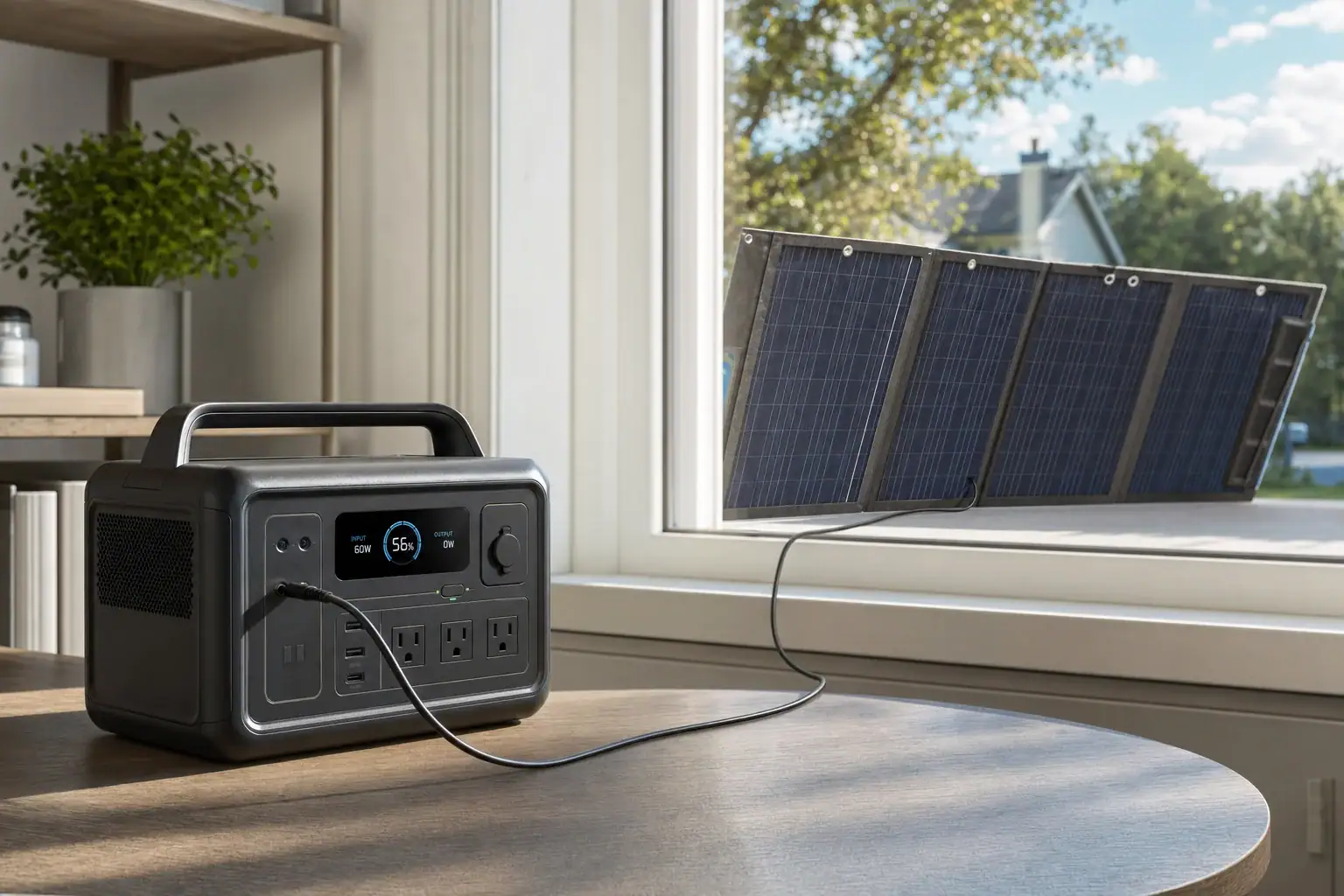
Yes, you can charge a portable power station through a window with solar panels, but the panel will usually generate less power than it would outdoors. Window glass, low-E coatings, insect screens, shadows, and an unfavorable panel angle can all reduce the sunlight reaching the solar cells.
Charging will work only if the panel’s voltage and current are compatible with the station’s solar input. Important terms include solar input, MPPT voltage range, open-circuit voltage, input limit, and charging time. Even a compatible system may charge slowly or cycle on and off when indoor light is weak.
Placing a panel behind glass can be convenient when outdoor installation is impractical, during temporary use, or in apartments where equipment cannot be left outside. However, it is generally a compromise rather than the best setup. Direct outdoor sunlight, safe placement, and correct electrical specifications provide more consistent charging.
1. What Charging Through a Window Means and Why It Matters
Charging through a window means placing a solar panel indoors so sunlight passes through one or more panes of glass before reaching the photovoltaic cells. The panel connects to the portable power station’s dedicated solar or DC input. The power station’s internal charge controller then converts the panel’s variable output into usable battery-charging power.
A solar panel does not require outdoor air to operate; it requires enough usable light. It can therefore produce electricity behind clear glass. The problem is that a window reflects and absorbs part of the solar energy. Modern insulated windows may have multiple panes, tint, ultraviolet filtering, or low-emissivity coatings that cause additional losses.
This matters because a panel rated at 200 watts under laboratory test conditions may produce only a fraction of that rating behind a window. Lower output increases charging time and may fall below the power station’s minimum operating threshold. Indoor placement can also make the panel hotter, and photovoltaic output typically declines as cell temperature rises.
2. How Solar Charging Through Glass Works
Solar cells produce direct-current electricity when photons reach the semiconductor material. Clear glass allows much of the visible light through, but transmission is not perfect. Reflections occur at each glass surface, while coatings and tint can block selected wavelengths. Screens, dirt, blinds, window frames, and partial shadows create further losses.
Panel angle and sunlight intensity
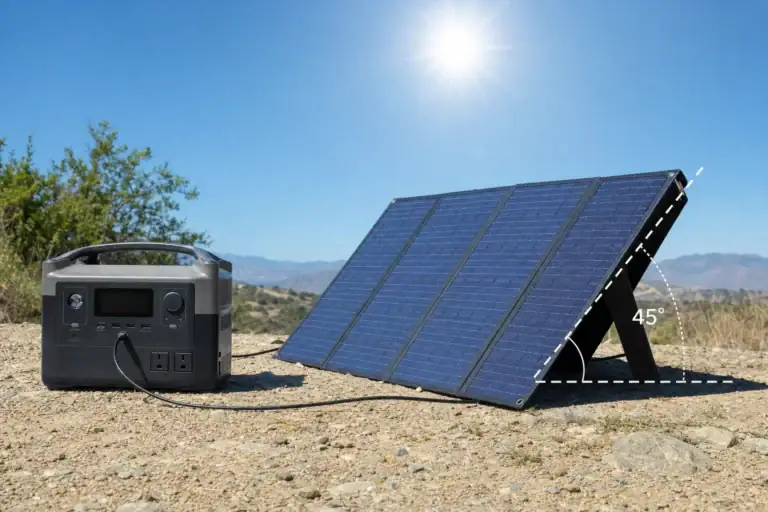
Output is highest when sunlight strikes the panel close to perpendicular. A vertically placed panel behind a window may perform reasonably when the sun is low but poorly when the sun is high overhead. Because the sun moves, a productive location in the morning may be shaded by afternoon. Diffuse daylight can produce some electricity, but it is far weaker than direct sun.
Electrical compatibility
The panel’s operating voltage should fall within the power station’s MPPT voltage range. Its open-circuit voltage must remain below the station’s maximum solar-input voltage, including the increase that can occur in cold conditions. Available panel current may exceed the station’s accepted current only if the equipment documentation permits current limiting; voltage must not exceed the stated maximum.
The station also has a maximum solar wattage. Connecting more rated panel wattage does not force excess power into the battery because a compatible controller normally limits intake. However, incompatible voltage, connectors, polarity, or wiring can prevent charging or damage equipment.
| Panel condition | Possible output from a 200 W panel | Main influence |
|---|---|---|
| Outdoors in strong, direct sun | 140–190 W | Angle, temperature, and weather |
| Behind clear single-pane glass | 90–160 W | Reflection and panel angle |
| Behind coated double-pane glass | 50–130 W | Multiple panes and coatings |
| Behind glass with a screen or partial shade | 15–90 W | Obstruction and uneven illumination |
3. Real-World Window Charging Examples
Consider a portable power station with a 1,000-watt-hour battery and a 200-watt solar panel. Outdoors, the panel might deliver an average of 150 watts during several favorable hours. After conversion losses and charging overhead, adding roughly 600 watt-hours could take about four to five hours of productive sunlight.
If the same panel produces an average of 90 watts behind a window, adding that energy might require seven hours or more. The process may extend across multiple days because the window receives direct sun for only part of each day. Charging also slows near a full state of charge as the battery-management system reduces input.
A smaller 100-watt panel behind coated glass might deliver 30 to 60 watts. That can be useful for maintaining charge or replacing energy used by phones, lights, and other small devices, but it may not keep pace with a continuously powered refrigerator or other substantial load.
Partial shade produces a less predictable result. A narrow window frame shadow across one section of a panel can reduce output disproportionately, depending on the panel’s cell layout and bypass diodes. Moving the panel a few inches or changing its orientation may produce a larger improvement than expected.
4. Common Mistakes and Troubleshooting Cues
Expecting the panel’s rated wattage
Panel ratings are measured under standardized light and temperature conditions. Indoor placement rarely matches those conditions. Compare the power station’s displayed solar input in several positions rather than assuming the panel is defective. Test outdoors in safe, direct sunlight to establish a useful baseline.
Using incompatible voltage or connectors
A connector that physically fits does not prove electrical compatibility. Verify the panel’s open-circuit voltage, operating voltage, polarity, connector type, and maximum current against the power station’s input specifications. An incorrect adapter or reversed polarity can result in zero input even when the panel is illuminated.
Ignoring minimum startup power
Some power stations need a minimum voltage or wattage before the solar controller activates. Weak light can cause the input display to alternate between zero and a small reading. This often indicates changing sunlight, shading, or insufficient voltage rather than a failed battery.
Overlooking screens, tint, and shadows
Remove movable obstructions such as blinds without damaging the window or creating excessive heat. If practical, compare output with and without an insect screen. Watch for narrow shadows from mullions, handles, nearby buildings, roof overhangs, and trees.
Charging while running heavy loads
The battery percentage may continue to fall if connected appliances consume more power than the panel supplies. Check both solar input and AC or DC output. A station receiving 70 watts while supplying a 120-watt load has a net battery discharge of at least 50 watts, plus conversion losses.
5. Safety Basics for Panels, Windows, and Cables
Keep the portable power station dry, ventilated, and within its specified operating-temperature range. Do not place it in a sealed window recess where direct sun can cause heat buildup. Leave clearance around cooling vents, and avoid covering the unit or placing it on easily damaged fabric.
Support the panel securely so it cannot fall, press against fragile glass, or obstruct an emergency exit. Do not place a rigid panel where concentrated heat, sharp edges, or excessive weight could damage the window. Panels mounted outside need appropriate structural support and weather-resistant hardware rather than temporary cords or unsecured hooks.
Route the cable without crushing it in a closing window or creating a trip hazard. A pinched cable can damage insulation and create resistance, heat, or an intermittent connection. Use only compatible, adequately rated cables and adapters. Do not open the power station, alter the battery, bypass protection circuits, or improvise connections to household wiring.
If a permanent exterior panel, wall penetration, grounding arrangement, or connection near building electrical systems is being considered, consult a qualified electrician or installer familiar with local requirements.
6. Maintenance and Storage for Reliable Solar Charging
Dust and fingerprints reduce the light reaching a panel, especially when window glass is also dirty. Clean the panel and the accessible side of the window according to their care instructions. Use nonabrasive materials, avoid harsh chemicals, and allow all surfaces and connectors to dry before use.
Inspect cables periodically for cuts, flattened sections, loose contacts, discoloration, or unusual warmth. Keep connector ends protected from moisture and debris during storage. Repeatedly bending a cable at the plug can weaken its conductors and create intermittent charging.
For long-term storage, follow the power station’s recommended charge level and recharge interval. Avoid leaving the battery fully depleted for extended periods. Store the station in a cool, dry location away from direct sun, freezing conditions, and sources of heat. Foldable panels should be dry and clean before being folded so grit does not scratch their surfaces.
| Item | Suggested check | Reason |
|---|---|---|
| Panel and window | Before a charging session | Dust and shade reduce output |
| Cables and plugs | Every few uses | Damage can interrupt charging |
| Stored power station | Every 2–4 months | Helps prevent deep discharge |
| Input reading | When conditions change | Confirms useful solar production |
Related guides: Can You Charge a Portable Power Station with Solar Panels? • How to Read Solar Panel Specs for Power Stations: Voc, Vmp, Imp, and Why It Matters • Shading and Angle: How Placement Changes Solar Charging Speed • Solar Safety Basics: Cables, Heat, and Preventing Connector Melt
7. Practical Takeaways and Specs to Look For
Window solar charging is feasible when direct sunlight reaches a compatible panel, but it should be treated as reduced-output charging. Start by comparing the panel and power station specifications, then test several indoor positions while watching the input wattage. A clean, unshaded panel facing the sun as directly as possible will usually perform best.
If indoor output is too low, the most effective improvement is often moving the panel outdoors to a safe, secure location while keeping the power station protected indoors. A longer compatible cable may help, although excessive cable length or undersized conductors can cause voltage loss. Do not exceed voltage limits in an attempt to compensate for poor sunlight.
Specs to look for
- MPPT voltage range: Look for a range that comfortably includes the panel’s normal operating voltage, such as 15–50 volts, because the controller must receive an acceptable voltage to charge efficiently.
- Maximum solar-input voltage: Compare this value with the panel’s open-circuit voltage and allow a cold-weather margin; staying below the maximum protects the input electronics.
- Solar-input wattage: A range such as 200–500 watts may support faster charging when adequate panel capacity and sunlight are available.
- Maximum input current: Check values such as 10–15 amps against the panel or array current because the station may cap usable power even when voltage is compatible.
- Minimum solar startup requirement: Look for low-voltage and low-power startup behavior if the panel will often operate behind glass or in variable light.
- Panel open-circuit voltage: Choose a panel whose highest expected voltage remains safely below the station’s input ceiling, especially in cold, bright weather.
- Connector type and polarity: Confirm direct compatibility or the availability of a correctly wired, adequately rated adapter to avoid unreliable or reversed connections.
- Input display resolution: A display or monitoring system that shows real-time solar watts makes it easier to optimize panel position and identify shading or connection problems.
- Operating-temperature range: Look for limits appropriate to the intended room or outdoor conditions because excessive heat can reduce charging power and battery longevity.
Through-window charging is best for convenience, maintenance charging, and modest daily energy needs. For predictable charging times or larger loads, unobstructed outdoor sunlight generally provides substantially better performance.
Frequently asked questions
How much slower is charging a portable power station through a window?
Charging through a window is often noticeably slower because glass, coatings, screens, shade, and panel angle reduce the light reaching the solar cells. Actual output can range from a modest reduction behind clean clear glass to a substantial reduction behind tinted or coated multi-pane windows. Checking the station’s live solar-input reading is the most reliable way to estimate charging time.
Can a solar panel charge a power station through double-pane or low-E glass?
It may charge through double-pane or low-E glass if enough direct sunlight reaches the panel and the electrical connection is compatible. These windows can reduce solar transmission more than plain single-pane glass, so output may be too low for useful charging at certain times of day. A short test in direct sun can show whether the station’s controller remains active.
What solar panel and power station specs matter for window charging?
Check that the panel’s normal operating voltage fits within the power station’s MPPT input range and that its open-circuit voltage stays below the maximum allowed solar-input voltage. Also confirm connector type, polarity, current limits, maximum input wattage, and any minimum voltage or power needed to start charging. These specifications matter regardless of whether the panel is indoors or outdoors.
Why does my power station show zero solar input behind a window?
Zero input can result from weak or indirect light, a shadow across the panel, tinted glass, a screen, or a panel angle that receives little sunlight. It can also indicate incompatible voltage, incorrect polarity, a loose adapter, or a controller that has not reached its startup threshold. Testing the same panel outdoors in direct sunlight helps separate a light-level issue from a connection or compatibility issue.
Is it a mistake to use a solar panel’s rated wattage to predict indoor charging time?
Yes. The rated wattage is measured under standardized test conditions and is not a guarantee of real-world output, particularly behind glass. Use the measured input watts shown by the power station and account for shorter periods of direct sun, battery charging losses, and any loads running at the same time.
Is it safe to leave a solar panel and portable power station by a window?
It can be safe when the panel is stable, the power station has ventilation, and cables are not pinched by the window or placed where they create a trip hazard. Keep the battery unit dry and out of excessive heat, and do not block exits or place heavy or rigid panels where they could damage glass. Use only compatible cables and adapters, and follow the equipment instructions.
Related guides
Browse this topic →
- Beginner-friendly sizing, runtime & specs
- Solar & charging (MPPT, fast charging, cables)
- Batteries (LiFePO4, cycles, care & storage)
- Safety, cold-weather performance, real-world tips
More in Solar
See all →- How to Clean Portable Solar Panels Without Damage
- Solar Charging on Cloudy Days: What Output Can a Portable Power Station Expect?
- How Many Portable Solar Panels Do You Need for a 1,000Wh Power Station?
- Solar Adapter Polarity Mistakes: How to Avoid Reverse-Polarity Charging Problems
- Portable Solar Panel Waterproof Ratings: What Rain, Dew, and Splash Resistance Mean
Keep reading
About this site
Portable Energy Lab publishes practical, independent guides about portable power—clear sizing, safe use, and real-world expectations.
Affiliate disclosure
Some links on this site may be affiliate links. If you buy through these links, we may earn a small commission at no extra cost to you. This helps support our content. Read our affiliate disclosure.