
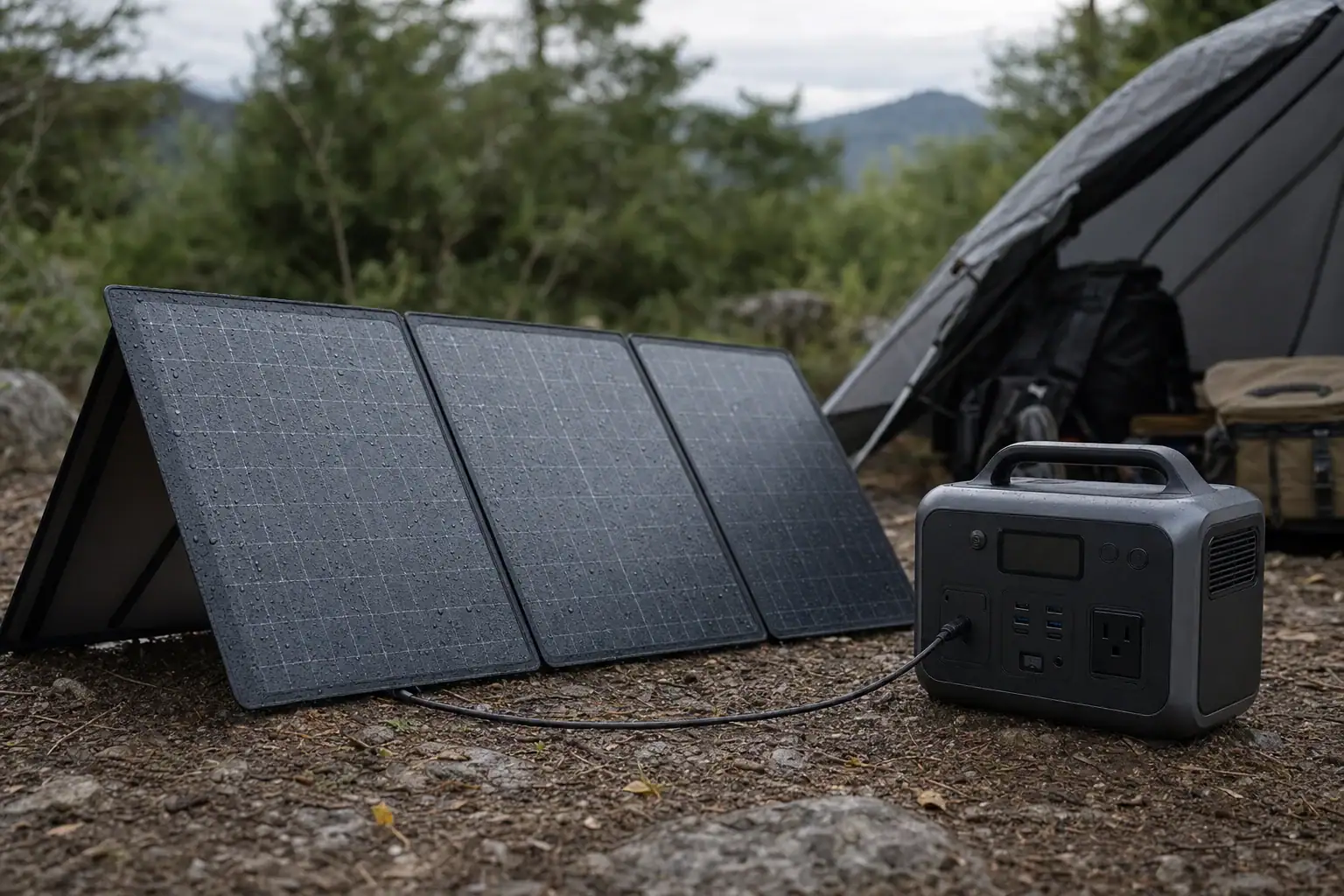
A portable solar panel is safe in rain only when its stated waterproof or water-resistance rating covers the complete panel and the exposure stays within that rating. Many panels tolerate light rain or splashes, but that does not mean their connectors, junction box, controller, or attached portable power station can get wet.
Look for an IP rating, such as IPX4, IP65, or IP67, rather than relying on general terms like weather-resistant or outdoor-ready. Rain resistance, splash resistance, dew protection, and temporary immersion are different levels of protection. The panel surface may shed water while moisture still reaches a cable connection or electronics enclosure.
For reliable outdoor solar charging, check which components the rating applies to, protect electrical connections, and avoid prolonged exposure. Even a highly rated panel should be dried before folding or storage because trapped moisture can promote corrosion, staining, odor, and insulation damage.
1. What Portable Solar Panel Waterproof Ratings Mean
A waterproof rating describes how an enclosure was tested against water entering it. For portable solar panels, the most common reference is an ingress protection, or IP, code. The code may apply to the panel body, its junction box, a permanently attached cable assembly, or another specifically identified component.
An IP code normally contains two characters after “IP.” The first position covers protection from solid particles such as dust. The second covers water. An “X” means that no rating is stated for that position; it does not mean zero protection, but it also does not prove protection.
For example, IP65 indicates a dust-tight enclosure and resistance to water jets under defined test conditions. IPX4 indicates splash resistance, with no declared dust rating. IP67 adds protection against temporary immersion under specified laboratory conditions. These ratings describe controlled tests, not an unlimited guarantee for storms, flooding, salt spray, or continuous outdoor installation.
The distinction matters because portable panels combine several materials and components. A laminated photovoltaic surface can resist water while fabric edging absorbs it. A sealed junction box may remain dry while exposed connector contacts collect moisture. The least-protected part of the charging system often determines whether outdoor use is appropriate.
2. How Rain, Dew, and Splash Exposure Affect a Panel
Rain reaches equipment from above, but wind can drive it sideways or underneath a folded-panel stand. Water can also follow a cable into a connector or enclosure. This movement, sometimes called water tracking, means placing a connector beneath the panel does not always keep it dry.
Splashes are usually brief and lower in volume than sustained rain. An IPX4-type rating is commonly associated with splashing from multiple directions, but it should not be interpreted as protection from forceful hose spray, puddle immersion, or hours of heavy rainfall. Higher water ratings indicate testing against more demanding exposure, yet test duration, nozzle pressure, enclosure condition, and installation position still matter.
Dew is different because it forms directly on cool surfaces when air reaches its dew point. It may appear inside folds, around connector shells, or beneath clear protective layers where ventilation is limited. Condensation can occur even when no rain fell. Repeated wet-dry cycles can leave mineral deposits and gradually corrode contacts.
Water resistance also changes with age and use. Creases, scratched coatings, worn cable glands, damaged edge seals, and distorted connector gaskets can reduce protection. Folding designs receive repeated mechanical stress, so their condition matters as much as the original rating.
| Rating or claim | Typical meaning | What it does not establish |
|---|---|---|
| No stated IP rating | Water protection is not confirmed by a standardized rating | Safe use in rain, dew, or splashes |
| IPX4 | Resistance to splashing water during a defined test | Resistance to jets, immersion, or prolonged storms |
| IP65 | Dust-tight enclosure with resistance to water jets | Safe submersion or protection for unrelated accessories |
| IP67 | Dust-tight enclosure with temporary immersion protection under test conditions | Continuous underwater use or operation with wet connectors |
| Weather-resistant | General outdoor durability claim | A specific, independently defined level of water ingress protection |
3. Real-World Rain, Dew, and Splash Examples
Light rain during charging
A rated panel may continue collecting solar energy during a brief shower, although cloud cover will reduce output. The complete setup is not automatically rain-safe. A portable power station with no suitable water rating should remain in a dry, ventilated shelter, and cable connections should be kept above wet ground and protected from direct rain.
Morning dew at a campsite
A panel left outside overnight may be covered with dew before sunrise. The front surface may tolerate this moisture, but folding the panel while wet can trap water against fabric, wiring channels, or connector pockets. Waiting for the assembly to dry reduces the chance of corrosion and mildew during storage.
Splashing near a pool, boat, or shoreline
Occasional freshwater droplets may fall within a splash rating, but saltwater and chemically treated water are more aggressive than clean test water. Residue can remain conductive and corrosive after the visible water evaporates. A waterproof designation should not be treated as approval for marine use unless that environment is specifically covered by the documentation.
A panel lying in a puddle
Shallow water can reach seams, cable exits, and connector contacts that would stay dry in ordinary rain. An immersion rating for the panel enclosure does not necessarily cover detachable plugs or a connected power station. Remove the equipment from the wet area without handling exposed electrical contacts while they are energized.
Heavy wind-driven rain
Strong wind can overturn a panel, strain cables, and push water into openings from unusual angles. Mechanical damage may become a greater risk than the rainfall itself. Portable panels should not be left unattended during severe weather, regardless of their stated IP code.
4. Common Rating Mistakes and Troubleshooting Cues
One common mistake is assuming that an IP rating covers every item in a solar charging kit. Product documentation may rate only the panel’s laminated section or junction box. Extension cables, adapters, controllers, USB modules, and power-station input ports may have lower protection or none at all.
Another mistake is treating “waterproof” as permanent. Seals wear, connectors loosen, and flexible materials develop stress around folds. Inspect the system if solar input becomes intermittent after moisture exposure. Output that repeatedly starts and stops may indicate weak sunlight, shading, a loose plug, moisture at a contact, or a protective circuit responding to an abnormal condition.
Visible fogging under the panel surface, water inside a junction box, green or white deposits on contacts, swollen laminate, peeling edges, burnt odors, or unusual heat are warning signs. Stop using affected equipment and disconnect it according to its normal shutdown instructions. Do not open sealed housings or attempt to bypass protection circuits.
Low output during rain is not necessarily water damage. Dense clouds can reduce panel wattage sharply, and partial shading may have an outsized effect on some panel layouts. After the equipment is fully dry, test it in clear sun with compatible input settings. If performance remains unstable or physical damage is visible, seek inspection or replacement through an appropriate service provider.
5. Outdoor Solar Charging Safety Basics
Keep the portable power station, charge controller, adapters, and unprotected connectors dry unless each item has a suitable rating for the conditions. Position electronics above ground where runoff cannot collect, while maintaining the ventilation clearances specified for the equipment. A plastic bag wrapped tightly around operating electronics is not a safe shelter because it can trap heat and condensation.
Do not connect or disconnect wet plugs with the system energized. If rain begins and the setup is not rated for it, stop charging using the equipment’s normal controls, move to a dry location when it is safe, and allow components to dry completely. Never use damaged connectors, cracked cable insulation, or contacts showing corrosion.
Secure the panel against wind without puncturing its laminate or blocking ventilation. Avoid placing it where roof runoff, sprinklers, waves, or vehicle spray can exceed ordinary rainfall. During lightning, flooding, severe wind, or rapidly worsening weather, discontinue outdoor use and move away from exposed equipment when conditions allow.
Water resistance does not address every electrical hazard. Confirm that the panel’s open-circuit voltage, current, connector type, and polarity are compatible with the power station’s solar input. If a setup involves permanent building wiring or other fixed electrical systems, consult a qualified electrician rather than improvising connections.
6. Drying, Cleaning, Maintenance, and Storage
After wet use, place the disconnected panel in a shaded, ventilated area and allow both sides, seams, pockets, stands, and cables to dry. Do not fold or pack it until hidden fabric layers and connector recesses are dry. Avoid concentrated heat, open flames, or high-temperature air, which can deform laminate and weaken adhesives.
For routine cleaning, remove loose dust with a soft cloth and use a lightly damp cloth when the manufacturer permits it. Abrasive pads, pressure washers, harsh solvents, and forceful spray can scratch the light-transmitting surface or drive water past seals. Residue from saltwater or chlorinated splashes should be addressed promptly using the cleaning method approved for the panel.
Inspect cable glands, edge seals, hinges, kickstands, and connector caps before trips and after severe exposure. Protective caps should be clean and fully seated during storage, but only after the contacts are dry. Store the panel in a cool, dry place without heavy objects pressing on folded cells or sharply bending cables.
Record changes in normal output under similar sunlight. A gradual decline can have many causes, including surface dirt, cell damage, aging, or connector resistance. Maintenance cannot restore a failed seal or delaminated surface, so equipment with water intrusion should be evaluated rather than returned immediately to service.
| Observation | Possible concern | Practical response |
|---|---|---|
| Droplets only on the front surface | Normal rain or dew exposure | Disconnect if necessary and dry before folding |
| Moisture inside a connector | Tracking water or a poorly seated cap | Keep de-energized and allow complete drying |
| Fogging beneath laminate | Possible seal failure or delamination | Stop use and obtain qualified evaluation |
| Green or white contact residue | Corrosion or dried mineral deposits | Do not reconnect until appropriately inspected |
| Intermittent input after drying | Connector, cable, shading, or internal damage | Test in clear sun and discontinue use if instability continues |
Related guides: Water, Humidity, and IP Ratings: What “Splash Resistant” Really Means • MC4, Anderson, DC Barrel: Solar Connectors and Adapters Explained • Solar Safety Basics: Cables, Heat, and Preventing Connector Melt • How to Read Solar Panel Specs for Power Stations: Voc, Vmp, Imp, and Why It Matters
7. Practical Takeaways and Specs to Compare
A water rating is useful only when its scope and limitations are clear. Match the rating to likely conditions, including dew, wind-driven rain, ground splash, and storage while damp. Treat the panel, connectors, adapters, and power station as separate components because each may have a different level of protection.
For occasional camping or emergency charging, good cable management and a dry location for electronics can matter as much as a high panel rating. For frequent outdoor exposure, prioritize documented test ratings, sealed connection points, durable edge construction, and clear operating guidance rather than broad marketing language.
Specs to look for
- Panel IP rating: Look for a clearly stated code such as IPX4, IP65, or IP67 and match it to expected splashes, jets, or temporary immersion; this provides more context than a generic waterproof claim.
- Rating scope: Confirm whether the rating covers the full panel, junction box, cable exits, and attached modules; an excluded component can become the main water-entry point.
- Connector protection: Look for capped or gasketed connectors with an identified protection level when mated and unmated; this matters because exposed contacts are vulnerable to moisture and corrosion.
- Surface and laminate material: Compare durable, UV-resistant outer layers and sealed edges designed for repeated folding; these features help preserve water resistance as the panel ages.
- Operating temperature range: A typical documented range might extend from below freezing to roughly 140°F; temperature cycling can affect seals, adhesives, and condensation risk.
- Cable length: Around 6 to 15 feet may provide flexibility to keep the power station under dry cover while the panel remains in sunlight; excessive extension length can also add voltage loss.
- Input compatibility: Check open-circuit voltage, operating voltage, current, polarity, and connector type against the power station’s input range; compatibility prevents failed charging and electrical stress.
- Warranty coverage: Review whether water ingress, seal failure, or outdoor exposure is covered or excluded; the wording indicates how the claimed protection is intended to be used.
- Drying and storage guidance: Look for explicit instructions on cleaning, drying, folding, and connector care; clear maintenance requirements help preserve performance after rain or dew.
The safest assumption is that any component without a documented water rating must stay dry. A rated portable solar panel can be useful in changing weather, but it should not be submerged, pressure-washed, packed wet, or left outside indefinitely unless its documentation specifically supports those conditions.
Frequently asked questions
Can portable solar panels get wet in the rain?
Some portable solar panels can tolerate rain when their documented IP rating covers that type of exposure. The rating may apply only to the panel body or junction box, not to connectors, adapters, charge controllers, or a connected power station. Check the product documentation and keep unrated components dry.
Is IPX4 waterproof enough for a portable solar panel?
IPX4 generally indicates protection against splashing water from multiple directions under defined test conditions. It does not establish protection against water jets, immersion, prolonged storms, or wet electrical connections. Whether it is sufficient depends on the expected conditions and the rating scope for the entire setup.
What portable solar panel specs and features matter most for wet weather?
Look for a clearly stated IP rating and confirm exactly which parts it covers, including the panel, junction box, cable exits, and connectors. Sealed edges, durable laminate, protected cable glands, connector caps, and manufacturer drying instructions can also affect real-world durability. Input compatibility and a dry location for connected electronics remain important even with a highly rated panel.
What is the most common mistake when using a solar panel in wet conditions?
A common mistake is assuming that a panel’s water rating protects every component in the charging system. Unrated plugs, extension cables, adapters, and power-station input ports may be vulnerable even when the panel surface is water-resistant. Another frequent error is folding and storing the panel before seams, pockets, and connectors are fully dry.
Is it safe to use a portable solar panel with wet connectors?
No. Avoid connecting, disconnecting, or operating wet connectors while the system is energized because moisture can contribute to corrosion, poor contact, or electrical faults. Stop charging using normal controls when appropriate, keep components de-energized, and allow them to dry completely before inspection and reconnection.
Can morning dew damage a folding solar panel?
Occasional dew on an intact panel surface may not cause immediate damage, but repeated wet-dry cycles can affect contacts, folds, and edge materials over time. Dew can also collect in connector recesses and fabric layers where it is less visible. Let the panel dry thoroughly before folding or packing it away.
Related guides
Browse this topic →
- Beginner-friendly sizing, runtime & specs
- Solar & charging (MPPT, fast charging, cables)
- Batteries (LiFePO4, cycles, care & storage)
- Safety, cold-weather performance, real-world tips
More in Solar
See all →- How to Clean Portable Solar Panels Without Damage
- Solar Charging on Cloudy Days: What Output Can a Portable Power Station Expect?
- How Many Portable Solar Panels Do You Need for a 1,000Wh Power Station?
- Solar Adapter Polarity Mistakes: How to Avoid Reverse-Polarity Charging Problems
- Can You Charge a Portable Power Station Through a Window With Solar Panels?
Keep reading
About this site
Portable Energy Lab publishes practical, independent guides about portable power—clear sizing, safe use, and real-world expectations.
Affiliate disclosure
Some links on this site may be affiliate links. If you buy through these links, we may earn a small commission at no extra cost to you. This helps support our content. Read our affiliate disclosure.