
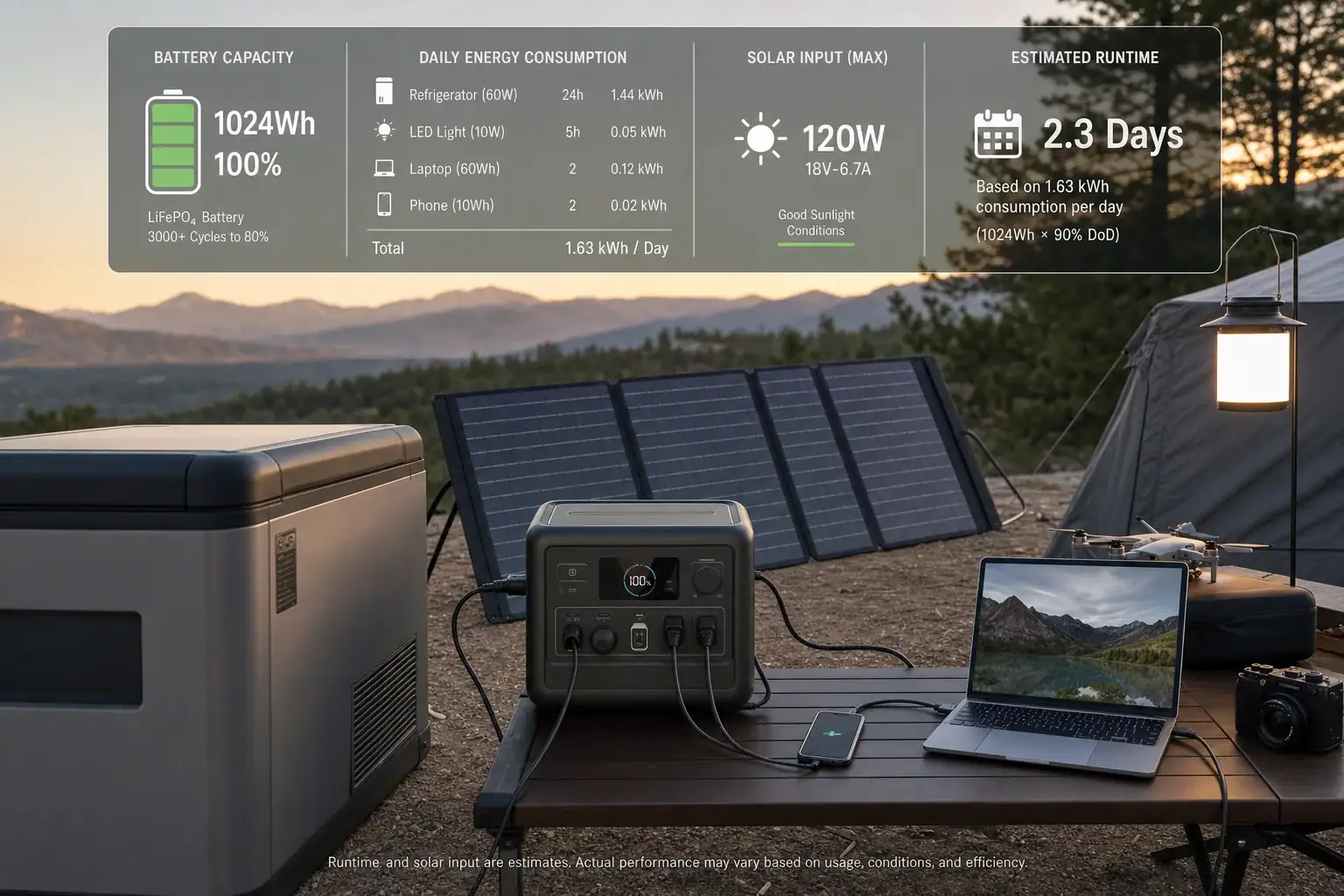
Days of autonomy is the estimated number of days a solar generator or portable power station can run selected devices before its usable stored energy is depleted. It is a practical form of runtime expressed in days rather than hours. The estimate depends on usable battery capacity, daily energy use, inverter loss, and whether solar recharge is available.
Autonomy is not simply the battery’s watt-hour rating divided by the wattage printed on one appliance. Refrigerators cycle, electronics draw standby power, inverters consume energy, and solar output changes with weather and season. A system that appears sufficient on paper may therefore run for less time in actual conditions.
A reliable estimate starts with a daily energy budget for essential loads. It then accounts for conversion losses, battery reserve, temperature, aging, and realistic solar production. This approach helps compare capacities, plan emergency backup, and decide which devices should remain powered when energy is limited.
1. What Days of Autonomy Means and Why It Matters
Days of autonomy describes how long stored energy can support a defined group of loads. In its strictest form, it assumes no new energy enters the battery during that period. A power station with two days of autonomy could support the planned loads for about 48 hours without solar, wall, vehicle, or generator charging.
The phrase is also used more loosely for solar-supported systems. In that context, autonomy may describe how long the system can continue through cloudy weather while receiving little or no useful solar energy. This distinction matters because a system may operate continuously in good sun but last only a day or two when solar production falls.
Autonomy is always tied to a particular load plan. A battery does not have one universal number of days. It might run lights and communication devices for several days, a refrigerator for a shorter period, or a high-wattage heater for only a few hours. The result changes whenever a device, operating schedule, or charging source changes.
This metric is useful for outage preparation, camping, mobile work, and off-grid use. It translates technical specifications into a planning question: how many complete days can the available energy cover while maintaining a reasonable reserve?
2. How Battery Capacity, Loads, and Solar Input Determine Autonomy
The basic calculation uses watt-hours. First estimate usable stored energy:
Usable energy in Wh = nominal battery capacity in Wh × usable capacity percentage
A 2,000 Wh battery operated with a 90% usable allowance provides about 1,800 Wh for planning. The allowance accounts for system protection, reserve settings, conversion losses not included elsewhere, and the preference to avoid planning around a completely empty battery.
Next calculate daily consumption. Multiply each device’s actual or average wattage by its hours of operation per day, then add the results:
Daily energy in Wh = device watts × operating hours per day
A constant 40 W load running for 10 hours uses 400 Wh. A cycling appliance requires its average consumption over time rather than only its running-watt specification. A plug-in energy meter or the power station’s history display can provide a more representative figure.
Without charging, the planning formula is:
Days of autonomy = usable stored energy ÷ total daily energy use
With solar, subtract expected net daily solar harvest from daily use before dividing. Net harvest is the energy that actually reaches the battery after panel conditions, charging losses, and input limits. If expected harvest equals or exceeds consumption, simple division may suggest continuous operation. In practice, battery size still determines how well the system bridges nights, storms, shade, and seasonal shortfalls.
| Load plan | Nominal capacity | Usable allowance | Daily use | Estimated autonomy |
|---|---|---|---|---|
| Lights and communications | 1,200 Wh | 85% | 400 Wh | 2.6 days |
| Refrigeration and small devices | 3,000 Wh | 90% | 1,800 Wh | 1.5 days |
| Basic camping loads | 800 Wh | 90% | 300 Wh | 2.4 days |
3. Real-World Autonomy Examples
Essential electronics during an outage
Suppose a 1,000 Wh power station has an estimated 88% usable allowance, providing 880 Wh. A communication device uses 60 Wh per day, LED lights use 120 Wh, and a small fan uses 280 Wh. Total daily demand is 460 Wh. Dividing 880 Wh by 460 Wh gives about 1.9 days without recharging.
If a solar array delivers 300 Wh of net energy on a reasonably sunny day, the battery must supply only the remaining 160 Wh. Under those conditions, stored energy could cover several days. However, planning around the full solar estimate would leave little margin for clouds, shade, or higher-than-expected fan use.
Refrigerator backup
A refrigerator’s compressor may have a running draw of 100 W but operate only part of each hour. If measured use is 1,500 Wh per day and miscellaneous loads add 300 Wh, total demand is 1,800 Wh per day. A 3,000 Wh station with 90% usable energy provides 2,700 Wh, or approximately 1.5 days of no-solar autonomy.
The refrigerator’s startup surge must also remain within the inverter’s surge capability. Surge capacity affects whether the appliance starts, while battery watt-hours determine how long it can operate. These are separate specifications.
Solar-supported off-grid use
Consider daily loads totaling 900 Wh. A 500 W solar array receiving four effective peak-sun hours has a theoretical yield of 2,000 Wh. After allowing for heat, panel angle, charging conversion, and variable conditions, a planning estimate might be 1,300 to 1,500 Wh.
That harvest could replace the day’s use and recharge some reserve in favorable weather. It does not guarantee indefinite autonomy. Several overcast days, shading, or a power station’s solar input limit could reduce collection below the load. A useful off-grid plan therefore considers both daily energy balance and no-solar reserve.
4. Common Calculation Mistakes and Troubleshooting Cues
Using inverter watts as battery capacity: Inverter output is measured in watts and indicates how much power can be delivered at once. Battery capacity is measured in watt-hours and indicates stored energy. A 2,000 W inverter does not provide 2,000 Wh of capacity unless the battery specification separately says so.
Using rated watts for cycling devices: Refrigerators, pumps, and some climate-control equipment switch on and off. Runtime estimates improve when based on measured watt-hours over a full day rather than a brief wattage reading.
Ignoring conversion and idle losses: AC loads require the inverter, which consumes energy and creates heat. The inverter can also draw power while switched on with no active load. DC or USB outputs may avoid some conversion losses, but they still are not perfectly efficient.
Assuming panel wattage equals daily harvest: A 400 W array rarely delivers exactly 400 W for every daylight hour. Clouds, panel temperature, orientation, shade, cable losses, and the solar charge controller’s voltage and current limits affect collection.
Overlooking hidden loads: Displays, wireless features, adapters, and appliances in standby mode can create meaningful consumption over several days. If runtime is unexpectedly short, disconnect nonessential devices and compare the power station’s reported output with the load inventory.
Planning to zero percent: Displayed state of charge is an estimate, and shutdown may occur earlier under a heavy load, low temperature, or aging battery. Maintaining a planning reserve reduces the chance that essential equipment stops unexpectedly.
5. Safety Basics for Multi-Day Portable Power
Operate portable power stations in dry, ventilated locations within the temperature range stated for the equipment. Keep the unit away from standing water, direct rain, blocked vents, combustible materials, and sources of excessive heat. Do not place it in an enclosed container while charging or supplying substantial loads.
Confirm that continuous output and surge output are suitable for connected appliances. Motors, compressors, and pumps can require a short startup surge several times higher than their normal running power. Repeated overload shutdowns are a cue to reduce the load rather than bypass protection.
Use charging cables and connectors intended for the power station’s input range. Solar panel voltage must remain compatible with the unit’s solar input specification, including expected changes in cold weather. Avoid damaged cords, loose connectors, and improvised adapters.
Never connect a portable power station directly to household wiring through an improvised cord or receptacle. Any system intended to supply home circuits requires approved transfer equipment and evaluation by a qualified electrician. Do not open the power station, alter battery cells, or bypass built-in protections.
For medical equipment, autonomy calculations should not be the only backup plan. Verify compatibility with the device provider, retain an alternate power source when possible, and include extra reserve for delayed charging or unexpected consumption.
6. Maintenance and Storage Factors That Affect Autonomy
Battery capacity gradually declines with age, charge cycles, temperature exposure, and storage conditions. A unit that originally delivered 1,800 usable Wh may provide less after extended service. Rechecking actual runtime periodically helps keep an autonomy plan realistic.
Follow the manufacturer’s storage guidance for state of charge and inspection intervals. For many battery chemistries, moderate charge levels are preferable for long storage, but the appropriate range varies by system design. Avoid leaving a stored unit fully depleted, and recharge it when the level approaches the recommended minimum.
Store the power station in a cool, dry area away from freezing conditions and prolonged high heat. Cold temperatures can temporarily reduce available output and charging performance. High temperatures can accelerate permanent battery aging. Allow equipment to reach an acceptable operating temperature before heavy charging or discharging.
Inspect accessible cables, ports, and housings before use. Stop using equipment that shows swelling, cracks, liquid intrusion, unusual odors, excessive heat, or damaged connectors. Cleaning should be limited to exterior surfaces and performed according to the supplied safety instructions.
Run a periodic load test using the devices included in the emergency plan. Record starting state of charge, watt-hours consumed, operating time, and ending state of charge. This practical test can reveal increased appliance consumption, battery degradation, or settings that create avoidable standby losses.
| Planning factor | Illustrative allowance | Possible effect on autonomy |
|---|---|---|
| Battery aging | Plan with 80% to 90% of original tested capacity | Reduces available days |
| Cold operation | Reserve an extra 10% to 20% | Accounts for temporary capacity reduction |
| Uncertain loads | Add a 15% to 25% energy margin | Helps cover longer operating cycles |
| Periodic load test | Every 3 to 6 months | Confirms the estimate remains realistic |
Related guides: How to Estimate Runtime for Any Device: A Simple Wh Formula + 5 Worked Examples • Energy Budget for a Power Outage: Lights, Phone, Internet, and Small Appliances • How Many Solar Watts Do You Need to Fully Recharge in One Day? • Cold-Weather Capacity Loss: How Much Power You Really Lose • Long-Term Storage Best Practices: Charge Level, Temperature, and Schedule
7. Practical Takeaways and Specs to Look For
Start by identifying essential devices and measuring or estimating their watt-hours per day. Calculate autonomy without solar first because this reveals the system’s stored-energy reserve. Then add a conservative net solar estimate to evaluate how charging may extend operation.
Separate energy capacity from output capability. Watt-hours determine duration, continuous watts determine which loads can run together, and surge watts determine whether motor-driven equipment can start. Build in a margin for conversion losses, battery aging, cold weather, and variable appliance behavior.
A larger battery is not always the only way to gain autonomy. Reducing idle losses, choosing lower-energy loads, limiting operating hours, improving solar exposure, and prioritizing essential devices can extend runtime without changing the power station.
Specs to look for
- Battery capacity in watt-hours: Compare nominal capacities such as 1,000 Wh, 2,000 Wh, or 4,000 Wh because stored watt-hours are the starting point for autonomy.
- Usable capacity: Look for tested or documented usable energy near 80% to 95% of nominal capacity because internal reserves and conversion losses reduce deliverable energy.
- Continuous AC output: Select an output rating above the combined running load, with roughly 20% to 30% headroom, to reduce overload risk.
- Surge output: Check for enough short-duration capacity to start refrigerators, pumps, and other motors because running watts alone may not show startup demand.
- Inverter efficiency and idle draw: Favor clear efficiency information and low no-load consumption, such as an idle draw below roughly 10 to 20 W, because continuous losses accumulate over multiple days.
- Solar input range: Compare maximum input watts, voltage range, and current limit with the planned panels because the lowest applicable limit can cap charging speed.
- Recharge time: Look for realistic AC and solar recharge estimates, such as two to eight hours under stated conditions, because faster recovery can restore reserve between outages or cloudy periods.
- Cycle-life specification: Compare the number of cycles expected before capacity falls to a stated percentage, often around 70% to 80%, because long-term capacity loss directly reduces autonomy.
- Expandable capacity: If multi-day backup is important, check whether compatible external batteries can increase watt-hours without unsafe modifications.
- Operating and storage temperature ranges: Choose ranges appropriate for the intended climate because extreme heat and cold can reduce performance, charging ability, and battery life.
The most useful autonomy figure is conservative, load-specific, and updated with real measurements. Treat solar production as a variable energy source rather than a guarantee, maintain a reserve for essential loads, and repeat the calculation whenever battery condition or daily consumption changes.
Frequently asked questions
How do I calculate days of autonomy for a portable power station?
Estimate usable battery energy in watt-hours, then divide it by the total watt-hours your planned devices use each day. For a more realistic result, include inverter losses, standby consumption, battery reserve, and any reduction expected from cold temperatures or battery aging.
Can solar panels provide unlimited days of autonomy?
Solar panels can extend runtime substantially when their net daily energy production meets or exceeds daily consumption. They do not guarantee unlimited operation because production changes with weather, shade, season, panel angle, and the power station’s solar input limits. Battery capacity is still needed to cover nighttime use and periods of poor solar generation.
What solar generator specs matter most for multi-day backup?
Battery capacity in watt-hours is the primary specification for estimating duration, while continuous and surge output determine which appliances can run. Also compare usable capacity, inverter idle draw, solar input voltage and wattage limits, charging efficiency, operating temperature range, and whether the battery can be expanded.
What is the most common mistake when estimating portable power station runtime?
A common mistake is dividing battery watt-hours by an appliance’s listed running watts without accounting for operating time and losses. Cycling appliances such as refrigerators should be estimated from measured daily watt-hour use, and the calculation should include inverter consumption, standby loads, and a reserve rather than assuming the battery can be used to zero.
How many days can a portable power station run a refrigerator?
The answer depends on the refrigerator’s measured daily energy use and the power station’s usable battery capacity. For example, a refrigerator and small miscellaneous loads using 1,800 Wh per day would use a 2,700 Wh usable battery reserve in about 1.5 days without recharging. The station must also have enough surge output to start the compressor.
Is it safe to use a portable power station indoors during an outage?
Battery-powered portable power stations can generally be used indoors when operated in a dry, well-ventilated area and according to the manufacturer’s instructions. Keep vents clear, avoid heat and water exposure, use undamaged cables, and do not connect the unit directly to household wiring without approved transfer equipment installed by a qualified electrician.
Related guides
Browse this topic →
- Beginner-friendly sizing, runtime & specs
- Solar & charging (MPPT, fast charging, cables)
- Batteries (LiFePO4, cycles, care & storage)
- Safety, cold-weather performance, real-world tips
More in Capacity
See all →- Two Small Power Stations vs One Large Power Station: Which Backup Setup Is Better?
- How to Build a Load Priority List for a Portable Power Station During Blackouts
- Usable Capacity vs Advertised Capacity: Why 1,000Wh Doesn’t Mean 1,000Wh at the Outlet
- Why Output Ports Have Separate Watt Limits on Portable Power Stations
- Runtime Planning for Mixed Loads: AC, DC, and USB at the Same Time
Keep reading
About this site
Portable Energy Lab publishes practical, independent guides about portable power—clear sizing, safe use, and real-world expectations.
Affiliate disclosure
Some links on this site may be affiliate links. If you buy through these links, we may earn a small commission at no extra cost to you. This helps support our content. Read our affiliate disclosure.