
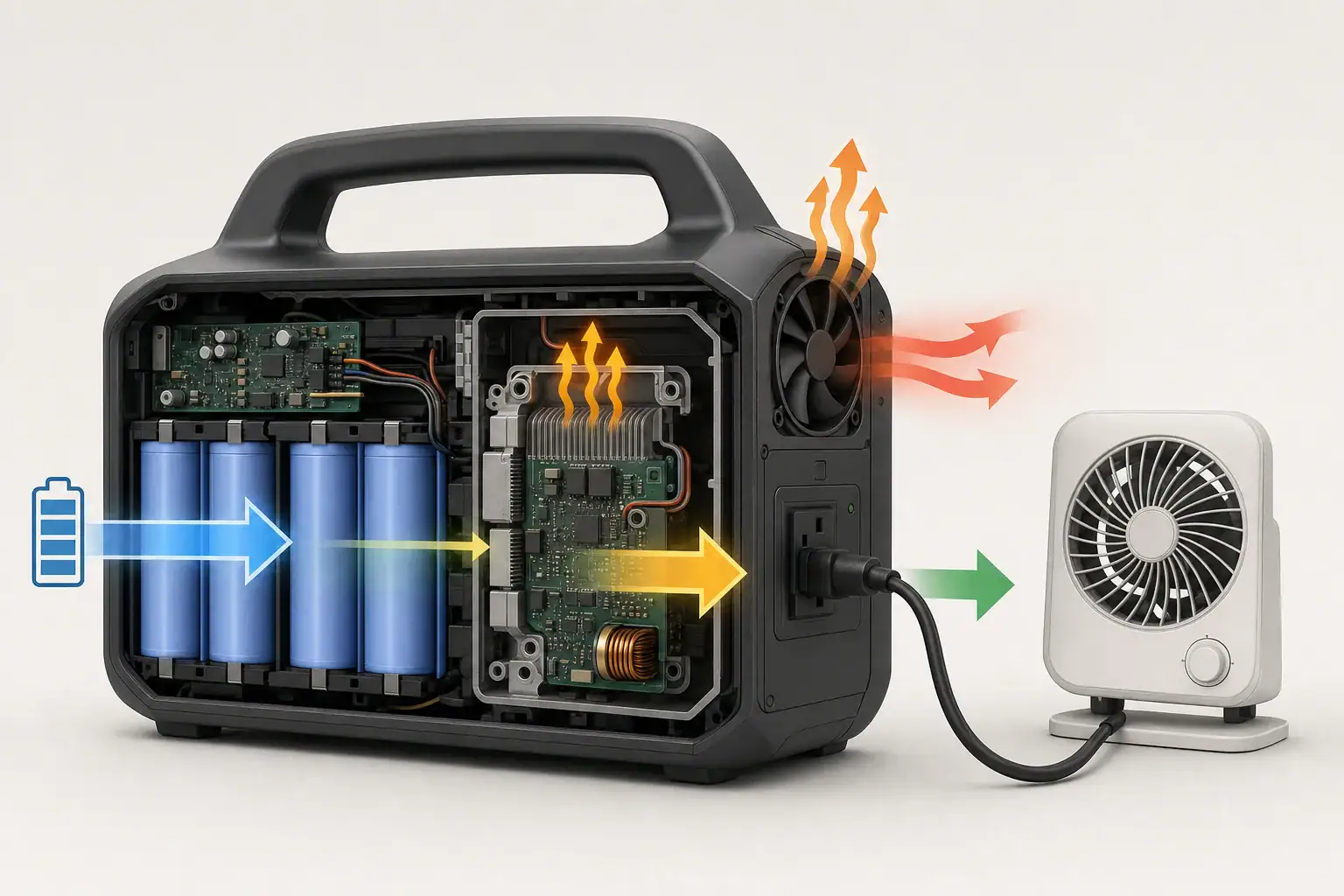
Large power stations waste energy on small AC loads because the inverter consumes power simply by being switched on, even when the connected device needs only a few watts. This AC inverter standby loss, also called inverter idle draw, no-load consumption, or parasitic drain, can substantially reduce runtime.
A high-capacity unit may contain an inverter designed to supply 1,500 watts, 2,000 watts, or more. Keeping its control circuits, switching electronics, cooling system, and AC output active requires energy. That fixed overhead matters little with a large appliance, but it can equal or exceed the demand of a router, clock, charger, or other small load.
As a result, the displayed AC efficiency or estimated runtime may look unexpectedly poor. Eco mode can help in some situations, but it may also shut the outlet off when a load is below its detection threshold. Understanding the difference between battery capacity, inverter efficiency, and standby consumption makes it easier to choose the right output and estimate realistic operating time.
What AC inverter standby loss means and why it matters
A portable power station stores direct-current energy in its battery. Its AC inverter converts that energy into household-style alternating current. Standby loss is the battery power consumed while the inverter is enabled but supplying no useful load, or only a very small one.
This loss is usually expressed in watts. If an active inverter draws 15 watts before powering anything, it consumes about 15 watt-hours every hour. Over 10 hours, that is roughly 150 watt-hours unavailable to the connected equipment. Actual battery use may differ because control electronics, temperature, cooling fans, display activity, and battery-management overhead can add further consumption.
Standby loss matters most when the useful load is small or runs for a long time. A 15-watt overhead is minor beside a 1,000-watt appliance, but it is significant beside a 5-watt modem. It can also make a large-capacity station deliver less runtime than a simple capacity-divided-by-load calculation suggests.
How inverter size, efficiency, and fixed overhead interact
An inverter does not have one efficiency percentage that applies at every output level. Its conversion efficiency normally changes with load. It may perform well near a moderate share of its rated output while becoming relatively inefficient at very low loads.
Total battery draw can be estimated as the useful AC load divided by conversion efficiency, plus any overhead not already included in that efficiency figure. For example, a 20-watt device operating through an inverter at 80% efficiency would require about 25 watts before additional system losses. If measured standby overhead adds another 12 watts, total battery-side demand could approach 37 watts.
Inverter rating also affects the design tradeoff. A large inverter needs components capable of handling high current, surge watts, voltage regulation, and thermal stress. It does not necessarily consume more at idle than every smaller inverter, but oversized systems often have more active circuitry than low-power converters. The relevant specification is measured no-load consumption, not inverter wattage alone.
Eco mode reduces waste by turning off or sleeping the inverter when output falls below a set threshold. It periodically checks for a load and restarts when demand rises. This works well for some intermittent appliances, but continuous low-watt devices may fail to keep the inverter awake.
| Useful AC load | Inverter overhead | Approximate total draw | Overhead share |
|---|---|---|---|
| 5 W | 15 W | 20 W | 75% |
| 20 W | 15 W | 35 W | 43% |
| 100 W | 15 W | 115 W | 13% |
| 500 W | 15 W | 515 W | 3% |
Real-world runtime examples with small AC loads
Consider a power station with 1,000 watt-hours of nominal battery capacity. A basic calculation suggests that a 10-watt internet router could run for 100 hours. That result assumes every stored watt-hour reaches the router, which is not realistic.
If the inverter and supporting electronics consume 15 watts while the router uses 10 watts, battery draw is already about 25 watts before accounting for other conversion losses. Usable runtime might then be closer to 30 to 36 hours, depending on usable battery capacity, temperature, state of charge, and shutdown reserve. The large difference is caused by fixed overhead continuing every hour.
A 60-watt television presents a different balance. Adding 15 watts of overhead produces roughly 75 watts of battery demand before smaller losses. The overhead remains important, but it no longer dominates consumption. With a 600-watt appliance, the same 15-watt draw has only a modest effect on runtime.
Intermittent loads require separate analysis. A compact refrigerator may draw 70 watts while its compressor runs and almost nothing between cycles. Eco mode could save energy during the off periods, but only if it reliably detects the next startup and supports the compressor surge. Without eco mode, the inverter continues consuming standby power throughout every idle period.
Common mistakes and troubleshooting cues
One common mistake is dividing advertised battery capacity by the appliance wattage and treating the answer as guaranteed runtime. Nominal capacity is measured at the battery, while the appliance receives energy after conversion and system losses. Battery reserve, temperature, cell voltage, and meter calibration also affect usable energy.
Another mistake is trusting a small AC plug meter as the complete measurement. It reports power delivered to the appliance but usually cannot see energy consumed inside the power station. To identify standby loss, compare the station’s battery-side discharge reading with the measured AC output when possible. Display values may be rounded, especially below 10 watts, so a longer runtime test can reveal more than an instant reading.
If the battery percentage falls while AC output shows zero watts, likely causes include inverter idle draw, display rounding, wireless features, cooling, or background electronics. If an outlet repeatedly switches off, check whether eco mode is enabled and whether the load is below its detection threshold. A device that cycles on and off unexpectedly may also have an intermittent demand pattern that the inverter does not recognize.
- Confirm that no other AC or DC outputs are active.
- Turn off unnecessary displays, wireless control, or lighting features.
- Compare battery decline with the AC outlet disabled and enabled over equal periods.
- Test eco mode cautiously to verify that the connected equipment restarts correctly.
- Use a direct USB or regulated DC output when its voltage, connector, and power rating match the device.
Direct DC operation can avoid AC conversion, but it is not automatically safe or efficient. The output voltage and polarity must match the equipment, and the port must support the required starting and continuous current.
Safety basics when using AC outputs
Standby loss is mainly an efficiency issue, but normal electrical precautions still apply. Keep the power station dry, allow ventilation around cooling openings, and do not cover it to suppress fan noise. Heat raises conversion losses and may trigger output reduction or shutdown.
Use cords and power strips rated for the actual load. Inspect plugs for damage, looseness, discoloration, or unusual heat. A small steady load is unlikely to approach the inverter’s continuous rating, but another appliance connected to the same station can create an overload or high surge.
Do not open the enclosure, modify the battery, bypass protection systems, or attempt to alter the inverter’s sleep threshold. Do not connect a portable power station directly to home wiring through improvised cords. Any connection intended to supply building circuits requires properly approved equipment and a qualified electrician.
Critical medical, communications, or safety equipment should not rely on eco mode unless its behavior has been verified. Automatic outlet shutdown can be more consequential than the energy saved.
Maintenance and storage practices that limit avoidable loss
AC standby loss does not usually indicate a damaged battery. However, unnecessary time with the inverter enabled adds charge cycles over the long term. Turn off the AC section when no AC device is in use rather than relying only on unplugging the appliance.
Store the station according to its stated charge and temperature guidance, with all outputs disabled. Check it periodically because battery-management electronics may consume a small amount of energy even when the main outlets are off. Avoid leaving the battery fully depleted for extended periods.
Keep vents free of dust and debris so the inverter can cool efficiently. If idle consumption rises sharply, the fan runs continuously at room temperature, or the case becomes warm with no connected load, shut the AC output off and consult qualified service support. Compare tests at similar temperatures and states of charge because cold or hot conditions can distort runtime results.
| Inverter idle draw | Energy used in 8 hours | Energy used in 24 hours | Energy used in 72 hours |
|---|---|---|---|
| 5 W | 40 Wh | 120 Wh | 360 Wh |
| 15 W | 120 Wh | 360 Wh | |
| 25 W | 200 Wh | 600 Wh | 1,800 Wh |
Related guides: Inverter Idle Consumption Explained: How Much Power You Lose Just Having AC On • How to Estimate Runtime for Any Device: A Simple Wh Formula + 5 Worked Examples • Usable Capacity vs Advertised Capacity: Why 1,000Wh Doesn’t Mean 1,000Wh at the Outlet
Practical takeaways and specs to compare
For small continuous loads, the most efficient option is often a properly matched USB or DC output that avoids running the AC inverter. When AC is required, estimate runtime using usable battery capacity and total battery-side draw rather than appliance wattage alone. A station’s large watt-hour capacity does not guarantee efficient operation at low output.
For an approximate test, fully charge the station, disable unrelated features, connect a stable known load, and record battery percentage or reported energy over several hours. Repeat with the AC inverter enabled but no appliance connected. Because percentage displays are coarse, longer tests generally provide a more useful comparison. Stop if the equipment behaves abnormally or becomes excessively warm.
Specs to look for
- AC no-load consumption: Look for a disclosed value in watts, such as roughly 5 to 20 watts; lower draw preserves runtime on small loads.
- Low-load efficiency: Look for efficiency data at loads such as 10, 25, or 50 watts, not only near full output; this shows how the inverter handles electronics and chargers.
- Usable battery capacity: Look for measured AC-delivered watt-hours or a clearly stated usable-energy estimate; nominal cell capacity alone can overstate runtime.
- Eco mode threshold: Look for a documented or adjustable threshold, often in the approximate 5-to-30-watt range; it determines whether small devices keep the outlet awake.
- Eco mode restart behavior: Look for automatic load checks and reliable restart with intermittent equipment; poor detection can interrupt refrigerators, pumps, or communications devices.
- Independent output controls: Look for separate switches for AC, USB, and DC sections; this prevents unused conversion circuits from remaining active.
- Regulated DC outputs: Look for voltage, current, connector, and power specifications that match intended devices; a suitable direct output can avoid inverter loss.
- Display resolution: Look for input and output readings that register low single-digit or low double-digit watts; better resolution helps diagnose parasitic draw.
- Continuous and surge ratings: Look for enough capacity for the intended appliance without extreme oversizing; adequate surge support matters for motors even when average consumption is low.
The key comparison is not simply battery size or maximum inverter watts. For routers, monitoring equipment, lighting, chargers, and other small loads, no-load draw, low-load efficiency, eco mode behavior, and suitable DC outputs often have a greater effect on practical runtime.
Frequently asked questions
How much AC inverter standby loss is normal?
Idle draw varies by inverter design, output capacity, temperature, and enabled features. A few watts to several tens of watts may be possible, so the most useful comparison is the manufacturer’s measured AC no-load consumption in watts.
Why does my power station battery drop when nothing is plugged into the AC outlet?
The AC inverter can continue using battery power for its switching electronics, controls, display, cooling, and output circuitry even with no appliance connected. Wireless functions and other active outputs may also contribute, while low readings on the display can be rounded to zero.
What power station specs matter most for small AC loads?
Look for AC no-load consumption, efficiency at low output levels, usable AC-delivered capacity, and eco mode threshold and restart behavior. Independent output switches and suitably rated USB or regulated DC ports can also reduce unnecessary conversion losses.
Is it a mistake to calculate runtime by dividing watt-hours by appliance watts?
Yes, that calculation is only a theoretical starting point because it assumes all stored battery energy reaches the appliance. Actual runtime can be lower due to inverter standby draw, conversion losses, battery reserve, temperature, and the station’s usable capacity.
Should eco mode be used with a router or other low-watt device?
Eco mode may reduce energy use, but a low-watt device can fall below the inverter’s detection threshold and cause the outlet to shut off. Test the setting with the specific device before relying on it for communications, monitoring, or other equipment that must remain powered.
Is it safe to leave an AC inverter turned on overnight?
It can be safe when the power station is used according to its instructions, kept dry and well ventilated, and connected with properly rated cords. However, leaving the inverter on can consume substantial energy, so it should be switched off when AC power is not needed.
Related guides
Browse this topic →
- Beginner-friendly sizing, runtime & specs
- Solar & charging (MPPT, fast charging, cables)
- Batteries (LiFePO4, cycles, care & storage)
- Safety, cold-weather performance, real-world tips
More in Capacity
See all →- Two Small Power Stations vs One Large Power Station: Which Backup Setup Is Better?
- How to Build a Load Priority List for a Portable Power Station During Blackouts
- Usable Capacity vs Advertised Capacity: Why 1,000Wh Doesn’t Mean 1,000Wh at the Outlet
- Why Output Ports Have Separate Watt Limits on Portable Power Stations
- Runtime Planning for Mixed Loads: AC, DC, and USB at the Same Time
Keep reading
About this site
Portable Energy Lab publishes practical, independent guides about portable power—clear sizing, safe use, and real-world expectations.
Affiliate disclosure
Some links on this site may be affiliate links. If you buy through these links, we may earn a small commission at no extra cost to you. This helps support our content. Read our affiliate disclosure.