
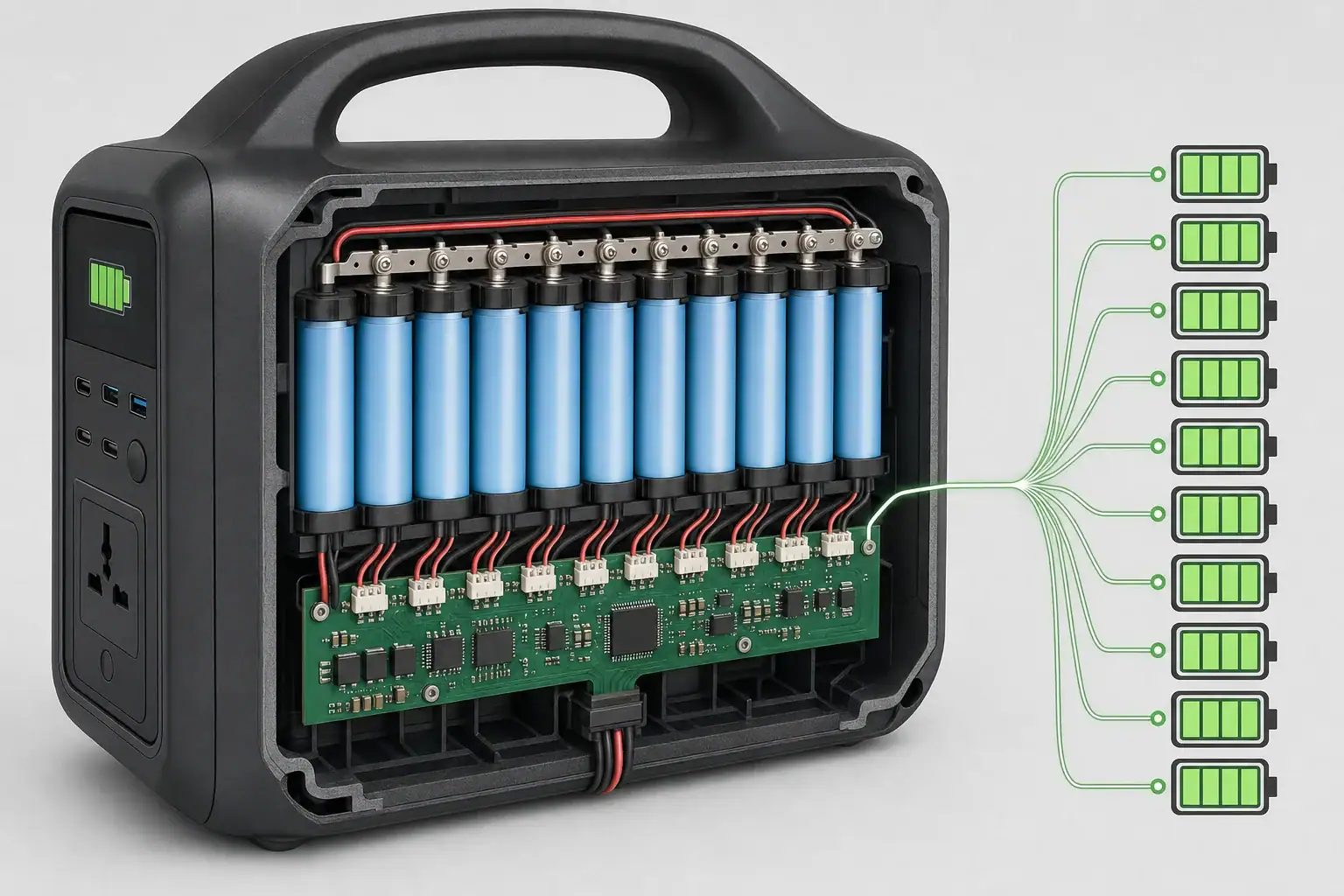
A full charge can sometimes improve a portable power station because it gives the battery management system enough time and voltage headroom to balance individual cells and correct its charge estimate. This may help when battery cells are out of balance, the state of charge drops unexpectedly, runtime seems unusually short, or the unit experiences an early shutdown.
However, charging to 100% is not a universal repair. It is most useful when the issue involves mild cell-voltage drift or BMS calibration rather than permanent battery degradation, extreme temperatures, a faulty charger, or an oversized load. Some systems balance mainly near the top of the charging range, while others balance over a wider range.
The practical goal is not to keep the battery full continuously. It is to occasionally let a compatible system complete its normal charging and balancing process, while following the operating and storage guidance for its battery chemistry.
What battery cell balancing means and why it matters
A portable power station battery contains many individual cells arranged in series and, in larger units, parallel groups. Cells connected in series contribute to the pack’s total voltage. Although they are manufactured to similar specifications, small differences in capacity, internal resistance, temperature, and self-discharge develop over time.
Cell balancing is the process of reducing differences in state of charge among those series-connected cells or cell groups. The battery management system, commonly called the BMS, monitors cell voltages and protects the pack against conditions such as overvoltage, undervoltage, overcurrent, and excessive temperature.
Balance matters because pack operation is limited by the highest or lowest cell, not merely by the average pack voltage. During charging, one high cell may reach its upper protection threshold before the others are full. During discharge, one low cell may reach its lower threshold while the display still shows remaining capacity. The BMS may then stop charging or shut off output to protect the battery.
Balancing can recover usable access to capacity that was being restricted by voltage mismatch. It does not recreate capacity lost through chemical aging, repair a damaged cell, or make an old battery equivalent to a new one.
How a full charge can help the balancing process
Many portable power stations use passive balancing. Small circuits remove a limited amount of energy from higher-voltage cells, often by dissipating it as heat, so lower-voltage cells can catch up. Passive balancing currents are generally small compared with the main charging current, which means balancing may require additional time.
Some BMS designs activate or become more effective only after cells enter an upper voltage range. Reaching the displayed 100% level and remaining connected to an approved charging source may therefore provide the conditions and time needed for the voltage spread to narrow. The charger may pause, restart briefly, or hold a controlled finishing stage while the BMS works.
Balancing and charge-gauge calibration are related but different. Balancing addresses differences among cells. Calibration helps the system estimate the pack’s state of charge by comparing voltage, current flow, and learned capacity against recognizable high or low reference points. A full charge may improve the percentage display even if cell imbalance was not the main problem.
Not every product balances only at full charge, and a displayed 100% does not prove that balancing is complete. The behavior depends on battery chemistry, BMS programming, charger design, temperature, and the size of the cell-voltage difference.
| Observed spread | Possible interpretation | Likely behavior |
|---|---|---|
| 5–15 mV | Cells are relatively close | Normal charging and discharge are more likely |
| 20–50 mV | Mild drift may be present | Additional balancing time may help |
| Over 100 mV | Significant mismatch or measurement issue | Protection may activate early; support may be needed |
Real-world examples of when a full charge may help
Unexpected shutdown with capacity remaining: A power station may turn off at a displayed 15% or 20% because one cell group reaches its low-voltage cutoff before the pack average suggests it should. If the mismatch is mild, a complete uninterrupted charge may allow balancing and improve the next discharge cycle.
The percentage jumps near empty or full: A display that moves rapidly from 10% to 0%, or remains at 99% for an unusually long time, may reflect charge-gauge estimation rather than a serious cell fault. Completing a normal charge can provide a high reference point for BMS calibration. One controlled discharge and recharge cycle may be suggested by the manufacturer, but repeated deep cycling should not be treated as routine maintenance.
Runtime seems lower after months of shallow cycling: Repeatedly operating within a narrow middle range can leave some charge gauges without recent endpoint data. An occasional full charge may improve the estimate. Actual runtime should still be assessed with a consistent load because inverter losses, temperature, idle consumption, and load type affect results.
Charging stops below the expected percentage: Balancing may be one explanation, but it is not the only one. Input power limits, battery temperature, charging schedules, conservation modes, charger compatibility, and protection events can also prevent a complete charge. If the unit repeatedly stops far below full, further troubleshooting is more appropriate than repeatedly reconnecting the charger.
Common mistakes and useful troubleshooting cues
Assuming every runtime problem is imbalance: High AC loads, poor power factor, cold conditions, inverter overhead, and battery aging can all reduce delivered watt-hours. Compare results using the same moderate load, similar temperature, and the same output type before drawing conclusions.
Disconnecting as soon as the display reaches 100%: On systems that balance near the top, the percentage may reach 100% before the finishing process is complete. If the instructions permit it, leaving the unit connected for a modest additional period, such as one to three hours, may help. It should remain in a ventilated location and should not be left unattended for an excessive period.
Repeatedly draining the battery to zero: A deep cycle may occasionally help recalibrate some charge gauges, but frequent full discharges add cycle wear and can leave the battery unavailable when needed. Start with a normal full charge rather than forcing an unnecessary deep discharge.
Balancing while powering a variable load: Pass-through operation or fluctuating output can make it harder to determine whether charging has finished. When practical, perform a diagnostic full charge with major outputs turned off. Do not interrupt equipment that requires continuous power merely to test the battery.
Ignoring temperature: Lithium batteries may charge slowly or refuse charging when too cold or hot. Move the power station to a dry, moderate environment and allow its internal temperature to stabilize before reassessing it. Never apply direct heat.
Warning signs that call for manufacturer support or qualified service include repeated protection shutdowns, severe runtime loss, a charge percentage that remains erratic after a normal full charge, unusual odor, swelling, hissing, visible damage, or excessive heat. Do not open the enclosure, probe battery cells, bypass the BMS, or modify the charger.
Safety basics for full charging and balancing
Use a charging source and cable that meet the power station’s specified voltage, current, polarity, and input protocol. An incompatible adapter can fail to charge correctly or create a safety risk. Place the unit on a stable, nonflammable surface with clear ventilation openings, and keep it away from water, direct sun, heaters, and combustible clutter.
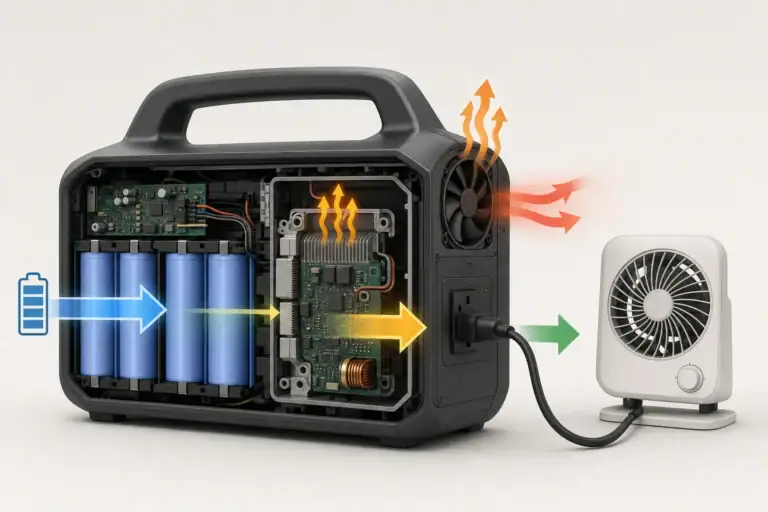
Normal charging can produce mild warmth, especially near the power electronics. Stop charging if the enclosure becomes unusually hot, changes shape, emits an odor, or produces unfamiliar sounds. Disconnect power only if it is safe to do so, move away from the area, and follow the product’s emergency guidance.
A full charge should not be performed solely to override a protection event. The BMS cutoff is a safety function, not an obstacle to bypass. If charging repeatedly stops with a fault code or temperature warning, identify the stated condition rather than forcing repeated restart attempts.
Portable power stations should not be connected to household wiring through improvised cords or unapproved arrangements. Any home integration should use suitable equipment and be evaluated or installed by a qualified electrician.
Maintenance and storage practices that limit cell drift
For routine use, avoid treating either 0% or 100% as the ideal permanent state. Lithium batteries generally age faster when stored for long periods at high temperature and high state of charge. A moderate storage level, often around 40% to 70%, is a practical range when the manufacturer’s instructions do not specify otherwise.
Turn the unit fully off for storage when possible because displays, wireless features, and control electronics can slowly drain the pack. Check it periodically, such as every two or three months, and recharge before it becomes deeply depleted. Products with higher standby consumption may need more frequent checks.
An occasional full charge can be reasonable after many partial cycles, before a runtime test, or when the charge display becomes inconsistent. It does not need to occur on a rigid schedule unless the product documentation specifies one. After balancing or calibration, use or discharge the power station to an appropriate storage level if it will not be needed soon.
Store the unit in a dry, temperature-controlled location and inspect the case, ports, and cables before use. Record charging time, delivered runtime, ambient temperature, and load wattage when tracking a suspected problem. Consistent records make it easier to separate cell imbalance from normal changes in operating conditions.
| Situation | Practical charge target | Reason |
|---|---|---|
| Long-term storage | About 40%–70% | Reduces time spent at voltage extremes |
| Emergency readiness | About 80%–100% | Prioritizes available energy over maximum longevity |
| Suspected mild imbalance | Complete normal charge | May give the BMS time to balance near the top |
| Routine cycling | Use a comfortable middle range | Avoids unnecessary deep cycles |
Related guides: Battery Cycle Life Explained: What “Cycles” Really Mean • Best Storage Charge Percentage: 40% vs 60% vs 80% (What Battery Chemistries Prefer) • Temperature Limits Explained: Safe Charging/Discharging Ranges and What Happens Outside Them
Practical takeaways and specs to look for
A full charge is most likely to help when a portable power station has mild cell-voltage drift or an inaccurate state-of-charge estimate. Charge it under moderate temperatures with compatible equipment, minimize major output loads during the test, and allow a reasonable finishing period if the instructions permit. Then compare runtime under a repeatable load.
If performance does not improve, the underlying cause may be battery wear, a weak cell group, a temperature restriction, charging hardware, high conversion losses, or a demanding load. Persistent faults and physical warning signs require support rather than repeated cycling.
Specs to look for
- Battery chemistry: Look for a clearly identified chemistry, such as lithium iron phosphate or another lithium-ion type, because chemistry affects voltage behavior, cycle life, storage practices, and balancing thresholds.
- Rated battery capacity: Compare watt-hours rather than amp-hours alone; capacities such as 500 Wh, 1,000 Wh, or 2,000 Wh make expected runtime easier to estimate.
- Usable energy information: Look for tested or stated delivered energy under representative AC and DC loads, because inverter and conversion losses mean usable output is lower than nominal capacity.
- BMS protections: Look for cell-level overvoltage, undervoltage, overcurrent, short-circuit, and temperature monitoring because these controls help prevent unsafe operation and limit damage from cell mismatch.
- Cell-balancing design: Look for confirmation that balancing is built into the BMS and, when disclosed, whether it is passive or active; this indicates how the pack manages cell-voltage drift.
- Charge completion behavior: Look for documentation explaining whether balancing continues at 100% and whether extra connection time is recommended, because procedures vary among BMS designs.
- Cycle-life rating: Look for a stated capacity-retention point, such as 2,000 to 4,000 cycles to about 80% capacity, because a cycle number without a retention threshold is difficult to compare.
- Operating and charging temperatures: Look for separate ranges, such as charging near 32°F to 104°F and a wider discharge range, because temperature restrictions can resemble charging or balancing faults.
- Battery status detail: Look for input and output watts, estimated time remaining, temperature alerts, and clear fault codes because detailed feedback makes imbalance and runtime problems easier to diagnose.
Battery cell balancing is an automatic battery-management function, not a user repair procedure. A well-documented power station should handle it internally while providing enough status information to recognize when charging is normal and when professional support is appropriate.
Frequently asked questions
How often should I charge a portable power station to 100% for battery cell balancing?
There is no universal schedule because balancing behavior depends on the battery chemistry and BMS programming. A normal full charge can be useful after many partial cycles, before a repeatable runtime test, or when the percentage display becomes inconsistent. Follow the product instructions rather than keeping the unit at 100% continuously.
Can cell balancing fix a portable power station that shuts down early?
It may help if mild voltage drift causes one cell group to reach its low-voltage cutoff before the rest of the pack. It will not fix capacity loss from aging, a damaged cell group, excessive load demand, or a charging-system fault. If early shutdowns continue after a normal complete charge, further diagnosis or service may be needed.
Is it bad to drain a portable power station to 0% to balance the cells?
Repeatedly draining a lithium battery to zero is a common mistake because it adds cycle wear and is not normally required for cell balancing. Some manufacturers may recommend one controlled discharge-and-recharge cycle to check charge-gauge accuracy, but this should not become routine maintenance. A normal uninterrupted full charge is usually the better first step.
What battery specs and features matter for managing cell imbalance?
Look for a BMS with cell-level voltage and temperature monitoring, overvoltage and undervoltage protection, and documented cell-balancing capability. It is also useful to know the battery chemistry, rated watt-hours, charging-temperature range, cycle-life rating with a capacity-retention threshold, and whether the documentation explains charge-completion behavior. Clear fault codes and detailed battery-status information can make troubleshooting easier.
Is it safe to leave a portable power station connected after it reaches 100%?
It can be appropriate for a limited finishing period if the product instructions allow it and the unit is using a compatible charger in a dry, ventilated location. Do not leave it unattended for an excessive time, block its vents, use damaged cables, or attempt to override protection warnings. Stop charging and seek guidance if there is unusual heat, swelling, odor, hissing, or visible damage.
Why does my power station show 100% but still have short runtime?
A 100% reading reflects the BMS estimate and does not guarantee the battery can deliver its original rated energy. Battery aging, cold temperatures, inverter losses, idle consumption, and high or variable loads can all shorten runtime. Test the unit with a consistent moderate load and compare the delivered energy with its rated watt-hour capacity.
Related guides
Browse this topic →
- Beginner-friendly sizing, runtime & specs
- Solar & charging (MPPT, fast charging, cables)
- Batteries (LiFePO4, cycles, care & storage)
- Safety, cold-weather performance, real-world tips
More in Battery
See all →- Portable Power Station Expansion Batteries: When Extra Capacity Makes Sense
- Lithium-Ion vs LiFePO4 Batteries Explained
- LiFePO4 vs Lithium-Ion in Cold Weather: Which Holds Up Better?
- Best Storage Charge Percentage: 40% vs 60% vs 80% for Different Battery Chemistries
- Why Battery Capacity Drops in Cold and Heat (and How to Get Better Runtime)
Keep reading
About this site
Portable Energy Lab publishes practical, independent guides about portable power—clear sizing, safe use, and real-world expectations.
Affiliate disclosure
Some links on this site may be affiliate links. If you buy through these links, we may earn a small commission at no extra cost to you. This helps support our content. Read our affiliate disclosure.