
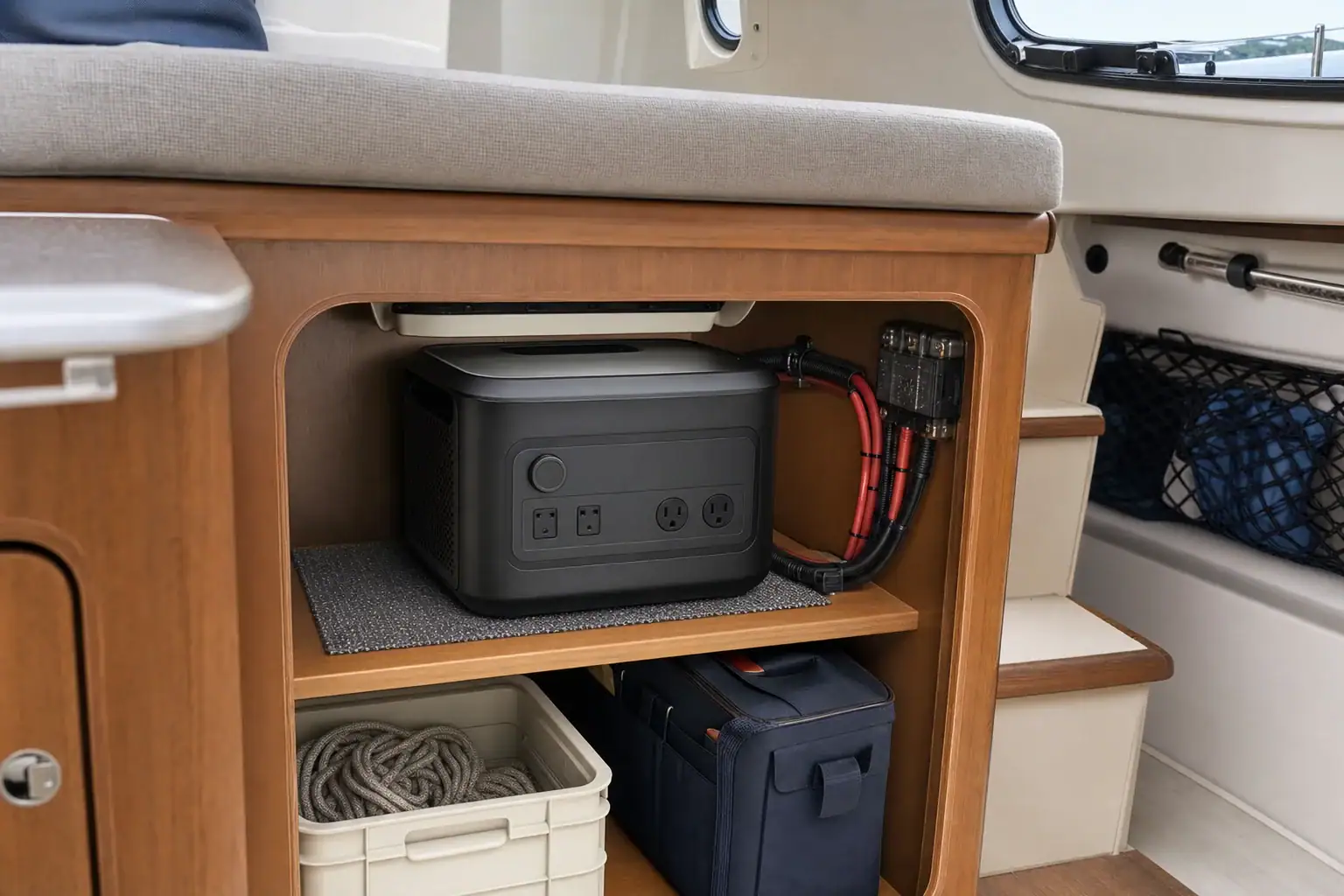
A portable power station can run many boat electronics safely when its 12V output, capacity, and environmental protection match the load. The key checks are the 12V amperage limit, surge watts, connector type, estimated runtime, and whether the unit can be kept away from spray and salt deposits.
Portable stations are useful for lights, device charging, small coolers, communications equipment, and occasional AC appliances. However, most are not marine electrical systems, starter batteries, or permanently installed replacements for a properly fused house bank. Their advertised watt-hours also do not equal the energy that reaches a connected appliance.
For dependable use, calculate each load before departure, leave operating margin, secure the station against movement, and store it in a dry, ventilated location. A pure sine wave inverter may help sensitive AC equipment, while a regulated DC output can improve consistency for compatible 12V loads.
What a Portable Power Station Means for Boat Use
A portable power station combines a rechargeable battery, charging electronics, DC outputs, and an AC inverter in one movable enclosure. On a boat, it can serve as a temporary or supplemental energy source without running an engine or generator.
Its role should be defined carefully. It may be suitable for comfort loads and backup charging, but it should not automatically become the sole source for bilge pumping, navigation lights, distress communications, or other safety-critical equipment. Those systems are normally better served by a dedicated marine electrical installation with appropriate batteries, fusing, conductors, and redundancy.
The marine environment also changes the risk profile. Salt aerosol can settle on ports and circuit surfaces, moisture can enter through open covers, and boat motion can turn an unsecured battery into a heavy projectile. A station that performs well on land still needs protected placement and inspection aboard a boat.
How 12V Loads, Watts, and Runtime Work
A nominal 12V outlet has a maximum current rating. Multiply voltage by amperage to estimate its power ceiling: a 12V, 10A port can provide roughly 120 watts under ideal conditions. A load rated at 15A should not be connected merely because the plug fits. The station may shut down, cycle repeatedly, or overheat a poorly matched connector.
Check whether the DC output is regulated. Some outputs remain near their stated voltage as the battery discharges, while others vary. Voltage-sensitive electronics and compressor coolers may work more consistently from a regulated output, provided their startup demand remains below the port limit.
Runtime can be estimated by multiplying appliance watts by operating hours and comparing the result with usable watt-hours. For example, a 40-watt load running continuously for five hours requires about 200 watt-hours. Conversion losses, standby consumption, temperature, and compressor cycling affect the result, so a 15% to 30% reserve is practical.
AC operation adds inverter loss. When an appliance can accept either compatible DC power or AC power, the DC connection will often provide longer runtime. AC appliances with motors may also have startup surge watts several times higher than their normal running watts.
| Illustrative load | Typical draw | Energy for stated use | Main check |
|---|---|---|---|
| LED cabin lights | 12 watts | 48 Wh for 4 hours | DC voltage and connector |
| Compressor cooler | 45 watts while running | 180 Wh for 4 running hours | Startup current |
| Phone charging | 15 watts | 30 Wh for 2 hours | USB charging profile |
| Small AC fan | 35 watts | 210 Wh for 6 hours | Inverter overhead |
Real-World Boat Power Examples
Day trip with lighting and device charging
Suppose two LED lights draw a combined 12 watts for four hours, and phones require 60 watt-hours total. The planned demand is about 108 watt-hours. After allowing for losses and reserve capacity, a station with roughly 150 to 200 usable watt-hours could cover this limited plan. The output ports must still support the lights’ voltage and the devices’ charging requirements.
Overnight use with a compressor cooler
A cooler rated at 45 watts may not draw that amount continuously. If its compressor runs half the time over 12 hours, the estimated energy use is 270 watt-hours. Warm weather, frequent lid opening, poor ventilation, and recently loaded food can increase runtime. Adding lights and electronics may bring the overnight budget closer to 400 watt-hours before reserve.
Occasional AC appliance
A 300-watt appliance used for 15 minutes consumes about 75 watt-hours before inverter losses. Although that energy total is modest, the inverter must support both its running wattage and startup surge. Heating appliances can consume capacity especially quickly and may exceed the station’s continuous AC rating.
These calculations are planning tools rather than guarantees. Equipment labels, measured consumption, ambient temperature, battery condition, and duty cycle provide a more reliable estimate than using generic averages alone.
Common Mistakes and Troubleshooting Cues
- Using watt-hours as an output rating: Watt-hours describe stored energy, while watts and amps describe how much power an outlet can deliver. A large battery can still have a low-current 12V port.
- Ignoring startup demand: A cooler or pump may run at a modest wattage but briefly require much more current when its motor starts. Repeated shutdowns at startup often indicate an overloaded output or excessive voltage drop.
- Powering everything through AC: Converting battery power to AC and then back to low-voltage DC wastes energy. Compatible direct DC or USB connections may extend runtime.
- Using undersized or damaged cables: Long, thin cables increase resistance and voltage drop. Warm plugs, intermittent operation, discoloration, or a burning odor are cues to disconnect the load.
- Confusing a socket shape with compatibility: Matching connectors do not prove that voltage, polarity, current, or charging protocol is correct. Verify all four before connection.
- Blocking ventilation: Tight lockers, bedding, and gear can trap heat around the battery or inverter. Thermal shutdown under a load may indicate inadequate airflow or excessive ambient temperature.
- Assuming weather resistance: A covered port does not necessarily make the enclosure resistant to salt spray, rain, or submersion. Check the stated ingress-protection rating and its conditions.
If a station repeatedly trips with a load that appears compatible, disconnect it and inspect the appliance rating, cable condition, port limit, state of charge, and temperature. Persistent faults, swelling, unusual heat, liquid exposure, or damaged terminals call for professional evaluation rather than continued testing.
High-Level Safety Basics on a Boat
Place the station above the normal bilge area and away from direct spray, fuel systems, hot engine components, cooking equipment, and emergency exits. Secure it with a restraint that can handle pitching, rolling, and sudden stops without covering vents or crushing the enclosure.
Keep ports dry before connecting equipment. Saltwater is conductive and highly corrosive; energizing a damp connector can cause short circuits, heat, or lasting damage. Do not handle wet electrical equipment while standing in water.
Use intact, appropriately rated cables and avoid loose adapter chains. Any DC branch connected to a boat’s installed wiring requires suitable overcurrent protection and marine-grade design. Permanent integration, shore-power interaction, grounding questions, or connections to critical systems should be reviewed by a qualified marine electrician.
Do not open the enclosure, modify the battery, bypass protective shutdowns, or use the station to crank an engine unless it is specifically designed for that purpose. Follow manufacturer guidance for charging temperature and compatible charging sources. Keep a suitable fire response plan aboard and know how to isolate power without putting people at risk.
Salt-Air Maintenance and Safer Storage
Salt contamination is often gradual. Store the unit inside a dry cabin or protected locker with ventilation rather than on an exposed deck. A sealed tote may block spray during transport, but the station should not operate or charge inside an airtight container because heat can accumulate.
After use, disconnect loads and inspect the case, ports, plugs, and cables for moisture, white or green deposits, rust, pitting, cracked insulation, or heat damage. With the unit switched off and disconnected, wipe exterior salt residue using the cleaning method specified by its manufacturer. Do not spray cleaner into ports or use abrasive tools on contacts.
For long-term storage, many battery systems are best kept partially charged rather than completely full or empty. A range around 40% to 60% is common, but the product’s instructions take priority. Store in a cool, dry location, avoid freezing or extreme heat, and check the charge periodically because internal electronics can consume a small amount of energy.
Allow a cold battery to reach an approved charging temperature before charging. Many lithium batteries restrict charging near or below 32°F, although exact limits vary by chemistry and internal heating features.
| Interval | Suggested check | Reason |
|---|---|---|
| Before each trip | Charge, ports, cables, and restraint | Find faults before departure |
| After salt exposure | Dryness and exterior residue | Reduce corrosion risk |
| During storage | Charge level every 1 to 3 months | Avoid deep discharge |
| Before reuse | Case condition and normal operation | Identify storage damage |
Related guides: Portable Power Station for Electric Coolers: 12V vs AC Runtime Planning • Water, Humidity, and IP Ratings: What “Splash Resistant” Really Means • Long-Term Storage Best Practices: Charge Level, Temperature, and Schedule • Surge Watts vs Running Watts: How to Size a Portable Power Station
Practical Takeaways and Specs to Look For
Start with a written energy budget. List each appliance’s running watts, startup demand, hours of use, and required connection. Add the watt-hours, account for conversion losses, and retain reserve capacity for changing conditions. Separate optional comfort loads from equipment needed for navigation, communication, dewatering, or emergency response.
A useful boat power station is not simply the model with the largest capacity. Port limits, regulated output, environmental protection, charging behavior, physical restraint points, and replacement cable availability can matter just as much. Favor clearly documented specifications over assumptions based on connector appearance.
Specs to look for
- Battery capacity: Look for enough watt-hours to cover the calculated load plus roughly 20% to 30% reserve; this reduces unexpected early shutdowns.
- Usable energy: Look for tested or documented delivered watt-hours rather than capacity alone; conversion losses determine real runtime.
- 12V output rating: Look for a regulated output with a continuous limit such as 10A or 15A that exceeds the connected load; this helps prevent overload trips.
- AC inverter rating: Look for continuous watts above the combined AC load and surge capacity suited to motors; adequate headroom supports reliable startup.
- Waveform: Look for a pure sine wave inverter when operating sensitive electronics, chargers, or motor-driven devices; cleaner output improves compatibility.
- Ingress protection: Look for a clearly stated IP rating and read what it covers; resistance to splashes does not mean the unit can tolerate saltwater immersion.
- Operating temperature: Look for separate charging and discharging ranges that match the expected climate; lithium charging is often more restricted in cold conditions.
- Charging input: Look for charging wattage and input-voltage ranges compatible with the intended shore, vehicle, or solar source; faster input can shorten recovery time.
- Physical design: Look for covered ports, stable handles, accessible controls, ventilation clearance, and secure restraint options; these features support safer placement aboard.
Before departure, test the actual load combination in a controlled, dry setting. Confirm that cables remain cool, the station does not cycle off, and estimated runtime is adequate. Keep critical marine systems independent unless a qualified professional has designed an appropriate integration.
Frequently asked questions
What size portable power station do I need for a boat?
Estimate the watt-hours required by each device by multiplying its power draw by expected operating time, then add the totals. Choose capacity with an additional reserve for conversion losses, temperature changes, and longer-than-expected use.
What specs matter most in a portable power station for a boat?
Check usable battery capacity, 12V port voltage and continuous amp rating, AC inverter continuous and surge ratings, and available connector types. Also consider a stated ingress-protection rating, charging-temperature limits, ventilation needs, and practical ways to secure the unit against boat movement.
Can a portable power station run a 12V compressor cooler on a boat?
It can if the cooler’s voltage, polarity, running current, and startup demand are within the station’s DC output limits. A regulated 12V output may improve compatibility, but runtime still depends on ambient temperature, compressor duty cycle, and usable battery capacity.
Is it safe to use a portable power station in salt air?
It can be used more safely when kept dry, out of direct spray, and away from fuel, heat sources, and emergency exits. Secure the station, keep connectors dry, inspect for salt deposits or corrosion, and do not operate or charge it in an airtight container.
What is a common mistake when using a portable power station on a boat?
A common mistake is assuming that a matching 12V socket or plug means the equipment is electrically compatible. Verify voltage, polarity, current demand, and connector suitability, and account for motor startup surge rather than relying only on running watts.
Can a portable power station replace a boat battery?
It may provide supplemental power for noncritical loads, but it is not automatically a replacement for a properly installed marine house bank or starter battery. Critical systems such as navigation, dewatering, and emergency communications should remain on appropriately designed, fused, and redundant marine electrical systems.
Related guides
Browse this topic →
- Beginner-friendly sizing, runtime & specs
- Solar & charging (MPPT, fast charging, cables)
- Batteries (LiFePO4, cycles, care & storage)
- Safety, cold-weather performance, real-world tips
More in Beginners
See all →- Charging an Electric Wheelchair or Mobility Scooter From a Portable Power Station
- Portable Power Station for a Gaming PC: Runtime, Load Spikes, and UPS Considerations
- Portable Power Station for a Pop-Up Camper: Lights, Fans, Fridge, and Recharge Plan
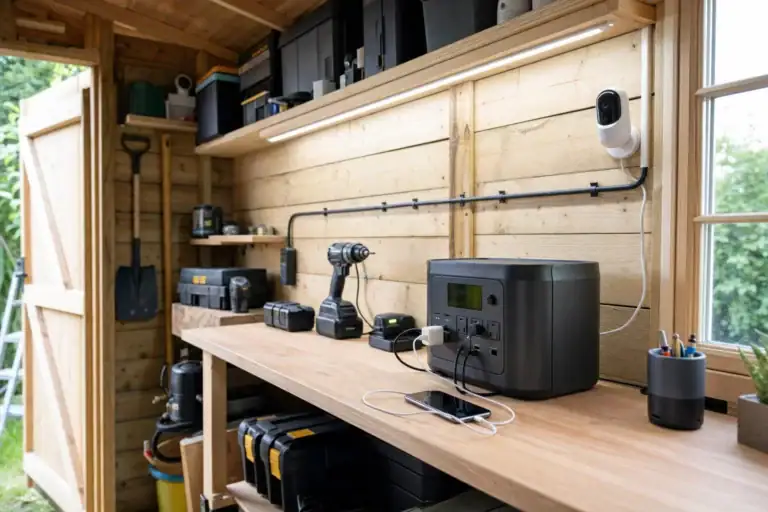
- Portable Power Station for a Shed or Outbuilding: Lights, Chargers, and Security
- Portable Power Station for a Small Jobsite: Tool Battery Chargers and Work Lights
Keep reading
About this site
Portable Energy Lab publishes practical, independent guides about portable power—clear sizing, safe use, and real-world expectations.
Affiliate disclosure
Some links on this site may be affiliate links. If you buy through these links, we may earn a small commission at no extra cost to you. This helps support our content. Read our affiliate disclosure.