
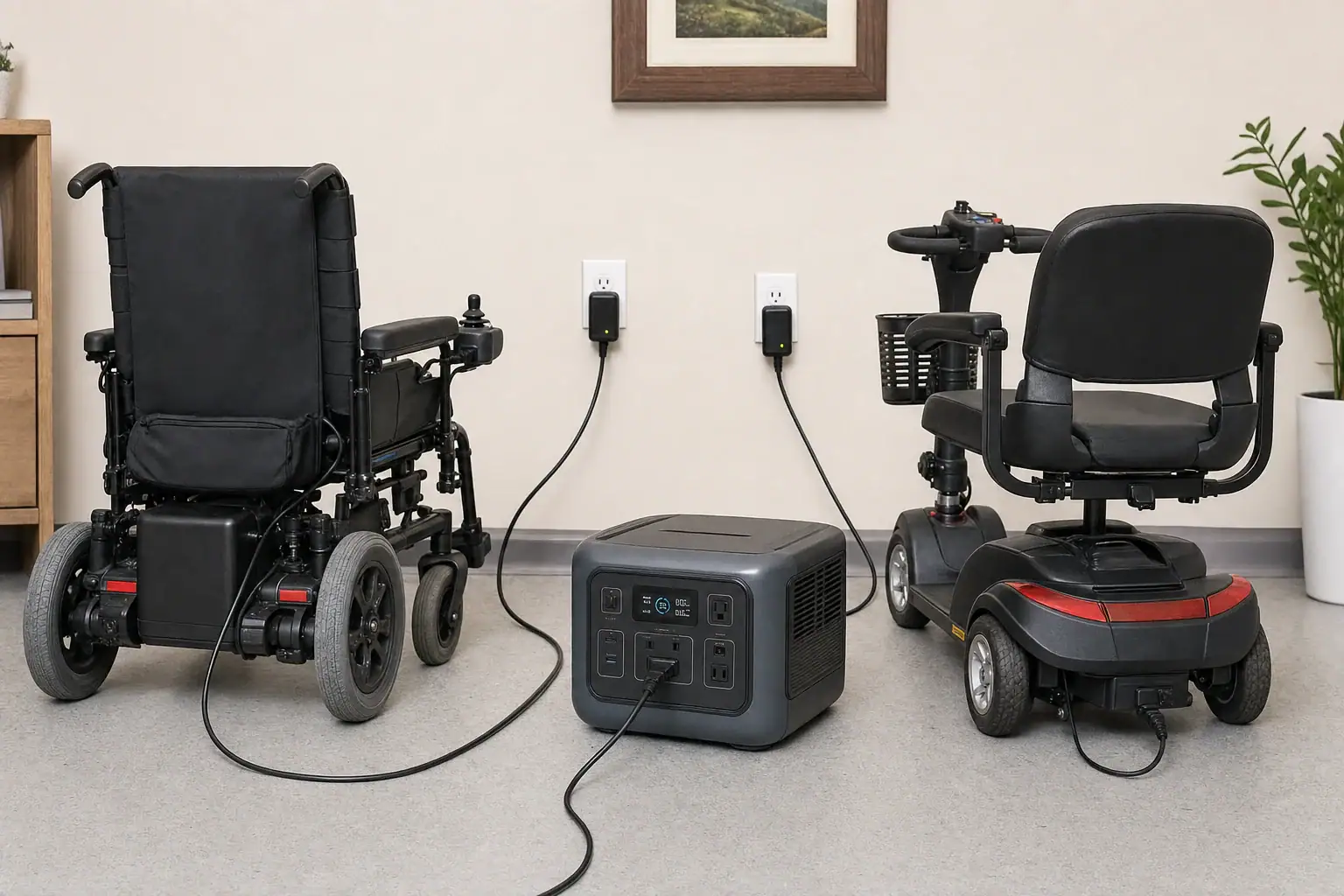
Yes, a portable power station can charge most electric wheelchairs and mobility scooters when its AC output supports the original charger and it has enough usable battery capacity.
The safest general method is to plug the mobility device’s approved charger into the power station’s AC outlet rather than connecting the station directly to the wheelchair battery. The important specifications are continuous watts, pure sine wave output, watt-hours, charger input power, and conversion efficiency. These determine whether charging will start, whether it will continue without an overload, and how much battery range can be restored.
A small station may handle the charger’s wattage but still lack the capacity for a full charge. A larger unit may provide several top-ups or one complete recharge, depending on the wheelchair battery size and its state of charge. Checking both power and energy requirements before relying on the setup is especially important when mobility equipment is medically necessary.
What charging from a portable power station means
Charging an electric wheelchair or mobility scooter from a portable power station usually means using the same charger that would normally plug into a household wall outlet. The charger connects to the power station’s AC receptacle, while its normal charging connector attaches to the mobility device.
This matters because the original or otherwise manufacturer-approved charger manages the battery’s required voltage, current, and charging stages. The power station simply replaces the wall outlet. It does not replace the mobility charger or directly control charging of the wheelchair battery.
A portable power station can be useful during an outage, while traveling, at an event, or in a location where a convenient outlet is unavailable. It can also provide a partial charge that extends practical range. However, it should not be treated as an unlimited power source. Its battery must store enough energy for the intended recharge, and its inverter must operate the charger reliably.
The device battery chemistry also matters. Many mobility products use sealed lead-acid batteries, while others use lithium-ion packs with dedicated battery management systems. Always use a charger specifically approved for the battery and mobility device. Similar-looking connectors do not prove that voltage, polarity, or charging behavior is compatible.
How charger watts and power station capacity work together
Two different ratings determine compatibility: watts and watt-hours. Watts describe how much power the charger needs at a given moment. Watt-hours describe how much energy the power station can supply over time.
Check the charger’s input label rather than relying only on its DC output rating. A label may list AC input in watts or in volts and amps. For a rough maximum estimate, multiply input volts by input amps. Actual draw may be lower and can change during the charging cycle. A plug-in energy meter can provide a more realistic measurement when used according to its instructions.
The power station’s continuous AC output should exceed the charger’s highest normal draw. Allowing roughly 25% to 50% headroom can reduce nuisance overloads and accommodate short startup behavior. A pure sine wave inverter is generally the most broadly compatible choice for chargers containing sensitive electronic controls.
Capacity requires a separate calculation. A station rated at 1,000 watt-hours does not normally deliver all 1,000 watt-hours through its AC outlet. The inverter, charger, cables, and battery all introduce losses. For planning, assuming that approximately 75% to 85% of the station’s rated capacity reaches the mobility battery is more realistic than assuming perfect efficiency.
A practical estimate is to multiply charger draw by charging time, then divide by expected AC efficiency. For example, a charger averaging 150 watts for four hours uses about 600 watt-hours at the outlet. At 85% power station efficiency, that session may consume about 706 watt-hours from the station’s rated energy reserve.
| Charger load | Charging time | Energy at AC outlet | Estimated station energy at 85% efficiency |
|---|---|---|---|
| 80 watts | 3 hours | 240 watt-hours | 282 watt-hours |
| 120 watts | 5 hours | 600 watt-hours | 706 watt-hours |
| 180 watts | 6 hours | 1,080 watt-hours | 1,271 watt-hours |
Real-world charging examples
Consider a compact mobility scooter with a nominal 24-volt, 12-amp-hour battery system. Its nominal stored energy is approximately 288 watt-hours. Replacing half of that energy means restoring about 144 watt-hours to the battery. After inverter and charger losses, the power station might need to provide roughly 180 to 220 watt-hours. Battery age, temperature, and the charger’s final absorption stage can change the result.
A larger power wheelchair might use a nominal 24-volt, 35-amp-hour battery system, equivalent to about 840 watt-hours. A nearly complete recharge could require approximately 950 to 1,150 watt-hours from a power station after losses. A station with a nominal 1,000-watt-hour capacity may therefore be insufficient for a true empty-to-full charge even though it can run the charger without an overload.
For a short top-up, charger measurements are often more useful than nominal battery capacity. If a charger draws an average of 130 watts for two hours, it delivers about 260 watt-hours from the AC outlet. At 80% overall AC-output efficiency, the session consumes approximately 325 watt-hours of power station capacity.
Battery labels describe nominal energy, not guaranteed driving range. Terrain, rider weight, tire pressure, speed, temperature, battery age, and motor efficiency all affect how far the restored charge will move the device. It is better to describe a portable station as providing a measured amount of recharge rather than promising a specific number of miles.
Common mistakes and troubleshooting cues
The charger does not turn on
Confirm that the power station’s AC output has been activated. Some units do not energize their receptacles automatically. Check the remaining charge, AC status indicator, timer settings, and any power-saving mode that may shut down low loads. Also verify that the charger works from a normal outlet before assuming the station is at fault.
The power station reports an overload
An overload indicates that the charger is drawing more than the inverter permits or that another connected device has pushed the combined load over the limit. Disconnect unrelated loads and compare the charger’s input rating with the station’s continuous AC rating. Surge watts alone do not compensate for an inadequate continuous rating.
Charging stops before the mobility battery is full
The station may have reached its low-battery cutoff even if its display previously showed some capacity. Conversion losses, cold conditions, battery aging, or an optimistic runtime estimate can cause an early stop. Automatic AC shutoff settings can also interrupt charging when the charger reduces its draw near the end of the cycle.
The charger hums, becomes unusually hot, or shows an error
Stop the session if behavior differs significantly from normal wall charging. Possible causes include incompatible inverter output, poor ventilation, a damaged cable, excessive ambient heat, or a charger fault. Do not continue by bypassing protective features. Have the charger or mobility device evaluated by a qualified service professional if the problem repeats.
The estimated capacity does not match actual results
Common calculation errors include confusing watts with watt-hours, using the charger’s output rating instead of measured AC input, and ignoring conversion losses. Battery capacity also declines with age. Testing a routine charge under controlled conditions is more reliable than depending entirely on label values during an emergency.
Safety basics for mobility-device charging
Use the original charger or another charger explicitly approved for the exact mobility device and battery type. Do not connect an unregulated DC output directly to the battery, improvise adapters, reverse polarity, open battery packs, or bypass fuses and battery management protections.
Place the power station and charger on stable, dry, nonflammable surfaces with ventilation around them. Keep cables away from wheels, footrests, doorways, pets, and areas where they can become trip hazards. Do not cover the charger or station, and do not charge near standing water, combustible materials, or excessive heat.
Inspect plugs, charging ports, and cables for looseness, scorching, corrosion, or damaged insulation. Stop using equipment that smells burnt, makes abnormal noises, becomes excessively hot, or repeatedly trips protection. Follow the mobility device instructions concerning whether charging is permitted while the user is seated or while the device is switched on.
Do not exceed the power station’s environmental limits, especially for temperature and moisture. Charging lithium-based equipment below its permitted temperature can cause damage, while high temperatures accelerate degradation in both lithium and lead-acid batteries.
When mobility is essential for health or evacuation, maintain a backup plan. A portable power station can fail, become depleted, or take longer than expected to recharge. Professional guidance is appropriate if charging equipment, household wiring, or outlets show signs of damage. Do not attempt to connect a portable station to home electrical wiring without properly designed equipment and a qualified electrician.
Maintenance, testing, and storage
Test the complete setup before it is needed. Begin with a well-charged power station, record its starting percentage, and observe a normal mobility-device charging session. Note the charger’s approximate watts, total charging time, ending station percentage, heat, noise, and any automatic shutoff behavior. This creates a practical baseline for future planning.
Recharge the portable station after use and follow its specified storage range. Many battery power stations should not remain completely empty for long periods. For extended storage, a moderate state of charge is often preferable, but the correct level and inspection interval depend on the battery chemistry and product instructions.
Keep mobility batteries on their prescribed charging schedule. Sealed lead-acid batteries can deteriorate when repeatedly left discharged, while lithium batteries rely on their approved charging system and internal protections. A portable station does not change those maintenance requirements.
Store all components in a clean, dry, temperature-controlled location. Periodically inspect cords and connectors, confirm that the station holds charge, and repeat a short functional test. If the station has been stored through very hot or cold conditions, allow it to return to an approved operating temperature before charging or discharging it.
| Check | Possible interval | Reason |
|---|---|---|
| Power station charge level | Every 1 to 3 months in storage | Reduces the chance of finding it deeply discharged |
| Cables and connectors | Before each charging session | Identifies damage, heat marks, or loose connections |
| Complete charging test | Every 3 to 6 months | Confirms capacity and charger compatibility |
| Vent and surface cleaning | As dust accumulates | Supports cooling and dependable operation |
Related guides:
Portable Power Station Buying Guide •
How to Estimate Runtime for Any Device: A Simple Wh Formula + 5 Worked Examples •
How to Test Real Capacity at Home: A Simple Step-by-Step Method •
Practical takeaways and specs to look for
Start by confirming the mobility charger’s AC input requirement, then select a station with sufficient continuous output and energy capacity. For dependable planning, include inverter losses and reserve capacity rather than sizing the station to an exact calculated minimum. A full recharge for a large wheelchair can require substantially more stored energy than a short scooter top-up.
Use the approved mobility charger, keep the equipment ventilated, and test the setup in advance. If the wheelchair or scooter is essential to daily mobility, plan for delayed charging, degraded batteries, and the possibility that the station cannot be recharged during a prolonged outage.
Specs to look for
- Continuous AC output: Look for a rating at least 25% to 50% above the charger’s measured or labeled input, such as 300 watts for a charger drawing 200 watts, to provide operating headroom.
- Battery capacity: Compare rated watt-hours with the expected charging session; roughly 500 to 1,500 watt-hours may cover anything from a partial scooter charge to a larger wheelchair recharge, depending on the battery.
- Usable AC energy: Plan around approximately 75% to 85% of rated capacity through the inverter because conversion and standby losses reduce delivered energy.
- Inverter waveform: Look for pure sine wave AC output because it offers broad compatibility with electronically controlled mobility chargers.
- AC outlet compatibility: Confirm that the receptacle accepts the charger’s plug securely and provides the voltage and frequency listed on the charger.
- Overload and thermal protection: Look for automatic shutdown for overload, overheating, and short circuits to reduce equipment stress when a fault occurs.
- Low-load timeout controls: Prefer adjustable or clearly documented AC shutoff behavior so the station does not turn off when charger draw falls near the end of charging.
- Recharge options: Consider AC, vehicle, or solar input ratings appropriate to the intended use; faster input can matter when the station must be replenished between mobility-device charging sessions.
- Display and power monitoring: Look for remaining watt-hours, input and output watts, or estimated runtime because these readings make it easier to confirm charger demand and remaining reserve.
The best practical match is not necessarily the station with the highest advertised surge rating. It is the one with adequate continuous AC power, enough usable watt-hours, a compatible waveform, reliable protection, and a tested ability to complete the required charging session.
Frequently asked questions
Can I charge an electric wheelchair with a portable power station?
Yes, charging an electric wheelchair from a portable power station is usually possible when the station can run the approved AC charger and has sufficient usable watt-hours. Plug the charger into the station’s AC outlet, then connect it to the wheelchair as you normally would. The available recharge may be partial or complete depending on battery size, charger draw, and power losses.
What size portable power station do I need for a mobility scooter?
The required size depends on both the charger’s AC wattage and the energy needed for the intended charge. Choose a unit whose continuous AC output exceeds the charger load, preferably with 25% to 50% headroom, and account for inverter losses when comparing watt-hours. A measured charging test is the most reliable way to confirm whether it can provide a full recharge or only a top-up.
What portable power station specs matter most for wheelchair charging?
Key features include sufficient continuous AC output, adequate battery capacity in watt-hours, pure sine wave AC output, and overload and thermal protection. A display showing output watts and remaining energy can help monitor the session. Adjustable or documented low-load shutdown behavior is also useful because some chargers draw less power near the end of charging.
Is it safe to connect a portable power station directly to a wheelchair battery?
No. A portable power station should generally power the mobility device’s original or manufacturer-approved charger rather than connect directly to the battery. Direct DC connections, improvised adapters, and incorrect voltage or polarity can damage equipment or defeat battery protections.
Why does my power station turn off before the wheelchair is fully charged?
The station may have reached its low-battery cutoff, or its AC outlet may be set to switch off at low loads. Conversion losses, cold temperatures, battery aging, and inaccurate runtime estimates can also reduce the expected charging time. Check the station’s settings and test the setup under normal conditions before depending on it in an emergency.
What is the most common mistake when using a power station to charge mobility equipment?
A common mistake is checking only the power station’s watt rating and overlooking its usable watt-hour capacity. A station may run the charger without overloading but still not store enough energy to finish the desired recharge. Another frequent error is using the charger’s DC output label instead of its AC input requirement for planning.
Related guides
Browse this topic →

- Beginner-friendly sizing, runtime & specs
- Solar & charging (MPPT, fast charging, cables)
- Batteries (LiFePO4, cycles, care & storage)
- Safety, cold-weather performance, real-world tips
More in Beginners
See all →- Portable Power Station for a Gaming PC: Runtime, Load Spikes, and UPS Considerations
- Portable Power Station for a Pop-Up Camper: Lights, Fans, Fridge, and Recharge Plan
- Portable Power Station for a Shed or Outbuilding: Lights, Chargers, and Security
- Portable Power Station for a Boat: 12V Loads, Salt Air, and Safer Storage
- Portable Power Station for a Small Jobsite: Tool Battery Chargers and Work Lights
Keep reading

About this site
Portable Energy Lab publishes practical, independent guides about portable power—clear sizing, safe use, and real-world expectations.
Affiliate disclosure
Some links on this site may be affiliate links. If you buy through these links, we may earn a small commission at no extra cost to you. This helps support our content. Read our affiliate disclosure.