
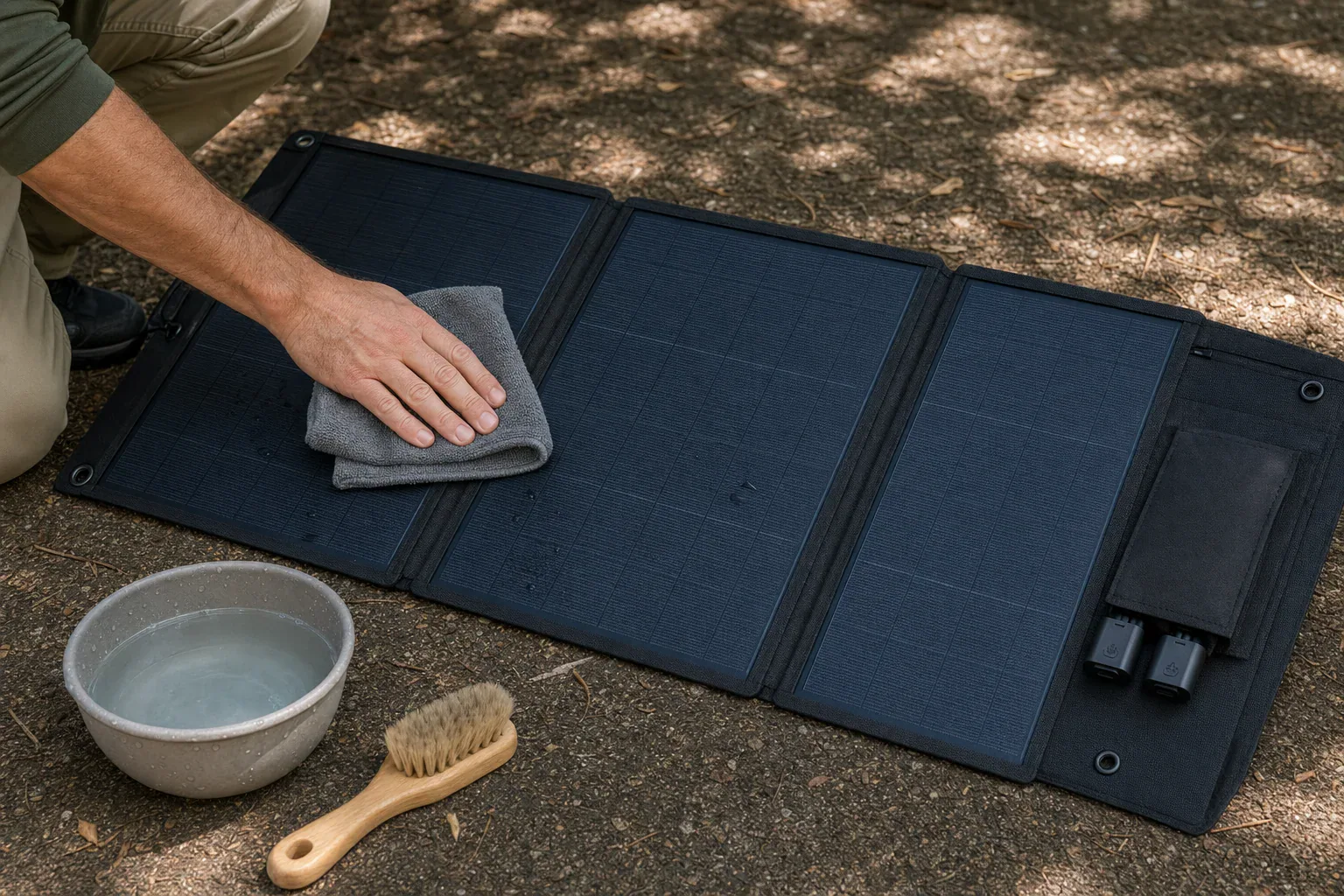
To clean a portable solar panel, disconnect it, let it cool, remove loose dust with a soft brush, and wipe the surface gently with a damp microfiber cloth. Clean water is usually enough. Keep connectors, junction boxes, seams, and fabric backing as dry as possible, then let the panel dry completely before reconnecting or folding it for storage.
Avoid pressure washers, abrasive pads, stiff brushes, solvents, glass cleaners, and scraping tools. Portable panels vary in surface coating and water resistance, so follow the panel manufacturer’s current care instructions whenever they differ from this general guidance.
What you need
- A clean, soft microfiber cloth
- A very soft brush for loose dust and grit
- Clean, lukewarm water
- Distilled or deionized water for a final wipe if tap water leaves mineral spots
- A small amount of mild soap only if the manufacturer permits it
Use separate clean cloths for washing and drying. A cloth that contains sand, metal particles, or dried dirt can scratch a panel’s protective surface.
Safe cleaning steps
- Check the care instructions. Confirm whether the panel may be wiped with water and whether any cleaners are prohibited. A weather-resistant panel is not necessarily suitable for spraying, soaking, or submersion.
- Disconnect the panel. Follow the manufacturer’s shutdown and disconnection sequence for the panel, power station, or charge controller. Do not allow moisture into unplugged connectors, and do not clean damaged cables or connectors while they are connected.
- Move it to a stable, shaded surface. Let the panel cool before cleaning. Applying cool water to a hot surface can create thermal stress, and water may evaporate quickly enough to leave spots.
- Remove loose grit first. Tilt the panel slightly and use a soft brush with light strokes so particles fall away. Do not grind sand or dried mud into the surface with a wet cloth.
- Wipe gently with clean water. Dampen—not saturate—a microfiber cloth and wipe in light, straight passes. Support foldable panels so hinges and active sections are not bent backward or pressed against sharp objects.
- Treat stuck-on residue patiently. Hold a damp cloth over bird droppings, sap, or dried mud for a few minutes to soften it, then wipe gently. Do not scrape with a blade, fingernail, or hard plastic edge. If water does not work, use only a cleaner specifically allowed by the manufacturer.
- Dry and inspect. Wipe away remaining water with a clean cloth and allow the panel, seams, cable ends, and connectors to air-dry in the shade. Reconnect or store it only when fully dry.
Products and methods to avoid
- Pressure washers and strong hose jets: Water can be forced through edge seals, stitching, junction boxes, or connector housings.
- Abrasive sponges, powders, or stiff brushes: These may scratch glass or polymer coatings and create areas that hold more dirt.
- Household glass cleaner: Ammonia, alcohol, fragrance, or other additives may be incompatible with anti-reflective coatings, plastics, adhesives, or printed surfaces.
- Solvents, degreasers, bleach, and vinegar: Do not use them unless the panel manufacturer explicitly approves the specific product and dilution.
- Compressed air at close range: A concentrated jet can push debris across the surface or force contamination into seams.
- Walking, kneeling, or placing weight on the panel: Cells and internal conductors can crack even when the outer layer looks intact.
- Cleaning while the panel is hot or electrically connected: Disconnect it and allow it to cool first.
Special care for foldable and flexible panels
Foldable portable panels often combine laminated solar sections with fabric, stitched edges, magnets, handles, and external pockets. These components may have different water resistance from the active panel face. Use a damp cloth rather than spraying the entire assembly, and prevent water from collecting in folds or cable pockets.
Do not sharply crease a flexible panel or bend it beyond the manufacturer’s stated limit. When drying or wiping, support the full panel rather than lifting one active section by a corner. Wait until the backing and hinges are dry before folding it, because trapped moisture can encourage odors, staining, or corrosion around hardware.
How often to clean
Clean when the panel is visibly dusty, spotted, or covered with pollen, mud, salt residue, leaves, or droppings. There is no universal schedule: a panel used occasionally on grass may need little attention, while one exposed to windblown sand or coastal spray may need a gentle wipe after each trip.
A lower charging rate can also prompt an inspection, but output alone does not prove the panel is dirty. Clouds, partial shade, panel angle, cell temperature, cable condition, and the receiving device’s charge limits can all change power production. Compare performance only under reasonably similar sunlight and setup conditions.
Inspect before reconnecting
After cleaning, look for cracked surfaces, peeling laminate, cloudy areas beneath the outer layer, loose seams, exposed conductors, damaged cable insulation, or scorched and deformed connectors. Stop using the panel if damage could expose electrical parts or allow water inside, and consult the manufacturer’s current service guidance rather than attempting to open or reseal the panel yourself.
Related guides
Browse this topic →
- Beginner-friendly sizing, runtime & specs
- Solar & charging (MPPT, fast charging, cables)
- Batteries (LiFePO4, cycles, care & storage)
- Safety, cold-weather performance, real-world tips
More in Solar
See all →- Solar Charging on Cloudy Days: What Output Can a Portable Power Station Expect?
- How Many Portable Solar Panels Do You Need for a 1,000Wh Power Station?
- Solar Adapter Polarity Mistakes: How to Avoid Reverse-Polarity Charging Problems
- Portable Solar Panel Waterproof Ratings: What Rain, Dew, and Splash Resistance Mean
- Can You Charge a Portable Power Station Through a Window With Solar Panels?
Keep reading
About this site
Portable Energy Lab publishes practical, independent guides about portable power—clear sizing, safe use, and real-world expectations.
Affiliate disclosure
Some links on this site may be affiliate links. If you buy through these links, we may earn a small commission at no extra cost to you. This helps support our content. Read our affiliate disclosure.