
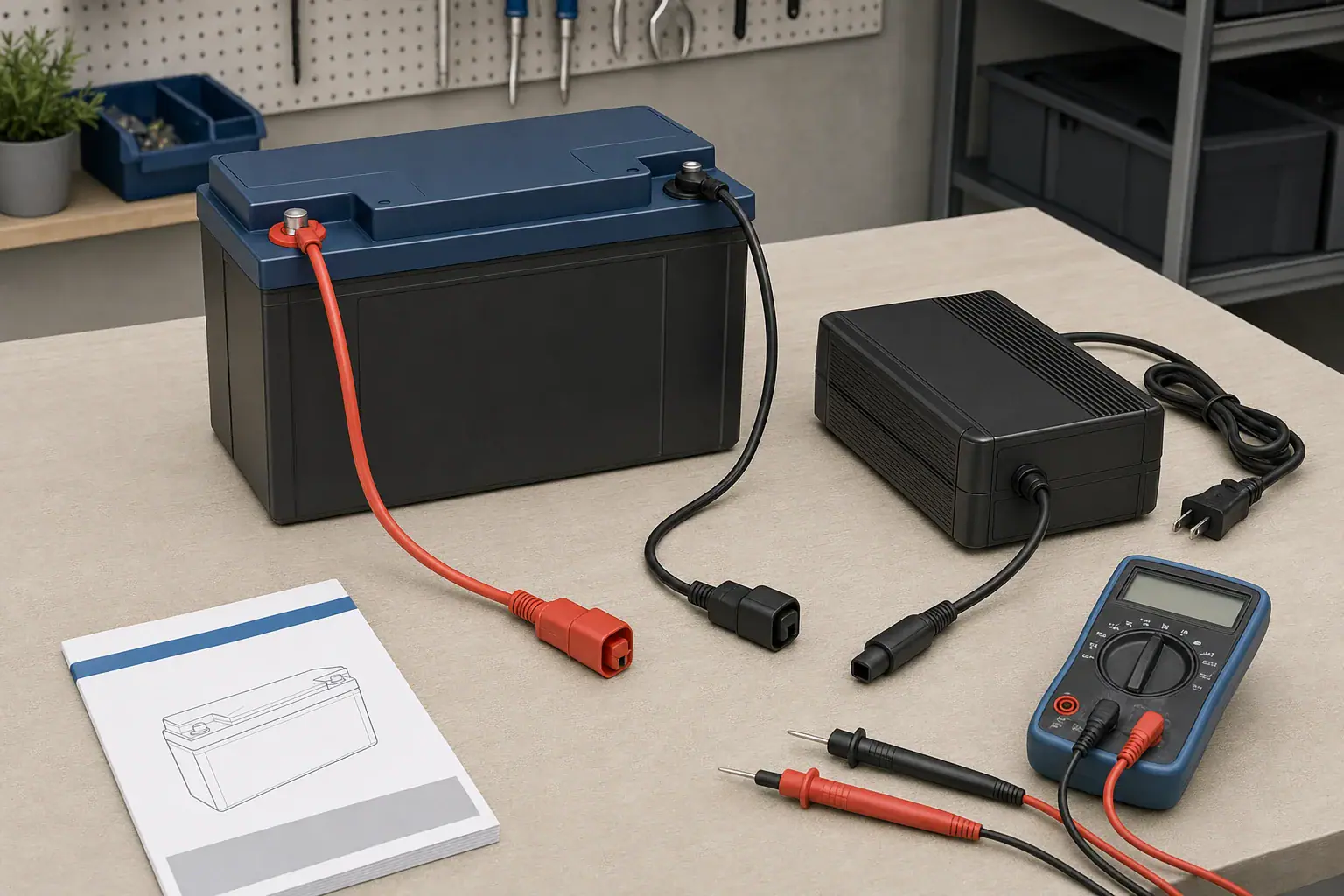
Quick answer: Choose a LiFePO4 battery charger only after matching its documented charge voltage and profile to the exact battery model. Keep charge current within the battery’s recommended and maximum limits and all documented cable, connector, and BMS limits. Before connecting, verify temperature permissions, plug pinout, polarity, and any required wake or communication procedure.
How to choose a LiFePO4 battery charger
Start with the exact battery model and its current manual, then compare it with the charger manual and output label. A nominal label such as “12 V” or “24 V” identifies a broad battery class; it does not, by itself, establish the allowed charging setpoint, current, temperature range, or connector wiring.
Record these items before buying or connecting a charger:
- The battery maker’s approved charge voltage and charging profile.
- Its recommended charge current and maximum permitted charge current.
- The permitted battery charging-temperature range.
- BMS limits, plus any wake-up or communication requirement.
- Connector type, pinout, polarity, and any stated cable or fuse requirements.
A charger is suitable only when its documented output and behavior are compatible with all of those requirements. A matching plug shape, a “LiFePO4” label, or a similar nominal voltage is not enough.
Match charger voltage to the battery documentation
The charger must be intended for the battery pack voltage and must provide a fixed preset or configurable setting that the battery manufacturer permits. Do not treat one voltage as universal for every battery marketed as 12 V LiFePO4.
For example, Victron specifies 14.2 V absorption and 13.5 V float for its cited 12.8 V Lithium Smart battery family, while also warning not to use a 24 V charger on a 12 V battery. Those values are instructions for that product family, not settings to copy to another brand or model. See the Victron Lithium Smart Battery manual.
Cell-count arithmetic can help identify an obvious mismatch, but it cannot replace the battery manual. Mascot describes 3.65 V multiplied by the number of series cells as a typical full-charge value and also says the correct voltage varies by battery type and manufacturer. See the Mascot LiFePO4 charger manual.
Do not use a BMS high-voltage cutoff as the routine charging target. For example, one Epoch 12.8 V battery lists 14.2–14.4 V for bulk/absorption charging and 14.6 V as its BMS high-voltage cutoff. The cutoff is a protective boundary for that model, not an instruction to select a 14.6 V charger. See the Epoch 12.8 V 105 Ah battery specifications.
Choose charging current from the lowest documented limit
When the battery maker supplies a recommended charge current, use it as the starting point. The charger’s output must also remain within every applicable documented maximum for the battery, BMS, cable, connector, and protection arrangement. A fuse rating alone does not establish a safe continuous charge-current rating.
Recommended and maximum current are different values. The cited Epoch battery lists 50 A as recommended and 100 A as maximum continuous charge current. Neither figure can be transferred to a different battery simply because it has the same nominal voltage.
For a battery assembled with a separately selected BMS, check the datasheet for that exact BMS. BMS voltage, current, and temperature protections vary by model. For example, the published information for Overkill Solar’s 4S BMS differs from the company’s 8S 100 A BMS. Do not infer a BMS limit from battery capacity or from another BMS model.
LiFePO4 battery charger compatibility table
| Battery documentation says | Charger must provide | Reject or pause when |
|---|---|---|
| Nominal voltage and pack configuration | The correct battery class and series-cell configuration | Only a plug shape or broad “12 V” label matches |
| Approved charge voltage and profile | A matching fixed preset or an allowed configurable setting | The fixed output exceeds the approved value or the profile is undocumented |
| Recommended and maximum charge current | Current within the documented limits for the complete charging path | Output exceeds a battery, BMS, cable, connector, or other documented limit |
| Permitted charging temperatures | Battery or charger controls that respect that stated range | Charging could continue outside the permitted range |
| Connector, pinout, and polarity | An exact mechanical and electrical match | The plug fits but polarity or pin assignment is unknown |
| Wake or communication requirements | The required interface or documented standalone operation | The BMS is inactive and the proposed recovery method is not manufacturer-approved |
| Permitted maintenance modes | Only modes expressly allowed for the battery | The charger can apply undocumented equalization, desulfation, repair, or similar modes |
Estimate charge time with Ah ÷ A
A basic estimate is:
idealized charge time (hours) ≈ amp-hours to replace ÷ charger current (A)
Illustrative calculation using assumptions: Assume 100 Ah must be replaced, the charger can deliver its full rated current continuously, and that current is approved for the battery and charging path.
100 Ah ÷ 20 A = 5 hours100 Ah ÷ 50 A = 2 hours
These are idealized results, not promised recharge times. Actual time can be longer because the starting state of charge, temperature, concurrent loads, charger behavior, and BMS behavior matter. A constant-current/constant-voltage charger can also reduce current as it approaches its voltage limit, as described in the Mascot manual.
DC output watts and AC input rating
Amperes describe current; watts describe power; watt-hours describe energy. At one operating point, approximate DC output power is voltage multiplied by current. For example, assuming 14.2 V and 20 A, the DC output is 14.2 V × 20 A = 284 W.
For an inverter, generator, or AC circuit, use the charger’s documented AC input rating rather than calculating from DC output alone. Follow the charger and power-source instructions for continuous operation and any stated startup requirement.
Check temperature, BMS, and maintenance restrictions
Charging-temperature instructions are battery-specific. The cited Victron manual permits charging its battery from +5°C to +50°C. The cited heated Epoch model blocks cell charging below 0°C, directs incoming power to heating, and resumes cell charging at 5°C. These are different model-specific approaches, so there is no universal temperature rule that substitutes for the battery manual.
Confirm whether temperature protection is built into the battery, requires an external sensor, depends on charger communication, or is not provided. Use heating only when it is integrated into the battery or otherwise approved by its manufacturer. Never bypass a low-temperature cutoff or other BMS protection.
Also check the charger for lead-acid-oriented functions such as equalization, desulfation, repair, or automatic maintenance modes. Use such a mode only if the battery manufacturer expressly permits it.
Preconnection checklist
- Confirm the exact battery and charger model numbers.
- Compare the charger’s complete profile and maximum output voltage with the battery’s approved settings.
- Confirm charger current is within the battery’s recommended value and every applicable documented maximum.
- Check the battery’s present temperature against its permitted charging range.
- Inspect the battery, charger, cables, connector, and protection arrangement for damage or undocumented modification.
- Match the connector pinout, not merely its shape or diameter.
- Verify polarity from both manuals and product markings. If measurement is needed, use a correctly rated meter and the charger manufacturer’s procedure without allowing probes to short the connector; otherwise, use a qualified technician.
- Confirm that equalization, desulfation, repair, and automatic maintenance modes are disabled or expressly permitted.
- Check whether an inactive BMS requires a documented wake procedure. Do not bypass the BMS.
- Follow the selected charger manual’s connection and disconnection sequence; connection sequences are not universal.
- If batteries are connected in series or parallel, confirm that the battery manufacturer permits the arrangement and states how it may be charged.
Certification and installation boundaries
Electrical compatibility and certification are separate checks. UL identifies several charger standards, including UL 1012, UL 1310, UL 1564, and IEC/UL 60335-2-29; applicability depends on charger construction and intended use. A certification mark does not establish that a charger has the correct voltage, current, connector, or charging logic for a particular battery. See UL’s industrial battery charger guidance.
This guide addresses standalone batteries used in portable, off-grid, RV, and temporary backup applications. A portable product incorporated into a stationary energy-storage installation may have different system and code requirements. UL notes that separately certified components do not automatically create a certified stationary system. Permanent building connections require applicable local requirements, equipment instructions, and qualified installation; never backfeed an outlet or improvise panel wiring. See UL’s guidance on portable power packs and stationary use.
The right charger is the one with documented compatibility for the exact battery—not simply the largest amp rating or the right-looking plug. If voltage, current, temperature, polarity, connector, or BMS information is missing, leave the connection unresolved until the manufacturer confirms it.
Frequently asked questions
Do I need an adjustable LiFePO4 battery charger?
Not necessarily. A fixed-preset charger can be suitable when its complete charging profile is explicitly permitted for the exact battery. An adjustable charger is useful only when the battery manufacturer allows the selected settings and profile.
Can I leave a LiFePO4 battery charger connected after charging?
Follow both the battery and charger instructions for standby, float, or maintenance operation. Do not assume continuous connection is permitted, and do not use equalization, desulfation, repair, or other automatic modes unless the battery manufacturer expressly approves them.
Related guides
Browse this topic →
- Beginner-friendly sizing, runtime & specs
- Solar & charging (MPPT, fast charging, cables)
- Batteries (LiFePO4, cycles, care & storage)
- Safety, cold-weather performance, real-world tips
More in Charging
See all →- Pass-Through Solar Charging During an Outage: What Works and What to Avoid
- Can You Daisy-Chain Portable Power Stations? Why It Usually Isn’t a Good Idea
- USB-C Input vs AC Input on Portable Power Stations: Which Charging Method Makes Sense?
- Car Alternator Charging vs Cigarette Lighter Charging: What Changes for Power Stations?
- Charging a Portable Power Station From an RV Outlet: 12V, 24V, and Safety Limits
Keep reading
About this site
Portable Energy Lab publishes practical, independent guides about portable power—clear sizing, safe use, and real-world expectations.
Affiliate disclosure
Some links on this site may be affiliate links. If you buy through these links, we may earn a small commission at no extra cost to you. This helps support our content. Read our affiliate disclosure.