
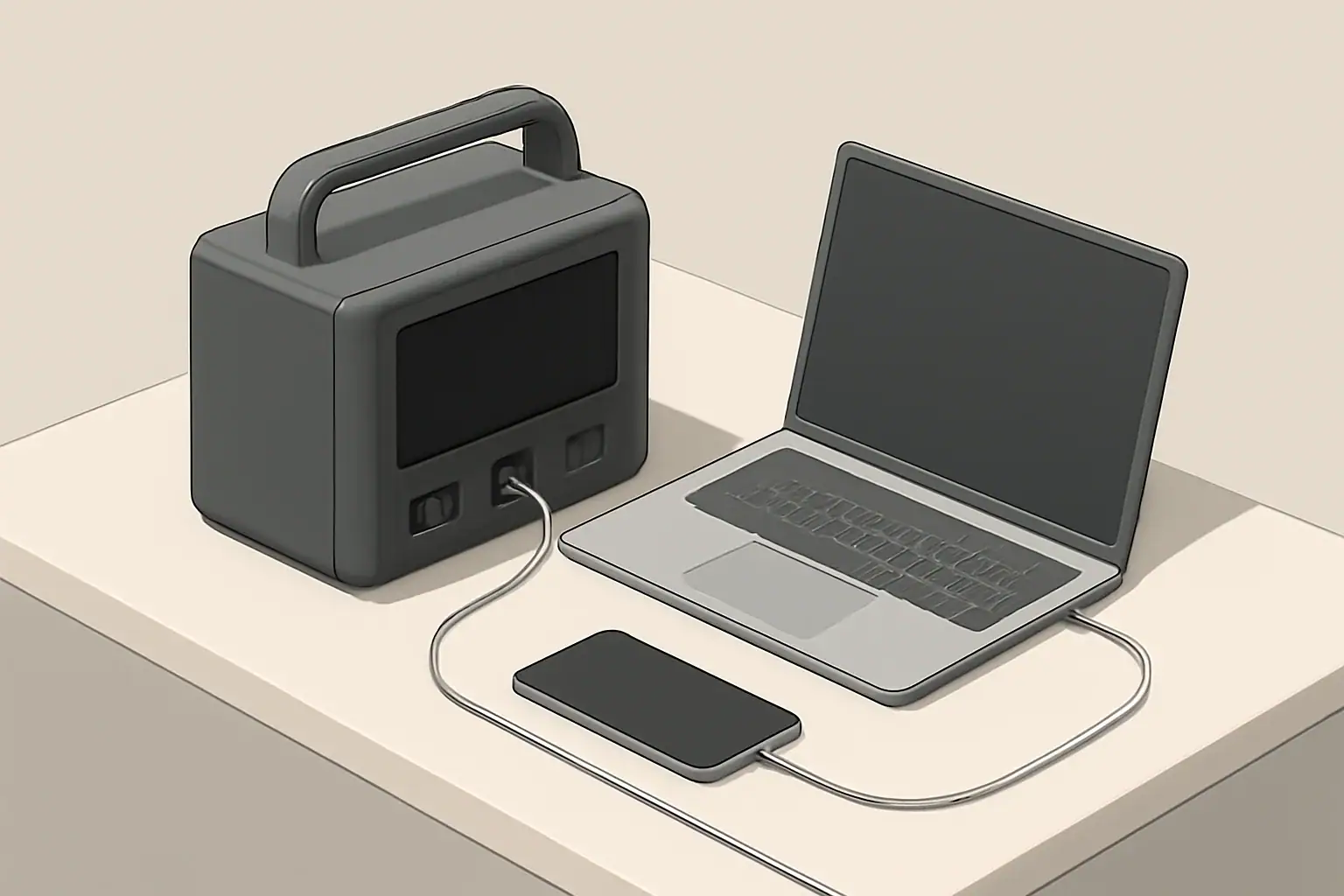
Portable power station terminology describes how much power a unit can deliver, for how long, and how safely it can do it. If you understand a few key terms like watts, watt-hours, inverter output, and battery chemistry, you can quickly see whether a power station will actually run your devices the way you expect.
This guide breaks down the most important portable power vocabulary in plain English. You will see how the numbers on spec sheets connect to real-world use, how to estimate runtime, and what to watch for when comparing units for camping, emergency backup, or work sites.
Use it as a reference while shopping or checking a user manual. The goal is not to turn you into an engineer, but to give you enough clarity to avoid surprises, under‑sizing, or overpaying for features you do not need.
What these power station terms mean and why they matter
Most portable power station specs fall into three groups: how much power they can output at once, how much energy is stored in the battery, and how safely the system manages that power. Understanding each group helps you pick a unit that matches your devices and use cases.
Power (W) tells you what the station can run at the same time. If your devices together draw more watts than the inverter’s continuous rating, the unit will shut down or refuse to start them.
Energy (Wh) tells you how long the station can run those devices. Higher watt-hours mean more runtime, but only part of that capacity is usable because of conversion losses and protective limits.
Battery chemistry and management affect lifespan, weight, and safety. Some chemistries are lighter; others tolerate more cycles and heat. The internal battery management system (BMS) enforces safe limits so the pack is not overcharged, overheated, or discharged too deeply.
Once you see how these terms connect, you can read a spec sheet and quickly answer three questions: “Will it start my devices?”, “How long will it run them?”, and “Is it built to last for my kind of use?”
Key concepts: power, energy, batteries, and inverters
This section defines the core terms you will see on almost every portable power station spec sheet.
Watts (W): how much at once
Watts measure the rate of power use. A device labeled 60 W uses 60 watts while it is running at full draw. Portable power stations list an AC continuous watt rating (for example, 500 W) and often a higher surge or peak rating for brief startups.
Watt-hours (Wh): how long it can run
Watt-hours measure stored energy. A 500 Wh battery can theoretically deliver 500 watts for one hour, 250 watts for two hours, and so on. In practice, you must subtract conversion losses and safety buffers.
A quick usable estimate is often around 80–90% of the stated watt-hours, depending on inverter efficiency and how hard you push the battery.
Voltage (V) and current (A)
Voltage (V) is electrical “pressure,” and current (A) is the amount of flow. Their product is power: P (W) = V × A. Understanding this helps you interpret DC outputs and solar inputs.
- Typical AC output: 120 V (in North America).
- Typical DC “car” output: about 12–13.6 V.
- USB outputs: 5 V for basic ports, higher for fast charging.
Continuous vs surge (peak) power
Continuous power is what the inverter can supply indefinitely under normal conditions. Surge or peak power is a short burst, often lasting a few seconds, to handle devices that draw extra power when they start.
Examples of surge-heavy loads include refrigerators, air compressors, and many power tools. If the surge rating is too low, these devices may never start, even if their running watts look fine on paper.
Battery chemistry basics
Most modern portable power stations use lithium-based batteries. Two common categories are:
- Lithium-ion (various blends): higher energy density (more Wh per pound), usually lighter and more compact, often with shorter cycle life than LiFePO4 at similar conditions.
- LiFePO4 (lithium iron phosphate): lower energy density, so heavier for the same Wh, but typically higher cycle life and improved thermal stability.
Cycle life is the number of full charge–discharge cycles until the battery falls to a defined percentage of its original capacity (often 70–80%). A higher cycle rating suggests better long-term durability, especially if you discharge the battery deeply and frequently.
Inverter and efficiency
The inverter converts the battery’s DC power into AC power for household-style outlets. Two main ideas matter:
- Waveform: a pure sine wave inverter closely matches grid power and is friendlier to sensitive electronics and many motors. A modified sine wave is cheaper but may cause noise, extra heat, or malfunction in some devices.
- Efficiency: no inverter is perfect. Some of the stored energy turns into heat. Efficiency is often in the 80–90% range. Lower efficiency means shorter runtime for the same battery size.
Charging input and MPPT
Input power rating tells you how fast the battery can be recharged, whether from wall AC, a vehicle outlet, or solar panels. Higher input watts generally mean faster charging, as long as the source can provide that power.
Many units include an MPPT (maximum power point tracking) solar controller, which adjusts voltage and current to pull more power from solar panels under changing light and temperature. MPPT usually improves solar charging speed compared with simple controllers.
Real-world examples and quick reference tables
Numbers become easier to understand when you see how they play out with common devices and realistic runtimes.
Estimating runtime in practice
A simple runtime estimate uses this formula:
Runtime (hours) ≈ (Battery Wh × Efficiency) ÷ Load W
If you assume 85% overall efficiency (0.85) for inverter and system losses, you can do quick back-of-the-envelope checks before you buy.
| Battery capacity (Wh) | Assumed efficiency | Example load (W) | Approx. runtime (hours) | Typical use case |
|---|---|---|---|---|
| 300 Wh | 0.85 | 30 W | ≈ 8.5 h | LED lights, phone charging, small fan |
| 500 Wh | 0.85 | 60 W | ≈ 7.1 h | Laptop, router, lighting |
| 1000 Wh | 0.85 | 150 W | ≈ 5.7 h | Mini fridge, router, lights |
| 1500 Wh | 0.85 | 300 W | ≈ 4.3 h | TV, game console, lights |
| 2000 Wh | 0.85 | 500 W | ≈ 3.4 h | Power tools, larger fridge, mixed loads |
Matching power ratings to devices
Here is how core terms interact when you plan to run real devices from a portable power station:
- Phone charging: very low watt draw (often under 10 W). Almost any station can handle this, and runtime is usually not a concern.
- Laptop plus monitor: often 60–150 W combined. Check that the inverter’s continuous rating covers this and that the battery capacity gives you the hours you need.
- Mini fridge: running watts might be 60–100 W, but startup surge can be 2–3× higher. You must check both continuous and surge ratings.
- Power tools: many tools have high surge demands and may cycle on and off. An undersized inverter may trip repeatedly.
Battery chemistry in everyday use
Battery chemistry terms also show up in real-world behavior:
- A LiFePO4-based station may be heavier for the same watt-hours but is often better suited to frequent daily cycling, such as for off-grid cabins or work vans.
- A lighter lithium-ion station may be easier to carry for short trips or occasional emergency use, where long cycle life is less critical.
Common mistakes and troubleshooting cues
Many problems people experience with portable power stations trace back to misunderstandings of the terminology on the label. Recognizing these patterns can help you avoid them or troubleshoot quickly.
Frequent sizing and usage errors
- Confusing watts with watt-hours: buying a unit because the inverter watt rating looks high, but the battery (Wh) is too small to run that load for long.
- Ignoring surge ratings: choosing a station that matches a device’s running watts but not its startup surge, so the device never starts.
- Overloading DC or USB ports: assuming all ports share the full inverter rating, when in reality each port or group of ports has its own amp and watt limits.
- Expecting spec-sheet charge times in all conditions: quoted charge times usually assume ideal input power and temperature; real times can be longer.
- Operating in extreme temperatures: using or charging the unit far outside its rated temperature range, which can trigger protective shutdowns or slow charging.
Troubleshooting by symptom and term
| Symptom | Likely related spec/term | What to check or adjust |
|---|---|---|
| Device will not start or shuts off immediately | Continuous watts, surge watts | Compare device running and startup draw to inverter ratings; try a lower-power device. |
| Runtime is much shorter than expected | Watt-hours, efficiency, total load | Recalculate runtime using battery Wh × 0.8–0.9; confirm actual device wattage with a meter. |
| Unit gets hot and fan runs constantly | Inverter efficiency, thermal management | Reduce load, move the unit to a cooler, well-ventilated spot, avoid covering vents. |
| Charging from solar is slower than expected | Solar input watts, MPPT, panel orientation | Check panel watt rating, sun angle, shading, and the station’s solar input limit. |
| Battery indicator drops quickly at high loads | Depth of discharge, voltage sag | Recognize that heavy loads reduce apparent runtime; try spreading loads over time. |
| Unit shuts down in cold or hot weather | Operating temperature range, BMS protection | Warm or cool the unit into its rated range before use or charging. |
Safety basics for portable power stations
Terminology around safety features is just as important as power and capacity. These systems store a significant amount of energy, and the right protections help keep that energy under control.
Battery Management System (BMS)
The BMS monitors individual cells and the pack as a whole. It enforces limits on voltage, current, and temperature to prevent conditions that could damage the battery or create hazards.
- Overcharge protection: stops charging when cells reach their safe voltage limit.
- Overdischarge protection: shuts down output before the battery is drained too far.
- Overcurrent and short-circuit protection: cuts power during abnormally high current events.
- Cell balancing: keeps cell voltages aligned to maintain capacity and longevity.
Thermal management and fan noise
Portable power stations rely on passive cooling (heat sinks, vents) and active cooling (fans) to stay within safe temperatures. Fans may turn on during heavy loads, fast charging, or in warm environments.
Key terms include operating temperature range and storage temperature range. Operating outside these can trigger protective shutdowns or reduced performance. Understanding these limits helps you plan for hot vehicles, direct sun, or cold overnight camping.
UPS-like functionality
Some stations advertise a UPS-like or backup power function. This usually means the unit can pass grid power through to your devices and switch to battery when the grid fails.
Two specs matter here:
- Transfer time: how fast the unit switches to battery. Sensitive electronics often tolerate brief interruptions, but not all.
- Supported load in UPS mode: sometimes lower than the full inverter rating.
Understanding these terms keeps expectations realistic when using a portable power station as backup power for routers, small servers, or home office equipment.
Long-term use, storage, and battery health
Battery terminology also affects how you should treat the unit over months and years. Proper storage and maintenance can preserve capacity and cycle life.
State of Charge (SoC) and Depth of Discharge (DoD)
State of Charge (SoC) is how full the battery is, usually shown as a percentage. Depth of Discharge (DoD) describes how much of the battery’s capacity you use before recharging.
- High DoD (for example, using 90% of the battery every cycle) can reduce cycle life faster.
- Moderate DoD (for example, using 50–70% per cycle) generally improves long-term durability.
When a spec sheet lists cycle life, note the DoD used for that rating. A battery rated for many cycles at 80% DoD is typically more robust than one rated at the same number of cycles but at 50% DoD.
Self-discharge and storage best practices
Self-discharge is the slow loss of charge even when the unit is not in use. Lithium-based chemistries have relatively low self-discharge, but they are not zero.
- For storage longer than a month, many manufacturers recommend keeping the battery at a partial SoC (often around 30–60%).
- Store in a cool, dry place within the recommended storage temperature range.
- Top up the charge every few months to avoid deep discharge from self-discharge and standby power draw.
Maintenance and firmware
Portable power stations are mostly maintenance-free, but a few simple habits help:
- Keep vents clear of dust and debris to maintain airflow.
- Avoid leaving the unit permanently at 0% or 100% SoC when not in use.
- Check for available firmware updates if your unit supports them; these can refine charging behavior, improve accuracy of SoC readings, or add minor features.
Practical takeaways and specs to look for
Once you are comfortable with the terminology, you can scan a spec sheet and quickly judge whether a portable power station fits your needs. The key is to tie each term back to your real-world use case.
Quick planning steps
- List the devices you want to power and note their watt ratings (or estimate using similar devices).
- Add up the watts for the devices you might run at the same time; this is your required continuous power.
- Estimate how many hours per day you want to run them, then multiply watts by hours to get daily watt-hour needs.
- Allow for 10–20% overhead for inverter losses, battery aging, and unexpected extra loads.
- Match your needs to a station with sufficient inverter watts and battery watt-hours, plus charging inputs that fit how you plan to recharge.
Specs to look for checklist
Use this checklist while reading spec sheets or product descriptions. Each item corresponds to a term explained earlier in this guide.
- Battery capacity (Wh): does it cover your estimated daily energy use with margin?
- AC inverter continuous watts: is it higher than the total watts of devices you plan to run simultaneously?
- AC inverter surge/peak watts: is it sufficient for startup surges of fridges, pumps, or tools?
- Battery chemistry: does the weight, cycle life, and intended use (occasional vs daily) match your priorities?
- Cycle life rating and DoD: how many cycles is it rated for, and at what depth of discharge?
- Inverter waveform: pure sine wave is generally preferred for sensitive electronics and many motors.
- Inverter efficiency or typical efficiency assumption: affects real runtime; you can assume around 80–90% if not specified.
- Input power (AC, DC, solar): do the maximum input watts and supported voltages match your charging sources?
- Solar charging details: presence of MPPT, supported voltage range, and maximum solar watts.
- Pass-through or UPS-like capability: if you plan to use it as backup power, check whether it supports powering loads while charging and what the transfer behavior is.
- Port types and counts: AC outlets, 12 V DC, USB-A, USB-C, and any high-power USB standards you need.
- Operating and storage temperature ranges: consider your climate and where the unit will be stored or used.
- Weight and dimensions: important for portability, especially if you will carry it frequently.
- Noise level: fan noise may matter for indoor use, nighttime operation, or quiet campsites.
By connecting these specs to the terminology in this guide, you can quickly filter out units that are too small, mismatched to your environment, or missing key safety and charging features. That makes it easier to focus on a short list of power stations that genuinely fit your needs, budget, and long-term plans.
Frequently asked questions
Which specs and features should I prioritize when choosing a portable power station?
Prioritize battery capacity (Wh) to meet your energy needs and AC inverter continuous watts to handle simultaneous device loads. Also check surge watts for startup-heavy devices, input charging limits (including solar/MPPT support) for recharge speed, and battery chemistry/cycle life for long-term durability.
What is a common mistake people make when selecting a power station?
A common mistake is confusing inverter wattage with battery capacity: buyers focus on a high continuous watt rating but choose a battery (Wh) that is too small to deliver meaningful runtime. Always match both the inverter rating for immediate power and the Wh for how long you need to run devices.
What safety features should I look for in a portable power station?
Look for a robust battery management system (BMS) that provides overcharge, overdischarge, overcurrent, and temperature protections, plus good thermal management and clear operating temperature ranges. These features reduce the risk of battery damage, thermal events, and unexpected shutdowns during use or charging.
How can I quickly estimate how long a power station will run my devices?
Use the simple formula: Runtime ≈ (Battery Wh × Efficiency) ÷ Load W, where efficiency typically ranges 0.8–0.9 for inverter and system losses. Divide the usable Wh by your device wattage to get an approximate runtime and factor in extra margin for surge events or battery aging.
Can I charge a portable power station from solar and what affects charging speed?
Yes — many stations support solar charging; models with MPPT controllers will usually extract more power under varying conditions. Charging speed depends on panel wattage, sun angle/shading, the station’s solar input limit, and ambient temperature.
Do all output ports deliver the full inverter power at once?
No. Individual ports or port groups often have their own amp/watt limits and the total combined output is usually capped by the inverter or internal distribution. Check per-port ratings and the unit’s total simultaneous output to avoid overloading specific connectors.
Related guides
Browse this topic →
- Beginner-friendly sizing, runtime & specs
- Solar & charging (MPPT, fast charging, cables)
- Batteries (LiFePO4, cycles, care & storage)
- Safety, cold-weather performance, real-world tips
More in Beginners
See all →- Charging an Electric Wheelchair or Mobility Scooter From a Portable Power Station
- Portable Power Station for a Gaming PC: Runtime, Load Spikes, and UPS Considerations
- Portable Power Station for a Pop-Up Camper: Lights, Fans, Fridge, and Recharge Plan
- Portable Power Station for a Shed or Outbuilding: Lights, Chargers, and Security
- Portable Power Station for a Boat: 12V Loads, Salt Air, and Safer Storage
Keep reading
About this site
Portable Energy Lab publishes practical, independent guides about portable power—clear sizing, safe use, and real-world expectations.
Affiliate disclosure
Some links on this site may be affiliate links. If you buy through these links, we may earn a small commission at no extra cost to you. This helps support our content. Read our affiliate disclosure.