
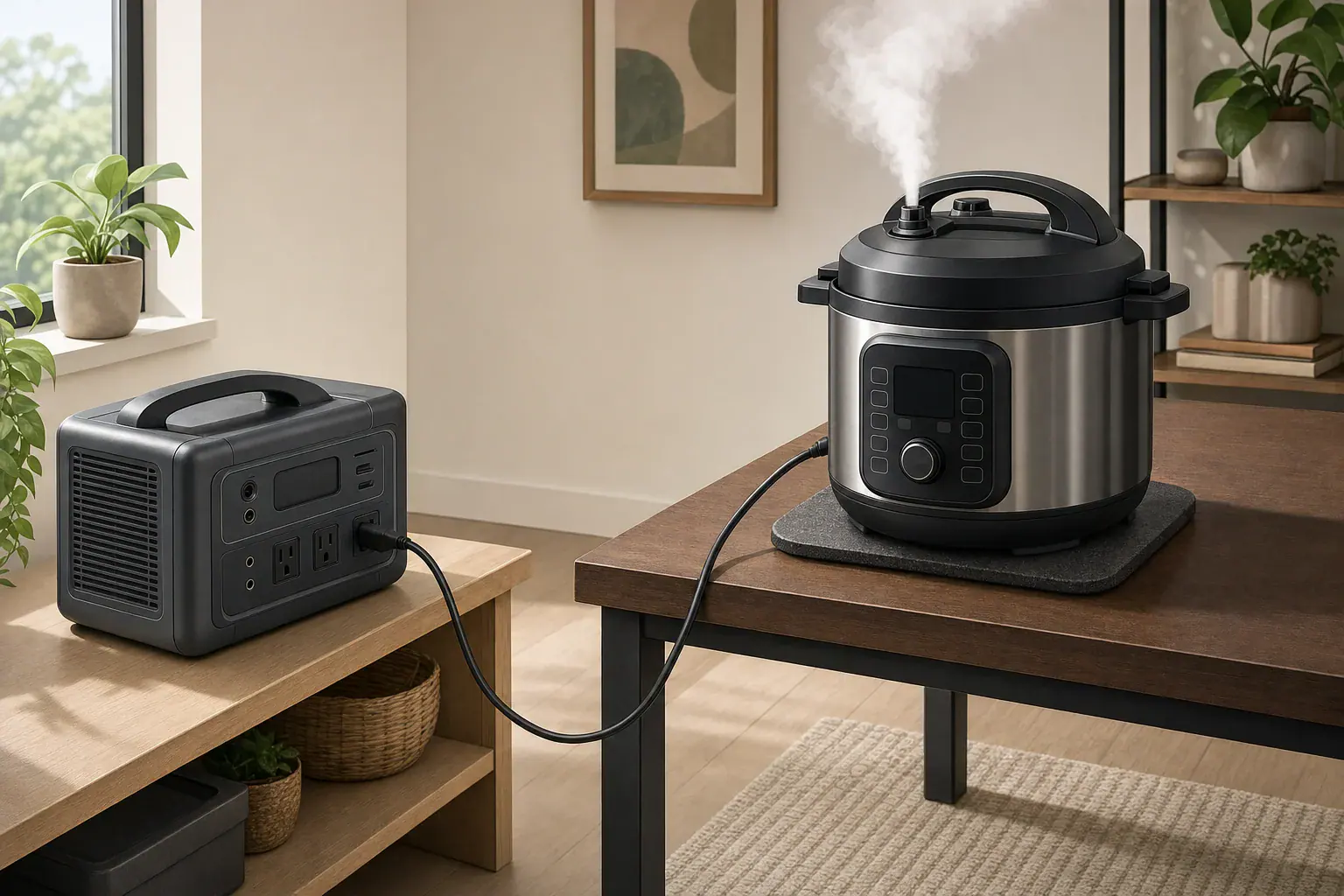
Quick answer: Usually. A portable power station can run an electric pressure cooker if its AC voltage and frequency match the cooker and its continuous AC output meets or exceeds the cooker’s nameplate watts. To finish a recipe, its available AC energy must also cover measured heat-up, cooking, release, and optional keep-warm energy.
Portable power station electric pressure cooker: make two checks first
There are two separate questions: whether the station can supply the cooker at all, and whether it stores enough energy to finish the selected recipe.
- Power compatibility: Match the cooker’s required AC voltage and frequency, then make sure the station’s continuous AC output meets or exceeds the cooker’s nameplate watts.
- Recipe energy: Measure watt-hours (Wh) for heat-up, pressure cooking, release or idle time, and any keep-warm period. Compare that result with the station’s available AC energy.
Watts (W) describe power at a moment in time. Watt-hours (Wh) describe energy used over time. A station can have enough output watts to run the heating element but not enough stored energy to complete a long recipe.
Use the exact appliance label or manual rather than a generic pressure-cooker estimate. For example, Instant Pot lists its Duo 6QT at 1,000 W and 120 V, 60 Hz. Those specifications apply to that listed model, not to every electric pressure cooker. Instant Pot Duo 6QT specifications
Pressure cooker and power station compatibility table
| Check | Pass condition | If it fails or is unknown |
|---|---|---|
| Voltage and frequency | The station AC output matches the cooker label. | Do not connect equipment with mismatched electrical requirements. |
| Continuous AC output | The station’s continuous rating meets or exceeds the cooker’s nameplate watts. | A peak, surge, or boost figure does not make a lower continuous rating adequate. |
| Heat-up demand | The station can sustain the cooker’s full heating load. | If ratings are close, obtain manufacturer guidance before use. |
| Recipe energy | Measured recipe Wh fits the station’s available AC energy. | Measure the cycle before relying on it during an outage. |
| Keep-warm energy | The intended hold time is included in the measurement. | Runtime is uncertain until keep-warm is included. |
| Connection instructions | The setup follows both product manuals. | Do not improvise with adapters, extension cords, or household wiring connections that either manual prohibits. |
What a specification match does—and does not—prove
A matching specification is only a paper compatibility check. As a model-specific example, Jackery lists the Explorer 1000 v2 with 120 V/60 Hz AC output, 1,500 W rated output, and 1,070 Wh rated battery capacity. Its 1,500 W rated output exceeds the listed 1,000 W requirement of the Duo 6QT. That does not establish the number of recipes the combination will complete: rated battery capacity is not necessarily the energy delivered at the AC outlet. Jackery Explorer 1000 v2 specifications See also usable capacity versus advertised capacity.
Does an electric pressure cooker need a large startup surge?
The important load is normally the heating demand used to bring the contents to pressure, rather than a refrigerator-style compressor start. A station therefore needs enough continuous output for the cooker’s full heating requirement.
Exact millisecond inrush is not established for every cooker. In a controlled test of one older Instant Pot DUO 60 V3, the heat-up stage averaged 969.2 W, close to its heating load. That result supports sizing for the full heat-up demand, but it does not prove that every model has identical behavior. If a station’s continuous rating only barely meets the cooker label, do not rely on a higher surge rating as the deciding factor.
During pressure hold and keep-warm, the heater may cycle. A low average reading in those phases does not mean the station can have a lower continuous output rating, because the heater can still switch on near its normal heating draw.
How many watt-hours does a pressure-cooker cycle use?
Programmed pressure time is only part of the energy budget. Energy use changes with the cooker model, fill quantity, starting temperature, recipe, pressure setting, heat-up time, release method, ambient conditions, and keep-warm duration.
A controlled Global LEAP test shows why measuring phases matters. With an older Instant Pot DUO 60 V3, water at 50% of pot capacity in high-pressure mode used 389.9 Wh to reach pressure. The following 30-minute pressure phase used 27.2 Wh. The test was conducted at roughly 5,000 feet in Fort Collins, Colorado. It was a water test, not a food recipe, and should not be assigned to a current Duo model or another cooker. Global LEAP 2020 electric pressure cooker test data
For that specific test through the end of the pressure phase, appliance-side energy was:
389.9 Wh heat-up + 27.2 Wh pressure phase = 417.1 Wh
This figure excludes any energy after that measured pressure phase, including release, idle time, or keep-warm. It also is not a runtime promise for any portable power station. To plan battery use, compare a complete measured recipe with the station’s published or measured usable AC energy. AC inverter losses are one reason battery capacity and appliance-side consumption are not identical.
Illustrative W × hours calculation
The following is a calculation example only. Its wattages and times are assumptions, not measured pressure-cooker results and not a recommended universal budget:
- Heat-up:
950 W × 0.30 hours = 285 Wh - Pressure phase average:
90 W × 0.50 hours = 45 Wh - Release or idle:
5 W × 0.25 hours = 1.25 Wh - Keep-warm average:
35 W × 2 hours = 70 Wh
The assumed appliance-side total is 401.25 Wh. Replace each assumption with readings from the specific cooker, recipe, and intended keep-warm period. Do not estimate a full recipe by multiplying the cooker’s nameplate watts by programmed pressure time alone.
Keep-warm can materially change the battery budget
Keep-warm may last far longer than active cooking. Instant Pot states that its automatic Keep Warm function can operate for up to 10 hours and can be disabled before or during cooking. That is an operating limit for the cited product guidance, not a verified wattage for every cooker. Instant Pot frequently asked questions
Because keep-warm cycles in response to conditions, measure its incremental energy for the actual meal:
Wh after keep-warm − Wh at the end of cooking = keep-warm Wh
If the cooker manual permits disabling keep-warm and food does not need to be held, disabling it can preserve energy for other loads. Follow food-safety guidance appropriate to the meal rather than using battery runtime as the only reason to hold or serve food.
Manual-reading and measurement checklist
Record before connecting the cooker
- Exact cooker brand, model, and size.
- Cooker input voltage, frequency, nameplate watts, and any stated current.
- Station AC voltage, frequency, and continuous AC output rating.
- Station rated battery capacity and any published usable AC-energy figure.
- Grounding, placement, ventilation, temperature, and cord instructions in both manuals.
Measure the selected recipe
- Recipe, fill quantity, pressure setting, and starting food temperature.
- Peak observed watts during heat-up.
- Wh when pressure is reached.
- Wh after the programmed pressure phase.
- Wh after release or idle time, as applicable.
- Wh before and after the intended keep-warm period.
- Any station overload, shutdown, or error indication.
A properly rated plug-in energy meter can record appliance-side watts and Wh, but use one only when its rating and connection comply with both manufacturers’ instructions. A station display can be useful for tracking battery use, but its accuracy and displayed values are model-specific. An instantaneous watt reading alone cannot establish the energy needed for an entire recipe.
Use the cooker and station safely
Follow both manuals for ventilation, moisture protection, operating temperature, placement, and cord use. Keep the power station on a separate dry surface away from steam, spills, hot surfaces, and the cooker’s pressure-release path. Keep cooling openings unobstructed.
Instant Pot’s FAQ instructs users to use a grounded outlet, avoid adapters and extension cords, and not leave its appliances unattended. These are manufacturer-specific instructions, so check the manual for the cooker in use as well as the power-station manual. Do not backfeed a household outlet or connect a power station to home wiring with an improvised cable.
Bottom line
A portable power station can run an electric pressure cooker when voltage and frequency match and the station’s continuous AC output meets the cooker’s nameplate requirement. For dependable recipe planning, measure the full cycle in Wh—including heat-up and any keep-warm period—then compare it with the station’s available AC energy rather than relying on a generic meal estimate.
Related guides
Browse this topic →

- Beginner-friendly sizing, runtime & specs
- Solar & charging (MPPT, fast charging, cables)
- Batteries (LiFePO4, cycles, care & storage)
- Safety, cold-weather performance, real-world tips
More in Home / Appliances
See all →Keep reading
About this site
Portable Energy Lab publishes practical, independent guides about portable power—clear sizing, safe use, and real-world expectations.
Affiliate disclosure
Some links on this site may be affiliate links. If you buy through these links, we may earn a small commission at no extra cost to you. This helps support our content. Read our affiliate disclosure.