
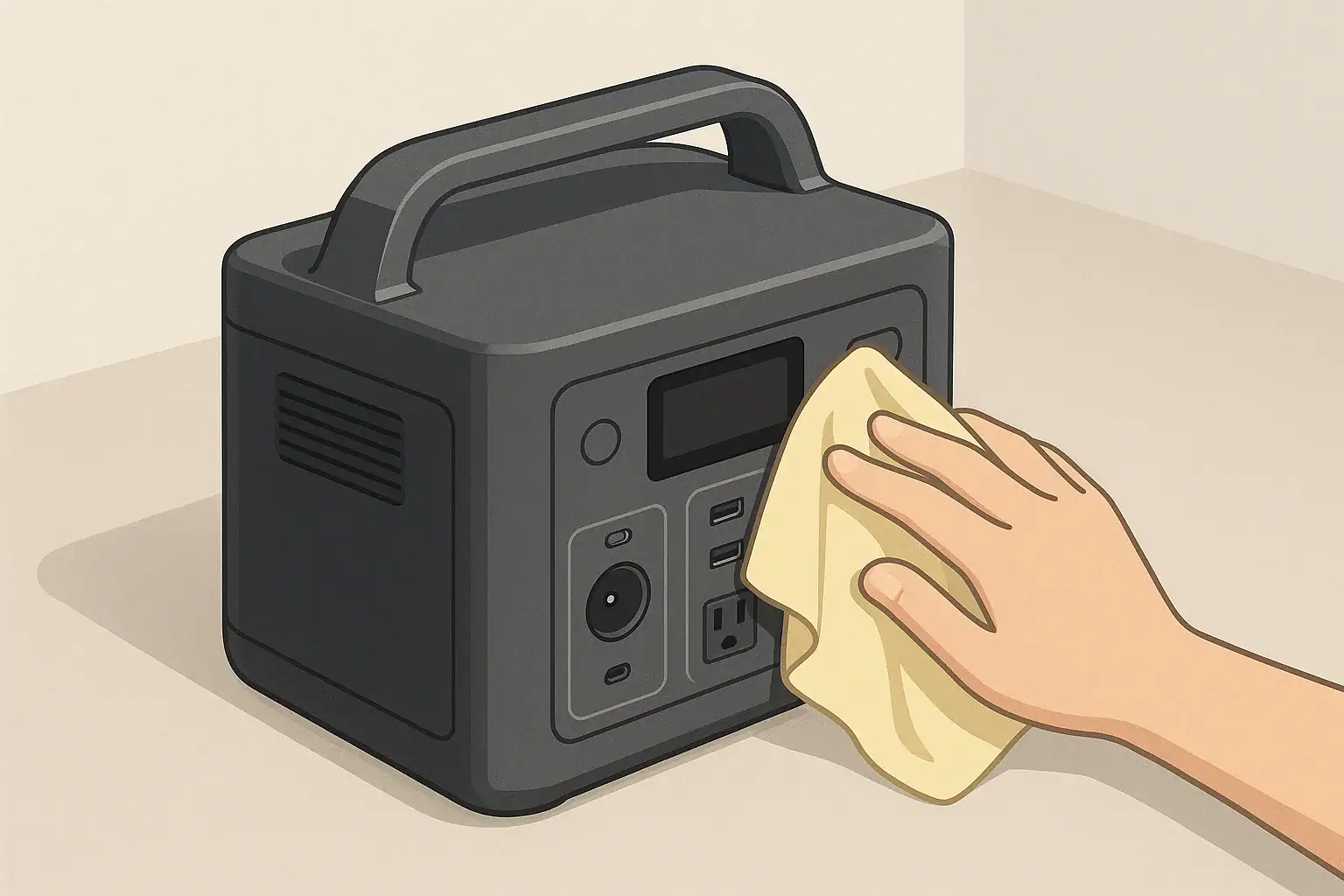
Long-term storage for a portable power station means keeping it unused for weeks or months while preserving its battery health, safety, and readiness. This includes how much it is charged before storage, the temperature where it is kept, and how often it is checked or topped up. Good storage habits can significantly extend the usable life of the battery and help ensure the unit works when you need it.
Portable power stations use rechargeable batteries, most commonly lithium-based chemistries, that slowly lose charge over time even when turned off. If the state of charge is too low or too high during long storage, or if the unit is exposed to extreme temperatures, the battery can degrade more quickly. In severe cases, it may no longer hold useful energy or may trigger built-in protection systems that make the station appear dead.
Thinking about storage as part of overall energy planning is especially important if you rely on a power station for emergency backup, camping, or remote work. A unit that has sat in a hot garage at full charge for a year is less likely to perform as expected than one kept at a moderate charge level in a climate-controlled space and checked periodically.
By understanding the basics of charge levels, temperature effects, and storage schedules, you can create a simple routine that fits your home, vehicle, or RV setup. The goal is not constant tinkering, but a predictable pattern that safeguards your investment and ensures reliable power when an outage or trip comes up.
What the topic means (plain-English definition + why it matters)
Key concepts & sizing logic (watts vs Wh, surge vs running, efficiency losses)
Even when you are focusing on long-term storage, it helps to understand how capacity and power ratings interact. The watt-hour (Wh) rating of a portable power station describes how much energy the battery can store. The watt (W) rating of the inverter and DC outputs describes how quickly that energy can be delivered to appliances. Together, they influence how often you will cycle and recharge the battery over its life, which in turn affects how you plan for storage.
Running watts represent the continuous power a device uses once it is operating, while surge watts represent the short burst of higher power some devices require to start up. A typical portable power station inverter is sized to handle a specific continuous load with some allowance for brief surges. If you regularly run the unit at or near its limits, you will cycle the battery more deeply, making careful storage practices even more important to preserve capacity.
Efficiency losses also play a role. Converting battery energy to AC power through an inverter is not perfectly efficient. Some energy is lost as heat. Similarly, using certain charging methods or adapters can introduce additional losses. Over many charge and discharge cycles, these inefficiencies slightly increase the total work that the battery has to do, which accumulates as wear.
From a storage perspective, this means that a power station used heavily at high loads will likely reach its useful cycle life sooner than one used more lightly. When planning how full to charge before storing and how often to top up, it is helpful to remember that both time and usage contribute to battery aging. Sound sizing, avoiding chronic overloads, and realistic expectations about runtime all support better long-term storage outcomes.
| What to check | Why it matters | Example guideline |
|---|---|---|
| State of charge before storage | Balances battery stress and readiness | Aim for roughly 40–60% for multi-month storage |
| Storage temperature | Extreme heat or cold accelerates aging | Choose a cool, dry indoor area whenever possible |
| Inverter and outputs off | Reduces standby drain and self-discharge rate | Disable all outputs if the unit offers that control |
| Cable and accessory condition | Prevents shorts, damage, and confusion later | Store main charging cables coiled, dry, and labeled |
| Expected downtime | Determines how often to inspect and top up | Schedule a brief check every 2–6 months |
| Dust and moisture exposure | Protects vents, ports, and electrical contacts | Use a breathable cover; avoid sealed plastic bags |
| Nearby heat sources | Localized heating can damage the battery | Keep away from radiators, windows, and heaters |
Real-world examples (general illustrative numbers; no brand specs)
Consider a portable power station with a battery capacity around 500 Wh commonly used for short power outages and camping. If you run a 50 W laptop and a 10 W router for remote work, the combined load is about 60 W. Ignoring losses, you might expect a little over 8 hours of runtime (500 Wh ÷ 60 W). Accounting for inverter and other efficiency losses, an example usable runtime might be closer to 6–7 hours. If you only use the station occasionally, you might run it a few times a year, then store it between events.
Now imagine a larger unit around 1500 Wh used for home essentials during outages, such as a small refrigerator rated at 80 W running average, plus LED lighting around 20 W, for a combined 100 W. Simple math suggests 15 hours of runtime, but when you factor in compressor cycles, inverter losses, and other small loads, you may see 10–12 hours in practice. Because this unit supports more critical loads, you may choose to store it closer to a mid-level charge and inspect it more often, especially during storm seasons.
For a compact unit around 300 Wh used mainly for camping and charging phones, small fans, or a low-power projector, the loads may be modest, such as 20–40 W total. It might last an evening or two between charges. If you only camp a few times a year, long stretches of storage become more important than cycle count. Keeping such a unit at a moderate charge level indoors between trips can help preserve capacity for several seasons.
In all of these examples, the actual numbers are less important than the pattern: understand your typical load, approximate runtime, and how often you cycle the battery. If the station spends more time sitting than working, storage practices like avoiding full charge in hot conditions, checking charge status a few times per year, and not letting it fully drain while powered off become the main tools for extending its service life.
Common mistakes & troubleshooting cues (why things shut off, why charging slows, etc.)
One common storage mistake is leaving the power station fully charged for months in a warm environment. High state of charge combined with elevated temperature tends to accelerate capacity loss in many lithium-based batteries. Another frequent issue is storing the unit nearly empty, which can allow the battery to self-discharge into a deep state of depletion. Some built-in protections may then prevent normal startup until the battery is recovered by a compatible charger, and in some cases capacity loss is permanent.
Users often discover problems only when they need the unit urgently. Signs of storage-related issues can include the device not turning on, displaying a much lower capacity than expected, or shutting off quickly under modest loads. Slow charging or the inability to reach a full charge on the display may also point to long-term degradation or, in milder cases, a battery management system recalibrating after long inactivity.
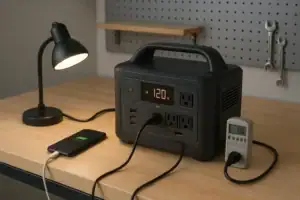
Another mistake is storing a power station with AC or DC outputs left enabled, even if nothing is plugged in. Many models draw a small amount of power to keep inverters, DC converters, or displays ready, which can gradually drain the battery. Forgetting about accessories left connected, such as a small light or wireless router, can lead to a slow but steady discharge that leaves the unit empty when an outage occurs.
If you notice the power station shutting off under loads it previously supported, or if charging seems to stall before reaching the expected level, consider the age of the battery, past storage conditions, and how long it has been since the last full cycle. While you should not open the unit or attempt to bypass built-in protections, you can often improve behavior by charging the unit fully per the manufacturer’s guidance, then avoiding extreme temperatures and deep discharge during future storage periods.
Safety basics (placement, ventilation, cords, heat, GFCI basics at a high level)
Safe storage begins with placement. Portable power stations should be stored on a stable, dry surface, away from direct sunlight, open flames, and sources of high heat. Avoid stacking heavy items on top of the unit, since pressure on the case can stress internal components and vents. Keeping vents and ports unobstructed supports thermal safety if the unit is briefly used or charged in its storage location.
Ventilation matters both in use and during charging before or after storage. While most modern units are designed to operate safely indoors, they can generate heat under load or while charging. Storing the station in a small enclosed cabinet with no airflow can trap heat if someone plugs it in without moving it. Providing a little space around the unit and avoiding sealed containers helps dissipate warmth and moisture.
Cords and extension cables should be stored neatly to prevent damage and tripping hazards. For long-term storage, inspect power cords for cuts, kinks, or crushed sections. If you plan to plug the station into household receptacles, use properly rated extension cords and avoid running them under rugs or through doorways where they can be pinched. GFCI outlets are commonly used in kitchens, bathrooms, garages, and outdoor areas to reduce shock risk; plugging into a GFCI-protected outlet is generally a good practice when operating or charging near moisture.
Do not attempt to wire a portable power station directly into your home electrical panel or permanent wiring without a code-compliant setup installed by a qualified electrician. Improper connections can create backfeed hazards, damage equipment, and pose shock or fire risks. For long-term storage, keep the unit clearly separated from panel equipment, and store any cords or adapters in a way that discourages improvised connections.
Maintenance & storage (SOC, self-discharge, temperature ranges, routine checks)
State of charge, often abbreviated SOC, is a central concept in long-term storage. Many lithium-based batteries are most comfortable when stored at a moderate SOC rather than at 0% or 100% on the display. As a general example, aiming for roughly 40–60% charge before storing for several months is a common recommendation for preserving battery health, while still leaving some energy available for short-notice use.
Self-discharge is the slow, natural loss of charge over time, even when the unit is powered off. The rate depends on battery chemistry, age, and internal electronics. Some portable power stations include a low-power standby mode that minimizes this drain, while others continue to run internal monitoring circuits that consume small amounts of energy. Over many weeks, this can shift SOC downward, so planning periodic checks is important.
Temperature also has a strong influence on both self-discharge and aging. Storing a power station in a cool, dry indoor space is generally better than a hot attic or uninsulated shed. Very cold temperatures can temporarily reduce apparent capacity and may be outside the recommended charging range, while high heat can permanently reduce capacity. As an example, keeping the unit in an environment close to typical room temperature is often a practical target for long-term storage.
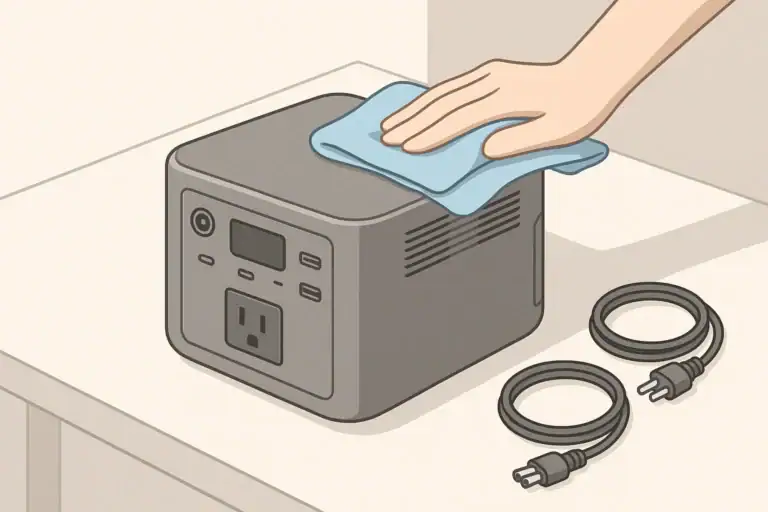
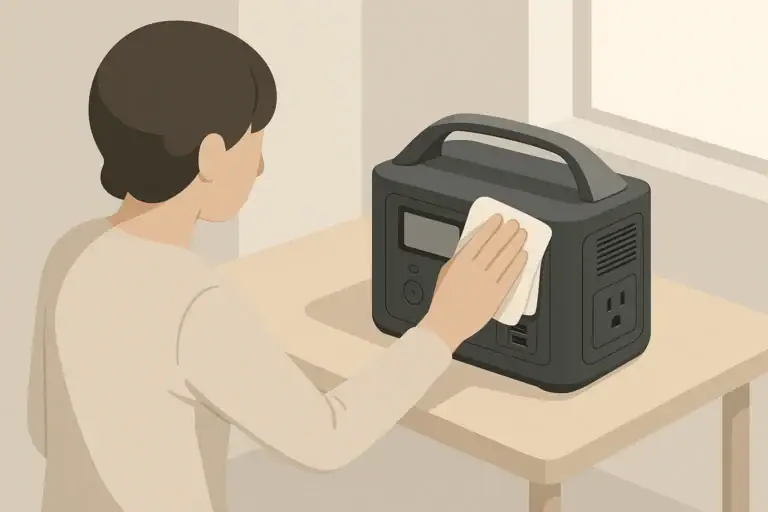
Routine checks can be simple. Every few months, power up the unit, confirm the remaining SOC, and visually inspect the case, vents, and cords. If the charge level has dropped significantly, top it up to a moderate level again rather than leaving it near empty. Use a dry cloth, such as a microfiber towel, to gently remove dust from surfaces and vents. Avoid using sprays directly on the unit or exposing it to liquids; a lightly dampened cloth applied away from ports is usually sufficient if deeper cleaning is needed.
| Timeframe | Suggested action | Notes |
|---|---|---|
| Before storing 1–3 months | Adjust SOC to moderate level | Target mid-range charge instead of full or empty |
| Every 2–3 months | Check charge level and top up as needed | Avoid letting displayed SOC fall near zero |
| Every 6 months | Inspect case, vents, and cords | Look for cracks, corrosion, or frayed insulation |
| Annually | Perform a light functional test | Power a small load briefly to confirm normal operation |
| Before storm season or trips | Charge closer to higher SOC | Prioritize readiness when increased use is likely |
| After heavy use | Allow to cool, then recharge and rest | Do not store immediately after high-heat operation |
| If stored in vehicle | Monitor temperature exposure | Remove during extreme heat or cold when practical |
Practical takeaways (non-salesy checklist bullets, no pitch)
Long-term storage is less about constant attention and more about establishing a consistent, low-effort routine. A simple plan that considers charge level, temperature, and inspection intervals can meaningfully extend the useful life of your portable power station while keeping it ready for outages, travel, and projects. The same underlying principles apply whether you use a compact unit for camping or a larger one for home essentials.
Think about where and how often you use the power station, then match your storage approach to those patterns. If it mainly supports rare emergencies, emphasize moderate SOC, cool storage, and scheduled checks. If it sees frequent use and short storage gaps, focus on avoiding extreme temperatures and giving the battery time to rest between deep cycles. In both cases, respecting the limits built into the device and avoiding improvised modifications are key to safety and longevity.
The following checklist summarizes core practices you can adapt to your situation:
- Store the power station at a moderate state of charge when it will sit unused for more than a few weeks.
- Keep it in a cool, dry, indoor location away from direct sun, heaters, or freezing conditions when possible.
- Turn off all outputs and displays before storage to reduce standby drain and self-discharge.
- Schedule brief checks every few months to confirm charge level and inspect the case, vents, and cables.
- Use proper, undamaged cords and avoid running extension cables where they can be pinched or overheated.
- Do not attempt panel wiring or internal modifications; consult a qualified electrician for any permanent connections.
- Clean dust with a soft dry cloth and avoid liquids around ports, buttons, and cooling vents.
- Plan ahead for seasons or trips when the unit is more likely to be needed, adjusting SOC and checks accordingly.
By integrating these habits into your regular home or vehicle maintenance routine, you can help your portable power station deliver reliable service over many years of intermittent use and storage.
Frequently asked questions
What state of charge should I leave a portable power station at for multi-month storage?
For storage of several months, aim for a moderate state of charge around 40–60%. This range limits stress that accelerates aging while leaving some capacity available for short-notice needs; avoid storing at or near 100% or fully depleted for long periods.
How often should I check and top up the battery during extended storage?
Check the unit every 2–3 months and top up to a moderate SOC if the charge has dropped significantly. Perform a more thorough visual inspection of the case, vents, and cables every 6 months and run a light functional test annually.
What temperature range is best for long-term storage of a portable power station?
Store the unit in a cool, dry indoor area near typical room temperature (roughly 15–25°C) when practical. Avoid prolonged exposure to high heat (above about 30°C) or freezing conditions, since both can accelerate capacity loss or temporarily reduce usable energy.
Can I leave my power station plugged in while it is in storage?
Generally avoid keeping the unit continuously at full charge unless the manufacturer specifies a dedicated storage or float mode. If continuous connection is necessary, use the device’s recommended settings; otherwise disconnect after charging and top up periodically to maintain a moderate SOC.
How should I store a portable power station in a vehicle or RV for long periods?
Remove the unit from the vehicle during extreme heat or cold when practical; if it must remain in the vehicle, keep it shaded, ventilated, and secured to prevent movement. Monitor SOC more frequently, store cables neatly, and avoid leaving it in confined, hot spaces like trunks during summer.
Related guides
Browse this topic →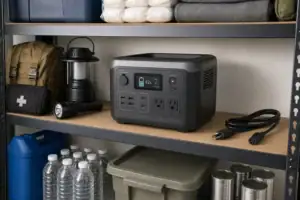

- Beginner-friendly sizing, runtime & specs
- Solar & charging (MPPT, fast charging, cables)
- Batteries (LiFePO4, cycles, care & storage)
- Safety, cold-weather performance, real-world tips
More in Maintenance
See all →- Where to Store a Portable Power Station at Home: Heat, Humidity, and Access
- How App Control and Smart Charging Affect Portable Power Station Battery Health
- How to Maintain a Portable Power Station
- How Long Do Portable Power Stations Last?
- Are Portable Power Stations Sustainable? Repairability, Recycling, and E-Waste
Keep reading
About this site
Portable Energy Lab publishes practical, independent guides about portable power—clear sizing, safe use, and real-world expectations.
Affiliate disclosure
Some links on this site may be affiliate links. If you buy through these links, we may earn a small commission at no extra cost to you. This helps support our content. Read our affiliate disclosure.