
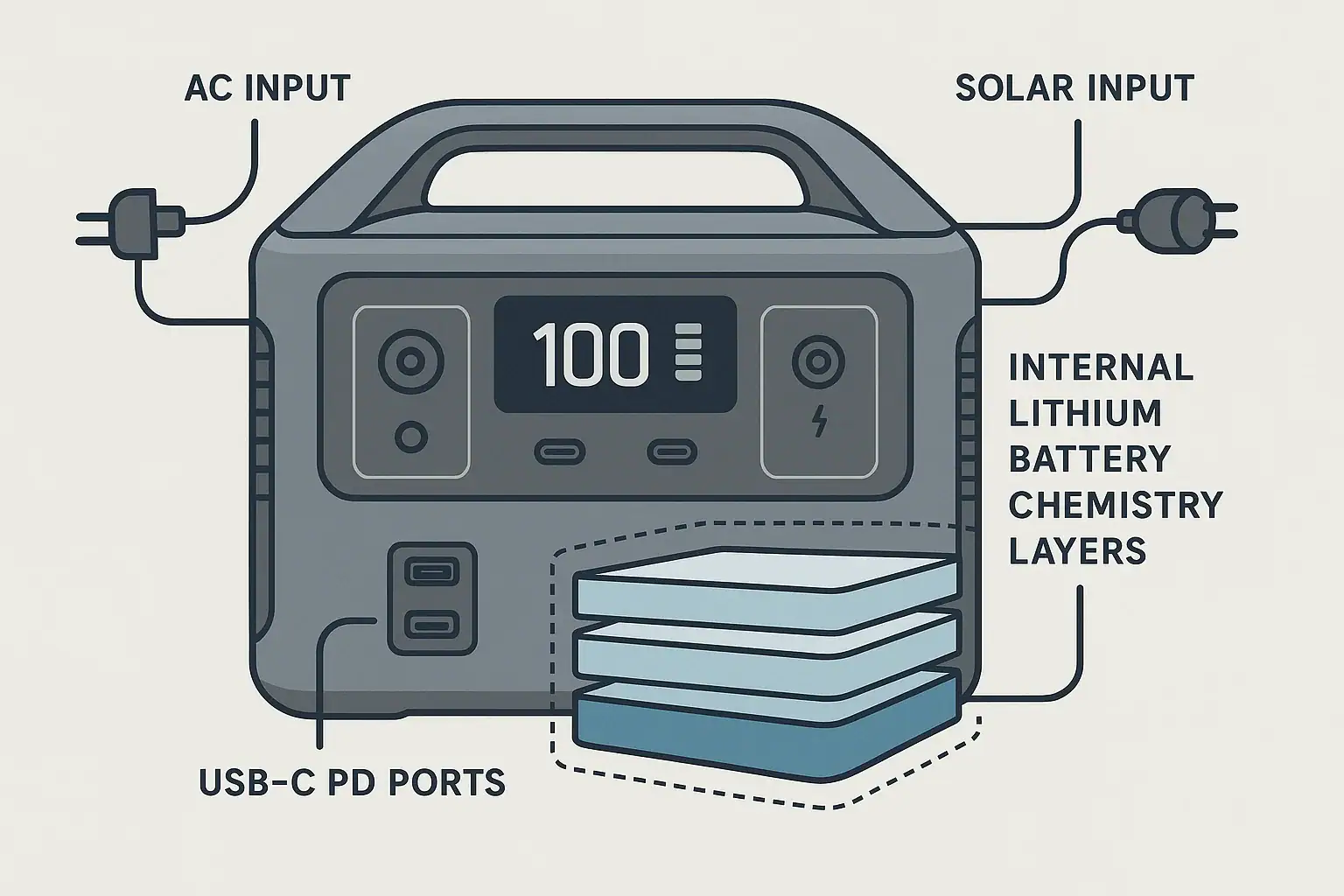
The most important thing to expect next in portable power stations is higher input limits, smarter USB-C power delivery, and safer, longer‑lasting battery chemistries. As charging standards and battery technology evolve, recharge times, runtime, and overall efficiency are changing quickly. If you are comparing input wattage, PD profiles, surge watts, or battery cycle life, these trends directly affect what your next power station can do.
Today’s models already blend AC charging, solar input, and USB-C fast charging, but the next generation will push those limits further. Understanding how input standards, USB-C specs, and battery chemistry work together helps you plan for real-world use: camping, backup power, tools, and electronics. This guide explains what is happening behind the scenes, what trade‑offs to expect, and which specs matter most before you buy.
Understanding Evolving Input Standards and Battery Chemistries
For portable power stations, “input standards” describe how the unit accepts energy: wall AC charging, DC car charging, solar input, and USB-C power delivery. Each standard defines voltage, current, and power limits, which directly control how fast a battery can recharge and how flexible your charging options are in the field.
At the same time, battery chemistry determines how that incoming energy is stored and released. Most modern portable power stations use lithium-based chemistries such as lithium-ion (often NMC or NCA) or lithium iron phosphate (LiFePO4). These chemistries differ in energy density, cycle life, weight, safety characteristics, and performance at different temperatures. Solid-state batteries could eventually improve energy density and safety, but real products must still prove cycle life, cost, and charging performance.
This combination—input standard plus battery chemistry—shapes three core experiences:
- Recharge time: Higher input wattage and robust chemistries allow faster charging without excessive heat.
- Portability: Higher energy density packs more watt-hours into a smaller, lighter package.
- Longevity and safety: Chemistries with higher cycle life and better thermal stability offer more years of use and safer operation.
Expect future portable power stations to standardize on faster, more interoperable inputs (especially USB-C PD and solar-ready ports) and to shift toward chemistries that favor durability and safety over maximum energy density alone.
How USB-C PD, AC Input, and Battery Chemistry Work Together
To understand where the technology is going, it helps to see how power moves from the wall or a USB-C charger into the battery and then back out to your devices.
USB-C Power Delivery Profiles
USB-C PD (Power Delivery) is becoming a central input standard for portable power stations. Instead of a fixed 5 V output like older USB ports, USB-C PD negotiates voltage and current between the source (charger) and the sink (power station). Common PD profiles include 5 V, 9 V, 12 V, 15 V, and 20 V, with power levels from 18 W up to 100 W and beyond on newer extensions.
When you plug a USB-C PD charger into a portable power station, the two devices communicate to agree on the highest safe combination of voltage and current. The station’s internal circuitry converts that power to the voltage needed to charge its battery pack. Multiple USB-C ports can share or balance power depending on the firmware and hardware design.
AC and DC Input Paths
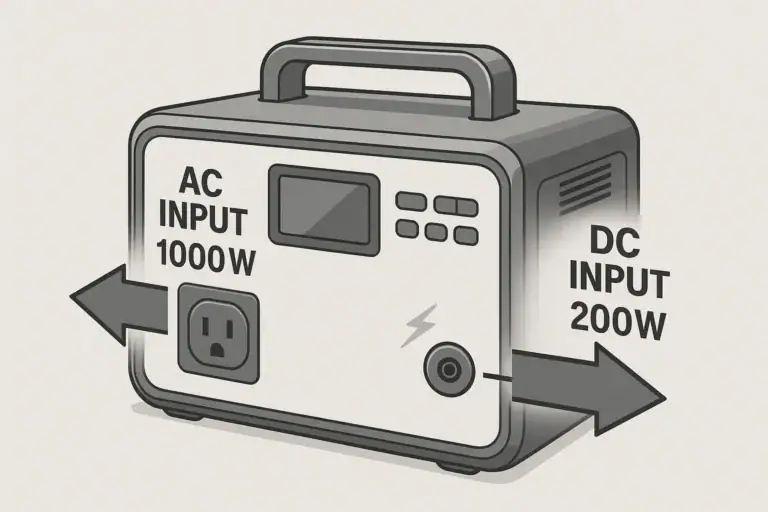
AC input from a wall outlet typically delivers the highest continuous charging power. Inside the portable power station, an AC-to-DC converter steps down and rectifies the voltage, then a charge controller manages how that energy flows into the battery. DC inputs, such as car sockets or solar ports, bypass AC conversion but still rely on charge controllers and maximum power point tracking (MPPT) for solar.
As standards evolve, more units are supporting higher AC input wattage, dual input (AC plus solar or AC plus USB-C), and more efficient MPPT for solar. These improvements cut recharge time and allow better use of variable solar power.
Battery Management Systems and Chemistry Limits
battery management system (BMS) monitors cell voltages, temperatures, and currents. It enforces limits such as maximum charge rate (often expressed as a C‑rate), over‑voltage protection, and thermal cutoffs.
High energy density chemistries like NMC can offer compact size and weight but may have lower cycle life and tighter thermal margins. LiFePO4 typically supports more cycles and better thermal stability but with lower energy density. Future designs are focusing on chemistries and BMS algorithms that allow higher input wattage without shortening battery life or compromising safety.
End-to-End Efficiency
Every conversion—AC to DC, DC to battery, battery to inverter output—introduces losses. Higher quality components, smarter firmware, and improved chemistries can increase round‑trip efficiency. That means more of the energy you put in (from the wall or solar) ends up as usable output for your devices, improving effective runtime.
| Input / Chemistry | Typical Input Power Range | Key Strength | Common Trade-Off |
|---|---|---|---|
| USB-C PD (single port) | 30–100 W | Universal, compact chargers | Too slow for large capacity |
| Wall AC input | 200–1200 W | Fastest full recharge | Requires grid power |
| Solar DC input | 100–800 W | Off-grid capability | Weather dependent |
| Li-ion (NMC/NCA) | Moderate–high C-rate | High energy density | Lower cycle life |
| LiFePO4 | Moderate C-rate | High cycle life, stability | Heavier per Wh |
Real-World Examples of Future-Focused Input and Battery Trends
Looking at how these trends play out in real scenarios makes it easier to understand what to expect from newer portable power stations.
Scenario 1: Faster Turnaround Between Outages
For home backup use, one of the biggest pain points is recharge time between grid outages. Older units with low AC input (for example, 150–300 W) can take many hours to refill a mid‑size battery, leaving you vulnerable if the power flickers repeatedly.
Newer designs are moving toward higher AC input limits—600 W, 1000 W, or more—combined with chemistries and BMS tuning that tolerate faster charging. This can cut recharge time from overnight to a few hours, especially when paired with partial solar input. As standards mature, expect more models to support configurable charge rates so you can choose between maximum speed and battery longevity.
Scenario 2: USB-C as a Primary Laptop and Device Hub
For travel and remote work, USB-C PD is increasingly replacing barrel connectors and proprietary chargers. A portable power station with high‑power USB-C PD (60–140 W per port, depending on the standard) can directly run laptops, tablets, and phones without using the AC inverter at all.
In practice, this means quieter operation (no inverter fan), less conversion loss, and better overall efficiency. As USB-C standards evolve, expect more ports that can act as both input and output, allowing you to charge the power station from a high‑power USB-C adapter while also powering smaller devices.
Scenario 3: Solar-Heavy Off-Grid Setups
Off‑grid users rely heavily on solar input and battery durability. Improved MPPT controllers can extract more energy from panels throughout the day, even under partial shading or changing light conditions. When paired with a chemistry like LiFePO4, which tolerates frequent cycling, the system can handle daily charge/discharge patterns for years.
Future models are likely to support higher solar voltage and current limits, enabling longer panel strings and more flexible wiring layouts (within safe design limits). This trend will make it easier to scale up off‑grid systems without stepping into full custom solar installations.
Scenario 4: High-Surge Loads and Tool Use
Contractors and DIY users often care about surge watts and sustained output. While surge capacity is mostly an inverter feature, the ability to recharge quickly between jobs is becoming more important. Higher AC input ratings and compatible chemistries reduce downtime, especially when combined with partial charging from a vehicle or on‑site solar.
Expect future portable power stations aimed at tools to emphasize both high surge watts and robust, fast-charging input paths, with thermal and BMS protections tuned to handle frequent, heavy cycling.
Common Mistakes and Troubleshooting Around Inputs and Chemistry
As input standards and battery chemistries evolve, certain user mistakes crop up repeatedly. Recognizing them can help you troubleshoot issues and choose better specs.
Mistake 1: Overestimating USB-C Input Capabilities
Many users assume that any USB-C port can rapidly recharge a portable power station. In reality, a single 45–65 W USB-C PD input is slow for a large battery. If you notice extremely long charge times, check:
- Whether the USB-C port supports PD input at all (some are output-only).
- The maximum PD profile advertised (e.g., 60 W vs. 100 W).
- Whether you are using a cable and charger rated for the required wattage.
Future models will better label ports and support higher PD levels, but verifying specs remains essential.
Mistake 2: Ignoring Input Limit When Adding Solar
Another common issue is connecting more solar panel wattage than the input can handle. The power station’s solar input will cap at its rated limit, so adding excess panel capacity may provide limited benefit. If your display shows the same solar wattage regardless of additional panels, you are likely hitting the input ceiling.
Newer designs may support higher voltage ranges and wattage, but the principle remains: match your solar array to the station’s DC input specs and MPPT range.
Mistake 3: Misunderstanding Cycle Life Claims
Battery chemistry marketing often highlights high cycle life numbers, especially for LiFePO4. However, real-world cycle life depends on depth of discharge, charge rate, temperature, and how often you push the unit to its limits. If you see capacity dropping faster than expected, consider whether you are:
- Regularly discharging to near 0% or charging to 100% and leaving it full for long periods.
- Charging or discharging at high power in hot conditions.
- Storing the unit fully charged in a warm environment.
Future chemistries and smarter BMS algorithms aim to reduce this sensitivity, but user behavior will still matter.
Mistake 4: Expecting Full Output While Fast Charging
Some users are surprised when their portable power station reduces AC output or limits certain ports while fast charging. This is often a design choice to protect the battery and internal components. If you notice reduced output or intermittent shutdowns under heavy use and fast charging, consult the manual for combined input/output limits.
As designs improve, expect clearer labeling and more transparent power-sharing rules between input and output paths.
Safety Basics for Higher Inputs and Advanced Chemistries
As input standards push toward higher wattage and batteries store more energy, safety becomes even more important. Modern portable power stations build multiple layers of protection into both hardware and software.
Built-In Protections
Common safety features include:
- Over‑current and over‑voltage protection: Prevents damage from faulty chargers or wiring.
- Short‑circuit protection: Quickly disconnects outputs if a fault is detected.
- Over‑temperature protection: Reduces power or shuts down the system if internal temperatures exceed safe limits.
- Cell balancing and monitoring: Keeps individual battery cells within safe voltage ranges.
These features are tightly integrated with the BMS and inverter firmware, especially on units that support high input wattage or rapid charging modes.
Safe Use of AC, USB-C, and Solar Inputs
When using higher input standards, keep these high-level practices in mind:
- Use appropriately rated cables and adapters for USB-C PD and DC inputs to avoid overheating.
- Protect solar wiring from abrasion and moisture, and follow basic polarity and voltage guidelines provided by the manufacturer.
- Avoid covering the power station during heavy charging, as this can trap heat and trigger thermal limits.
For any integration with home circuits beyond plugging into standard outlets, consult a qualified electrician. Portable power stations are not a replacement for properly installed transfer equipment.
Chemistry-Specific Considerations
Different chemistries have different safety profiles. LiFePO4 is known for good thermal stability and resistance to runaway, while high energy density chemistries require more careful thermal management. Future designs will continue to refine enclosures, venting, and firmware to minimize risk even under fault conditions.
Regardless of chemistry, avoid physical damage, immersion in water, or exposure to extreme temperatures. If a unit is visibly swollen, leaking, or badly damaged, discontinue use and follow local guidelines for disposal.
| Safety Feature | What It Does | Why It Matters |
|---|---|---|
| BMS protections | Monitors cells, current, and temperature | Prevents overcharge and deep discharge |
| Thermal sensors | Detect internal overheating | Reduces power or shuts down safely |
| Input current limiting | Caps AC/DC/USB-C draw | Protects wiring and connectors |
| Short-circuit detection | Stops output on fault | Reduces fire and damage risk |
| Enclosure design | Contains and directs heat | Adds a physical safety barrier |
Related guides: Input Limits (Volts/Amps/Watts) Explained: How Not to Damage Your Unit • Fast Charging vs Battery Life: C-Rate Explained for Portable Power Stations (No Hype) • LiFePO4 Charging Profile Explained (in Plain English)
Practical Takeaways and Future-Proof Specs to Watch
Portable power stations are moving toward higher, smarter inputs and more durable chemistries. For users, this means faster charging, better compatibility with USB-C devices, and longer service life—if you choose the right combination of specs.
Expect more models to advertise dual or multi-input charging, higher AC input wattage, and USB-C PD that can serve as both input and output. Battery chemistries will continue shifting toward options that balance energy density with cycle life and safety, supported by more sophisticated BMS designs.
When comparing units, focus on how the input standards and battery chemistry match your actual use: frequent cycling vs. occasional backup, heavy solar use vs. mostly wall charging, and whether USB-C should be a primary or secondary charging path.
Specs to look for
- AC input wattage: Look for roughly 400–1200 W on mid to large units; higher input means faster recharge after outages or trips.
- USB-C PD power rating: Aim for at least one 60–100 W PD port; this supports modern laptops and can serve as an alternate charging path.
- Solar input range and wattage: Check for 100–800 W and a wide voltage window; this increases flexibility when sizing and wiring panels.
- Battery chemistry type: Note whether it is Li-ion (NMC/NCA) or LiFePO4; LiFePO4 typically offers longer cycle life and better thermal stability.
- Cycle life rating: Look for cycle counts at a defined remaining capacity (e.g., 2000+ cycles to 80%); more cycles mean better long-term value.
- Round-trip efficiency: Values around 80–90% are common; higher efficiency delivers more usable watt-hours from each charge.
- Operating temperature range: A broad range (for example, 32–104°F or wider) supports more reliable performance in varied climates.
- Input/output power sharing limits: Clear combined wattage limits help you understand how much you can run while fast charging.
- BMS and safety certifications: Look for documented protections and recognized safety testing; this indicates mature design and testing.
By focusing on these technical details instead of just headline capacity, you can choose a portable power station that remains useful as input standards, USB-C capabilities, and battery chemistries continue to advance.
Frequently asked questions
Which specifications and features matter most when choosing a portable power station?
Prioritize AC input wattage for recharge speed, USB-C PD rating for direct device charging, and the solar input’s wattage and voltage window for off-grid flexibility. Also consider battery chemistry and cycle life for longevity, and round-trip efficiency to understand how much usable energy you get back.
Why doesn’t adding more solar panels always increase charging speed?
Most power stations have a maximum solar input limit and an MPPT voltage window, so any extra panel capacity beyond that cap won’t increase charge power. Mismatched wiring, shading, or incorrect panel voltages can also prevent higher charging rates.
What safety precautions should I follow when using high-wattage inputs or advanced battery chemistries?
Use cables and chargers rated for the intended wattage, avoid covering the unit during heavy charging, and follow the manufacturer’s limits for input voltage and current. For any permanent or complex home integration, consult a qualified electrician and heed BMS warnings and thermal cutoffs.
Can USB-C Power Delivery replace AC charging for large portable power stations?
USB-C PD is convenient and efficient for small to mid-size stations and for running laptops or phones without the inverter, but it is typically slower than high-wattage AC input for refilling large batteries. Some stations support multi-port PD or simultaneous inputs to speed charging, but large-capacity units still benefit from high-power AC or dedicated solar arrays.
How does battery chemistry influence a power station’s lifespan and day-to-day performance?
LiFePO4 chemistry generally offers higher cycle life and better thermal stability at the cost of lower energy density, while NMC/NCA chemistries provide higher energy density but typically fewer cycles and narrower thermal margins. Choice of chemistry affects weight, how fast you can safely charge, and how the unit ages under frequent cycling.
Related guides
Browse this topic →

- Beginner-friendly sizing, runtime & specs
- Solar & charging (MPPT, fast charging, cables)
- Batteries (LiFePO4, cycles, care & storage)
- Safety, cold-weather performance, real-world tips
More in Charging
See all →- Can You Daisy-Chain Portable Power Stations? Why It Usually Isn’t a Good Idea
- USB-C Input vs AC Input on Portable Power Stations: Which Charging Method Makes Sense?
- Car Alternator Charging vs Cigarette Lighter Charging: What Changes for Power Stations?
- Charging a Portable Power Station From an RV Outlet: 12V, 24V, and Safety Limits
- Fast AC Charging vs Battery Longevity: Should You Use Turbo Mode Every Time?
Keep reading
About this site
Portable Energy Lab publishes practical, independent guides about portable power—clear sizing, safe use, and real-world expectations.
Affiliate disclosure
Some links on this site may be affiliate links. If you buy through these links, we may earn a small commission at no extra cost to you. This helps support our content. Read our affiliate disclosure.