
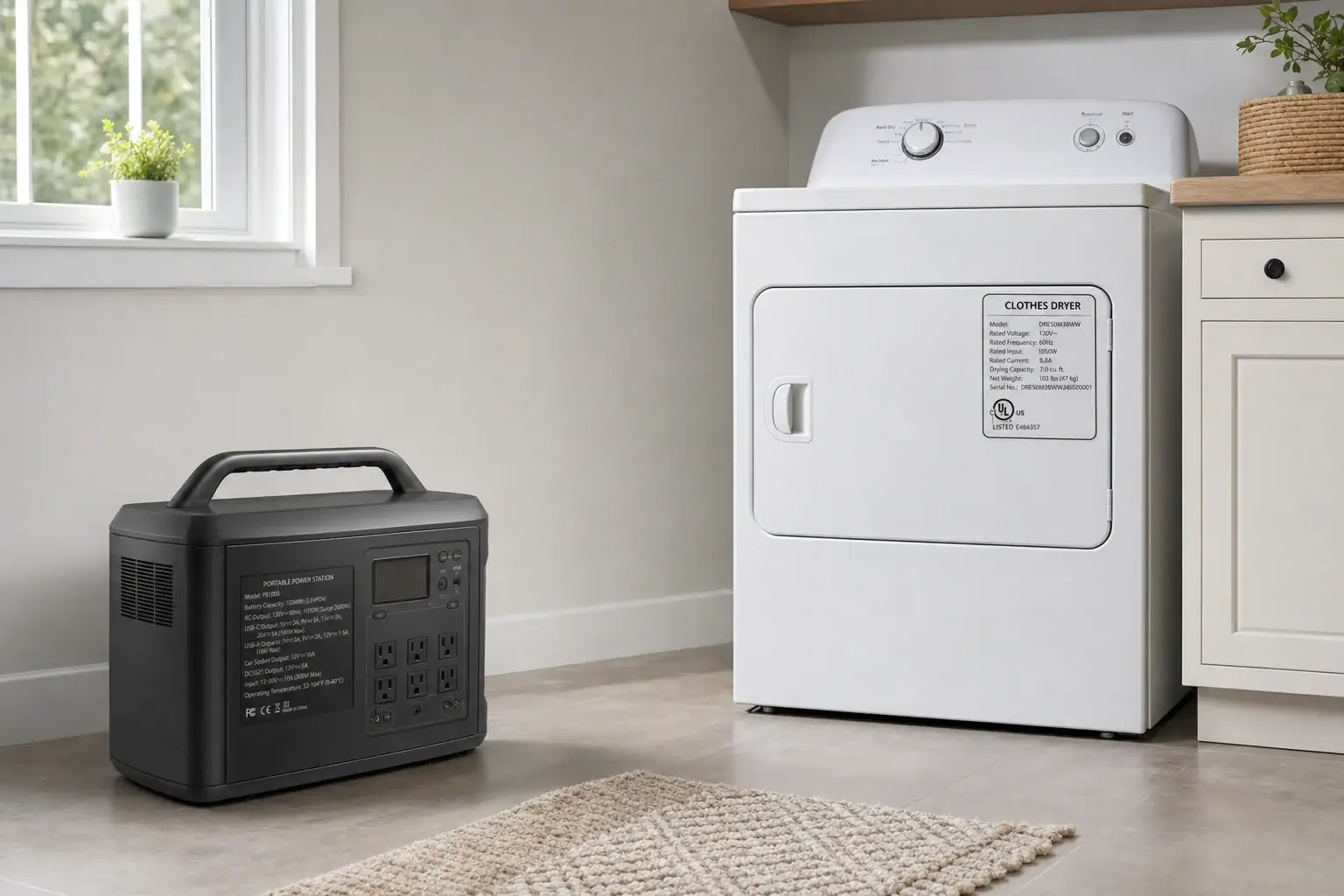
Most portable power stations cannot run a standard electric clothes dryer. A conventional dryer commonly needs 240-volt split-phase power and several thousand watts, while many portable stations provide only 120-volt AC output.
It is possible with certain high-output systems designed to supply the dryer’s exact voltage, continuous wattage, startup surge, receptacle, and grounding requirements. Compact 120-volt, heat-pump, and gas dryers may be easier to power, but their nameplates and manuals must still be checked individually.
Why dryer type matters
The heating method usually determines how demanding a dryer is. The following ranges are illustrative planning figures, not universal specifications:
| Dryer type | Possible supply | Illustrative input range | Main compatibility issue |
|---|---|---|---|
| Conventional electric | Usually 240 V | About 4,000–6,000 W while heating | High output and split-phase voltage |
| Compact electric | Often 120 V | About 1,200–1,800 W | Long runtime and substantial battery use |
| Heat-pump | 120 V or 240 V, depending on model | About 700–2,000 W | Compressor startup and model-specific voltage |
| Gas | Often 120 V for controls and motor | Several hundred watts | Motor surge, ignition, controls, and proper gas operation |
Check the dryer’s nameplate and current manufacturer documentation rather than selecting a station from these broad ranges. A dryer’s branch-circuit rating is not necessarily its actual operating wattage. For example, a 240-volt, 30-amp circuit represents up to 7,200 volt-amperes of circuit capacity, but the appliance may draw less.
Four requirements must match
1. Output voltage and configuration
A 240-volt dryer requires a power source specifically designed to provide the correct 240-volt split-phase output. Two ordinary 120-volt outlets do not become a compatible dryer supply through an adapter. Likewise, added battery capacity does not give a 120-volt inverter 240-volt capability.
The station must also have a manufacturer-approved outlet and operating configuration compatible with the appliance. Do not use improvised adapters, combine independent outputs, backfeed a receptacle, or connect a portable power station to a home electrical panel.
2. Continuous output power
The station’s continuous AC rating must exceed the dryer’s maximum simultaneous demand, not merely its average consumption. Heating elements, the drum motor, blower, controls, and—where present—a compressor may operate together.
If only voltage and current are listed, multiplying them provides a useful upper-bound estimate:
Apparent power in volt-amperes = volts × amperes
For motors and compressors, volt-amperes and watts are not always identical because of power factor. Use the manufacturer’s input-watt specification when available.
3. Startup or surge capacity
Resistance heating elements generally do not create a large startup surge, but motors and compressors can briefly draw more than their normal running power. The station’s surge rating must accommodate that event without shutting down.
Surge ratings are not directly comparable unless their permitted duration is known. A high surge number available for only a fraction of a second may not support a motor that takes longer to start. Dryer and power-station manufacturers may specify these values differently.
4. Battery energy
Output power, measured in watts, determines whether the dryer can operate. Battery capacity, measured in watt-hours or kilowatt-hours, determines approximately how long it can operate. A station can have enough inverter power to start a dryer yet too little stored energy to finish a load.
A simplified estimate is:
Usable AC energy = rated battery capacity × usable-capacity fraction × inverter efficiency
For example, assume a station has a 5,000 Wh battery, 90% usable capacity, and 90% inverter efficiency:
5,000 Wh × 0.90 × 0.90 = 4,050 Wh, or 4.05 kWh of estimated AC energy
If a dryer drew 4,500 W continuously for 45 minutes, the simplified energy requirement would be:
4,500 W × 0.75 hour = 3,375 Wh
That example leaves little practical margin after accounting for changing loads, battery temperature, conversion losses, aging, and cycle length. Real dryers cycle their heaters or compressors, so an appliance’s documented energy per cycle may provide a better estimate than multiplying maximum wattage by time. Use the dryer’s current manufacturer data when available.
When running a dryer is realistic
A conventional 240-volt electric dryer is realistic only with a large system that explicitly supports the required split-phase voltage, outlet, continuous load, surge, and enough usable energy for the drying cycle. Merely adding expansion batteries solves the runtime problem, not an inverter-output limitation.
A compact 120-volt dryer may work with a much smaller station, but its heating load can still be close to the limit of a typical household outlet-style inverter. A heat-pump dryer may consume less energy per cycle, although compressor surge and voltage requirements vary. A gas dryer usually has a lower electrical demand because gas supplies the heat, but it still requires a compatible electrical source and a properly installed, safely operating fuel and exhaust system.
Compatibility checklist
- Confirm the dryer’s required voltage and phase configuration.
- Find the appliance’s maximum input watts or rated current.
- Account for motor or compressor startup demand.
- Verify the station’s continuous and time-limited surge ratings.
- Confirm that the outlet and grounding arrangement are manufacturer-approved.
- Estimate usable AC energy after capacity and inverter losses.
- Leave operating margin rather than sizing both devices to identical ratings.
Electronic controls can also be sensitive to waveform or grounding characteristics. Follow both manufacturers’ instructions, including any requirement for pure sine-wave power. Keep the station dry, ventilated, and clear of dryer heat and exhaust, and do not exceed the rating of any manufacturer-approved cord or accessory.
Bottom line
A standard 240-volt electric dryer is beyond the capabilities of most portable power stations, though certain large split-phase systems may support one. Lower-power compact, heat-pump, or gas dryers are more practical candidates. Compatibility depends on all four factors—voltage, continuous watts, startup surge, and usable battery energy—not battery capacity alone.
Related guides
Browse this topic →
- Beginner-friendly sizing, runtime & specs
- Solar & charging (MPPT, fast charging, cables)
- Batteries (LiFePO4, cycles, care & storage)
- Safety, cold-weather performance, real-world tips
More in Home / Appliances
See all →Keep reading
About this site
Portable Energy Lab publishes practical, independent guides about portable power—clear sizing, safe use, and real-world expectations.
Affiliate disclosure
Some links on this site may be affiliate links. If you buy through these links, we may earn a small commission at no extra cost to you. This helps support our content. Read our affiliate disclosure.