
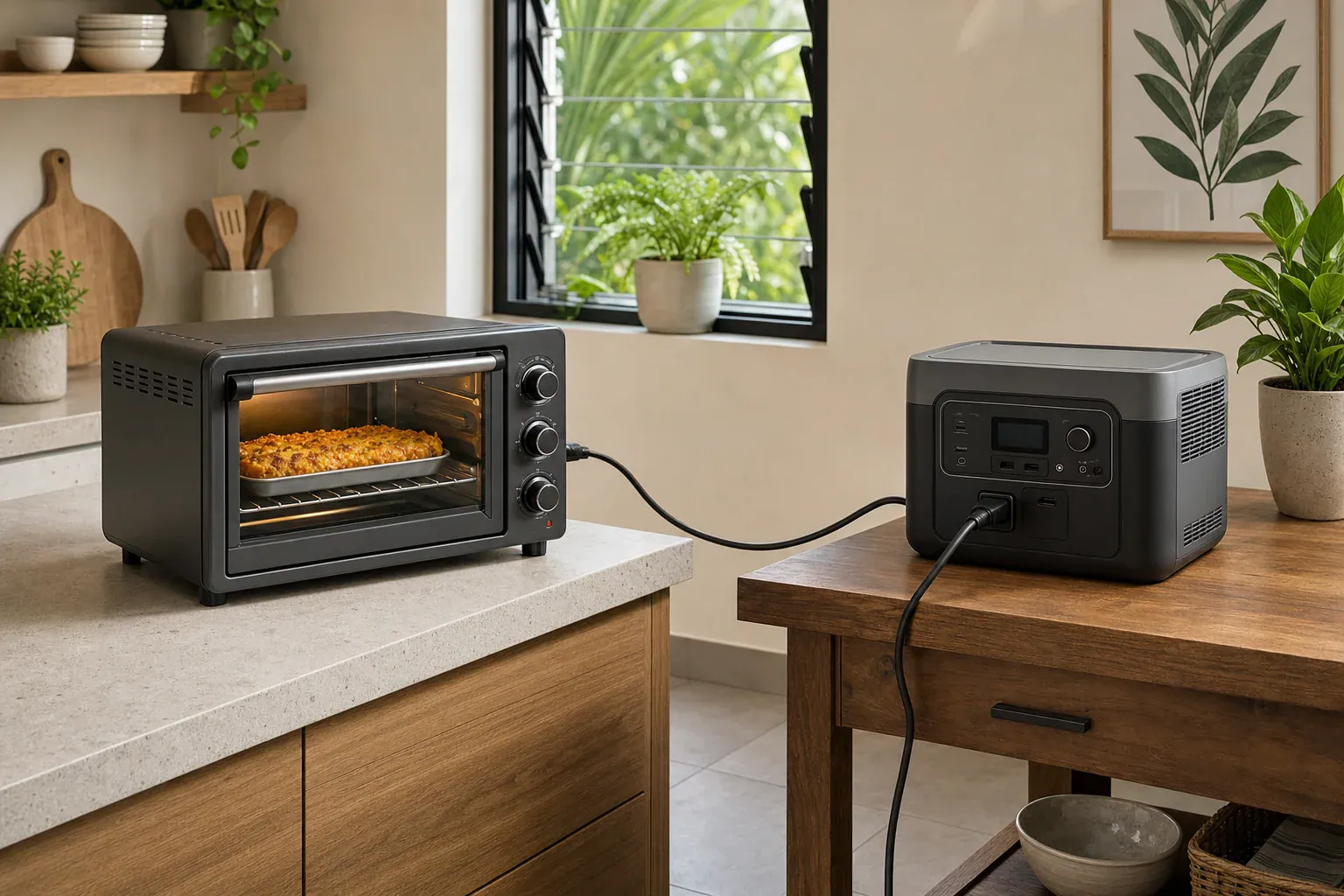
Quick answer: Yes. A portable power station can run a toaster oven when its continuous AC output meets or exceeds the oven’s nameplate input watts, with room for any other simultaneous loads. Battery watt-hours affect cooking-session count, but actual energy use varies with thermostat cycling, recipe settings, and AC conversion losses.
Can a portable power station run a toaster oven safely?
Start with the electrical label on the exact toaster oven rather than a generic wattage range. Compare the oven’s input watts with the power station’s continuous AC output, not its short-term surge rating. Also confirm that the station provides the voltage and frequency required by the appliance.
For example, the Hamilton Beach 31190-series manual lists 120V, 60Hz, 1,500W. The Breville BOV670 manual lists 120V, 60Hz, 1,800W. Those ratings apply only to the models covered by those manuals.
- Find the oven’s input watts on its rating label or in its manual.
- Find the station’s total continuous AC-output rating.
- Add the watts of every load that will run at the same time.
- Use the pairing only if the total remains within the station’s continuous-output limit.
Two documented compatibility examples
This is a comparison of published ratings, not a performance test or a runtime guarantee.
| Power station | Published capacity and AC output | 1,500W Hamilton Beach oven | 1,800W Breville oven |
|---|---|---|---|
| EcoFlow DELTA 2 | 1,024Wh; 1,800W continuous total AC output; 2,700W surge | Passes the rating screen; 300W remains for other loads | At the published continuous-output ceiling |
| Jackery Explorer 1000 Plus | 1,264.64Wh rated capacity; 2,000W rated total AC output; 4,000W surge peak | Passes the rating screen; 500W remains for other loads | Passes the rating screen; 200W remains for other loads |
The DELTA 2 manual instructs users to keep total loaded-device power at or below 1,800W. An oven rated at the station’s exact ceiling leaves no published allowance for another AC appliance. A modest margin can be practical, but neither oven manual establishes a required margin percentage.
Watts decide whether it runs; watt-hours estimate cooking sessions
Watts (W) are the rate of power use. They determine whether the station can support the oven while its heating elements are energized.
Watt-hours (Wh) are stored energy. They help estimate how many cooking sessions the battery may support. However, a station’s advertised battery capacity is not automatically the energy available from its AC outlets. Inverter conversion and the station’s own operating consumption reduce delivered AC energy. See usable capacity versus advertised capacity for the distinction.
The cited manufacturer specifications provide battery-capacity ratings, but they do not establish usable AC watt-hours for these toaster-oven loads. Exact session counts cannot be derived from the advertised Wh figure alone.
Does a toaster oven need startup or surge headroom?
The manuals for the two example ovens do not publish separate startup-watt figures. There is no basis here for assuming that either oven requires twice its nameplate wattage or any other generic startup multiplier.
Use the station’s continuous-output rating as the primary limit for a heating appliance. Surge output describes brief overload capability; it does not make a lower-continuous-output station suitable for sustained cooking. If the manuals for your exact oven or power station state a model-specific starting requirement, follow those instructions. For more on the distinction, see surge watts versus running watts.
Why thermostat cycling changes energy use
Nameplate watts should not be treated as a guaranteed average draw for every recipe. The Breville BOV670 manual states that the top and bottom elements cycle on and off in Bake mode to regulate temperature. The station must still support the oven’s heat-on demand, even when the session’s average consumption is lower.
No universal cycling percentage is available. Preheating, selected mode and temperature, food load, room conditions, and door opening can affect energy used during a session. A full-nameplate calculation is useful as a conservative planning assumption, but it is not a measured runtime result.
Illustrative watt-hour calculation
Assume, only for this example, that a 1,500W oven draws its full nameplate input for a complete 20-minute session, including preheating:
1,500W × (20 ÷ 60 hours) = 500Wh per session
Using the Jackery Explorer 1000 Plus’s published 1,264.64Wh battery capacity as an idealized comparison:
1,264.64Wh ÷ 500Wh = 2.53 idealized sessions
This is not a claim that the station will provide 2.53 sessions. AC conversion and station overhead reduce energy delivered at the outlet, while thermostat cycling can reduce the oven’s energy consumption below the full-power assumption. The actual number of complete sessions is unknown until it is measured with the intended recipe.
How to measure your own cooking-session energy
- Use the same cooking mode, temperature, preheat routine, and duration that you expect to repeat.
- Disconnect unrelated loads so the oven is the only meaningful load on the station.
- Record the watt-hours used for one complete preheat-and-cook session from the station display, if it provides an energy reading, or use a plug-in energy meter rated for the appliance load and used according to its instructions.
- Repeat the observation, since thermostat cycling and cooking conditions can vary.
- When available, use a manufacturer-published usable-AC-energy figure measured under comparable conditions rather than substituting battery capacity.
Once both values are known, calculate complete sessions as:
complete sessions = floor(usable AC Wh ÷ measured Wh per session)
Operating and cord precautions
- Follow the toaster oven’s manual before using an extension cord or power strip. The Breville BOV670 instructions recommend a dedicated outlet and do not recommend an extension cord or power strip.
- If the oven manual permits an extension cord, use one with an electrical rating at least equal to the appliance. The Hamilton Beach 31190-series instructions provide model-specific extension-cord guidance.
- Keep every simultaneous load within the power station’s stated limits. Do not rely on surge output for sustained cooking.
- Set the toaster oven on a stable surface and maintain the clearances required by its manual. Keep the power station separate from the oven’s heat, steam, grease, and spills.
- Do not operate the toaster oven unattended. The Hamilton Beach instructions also direct users to unplug the appliance when it is not in use.
- Plug the appliance into the power station’s AC outlet only. Never connect a power station to a household receptacle or use it to backfeed building wiring.
Bottom line
A toaster oven is a high-draw cooking load, so the continuous AC-output number is the first pass-or-fail check. Match the exact oven label to the exact station manual, avoid competing loads, and measure watt-hours for the recipe you actually plan to cook. That approach is more reliable than generic toaster-oven wattage ranges or advertised battery capacity alone.
Related guides
Browse this topic →
- Beginner-friendly sizing, runtime & specs
- Solar & charging (MPPT, fast charging, cables)
- Batteries (LiFePO4, cycles, care & storage)
- Safety, cold-weather performance, real-world tips
More in Home / Appliances
See all →Keep reading
About this site
Portable Energy Lab publishes practical, independent guides about portable power—clear sizing, safe use, and real-world expectations.
Affiliate disclosure
Some links on this site may be affiliate links. If you buy through these links, we may earn a small commission at no extra cost to you. This helps support our content. Read our affiliate disclosure.