
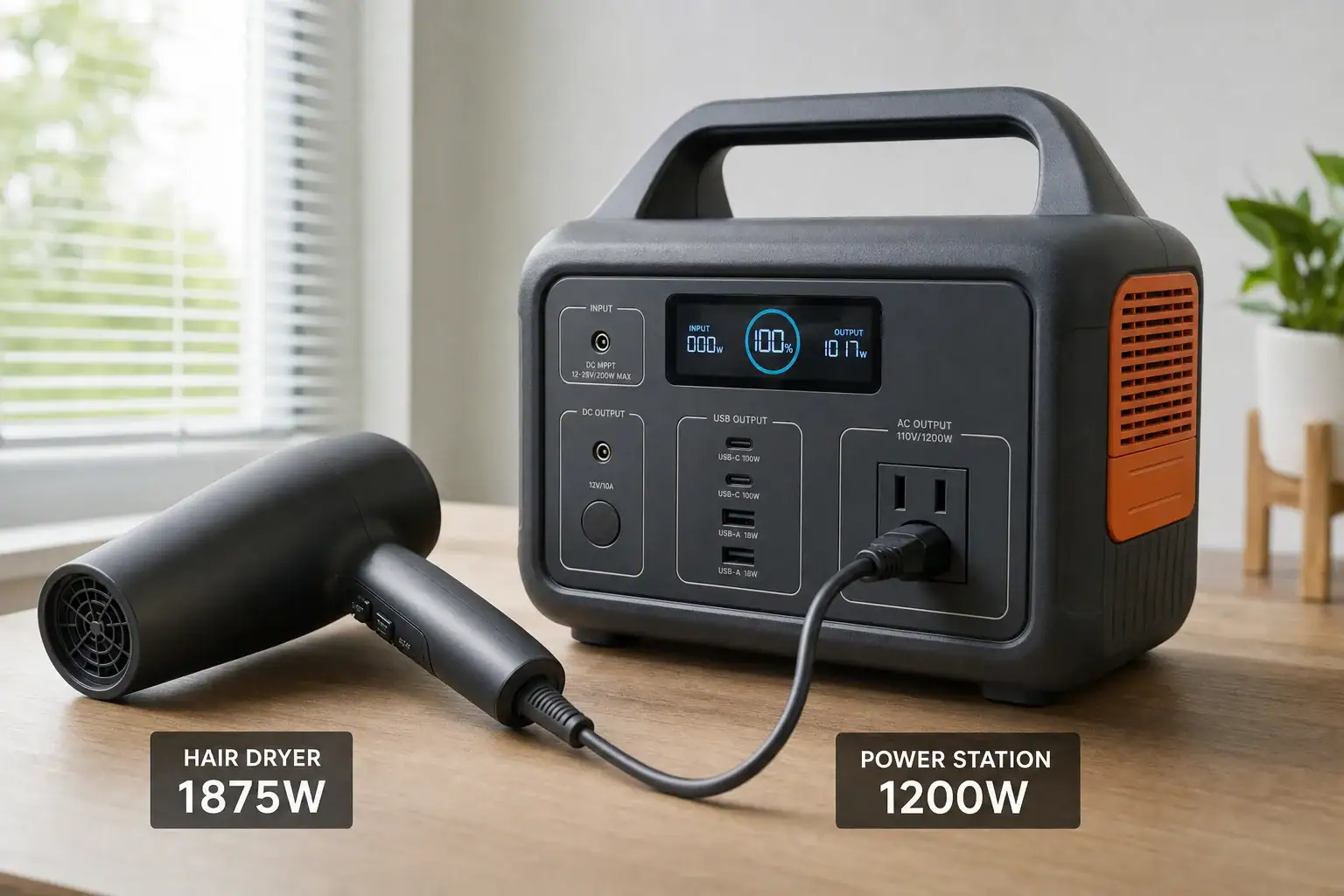
Yes, a portable power station can run a hair dryer if the station’s continuous AC output is at least as high as the dryer’s maximum input wattage. Hair dryers are demanding appliances: many full-size models draw roughly 1,200 to 1,875 watts, although the actual rating varies. A small power station with a 300- or 500-watt inverter will not run a typical full-size dryer.
Check the electrical label on the hair dryer rather than relying on a general wattage estimate. The power station must also provide the correct outlet voltage and frequency, have enough battery capacity for the intended drying time, and accommodate any brief startup demand from the dryer’s motor.
How to determine whether the power station is compatible
1. Compare continuous output with dryer wattage
Find the dryer’s rated watts on its label or in its manufacturer instructions. Then compare that number with the power station’s continuous AC output rating.
For example, a 1,500-watt dryer requires a power station rated for at least 1,500 watts of continuous AC output. A station advertised with a 1,500-watt surge rating but only 1,000 watts of continuous output is not sufficient. Surge or peak output is available only briefly and does not support the heating element during normal operation.
Ratings may apply to all AC outlets combined. If other devices are connected, add their wattage to the dryer’s demand and compare the total with the station’s continuous limit.
2. Allow for startup behavior
A hair dryer combines a resistive heating element with a fan motor. The heater generally does not create the large startup surge associated with compressors, but the motor and electronic controls can cause a brief increase or irregular demand when the dryer starts or changes settings.
The power station should therefore have some output headroom rather than matching the dryer’s rating exactly. Manufacturer designs vary, so a dryer near the station’s continuous limit may trigger overload protection even if the nameplate numbers appear compatible. The station’s published surge rating and appliance-compatibility guidance should be checked when available.
3. Confirm voltage and frequency
The dryer’s required voltage and frequency must match the power station’s AC output. In the United States, that commonly means a 120-volt, 60-hertz dryer and power station, but labels should still be verified.
Dual-voltage travel dryers must be set according to their manufacturer instructions. Do not assume that a plug adapter changes voltage, and do not use an improvised transformer or modified connection.
How long will the dryer run?
Battery capacity is usually listed in watt-hours (Wh). A simple runtime estimate is:
Runtime in hours = battery capacity in Wh × usable AC fraction ÷ dryer watts
The usable AC fraction accounts for inverter losses, internal power consumption, battery protection limits, temperature, and other variables. For illustration, an 85% usable fraction can provide a reasonable planning assumption, but it is not a guaranteed value. Check the power station manufacturer’s specifications when precise planning matters.
| Battery capacity | Dryer load | Assumption | Estimated continuous runtime |
|---|---|---|---|
| 500 Wh | 1,200 W | 85% usable AC energy | About 21 minutes |
| 1,000 Wh | 1,500 W | 85% usable AC energy | About 34 minutes |
| 1,000 Wh | 1,875 W | 85% usable AC energy | About 27 minutes |
These estimates assume uninterrupted operation at the stated wattage. Actual runtime can differ because heat settings may change power consumption, thermostats may cycle, and some stations reserve part of their stated capacity.
For a typical short session, energy use is often more useful than maximum runtime. A 1,500-watt dryer operated continuously for 10 minutes delivers:
1,500 W × 10 ÷ 60 = 250 Wh
At an illustrative 85% AC efficiency, that session would draw about 294 Wh from the battery: 250 Wh ÷ 0.85. Other loads and standby consumption would increase the total.
Do lower heat settings solve an output mismatch?
A lower setting may reduce consumption, but it should not be treated as a guaranteed way to operate a dryer that exceeds the station’s rating. Control designs vary: some settings reduce heater wattage, while others cycle full power on and off. The dryer may still briefly draw close to its maximum rating.
Use the dryer’s maximum labeled input when deciding whether the power station is compatible. A manufacturer-specified low-wattage mode can be considered only if the instructions explicitly state its electrical demand.
Safe operating considerations
- Keep the power station, plugs, and connections dry. Do not place the station near a sink, tub, shower, or other source of splashing water.
- Use the power station in the orientation and ventilation conditions specified by its manufacturer. A high-wattage load can create substantial inverter heat.
- Do not defeat or remove an appliance leakage-current interrupter, ground-fault feature, polarized plug, or other safety device built into the dryer.
- Inspect the dryer cord and plug before use. Do not operate equipment with damaged, loose, scorched, or unusually hot connections.
- Avoid extension cords unless both equipment manufacturers permit them. Any cord used must be intact and appropriately rated for the full appliance load.
- Stop using the setup if the station repeatedly reports an overload, shuts down from excessive temperature, smells unusual, or produces a hot connection. Repeatedly restarting it does not correct an output mismatch.
Some hair dryers use protective plugs that may behave differently with certain inverter grounding arrangements. Follow the instructions for both products, including any required plug test procedure. Do not bypass a protective plug if it will not reset or operate normally.
Quick compatibility checklist
- Dryer maximum watts are below the station’s continuous AC rating.
- Other connected loads are included in the total wattage.
- The station has enough surge capacity and output headroom.
- Voltage and frequency match the dryer’s requirements.
- Estimated usable watt-hours cover the expected drying time.
- The station can remain dry, stable, and properly ventilated during use.
Bottom line
A portable power station can run a hair dryer, but inverter output is usually the deciding factor. Compare the dryer’s maximum labeled wattage with the station’s continuous—not peak—AC rating, then estimate battery use in watt-hours after allowing for conversion losses. Because hair dryers combine high heat demand with a motor, choosing a station with reasonable output headroom is more reliable than operating at the inverter’s limit.
Related guides
Browse this topic →
- Beginner-friendly sizing, runtime & specs
- Solar & charging (MPPT, fast charging, cables)
- Batteries (LiFePO4, cycles, care & storage)
- Safety, cold-weather performance, real-world tips
More in Home / Appliances
See all →Keep reading
About this site
Portable Energy Lab publishes practical, independent guides about portable power—clear sizing, safe use, and real-world expectations.
Affiliate disclosure
Some links on this site may be affiliate links. If you buy through these links, we may earn a small commission at no extra cost to you. This helps support our content. Read our affiliate disclosure.