
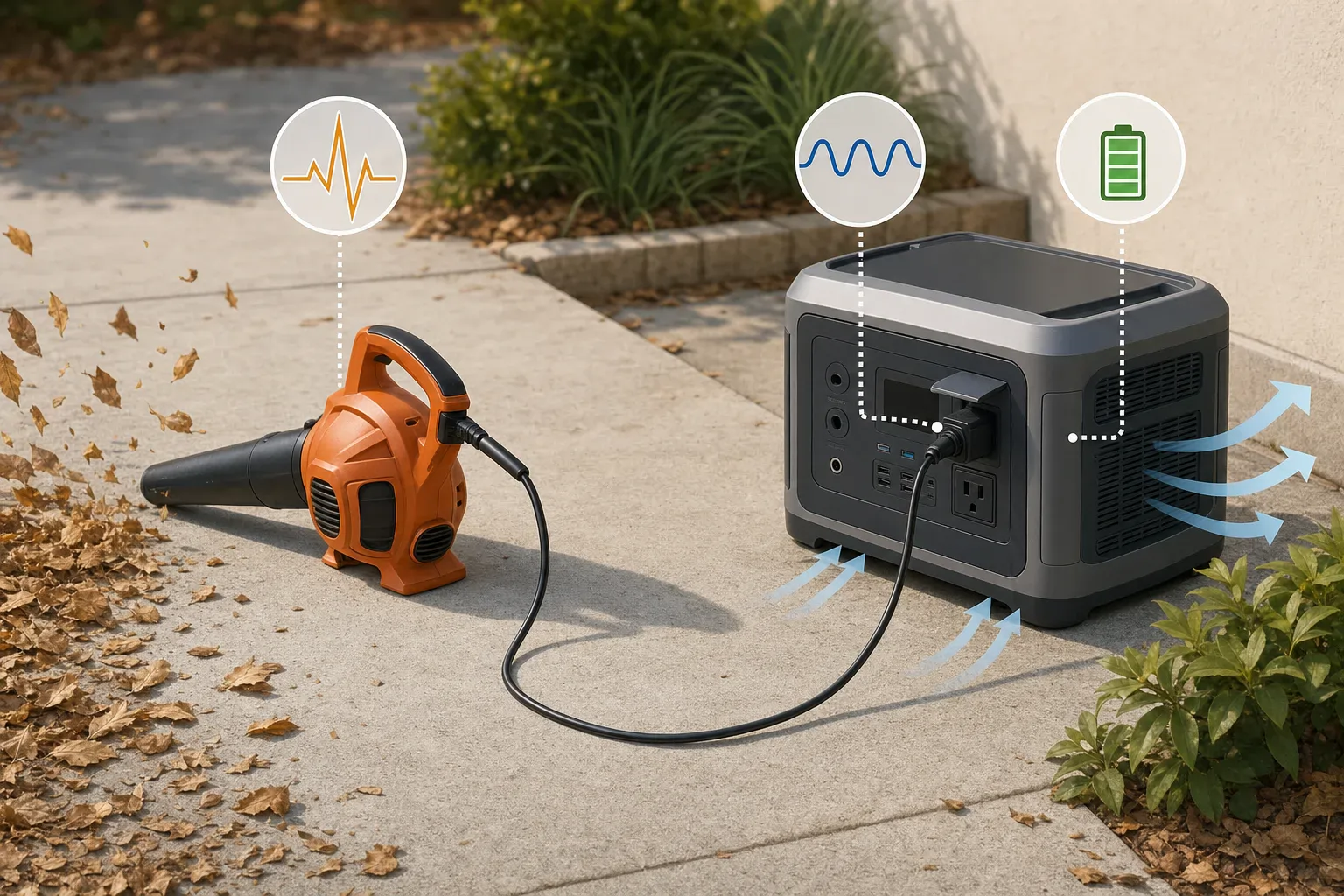
Quick answer: A portable power station can run a corded leaf blower only when its AC output supports the blower’s running load and its surge capability starts the motor. Check voltage, frequency, output limits, and startup behavior separately. Battery watt-hours affect operating time, not whether the blower can start.
Size a portable power station for a corded leaf blower
There are three separate questions: can the inverter supply the blower while it runs, can it tolerate motor startup, and how long can the battery supply that load? A large battery does not compensate for an undersized AC inverter.
Start with the exact model numbers and manuals. Confirm that the power station’s AC output voltage and frequency match the blower’s label, then compare the station’s continuous output, any outlet or total-output current limit, and its published surge specification.
Use the blower label as a screening check
Look for volts, amps, watts, frequency, and the model number. If the label provides volts and amps, calculate:
VA = volts × amps
For example, BLACK+DECKER describes its BV6600 as having a 12-amp motor and variable-speed selections. If a 120V supply applies, the nameplate screening calculation is:
120V × 12A = 1,440VA
This is not proof that the blower uses 1,440W. For AC loads, apparent power is volts × amps, while true power depends on power factor: watts = volts × amps × power factor. BLACK+DECKER does not publish measured running watts, power factor, or startup demand for the BV6600 on its cited product page. Treat those values as unknown until documented or measured. See the BLACK+DECKER BV6600 product page and Fluke’s electrical glossary.
When power factor is unavailable, use nameplate VA as a cautious screening figure and check the station manual for watt, VA, and AC-current restrictions. Read more about the distinction in VA vs. watts for portable power stations.
Startup is a separate limit
A corded blower motor can draw more power while starting than after reaching speed. There is no verified universal startup multiplier for corded leaf blowers, so do not assume that a stated surge rating guarantees compatibility. Compare documented startup demand, if available, with the station’s surge rating and its stated conditions. Surge output is not continuous output.
As one specification example, EcoFlow’s US DELTA 2 manual lists a 1,024Wh battery, 1,800W total AC output, and 2,700W surge output. Those figures apply to that model only and do not certify it for a particular blower. The manual also says X-Boost is not compatible with every appliance and is more suitable for heating devices; do not use that feature as evidence that a blower motor will run. See the EcoFlow DELTA 2 manual.
Leaf-blower power-station decision table
| What you find | Practical decision |
|---|---|
| Station continuous output is below the blower’s measured maximum running watts | Do not use the pairing. |
| Nameplate VA is close to the station’s watt, VA, or AC-current limit | Treat the match as marginal; obtain better load data before relying on it. |
| Running load appears to fit, but startup demand is unknown | Check both manuals and perform a normal, supervised startup test from a full charge with no other loads connected. |
| The station reports overload, shuts down, or trips during startup | The pairing is not compatible under those conditions. Do not bypass protection. |
| Running demand and startup both remain within documented limits | The electrical match is promising; calculate runtime from average operating watts. |
A 1,500W station is too close to a 1,440VA nameplate calculation to support a universal compatibility claim. Watts and VA are different quantities, and the blower’s startup demand remains unknown. More continuous-output and surge headroom is preferable, but the manuals and a successful normal startup are the deciding evidence.
Estimate corded leaf blower runtime
Runtime depends on energy delivered at the AC outlet and the blower’s average power during real work:
runtime (hours) = usable AC energy (Wh) ÷ average blower power (W)
Do not assume all nominal battery watt-hours reach the AC outlet. Conversion losses, the station’s shutdown reserve, temperature, battery condition, and operating mode can change usable output. See usable capacity versus advertised capacity for why battery nameplate capacity is not an AC-runtime guarantee.
Illustrative calculation, not a test result
Assume a station has 1,024Wh of nominal battery capacity and a blower averages 1,200W during the intended work cycle:
1,024Wh ÷ 1,200W = 0.853 hours
0.853 hours × 60 minutes/hour = about 51 minutes
That is an ideal mathematical ceiling, not an expected field runtime, because it assumes every nominal watt-hour is delivered to the blower. If a controlled record instead showed 850Wh delivered at the AC outlet under comparable conditions, the estimate would be:
850Wh ÷ 1,200W = 0.708 hours, or about 42.5 minutes
For a useful personal estimate, record the blower’s average watts during representative use and divide a known usable AC-energy result by that average. Variable speed and pauses can change average consumption, so measure the work pattern you actually expect.
Safe setup and pre-use checks
- Identify both models. Record the blower’s voltage, frequency, and amps or watts; record the station’s continuous AC watts, surge specification, and AC-output limits.
- Read both manuals. Confirm output compatibility and follow any manufacturer restrictions for motor loads or operating environment.
- Use an appropriate extension cord. Follow the blower manual’s model-specific wire-gauge and length table rather than copying a table from another tool.
- Inspect before use. Do not use damaged plugs, loose receptacles, cut insulation, or worn cords.
- Keep equipment dry and ventilated. Keep the station, plugs, and cord connections away from standing water, wet grass, and debris while preserving the station’s required ventilation clearances.
- Test with no other loads. Fully charge the station, disconnect other devices, start the blower in the intended mode, and watch for an overload warning or shutdown.
- Stop for warning signs. Disconnect if the station overloads, the motor sounds unstable, or a plug or cord becomes abnormally hot. Never defeat protective devices or remove a grounding pin.
For example, Toro’s manual for blower model 51619 calls for a polarized, UL-listed extension cord recommended for outdoor use and provides a model-specific gauge-by-length table. It also warns against damaged cords, standing water, and wet grass. Those instructions are not a universal cord table for other blowers. See the Toro 51619 operator’s manual.
OSHA’s cord-safety guidance likewise emphasizes factory-assembled cord sets, inspection, suitable service markings, strain relief, and moisture control. Its regulatory requirements apply to covered workplaces, not automatically to every home, but the hazard-control guidance is relevant. See OSHA’s extension-cord and electrical-safety guidance.
When not to use a power station with a blower
Do not use the pairing when the blower exceeds the station’s continuous output, startup causes an overload, the match is marginal and necessary limits cannot be verified, or the required cord arrangement conflicts with either manual. Adding battery capacity may extend runtime, but it will not make an undersized inverter start a motor.
Related guides
Browse this topic →
- Beginner-friendly sizing, runtime & specs
- Solar & charging (MPPT, fast charging, cables)
- Batteries (LiFePO4, cycles, care & storage)
- Safety, cold-weather performance, real-world tips
More in Home / Appliances
See all →Keep reading
About this site
Portable Energy Lab publishes practical, independent guides about portable power—clear sizing, safe use, and real-world expectations.
Affiliate disclosure
Some links on this site may be affiliate links. If you buy through these links, we may earn a small commission at no extra cost to you. This helps support our content. Read our affiliate disclosure.