
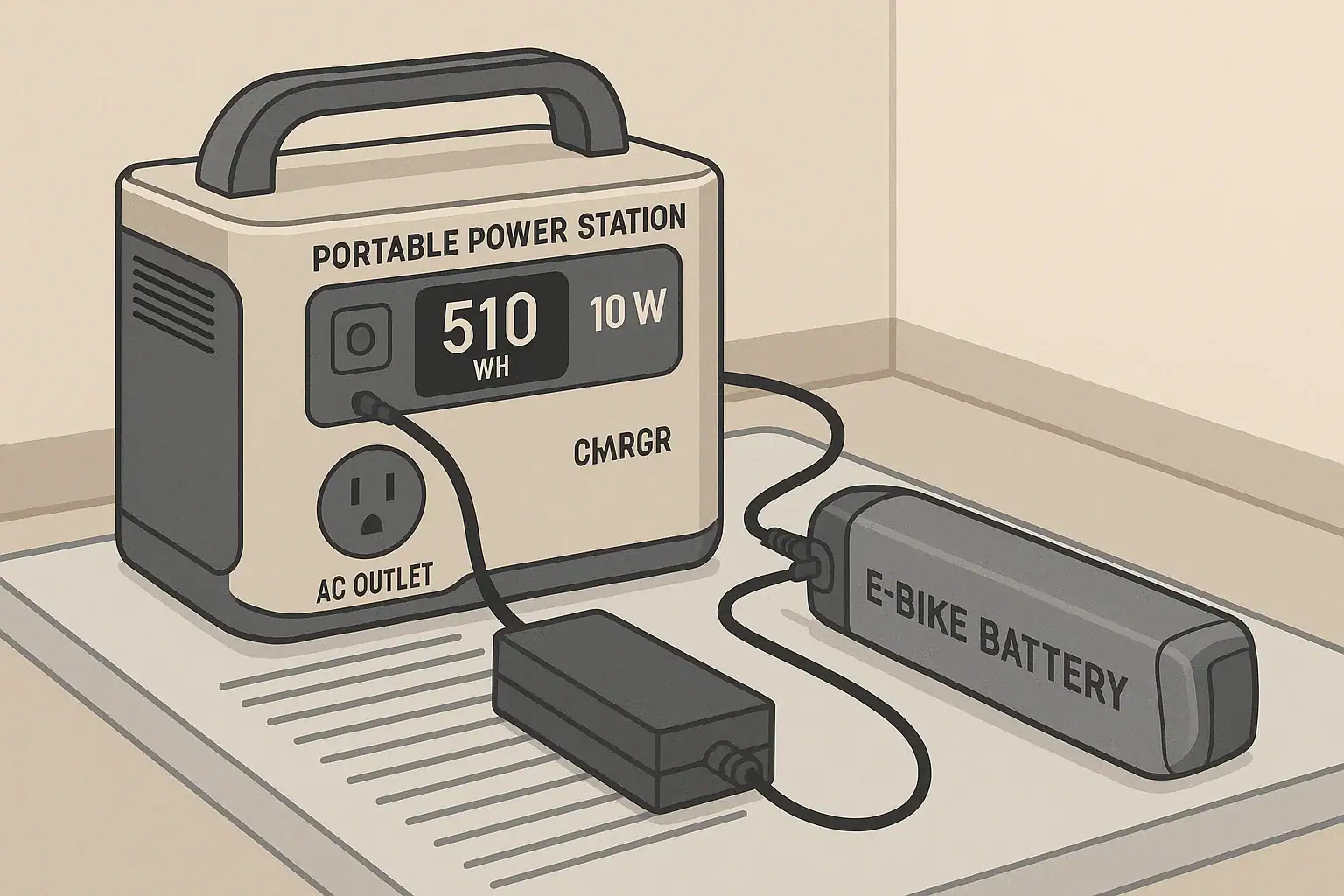
A portable power station can charge an e-bike if its usable watt-hour capacity is large enough and its AC output can handle the e-bike charger’s watts.
The main limits are battery capacity, charger watts, inverter rating, input limit, surge watts, runtime losses, and battery safety conditions. Most e-bike owners use the standard wall charger plugged into the station’s AC outlet, then estimate how many watt-hours the charger will pull. A large station may refill one or more e-bike batteries; a small one may only add partial range.
The key is not just whether the plug fits. The station must support the charger continuously, have enough usable energy after conversion losses, and operate in a safe temperature range. Charging speed is usually set by the e-bike charger, not by the power station’s total capacity.
What a Portable Power Station Does for E-Bike Charging
A portable power station is a rechargeable battery system with built-in outputs such as AC outlets, DC ports, and USB ports. For e-bike charging, it acts like a temporary wall outlet when you are away from grid power, storing energy in watt-hours and delivering it through an inverter to the e-bike charger.
This matters because an e-bike battery is already a significant energy storage device. Charging one battery from another battery adds conversion losses, heat, and power limits. A power station that works well for phones, lights, or laptops may be too small for a full e-bike recharge.
The most important number is not peak watts alone. It is the combination of usable capacity and continuous output. Capacity determines how much energy is available. Continuous AC output determines whether the charger can run without tripping an overload protection circuit. Charging one 500 watt-hour e-bike battery may require roughly 550 to 650 watt-hours from the station after inverter and charger losses.
A portable power station is most useful for topping off an e-bike during camping, commuting gaps, van travel, emergency backup, or trailhead charging. It is less suitable if you need fast repeated charging for multiple high-capacity bikes unless the station is sized accordingly.
How Capacity, Charger Watts, and Charge Speed Work
E-bike batteries are commonly labeled by voltage and amp-hours, such as 48 volts and 14 amp-hours. Multiplying those numbers gives an approximate battery capacity: 48 volts times 14 amp-hours equals 672 watt-hours. Some batteries list watt-hours directly, which is easier for sizing.
The e-bike charger controls charging speed. A charger rated at 54.6 volts and 2 amps outputs about 109 watts to the battery before losses. A 4 amp charger may output about 218 watts. The power station must supply the charger’s wall-side demand, which is often higher than the charger’s DC output because no conversion process is perfectly efficient.
To estimate station size, start with the e-bike battery watt-hours and add a margin for losses. A practical planning range is about 15 to 30 percent extra. For example, a 500 watt-hour e-bike battery may need around 575 to 650 watt-hours from the station for a near-full charge. If the power station has 700 watt-hours of advertised capacity, its usable AC energy may be lower, so it may not always provide a complete refill from empty.
Charge time depends mostly on the charger’s output and the battery’s state of charge. A 500 watt-hour battery charged by a 100 watt class charger may take roughly 5 to 7 hours from low to full. A 200 watt class charger may take roughly 3 to 4 hours, but only if the e-bike battery management system accepts that rate and the charger is designed for that battery.
| E-bike battery size | Typical charger draw | Station energy to plan for | Likely result |
|---|---|---|---|
| 360 Wh | 90 to 150 W | 425 to 475 Wh | One full charge from a mid-size station may be possible |
| 500 Wh | 120 to 220 W | 575 to 650 Wh | Needs a larger compact station for a reliable full refill |
| 672 Wh | 150 to 250 W | 775 to 875 Wh | Often requires a high-capacity station for one full charge |
| 1,000 Wh | 200 to 400 W | 1,150 to 1,300 Wh | Best matched with a large station or partial-charge expectations |
Real-World Charging Examples
Consider a commuter e-bike with a 500 watt-hour battery and a 2 amp charger. If the charger draws about 120 watts from the AC outlet, a full recharge from a low battery may take around 5 to 6 hours and use roughly 600 watt-hours from the station. A 300 watt-hour station would not fully recharge it, but could add meaningful range.
Now consider a cargo e-bike with a 48 volt, 20 amp-hour battery, which is about 960 watt-hours. Even with a modest charger, a full refill may require more than 1,100 watt-hours from the station after losses. This is a different use case than topping up a small folding e-bike. The charger may run for many hours, so ventilation and remaining station capacity become more important.
A two-bike camping scenario is even more demanding. If each bike has a 500 watt-hour battery and both riders want a full charge, the station may need roughly 1,200 watt-hours of usable AC energy. If the station is also running a fridge, lights, or device chargers, those loads must be added. The total energy budget should include everything connected, not only the e-bike charger.
Solar charging can help, but it should be treated as an input source, not guaranteed replacement energy. Solar output varies with sun angle, shade, panel temperature, and the power station’s solar input limit. A station with a 200 watt solar input may only average a fraction of that over a day in mixed conditions. If you plan to ride daily, compare expected solar harvest against the watt-hours your e-bike needs each day.
Common Mistakes and Troubleshooting Cues
One common mistake is sizing by AC watt rating alone. A station rated for 600 watts can usually run a 150 watt e-bike charger, but it may still have too little capacity for a full charge. Watts describe power at a moment. Watt-hours describe stored energy over time.
Another mistake is assuming advertised capacity equals usable AC energy. The inverter consumes energy and creates heat. The e-bike charger also has losses. A station with 500 watt-hours of stored energy may deliver less than that through AC. This is normal, not necessarily a defect.
If the power station shuts off shortly after charging begins, check whether the charger’s wall-side draw exceeds the station’s continuous AC rating. Some chargers have brief startup behavior, but most e-bike chargers do not create a large motor-like surge. If overload warnings appear, the charger may be too large for the station, the station may be too warm, or another load may be connected at the same time.
If charging is slower than expected, the cause is usually the charger, not the station. A larger station does not force the e-bike battery to charge faster. The charger output, battery management system, battery temperature, and state of charge determine the charging curve. Many lithium batteries slow near full to balance cells and reduce stress.
If the station turns off before the e-bike is full, its low-battery cutoff may have been reached. Even if the display shows a few percent remaining, the station may stop AC output to protect its own battery. Plan with a reserve instead of expecting 100 percent of displayed capacity to be usable.
If the e-bike charger does not start at all, confirm that the station’s AC outlet is turned on, the charger is the correct one for the battery, and the battery is within its allowed temperature range. Do not open the charger, modify connectors, bypass fuses, or attempt to adapt chargers to unsupported battery packs.
Safety Basics for Charging E-Bike Batteries from a Power Station
The safest approach is to use the e-bike manufacturer’s correct charger and connect it to a power station that can support the charger’s continuous power draw. Avoid improvised adapters, damaged cords, swollen batteries, liquid exposure, and charging in tightly enclosed spaces.
Charge on a stable, nonflammable surface with airflow around the power station, charger brick, and e-bike battery. Both the inverter and the charger create heat. A charger that feels warm is common, but excessive heat, odor, discoloration, buzzing, or repeated fault lights are warning signs to stop using the equipment until it is inspected or replaced.
Temperature matters. Lithium e-bike batteries should not be charged when they are too cold, overheated, or recently stressed by hard riding in hot weather. Let the battery return to a moderate temperature before charging. Charging outside the intended range can reduce battery life and may increase risk.
Keep the charging area dry. Portable power stations and e-bike chargers vary in weather resistance, but many are not intended for rain, puddles, or wet grass. Use covered, ventilated protection rather than sealing the equipment in a bag or box while charging.
Do not connect a portable power station to home wiring, panels, transfer switches, or interlocks unless the system is designed for that use and installed by a qualified electrician. For e-bike charging, a normal plug-in connection to the station’s outlet is the appropriate high-level use case.
Maintenance and Storage for Reliable E-Bike Charging
Good maintenance starts with keeping both battery systems within reasonable charge levels when stored. Avoid leaving an e-bike battery empty for long periods, and avoid storing a power station fully depleted. Many portable power stations should be checked every few months and recharged as needed, especially before a trip.
Store the station and e-bike battery in a cool, dry place away from direct sun, heaters, and freezing conditions. High heat accelerates battery aging. Cold storage may be acceptable for some batteries, but charging while cold is the bigger concern. Let equipment warm naturally to room temperature before use if it has been stored in a cold location.
Inspect cords, plugs, charger housings, and battery cases before charging. Look for crushed insulation, loose prongs, cracks, corrosion, or swelling. Do not continue using equipment that shows physical damage or abnormal behavior.
For trip planning, recharge the station before leaving and test the e-bike charger with the station at home. This confirms that the AC outlet, inverter, and charger are compatible before you rely on them at a trailhead or campsite. If solar panels are part of the plan, test solar input separately so you understand realistic daily recharge rates.
| Item to check | What to look for | Why it matters |
|---|---|---|
| Power station state of charge | Stored with a moderate charge and topped up before travel | Reduces surprise shutdowns and supports battery health |
| E-bike charger | No damaged cord, cracked case, or unusual heat | Charger faults can stop charging or create hazards |
| Battery temperature | Not frozen, overheated, or fresh from extreme riding | Improves safety and helps the battery accept charge properly |
| Ventilation | Clear space around charger and station | Helps prevent heat buildup during long charging sessions |
| Solar input plan | Expected watt-hours, not just panel watt rating | Shows whether daily riding energy can realistically be replaced |
Related guides: Portable Power Station Watt-Hours Explained • How to Choose the Right Size Portable Power Station • Portable Power Station Basics: Outputs, Inputs, and What the Numbers Mean
Practical Takeaways and Specs to Look For
A portable power station can be a practical e-bike charging source when it is sized around watt-hours first and watts second. For a single partial top-off, a compact station may be enough. For a full charge on a 500 to 700 watt-hour e-bike battery, expect to need a station with substantially more advertised capacity than the battery label suggests. For multiple bikes or large cargo-bike batteries, plan for a much larger energy budget.
Charging speed is usually limited by the e-bike charger. Buying more station capacity does not automatically shorten charging time. A bigger station mainly increases how many watt-hours are available and how long the charger can run. If fast charging is important, the e-bike battery and charger must be designed for it; do not force mismatched charging equipment.
For most owners, the best planning method is simple: identify the e-bike battery watt-hours, add 15 to 30 percent for losses, confirm the charger’s wall-side watt draw is below the station’s continuous AC rating, and leave reserve capacity for other loads. If any equipment becomes unusually hot, shows errors, or behaves unpredictably, stop charging and inspect the setup.
Specs to look for
- Usable capacity: Look for enough watt-hours to cover the e-bike battery plus about 15 to 30 percent; this accounts for inverter and charger losses.
- Continuous AC output: Look for an output rating above the charger’s draw, such as a 300 watt or higher outlet for many 100 to 250 watt chargers; this prevents overload shutoffs.
- AC outlet compatibility: Look for a standard grounded outlet layout that fits the charger plug securely; loose adapters add failure points.
- Pure sine wave inverter: Look for pure sine wave AC output when available; it is generally preferred for charger electronics and long charging sessions.
- Battery chemistry and cycle rating: Look for a cycle-life rating that matches how often you will recharge e-bike packs; frequent riders benefit from longer cycle endurance.
- Solar input limit: Look for input such as 100 to 400 watts if off-grid recharging matters; the input limit controls how quickly the station can recover energy from panels.
- Display and load readout: Look for real-time watts and remaining time estimates; these help confirm the charger’s draw and predict whether a full charge is possible.
- Thermal and overload protections: Look for automatic shutdown protections and clear fault indicators; they help prevent unsafe operation when loads, heat, or battery levels are outside normal range.
- Weight and portability: Look for a capacity-to-weight balance that fits your transport method; very large stations may be impractical for bike-only travel.
The practical limit is this: if the station can safely run the charger and has enough usable watt-hours, it can charge the e-bike. If either the output rating or the energy capacity is too low, the result will be slow, partial, or interrupted charging.
Frequently asked questions
How do I know if a portable power station can charge my e-bike battery?
Check two numbers: the e-bike battery’s watt-hours and the power station’s usable watt-hours. The station also needs a continuous AC output rating that is higher than the charger’s wall-side draw. If both capacity and output are sufficient, the setup should work for normal charging.
What specs matter most when choosing a power station for e-bike charging?
The most important specs are usable capacity in watt-hours, continuous AC output, inverter type, and solar input if you plan to recharge off-grid. A clear display showing watts and remaining runtime is also helpful. Weight matters too if you need to carry the station with the bike.
Can a bigger power station charge my e-bike faster?
Usually no. Charging speed is mainly set by the e-bike charger and the battery management system, not by the station’s total capacity. A larger station mainly gives you more runtime and more total energy available.
What is the most common mistake people make with e-bike charging from a power station?
The most common mistake is sizing the station by watts alone and ignoring watt-hours. A station may have enough output to run the charger but still not have enough stored energy for a full charge. Another frequent error is forgetting to account for conversion losses.
Is it safe to charge an e-bike battery from a portable power station?
Yes, if you use the correct charger and the station can handle the charger’s continuous load. Keep the setup dry, ventilated, and away from damaged batteries or cords. Stop charging if you notice unusual heat, odor, fault lights, or swelling.
Why does my power station stop before the e-bike battery is full?
The station may have reached its low-battery cutoff before all usable energy was delivered. Advertised capacity is not the same as usable AC energy because inverter and charger losses reduce what reaches the battery. This is more likely with smaller stations or larger e-bike batteries.
Related guides
Browse this topic →
- Beginner-friendly sizing, runtime & specs
- Solar & charging (MPPT, fast charging, cables)
- Batteries (LiFePO4, cycles, care & storage)
- Safety, cold-weather performance, real-world tips
More in Beginners
See all →- Charging an Electric Wheelchair or Mobility Scooter From a Portable Power Station
- Portable Power Station for a Gaming PC: Runtime, Load Spikes, and UPS Considerations
- Portable Power Station for a Pop-Up Camper: Lights, Fans, Fridge, and Recharge Plan
- Portable Power Station for a Shed or Outbuilding: Lights, Chargers, and Security
- Portable Power Station for a Boat: 12V Loads, Salt Air, and Safer Storage
Keep reading
About this site
Portable Energy Lab publishes practical, independent guides about portable power—clear sizing, safe use, and real-world expectations.
Affiliate disclosure
Some links on this site may be affiliate links. If you buy through these links, we may earn a small commission at no extra cost to you. This helps support our content. Read our affiliate disclosure.