
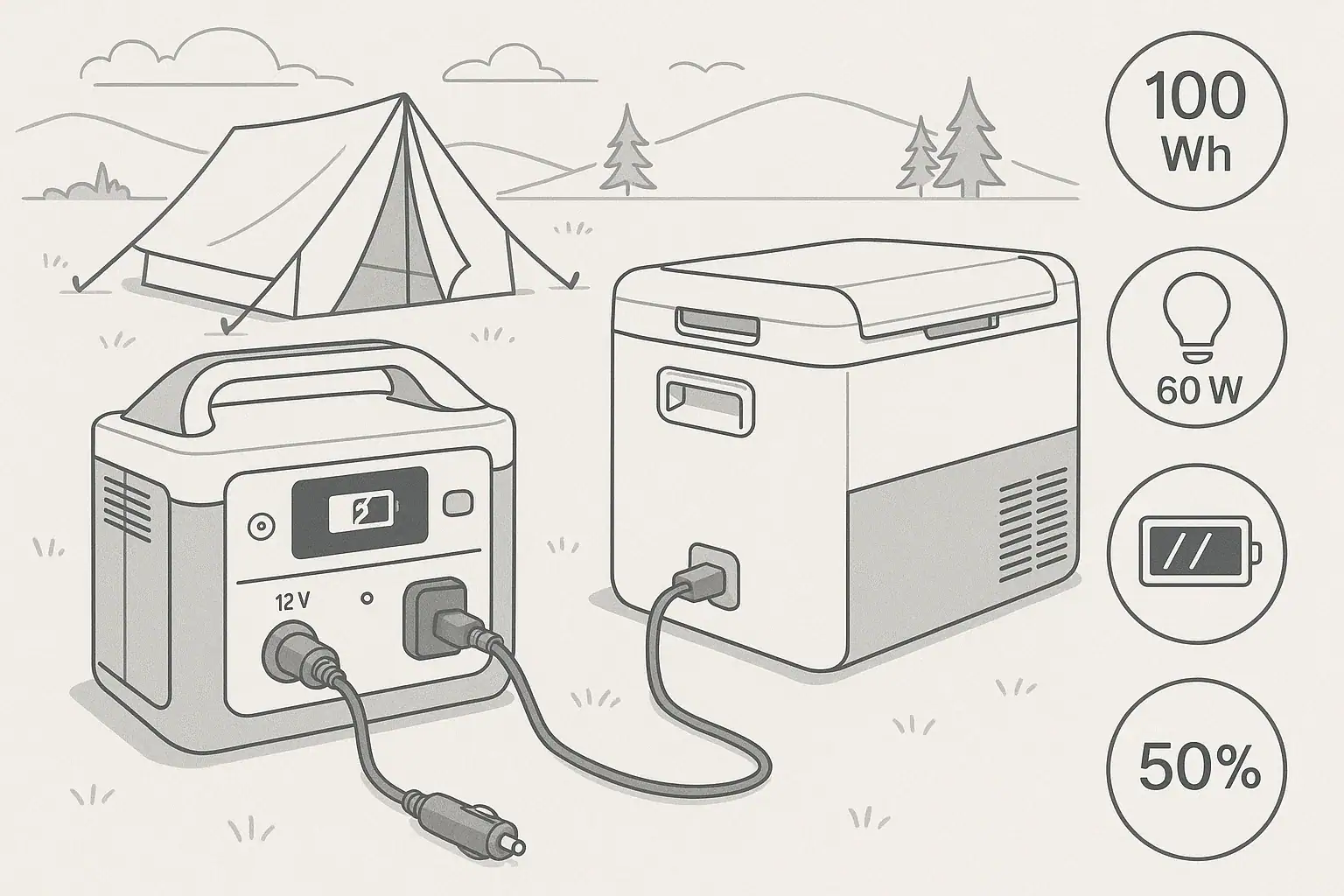
A portable power station can run an electric cooler, but runtime is usually longer and more predictable when the cooler uses a 12V DC connection instead of an AC wall plug.
The reason is simple: most electric coolers already operate internally on low-voltage DC power, while AC mode requires the power station to run an inverter. That inverter adds conversion loss, standby draw, and sometimes startup behavior that can shorten runtime. For anyone planning a camping trip, road stop, tailgate, overlanding setup, or backup cooling for food and medicine, the important terms are watt-hours, running watts, surge watts, inverter efficiency, runtime, and state of charge.
This guide explains how 12V and AC operation differ, how to estimate runtime realistically, why some coolers cycle on and off, and which power station specs matter before you rely on one for cold storage.
What 12V vs AC Runtime Planning Means and Why It Matters
Runtime planning means estimating how long a portable power station can operate an electric cooler before the battery reaches a low state of charge or shuts off. The planning is different for 12V and AC because the power path is different.
With a 12V DC outlet, the power station sends low-voltage direct current to the cooler. With an AC outlet, the power station first converts battery power into household-style alternating current through an inverter, and the cooler or adapter then converts it back to a form the cooler can use. Every conversion uses some energy, so the same cooler may run fewer hours on AC than on 12V.
This matters most when cooling time is the priority. A cooler used for drinks at a picnic may only need several hours. A compressor cooler used for food on a weekend trip may need one to three days. A medicine cooler may need much more careful planning, extra battery capacity, and temperature monitoring.
Another key point is that electric coolers do not all draw power the same way. Thermoelectric coolers often draw a steady load whenever they are on. Compressor coolers cycle: they draw more power while the compressor runs, then much less while maintaining temperature. That cycling behavior makes average watts more important than the maximum label wattage for runtime estimates.
How Electric Cooler Power Draw Works
The basic runtime formula is straightforward: usable watt-hours divided by average watts equals estimated hours. If a power station has 600 watt-hours and the cooler averages 35 watts, the simple estimate is about 17 hours. In real use, the result may be lower because of inverter loss, battery reserve, heat, cable voltage drop, and how often the cooler cycles.
Watt-hours describe energy capacity. Watts describe the rate of energy use. A cooler that runs at 50 watts for 10 hours uses about 500 watt-hours. If it cycles and averages only 25 watts over time, it may use about 250 watt-hours in 10 hours.
For 12V operation, check the power station’s DC output rating and the cooler’s DC input requirement. Many cooler plugs are designed for vehicle-style sockets, but the actual draw can vary from a modest compressor load to a heavier thermoelectric load. The outlet must support the cooler’s required amps without tripping.
For AC operation, check the continuous AC output rating and any surge or startup watts. Compressor coolers may draw a brief startup current when the compressor starts. Most small coolers are not extreme surge loads compared with large refrigerators, but the power station still needs enough inverter capacity to start and run the unit reliably.
Inverter efficiency is the main reason AC runtime is often shorter. If the cooler needs 40 watts and the inverter is operating at 85 to 90 percent efficiency, the battery may supply roughly 44 to 47 watts before considering inverter standby draw. At light loads, standby draw can become noticeable over many hours.
| Connection type | Typical power path | Runtime effect | Planning note |
|---|---|---|---|
| 12V DC outlet | Battery to DC output to cooler | Usually more efficient | Check DC amps and cable fit |
| AC outlet | Battery to inverter to AC adapter or cooler | Usually shorter runtime | Include inverter loss and standby draw |
| USB-C PD, if supported | Battery to regulated USB-C output | Varies by PD profile | Only use if the cooler is designed for it |
Real-World Runtime Examples for Cooler Planning
The following examples are illustrative, not guarantees. Actual runtime depends on ambient temperature, cooler size, insulation, set temperature, how often the lid is opened, food temperature at loading, and whether the power station keeps DC or AC outputs active at low loads.
Small compressor cooler on 12V
Assume a compact compressor cooler averages 25 watts after it reaches temperature. On a 500 watt-hour power station with about 85 percent usable energy after reserves and conversion, usable energy might be around 425 watt-hours. Dividing 425 by 25 gives about 17 hours. If the cooler is pre-chilled, kept in shade, and opened rarely, runtime may improve. In hot sun with frequent opening, it may drop.
Same cooler on AC
If the same cooler is run from the AC outlet and the inverter plus adapter losses increase battery demand to an average of 32 watts, the same 425 watt-hours may provide about 13 hours. The cooler did not necessarily become less efficient; the power path did.
Thermoelectric cooler
A thermoelectric cooler may draw close to a steady 45 to 60 watts whenever it is operating. On a 500 watt-hour station, even with efficient DC output, a 55-watt average load may run for roughly 7 to 8 hours after accounting for usable capacity. These coolers can be convenient, but they are often more demanding for all-day battery operation.
Larger compressor cooler or dual-zone unit
A larger compressor cooler may have a higher startup draw and a higher average draw, especially if one zone is set to freezing. If it averages 45 watts over time, a 1,000 watt-hour station with about 850 usable watt-hours may run it for about 18 to 19 hours. If freezing, high heat, or frequent access increases the average to 70 watts, runtime may fall closer to 12 hours.
The best estimate comes from measuring average power over several hours under realistic conditions. If you cannot measure it, plan with conservative assumptions and include a reserve instead of draining the power station to zero.
Common Mistakes and Troubleshooting Cues
The most common mistake is using the cooler’s maximum wattage as if it were the average wattage, or using the lowest advertised power figure as if it applied in all conditions. Maximum watts help with output sizing. Average watts drive runtime.
Another common issue is choosing AC by default. AC may be convenient, but if the cooler has a proper 12V input and the power station’s 12V output can support the load, DC is often the better runtime choice. AC is still useful when the cooler requires it, when the DC outlet is current-limited, or when the AC cord is the only safe supported connection.
If the cooler shuts off or the power station turns off unexpectedly, check whether the outlet is overloaded, whether the cooler has a low-voltage protection setting, and whether the power station has an auto-off feature for low loads. Some power stations shut down DC or AC outputs when they sense little or no draw. A compressor cooler’s cycling can sometimes look like a low-load condition during off cycles.
If the cooler runs but does not stay cold, power may not be the only problem. The cooler may be overloaded with warm items, placed in direct sun, set too low for the conditions, or opened too often. Air space around the vents also matters. A compressor needs airflow to reject heat; blocking vents can increase energy use and reduce cooling performance.
If a 12V plug becomes warm, loose, or intermittent, stop relying on that connection until it is checked. Vehicle-style sockets vary in fit and can vibrate loose. Poor contact can cause voltage drop and nuisance shutdowns. Do not defeat fuses or modify plugs to keep a weak connection working.
Safety Basics for Portable Power Stations and Electric Coolers
Use only power connections supported by the cooler and the power station. Do not open the cooler, modify the battery pack, bypass protective circuits, or improvise adapters that exceed the rated voltage, current, or connector type. A cooler that needs a regulated input should not be connected to an unverified output.
Keep the power station dry, ventilated, and away from direct heat. Many power stations can safely operate outdoors only when protected from rain, pooling water, dust, and excessive temperature. Heat reduces efficiency and may cause the station to limit output or shut down.
Respect output ratings. The AC inverter rating should exceed the cooler’s running watts and allow for startup draw. The 12V output should supply the needed amps continuously. For example, a cooler drawing 5 amps at 12 volts is using about 60 watts, and the outlet should be rated above that load with room to spare.
Food safety also matters. Battery runtime is not the same as safe cooling time. Use a thermometer when temperature matters, keep perishable food in the safe range, and avoid assuming that a running cooler is always maintaining the correct internal temperature.
If you plan to integrate backup power into a fixed building electrical system, use a qualified electrician. This article is about portable cooler connections only, not wiring into home panels, transfer switches, or interlocks.
Maintenance, Storage, and Efficiency Habits
Good maintenance improves both runtime and reliability. Store the power station within the manufacturer’s recommended charge range, especially during long periods of non-use. Avoid leaving it fully depleted. Recharge it before a trip and verify that the output mode you plan to use actually powers the cooler.
Inspect cords, plugs, and sockets before travel. A 12V cable that worked in a vehicle may not fit every portable power station socket equally well. A loose connector can cause voltage drop, heat, and shutdowns. Replace damaged cords with properly rated replacements rather than taping or bending them into working order.
Pre-chill the cooler and contents whenever possible. Cooling warm drinks or groceries from room temperature uses far more energy than maintaining already-cold items. Load frozen items together, reduce empty air space when practical, and minimize lid openings.
Place the cooler in shade and keep ventilation openings clear. A cooler sitting in a hot vehicle or direct sunlight can use much more energy than the same cooler in a shaded, ventilated area. Even a highly efficient compressor cooler will cycle more often when heat load increases.
For longer trips, plan recharging separately from cooler runtime. Solar input, vehicle charging, or wall charging may help, but charging rates vary. A station that can run a cooler for 20 hours may still need several hours to recharge, depending on input limit, sunlight, alternator setup, and charger wattage.
| Habit or condition | Likely effect on runtime | Why it matters |
|---|---|---|
| Pre-chilled food and cooler | Longer runtime | Less energy is spent pulling temperature down |
| Direct sun or hot vehicle | Shorter runtime | Compressor or cooling element works harder |
| Frequent lid openings | Shorter runtime | Warm air enters and cold air escapes |
| 12V connection with adequate amps | Often longer runtime | Reduces inverter conversion losses |
| AC inverter left on unnecessarily | Shorter runtime | Standby draw continues even at low load |
Related guides: Portable Power Station Watt-Hours Explained • Inverter Efficiency Explained: Why Your Runtime Is Shorter Than Expected • AC vs DC Power: How to Maximize Efficiency and Runtime
Practical Takeaways and Specs to Look For
For the longest runtime, use a supported 12V DC connection when the power station’s outlet has enough current capacity for the cooler. Use AC when the cooler requires it, when the DC output is not compatible, or when AC operation is the safer supported option. In either case, estimate runtime from usable watt-hours and average watts, not only from the power station’s advertised capacity.
A practical planning method is to start with the power station’s watt-hour rating, assume a usable portion such as 80 to 90 percent, then divide by the cooler’s estimated average watts. For AC operation, reduce the estimate further for inverter loss and standby draw. Add a reserve if food, medicine, or overnight use is important.
Specs to look for
- Battery capacity: Look for watt-hours that match your trip length, such as 500 watt-hours for short use or 1,000 watt-hours and above for longer cooling; capacity is the main limit on runtime.
- Usable energy estimate: Plan around roughly 80 to 90 percent of rated capacity; reserves and conversion losses mean the full label capacity is rarely available at the outlet.
- 12V DC output rating: Look for an outlet rated above the cooler’s amp draw, such as 10 amps for many small loads; insufficient current can cause shutdowns.
- AC continuous watts: Choose an inverter rating comfortably above the cooler’s running watts, such as several times a 40 to 80 watt load; this prevents nuisance overloads.
- Surge watt capability: Look for enough headroom for compressor startup, even if it lasts only a moment; startup spikes can trip undersized inverters.
- Inverter efficiency and idle draw: Favor low standby consumption if you must use AC for many hours; inverter idle draw can noticeably reduce overnight runtime.
- Output auto-off controls: Look for settings that keep DC or AC active during low-load compressor cycles; auto-off behavior can stop a cooler even when battery remains.
- Recharge input limit: Compare solar, vehicle, and wall charging watts, such as 100 to 500 watts depending on use; recharge speed determines whether daily operation is practical.
- Operating temperature range: Look for a range suitable for summer vehicles, campsites, or winter storage; temperature affects both battery performance and cooler duty cycle.
The simplest rule is this: match the outlet to the cooler, use 12V when it is supported and adequately rated, and size battery capacity from average power draw with a reserve. That approach gives a more realistic runtime plan than relying on best-case estimates or advertised capacity alone.
Frequently asked questions
How do I estimate runtime for a portable power station and electric cooler?
Start with the power station’s usable watt-hours, then divide by the cooler’s average watts. For AC use, reduce the estimate further to account for inverter loss and standby draw. Because compressor coolers cycle on and off, average power is more useful than the peak label wattage.
What specs matter most when choosing a portable power station for an electric cooler?
The most important specs are battery capacity in watt-hours, 12V DC output rating, AC continuous watts, surge capability, and inverter efficiency. If the cooler supports 12V, that output is often the better choice for runtime. Also check whether the power station has auto-off behavior that could interrupt a cycling compressor.
Is it better to run an electric cooler on 12V or AC?
In most cases, 12V is better for runtime because it avoids inverter conversion losses. AC is still useful when the cooler requires it or when the DC output is not compatible or not strong enough. The best option is the one the cooler is designed to use safely and continuously.
What is the most common mistake people make when planning cooler runtime?
A common mistake is using the cooler’s maximum wattage instead of its average wattage. Another mistake is assuming AC and 12V will deliver the same runtime. Real-world runtime is usually shorter on AC and changes with temperature, lid openings, and how full the cooler is.
Are portable power stations safe to use with electric coolers?
Yes, if the cooler and power station are used within their rated voltage, current, and connector limits. Keep the power station dry, ventilated, and away from heat, and do not use improvised adapters or bypass safety features. For food or medicine, also monitor temperature rather than relying on runtime alone.
Why does my cooler shut off even though the battery is not empty?
This can happen if the outlet is overloaded, the connector is loose, or the power station has an auto-off feature for low loads. Compressor coolers also cycle, and that cycling can sometimes trigger low-load shutdown behavior. Check the output settings, cable fit, and load rating before assuming the battery is the problem.
Related guides
Browse this topic →
- Beginner-friendly sizing, runtime & specs
- Solar & charging (MPPT, fast charging, cables)
- Batteries (LiFePO4, cycles, care & storage)
- Safety, cold-weather performance, real-world tips
More in Beginners
See all →- Charging an Electric Wheelchair or Mobility Scooter From a Portable Power Station
- Portable Power Station for a Gaming PC: Runtime, Load Spikes, and UPS Considerations
- Portable Power Station for a Pop-Up Camper: Lights, Fans, Fridge, and Recharge Plan
- Portable Power Station for a Shed or Outbuilding: Lights, Chargers, and Security
- Portable Power Station for a Boat: 12V Loads, Salt Air, and Safer Storage
Keep reading
About this site
Portable Energy Lab publishes practical, independent guides about portable power—clear sizing, safe use, and real-world expectations.
Affiliate disclosure
Some links on this site may be affiliate links. If you buy through these links, we may earn a small commission at no extra cost to you. This helps support our content. Read our affiliate disclosure.