
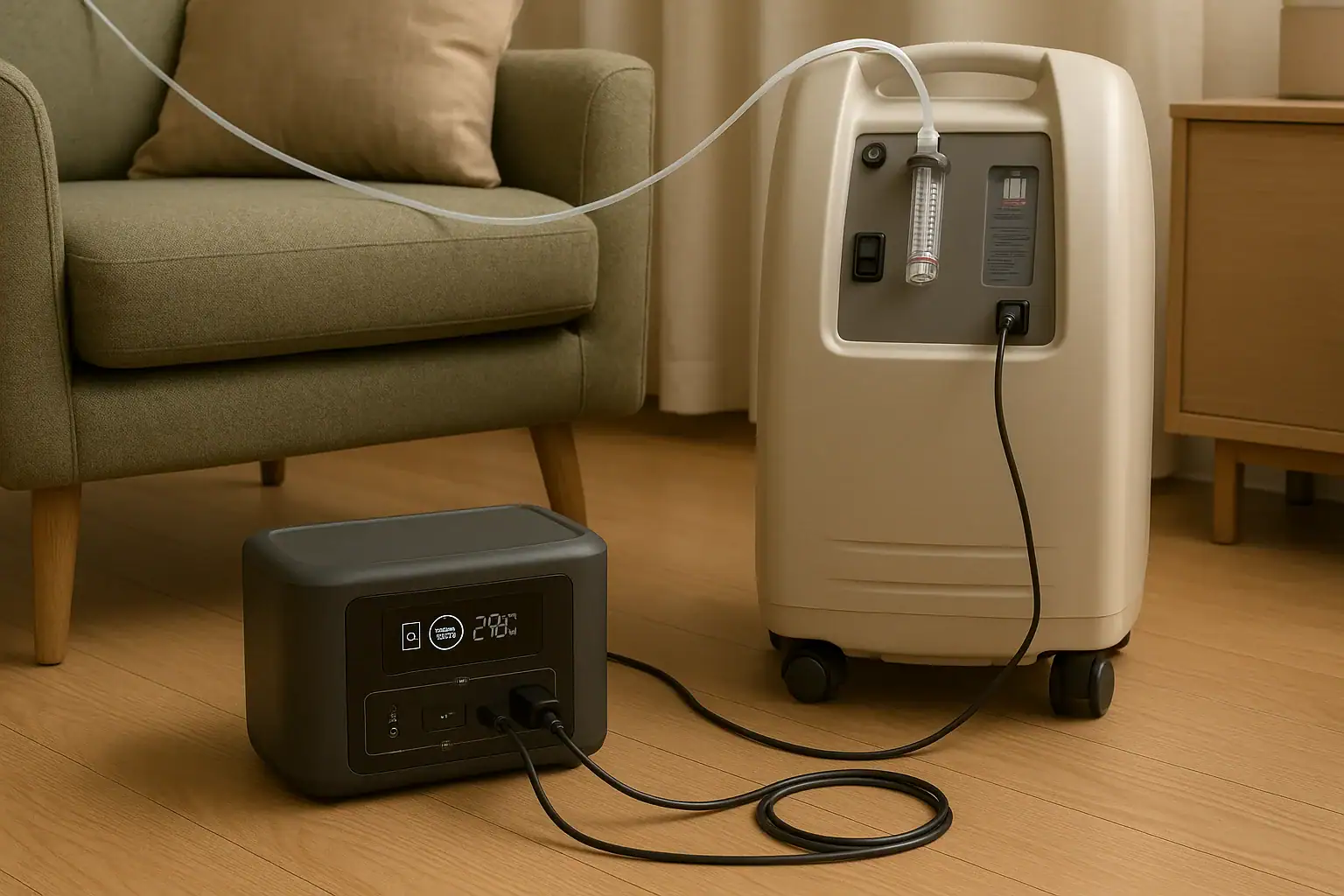
A portable power station can run an oxygen concentrator if its continuous watt rating, battery capacity, and inverter output match the concentrator’s requirements.
The main planning questions are runtime, surge watts, continuous watts, pure sine wave output, battery capacity, and whether the unit can recharge fast enough during an outage. Oxygen equipment is not the place to guess from marketing claims, because the same size power station can provide very different usable hours depending on the concentrator’s watt draw and settings.
For home backup, treat the power station as one layer in a broader medical power plan. Check the concentrator label, documentation, or power supply for input requirements, then compare them with the power station’s AC output and watt-hour capacity. If oxygen use is medically necessary, involve your clinician, durable medical equipment provider, or emergency planning contact before relying on any battery source.
What a Portable Power Station Means for an Oxygen Concentrator
A portable power station is a rechargeable battery system with built-in outlets and charging ports. For an oxygen concentrator, it acts like a temporary backup power source when a wall outlet is unavailable or utility power fails. It is not the same as a whole-home generator, and it should not be treated as a permanent medical power solution unless the care team and equipment provider have confirmed the plan.
The reason this matters is simple: oxygen concentrators are continuous-use devices for many households. A laptop or lamp can be turned off to save battery, but oxygen therapy may need to continue through the night or through a long outage. Runtime planning is therefore about more than choosing a large battery. You need to know whether the inverter can start and run the concentrator, how quickly the battery drains at the required setting, and what backup options exist if the outage lasts longer than expected.
Most home concentrators use AC power, while many portable concentrators have dedicated DC adapters or external batteries. A power station can support either type if the voltage, wattage, and connector method are appropriate. In general, AC outlets are easier to use but less efficient because the battery power must be converted through an inverter. DC outputs can be more efficient when compatible, but compatibility should be confirmed from the concentrator documentation rather than assumed.
How Power Requirements and Runtime Calculations Work
The most important number is the concentrator’s running wattage. This may be listed on a label as watts, amps, or volt-amps. If power is listed in amps, multiply volts by amps to estimate watts. For example, a device drawing 3 amps at 120 volts is approximately 360 watts. Real use may vary by oxygen setting, compressor cycling, altitude, filters, and age of the equipment.
Next, compare that draw with the power station’s continuous AC output. Continuous watts describe what the inverter can supply steadily. Surge watts describe a short starting burst. Some concentrators draw more power for a moment when the compressor starts, so a power station that barely matches the running watts may overload or shut down. A practical plan usually leaves headroom instead of running at the maximum rating.
Battery capacity is usually shown in watt-hours. A simple runtime estimate is watt-hours divided by device watts, then reduced for inverter losses and reserve margin. For AC use, many people use 80% to 90% of rated capacity as a rough planning range. A 1,000 watt-hour power station running a 300-watt concentrator might provide around 2.5 to 3 hours after losses, not the full 3.3 hours suggested by ideal math.
- Running watts: the steady power the concentrator needs during normal operation.
- Surge watts: the brief start-up demand that can trip a smaller inverter.
- Watt-hours: the stored energy that determines approximate runtime.
- Inverter efficiency: the energy lost when battery power is converted to AC power.
- Reserve margin: unused capacity kept for medical uncertainty, battery aging, and display inaccuracies.
| Concentrator load | Power station capacity | Planning efficiency | Estimated runtime |
|---|---|---|---|
| 120 watts | 500 watt-hours | 85% | About 3.5 hours |
| 250 watts | 1,000 watt-hours | 85% | About 3.4 hours |
| 350 watts | 1,500 watt-hours | 85% | About 3.6 hours |
| 500 watts | 2,000 watt-hours | 85% | About 3.4 hours |
Real-World Runtime Examples for Home Planning
Consider a smaller portable oxygen concentrator that averages about 90 to 150 watts when charged through AC power. A 500 watt-hour power station may look large, but after inverter losses it may provide only a few hours of operation. If the concentrator can use a compatible DC power input, runtime may improve, but only if the voltage and connector are designed for that device.
A typical stationary home oxygen concentrator can draw several hundred watts. If it uses 300 watts on average, a 1,000 watt-hour power station may cover roughly one evening but not a full night. At 500 watts, even a larger unit can drain quickly. This is why a power station that works well for phones, lights, and a router may be undersized for oxygen equipment.
Settings also matter. Some concentrators draw more power at higher liter flow settings, while others have a more stable draw but still work harder under certain conditions. If the equipment cycles on and off, a plug-in power meter can help estimate average wattage during normal use. Do not run an unapproved test that interrupts prescribed oxygen therapy. If testing is needed, do it with backup oxygen available and with guidance from the equipment provider.
Runtime planning should also include overlapping loads. Adding a heated humidifier, extension cord losses, a CPAP machine, refrigerator, or room fan can reduce available hours. When oxygen is the priority, avoid using the same backup battery for nonessential appliances unless the capacity plan clearly supports it.
Common Mistakes and Troubleshooting Cues
The most common mistake is sizing only by battery capacity while ignoring inverter output. A high watt-hour number does not help if the AC outlet cannot supply the concentrator’s starting load. If the power station clicks off, shows overload, or turns the AC outlet off shortly after the concentrator starts, the inverter may be undersized or the surge demand may be too high.
Another mistake is accepting the display estimate without checking actual draw. Many power stations estimate time remaining from the current load, and that estimate can change as the concentrator cycles. If the display drops quickly at start-up, then stabilizes, that may be normal. If it repeatedly falls faster than expected, the concentrator may be using more watts than planned, the battery may be cold, or additional devices may be plugged in.
A third mistake is using long, thin extension cords. Voltage drop can make compressors start harder and can create heat at the cord. If an extension cord is unavoidable, use a heavy-duty cord rated for the load and keep it as short as practical. Do not run cords under rugs, through door pinch points, or where they can become a tripping hazard around medical tubing.
Other troubleshooting cues include beeping alarms from the concentrator, low oxygen output warnings, the power station fan running constantly, hot plugs, or repeated shutdowns. These are signs to stop relying on that setup until it is checked. A power station should support the concentrator without alarms, overheating, or frequent overload events.
Safety Basics for Oxygen and Battery Backup
Oxygen supports combustion, which means fire safety is central. Keep the power station, cords, and charger away from open flames, smoking materials, space heaters, stoves, candles, and other ignition sources. Maintain ventilation around both the concentrator and the power station so cooling fans are not blocked.
Use a pure sine wave AC output for sensitive medical equipment unless the concentrator documentation clearly allows another type. Many modern power stations use pure sine wave inverters, but it should still be verified in the specifications. A poor-quality waveform can cause heat, noise, inefficient operation, or error behavior in motor-driven devices.
Do not open the power station, modify battery packs, defeat overload protection, or use improvised adapters. Do not wire a power station into a home electrical panel, transfer switch, or interlock unless the work is designed and performed by a qualified electrician according to applicable codes. For most households, the safer approach is to plug the concentrator directly into the power station outlet during an outage.
Because oxygen therapy can be medically critical, do not rely on a single untested power station as the only backup. A safer plan may include charged concentrator batteries, oxygen cylinders if prescribed and supplied, a neighbor or family contact, transportation options, and a local emergency power plan. The correct backup plan depends on the prescription, the patient’s condition, and the expected outage risk.
Maintenance, Storage, and Readiness at Home
A power station is only useful if it is charged, accessible, and known to work. Store it in a dry indoor location within the temperature range suggested by the manufacturer. Avoid storage in hot cars, freezing garages, damp basements, or direct sunlight. Extreme temperatures can reduce capacity and may affect whether the inverter can deliver its rated output.
Check the charge level on a routine schedule. Many lithium power stations can hold a charge for months, but standby drain and battery management systems can still reduce available energy over time. If the unit has a storage mode, follow the manual. For emergency oxygen backup, many households choose to keep the unit at a high state of charge, while still performing periodic checks so it is ready when needed.
Inspect the AC outlet, charging cable, and any approved adapter before relying on them. Look for cracked insulation, bent plugs, scorch marks, loose connections, or damaged cords. Do not use damaged power accessories with oxygen equipment. Also keep the power station in a location where the user or caregiver can reach it without moving heavy furniture during an outage.
Practice a non-emergency test under safe conditions. The goal is to confirm that the concentrator starts, runs, and does not alarm when connected to the power station. Record the displayed watt draw and approximate runtime trend. Keep those notes with the oxygen instructions so a caregiver does not have to make calculations during a power failure.
| Item to check | Practical target | Why it matters |
|---|---|---|
| Charge level | Check monthly or before storms | Confirms usable energy is available |
| Test run | Run long enough to confirm stable operation | Reveals overloads, alarms, or unexpected watt draw |
| Storage location | Cool, dry, ventilated indoor area | Helps preserve battery capacity and safe operation |
| Cords and plugs | No damage, heat, or loose fit | Reduces fire and connection risk around oxygen |
Related guides: Portable Power Stations for CPAP and Medical Devices • Surge Watts vs Running Watts: How to Size a Portable Power Station • Pure Sine Wave vs Modified Sine Wave: Does It Matter for a Portable Power Station?
Practical Takeaways and Specs to Compare
The right portable power station for an oxygen concentrator is the one that can run the exact device, at the prescribed setting, for the required backup time with safe headroom. Start with the concentrator’s watt draw, then size the inverter and battery capacity around that load. If the number of hours needed is high, a single portable unit may not be enough, and the household should plan additional medically appropriate backup options.
For affiliate-ready comparison later, the key is to evaluate specifications rather than brand claims. Look for clear published ratings, plain-language safety features, and enough capacity to support the oxygen plan without using every watt-hour under ideal conditions.
Specs to look for
- Continuous AC output: look for a rating comfortably above the concentrator’s running watts, such as 25% to 50% headroom, because compressors and electronics should not be operated at the inverter’s limit.
- Surge or peak output: look for a short-term rating high enough for start-up demand, often 2 times the running load for motorized equipment, because start-up spikes can trigger overload shutdowns.
- Battery capacity in watt-hours: look for enough capacity to cover the desired runtime after losses, such as 1,000 to 2,000 watt-hours for several hours of a mid-sized home concentrator, because rated capacity is not the same as usable AC runtime.
- Pure sine wave inverter: look for pure sine wave AC output, because medical electronics and compressor motors generally run more predictably on clean power.
- AC outlet rating and layout: look for outlets rated for the full load with enough spacing for plugs, because loose adapters and overloaded strips add unnecessary risk.
- Recharge speed: look for AC recharge times of a few hours when possible, because a short window of grid power may need to restore the backup battery quickly.
- Pass-through or UPS-style behavior: look for clearly described support if you intend to keep equipment connected while charging, because not all power stations switch fast enough or are intended for medical continuity.
- Operating temperature range: look for a range that matches the storage and use environment, because cold or heat can reduce capacity and may limit charging.
- Display and load monitoring: look for real-time watts, percent charge, and time remaining, because caregivers need quick information during an outage.
- Safety protections: look for overload, over-temperature, short-circuit, and battery management protections, because these help the unit shut down safely instead of overheating or damaging equipment.
Before depending on any backup setup, confirm compatibility with the oxygen concentrator documentation and the medical equipment provider. A portable power station can be a useful home outage tool, but it should be part of a planned, tested, and medically appropriate backup strategy.
Frequently asked questions
Can a portable power station run an oxygen concentrator overnight?
It can, but only if the power station has enough usable watt-hours and enough continuous AC output for the concentrator’s actual draw. Overnight runtime is often much shorter than people expect once inverter losses and safety margin are included. Check the concentrator’s wattage and test the setup before relying on it for sleep-time backup.
What specs matter most when choosing a portable power station for an oxygen concentrator?
The most important specs are continuous AC output, surge or peak output, battery capacity in watt-hours, and pure sine wave inverter output. Recharge speed and clear load monitoring also matter because they affect readiness during a long outage. The power station should be sized for the concentrator’s real running load, not just the marketing label.
What is the most common mistake people make with oxygen concentrator backup power?
The most common mistake is buying a unit with enough battery capacity but not enough inverter output. A concentrator may overload the AC outlet at startup even when the watt-hour number looks large. Another frequent error is assuming the display runtime estimate is accurate without checking the actual load.
Is it safe to use an extension cord with a portable power station and oxygen concentrator?
It can be safe if the cord is heavy-duty, properly rated, and kept as short as practical. Thin or very long cords can cause voltage drop, heat, and startup problems for compressor-based equipment. Avoid damaged cords, loose plugs, and any routing that creates a trip hazard around oxygen tubing.
How long will a portable power station last with an oxygen concentrator?
Runtime depends on the concentrator’s watt draw, the power station’s watt-hour capacity, and inverter efficiency. A rough estimate is usable watt-hours divided by device watts, then reduced for losses and reserve. In real use, the result is usually less than the ideal math suggests.
What safety precautions should I follow when using battery backup with oxygen?
Keep the concentrator, power station, and cords away from flames, smoking materials, heaters, and other ignition sources. Make sure the area is ventilated and do not modify the battery system or bypass protection features. If oxygen therapy is medically necessary, keep a second backup option in place and confirm the plan with the care team.
Related guides
Browse this topic →
- Beginner-friendly sizing, runtime & specs
- Solar & charging (MPPT, fast charging, cables)
- Batteries (LiFePO4, cycles, care & storage)
- Safety, cold-weather performance, real-world tips
More in Home / Appliances
See all →Keep reading
About this site
Portable Energy Lab publishes practical, independent guides about portable power—clear sizing, safe use, and real-world expectations.
Affiliate disclosure
Some links on this site may be affiliate links. If you buy through these links, we may earn a small commission at no extra cost to you. This helps support our content. Read our affiliate disclosure.