
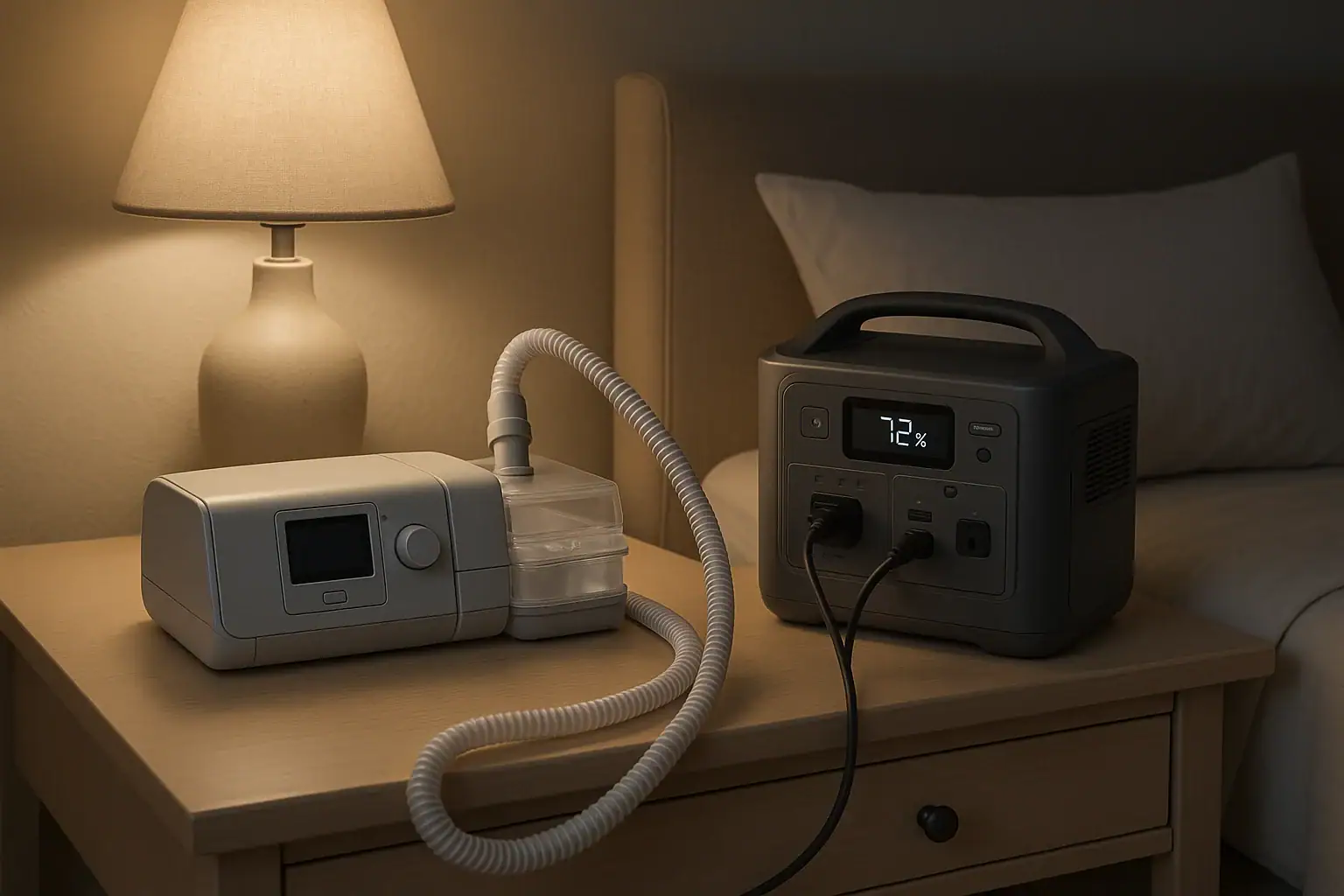
A CPAP humidifier can cut portable power station runtime by half or more because heating water uses much more energy than running the blower alone. If your CPAP battery backup lasts all night without humidification but shuts off early with the humidifier on, the most likely cause is higher watt-hours used overnight, not a defective power station.
Runtime depends on CPAP pressure, heated humidifier setting, heated tube use, mask leak, room temperature, AC inverter efficiency, and the usable battery capacity of the power station. Search terms such as CPAP runtime, watt-hours, AC inverter, humidifier setting, surge watts, and DC output all point to the same practical question: how much energy will your setup use while you sleep?
The short answer is that blower-only CPAP use is often a low electrical load, while active humidification turns it into a medium load that can drain small power stations quickly.
What a Portable Power Station for CPAP With Humidifier Means
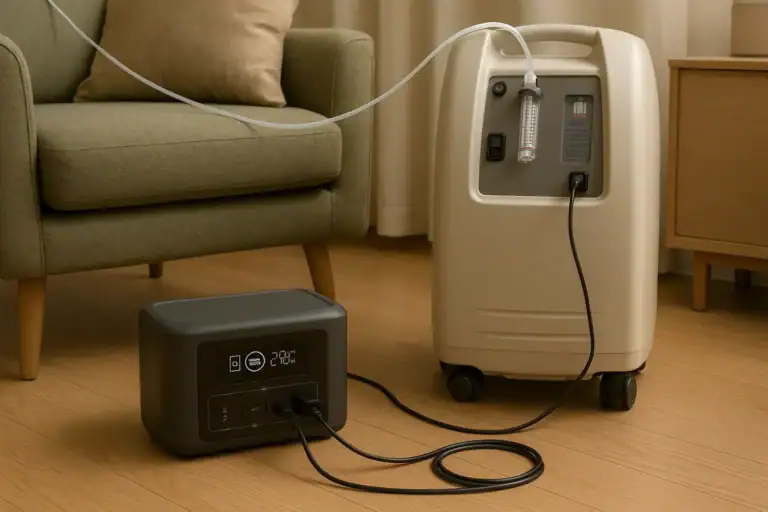
A portable power station for CPAP with humidifier is a rechargeable battery system used to run a sleep apnea machine when wall power is unavailable, unreliable, or inconvenient. It may be used during outages, travel, camping, or as a bedside backup. Unlike a small CPAP-specific travel battery, a portable power station usually includes an internal battery, an AC outlet, DC outputs, USB ports, a display, and built-in safety electronics.
The humidifier matters because it changes the load profile. The CPAP blower moves air at a set pressure, which typically uses a predictable amount of power. The humidifier heats water to add moisture to that airflow. Heating is energy-intensive, especially when the room is cool, the humidifier is set high, or a heated tube is also active.
This matters for overnight planning because power station size is usually advertised in watt-hours, while CPAP machines are used for hours at a time. A compact unit that looks sufficient based on peak watts may not store enough usable energy for a full night with humidification. The right question is not only whether the outlet can run the CPAP, but whether the battery has enough usable capacity to support the blower, humidifier, and inverter losses for the entire sleep period.
How Humidification Changes CPAP Power Use
Runtime is based on a simple relationship: usable watt-hours divided by average watts equals approximate hours of operation. For example, if a power station can deliver about 450 usable watt-hours and the CPAP setup averages 45 watts, estimated runtime is about 10 hours. If the same setup averages 90 watts with a high humidifier setting and heated tube, runtime drops to about 5 hours.
The important word is average. A CPAP may not pull the same wattage all night. The humidifier heater cycles on and off to maintain temperature and moisture. The blower may work harder at higher pressures or when mask leaks increase airflow. A heated hose can add another steady or cycling load. The display on the power station may show changing watts because these loads are dynamic.
Using the AC outlet also introduces inverter efficiency loss. Many CPAP machines plug into AC power, so the power station converts stored DC battery energy into AC power. That conversion is convenient, but not perfectly efficient. A DC cable that is specifically designed for the CPAP input voltage can sometimes reduce conversion losses, but it must match the device requirements. Guessing at voltage or connector compatibility is not safe.
Surge watts usually are not the main problem for CPAP use. Most CPAP machines do not have large motor-start surges like refrigerators or pumps. Still, a power station must handle the normal running watts of the CPAP plus humidifier and any brief heating cycles without shutting down on overload.
| CPAP setup | Typical average draw | Approximate runtime from 300 usable Wh | Approximate runtime from 600 usable Wh |
|---|---|---|---|
| Blower only, no heated tube | 10 to 25 watts | 12 to 30 hours | 24 to 60 hours |
| Blower with low humidifier | 30 to 50 watts | 6 to 10 hours | 12 to 20 hours |
| Blower with medium humidifier | 50 to 75 watts | 4 to 6 hours | 8 to 12 hours |
| High humidifier plus heated tube | 75 to 110 watts | 3 to 4 hours | 5 to 8 hours |
Real-World Overnight Runtime Examples
Consider an 8-hour night with a CPAP blower averaging 18 watts and no humidifier. The energy needed is about 144 watt-hours before conversion losses. With inverter losses included, a power station may need roughly 165 to 190 watt-hours of stored energy to complete the night. In that case, a smaller unit can be practical if it is fully charged and in good condition.
Now add a heated humidifier on a moderate setting. The same CPAP system may average closer to 55 watts. Over 8 hours, that is 440 watt-hours before accounting for inverter losses. With AC conversion, display overhead, and battery reserve behavior, the practical requirement may be closer to 500 watt-hours or more. This is why users often see a major runtime drop after turning humidity back on.
A high-humidity setup can be even more demanding. If the CPAP, humidifier, and heated tube average 90 watts for 8 hours, the energy required is 720 watt-hours before losses. A power station labeled around that capacity may still fall short if its usable AC capacity is lower than the nameplate number, if it starts at less than 100 percent charge, or if cold conditions reduce battery performance.
Runtime can also change from night to night. A colder room may cause the heater plate and heated tube to work harder. A dry environment can require more humidification to maintain comfort. A poor mask seal may increase airflow and raise blower power. These changes explain why one night may finish with charge remaining while another ends with the power station empty before morning.
Common Mistakes and Troubleshooting Cues
The most common mistake is sizing the power station based only on the CPAP label or power adapter rating. The adapter may list a maximum output that is higher than the typical draw. This number is useful for compatibility, but it does not tell you overnight energy use. Runtime planning should be based on average watts over time, ideally observed with your usual pressure, humidifier setting, and tube setting.
Another mistake is assuming advertised battery capacity equals usable AC capacity. A power station rated at a certain number of watt-hours may deliver less through the AC outlet because of inverter losses and built-in reserve limits. This is normal and should be expected. If you need 500 watt-hours for the night, choosing a unit with only slightly more than that on the label leaves little margin.
If the CPAP stops after a few hours, check the power station display if available. A steady decline to zero suggests normal battery depletion. An abrupt shutoff while charge remains may indicate overload, low-temperature protection, sleep mode behavior, or an AC outlet timeout. Some power stations turn off outputs when they detect a load below a certain threshold, though humidified CPAP use is usually high enough to stay awake.
If runtime is shorter than expected, reduce variables one at a time. Lowering the humidifier setting, turning off the heated tube, improving mask seal, and using a warmer room can reduce demand. If medically appropriate and comfortable, some users use passover humidification, where water is present but not actively heated. Any therapy comfort changes should be consistent with clinical guidance and personal sleep needs.
Also confirm that the power station is fully charged before bedtime and that the AC outlet is actually enabled. Many units have separate buttons for AC, DC, and USB outputs. If the display shows high wattage from other connected items, remove nonessential loads. A phone, lamp, fan, or heated blanket can materially reduce CPAP runtime.
Safety Basics for Overnight CPAP Backup Power
For CPAP use, safety starts with electrical compatibility. The power station should support the CPAP power adapter without exceeding outlet ratings. If using DC output, the voltage, polarity, connector, and current capability must match the CPAP requirements. Do not improvise cables, bypass protections, modify battery packs, or open devices to make them work.
Place the power station where it has ventilation and will not be covered by bedding, pillows, clothing, or curtains. Even efficient electronics generate heat during AC inverter use. Keep the unit on a stable surface away from water containers, including the CPAP humidifier chamber. Refill the humidifier carefully so water does not spill onto outlets, cords, or the power station.
Use the CPAP manufacturer’s normal cleaning and water guidance for the humidifier chamber. Distilled water is commonly used to reduce mineral buildup, but the key electrical point is to keep water away from power connections. Inspect cords for damage before relying on them overnight, and avoid running cords where they can be pinched, pulled, or tripped over.
If you intend to connect backup power to household wiring, do not attempt makeshift wiring, backfeeding, or panel modifications. Whole-circuit backup arrangements require proper equipment and should be handled by a qualified electrician. For CPAP specifically, the safer and simpler approach is usually to plug the CPAP power adapter directly into a suitable portable power station placed near the bed.
Maintenance and Storage for Reliable CPAP Runtime
Reliable overnight runtime depends on battery condition as much as capacity. Store the power station in a dry, temperature-controlled location when possible. Extreme heat can accelerate battery aging, and cold conditions can reduce available capacity temporarily. Before storm season, travel, or planned off-grid use, recharge the unit and run a short test with the CPAP setup you actually plan to use.
A periodic runtime test is more useful than reading the capacity label. Fully charge the power station, connect the CPAP with your normal humidifier and tube settings, and observe the starting charge, average watts, and remaining charge after a known period. You do not need to drain the unit completely every time; even a two-hour test can show whether the estimated overnight runtime is realistic.
Keep the CPAP humidifier chamber clean and free from excessive mineral deposits. Scale on the heater plate or chamber can affect heat transfer and may alter humidification performance. Replace worn seals, chambers, tubing, and filters according to the CPAP equipment guidance because leaks and restrictions can make the blower work harder.
For storage, avoid leaving the power station empty for long periods. Many battery systems age better when stored partly charged and topped up periodically. Follow the unit’s storage guidance, but for planning purposes, treat an old or heavily used battery as having less capacity than it did when new. If overnight CPAP use is medically important, build in extra reserve rather than planning to use every last watt-hour.
| Maintenance item | What to check | Why it affects runtime |
|---|---|---|
| State of charge | Confirm the unit is charged before bedtime | Starting at 80 percent instead of full can remove hours of reserve |
| Battery age | Account for reduced capacity over time | Older batteries may deliver fewer usable watt-hours |
| Humidifier chamber | Keep it clean and seated correctly | Poor chamber condition can affect heating and comfort |
| Mask and tubing | Look for leaks, loose fittings, or worn parts | Leaks can increase blower workload |
| Storage temperature | Avoid hot cars, freezing areas, and damp storage | Temperature extremes reduce performance and battery life |
Related guides: Portable Power Stations for CPAP and Medical Devices • Portable Power Station Watt-Hours Explained • Inverter Efficiency Explained
Practical Takeaways and Specs to Look For
A portable power station can run a CPAP with a humidifier overnight, but runtime changes dramatically when heat is involved. Blower-only use may require less than 200 watt-hours for a typical night, while heated humidification can require several hundred watt-hours or more. High humidity settings, heated tubing, cold rooms, air leaks, and AC inverter losses all reduce runtime.
For dependable planning, estimate your actual average watts and multiply by sleep hours, then add a margin. A practical reserve is especially important if therapy is medically necessary, if outages may last more than one night, or if the power station will also charge phones, run lights, or power other devices. The best specification is not the largest peak watt number; it is enough usable watt-hours for your real CPAP settings.
Specs to look for
- Usable battery capacity: Look for enough watt-hours to cover your CPAP load for 8 to 10 hours with a margin; humidified setups often need about 500 to 900 Wh for comfortable reserve.
- AC output rating: Look for continuous watts comfortably above the CPAP adapter and humidifier draw, such as 150 to 300 watts; this prevents nuisance overload shutdowns.
- Inverter efficiency: Look for clear AC runtime expectations or efficient inverter design; lower conversion loss means more of the battery reaches the CPAP.
- Compatible DC output: Look for a DC option only if it matches the CPAP voltage and connector through a proper cable; avoiding AC conversion can improve runtime.
- Low-load behavior: Look for outputs that stay on through steady overnight loads; automatic sleep modes can interrupt small medical devices in some situations.
- Display and watt meter: Look for real-time watts, remaining percentage, and estimated time; these help diagnose whether the humidifier is draining the battery faster than expected.
- Recharge speed: Look for recharge times that fit your outage or travel pattern, such as full recharge within a few hours from wall power; this matters for multi-night use.
- Battery chemistry and cycle life: Look for long cycle life and stable storage characteristics; backup devices may sit unused for months and still need to perform reliably.
- Operating temperature range: Look for performance suitable for bedrooms, vehicles, or camping conditions; cold can reduce available capacity and heat can shorten battery life.
The main takeaway is simple: turning on the humidifier changes CPAP backup power from a small load into a much larger overnight energy requirement. Size the power station by watt-hours, verify performance with your own settings, and keep enough reserve so comfort settings and normal battery losses do not leave you without therapy before morning.
Frequently asked questions
How long will a portable power station run a CPAP with humidifier overnight?
It depends on the CPAP’s average watt draw, humidifier setting, heated tube use, and the power station’s usable watt-hours. A blower-only setup may last all night on a modest battery, while heated humidification can cut runtime substantially. The most reliable estimate comes from testing your exact settings and using the average watts over time.
What size power station do I need for a CPAP with heated humidifier?
There is no single size that fits every setup, but humidified CPAP use often needs several hundred usable watt-hours for a full night. If you want margin for battery aging, inverter losses, and colder room conditions, a larger capacity is usually safer than a unit sized only to the minimum. The best choice is based on your measured average watts and sleep duration.
What specs or features matter most when choosing one?
Usable watt-hours matter more than peak watts for overnight CPAP runtime. Also look for a continuous AC output that comfortably exceeds the CPAP’s draw, efficient inverter performance, and a compatible DC output if you plan to avoid AC conversion. A clear display showing watts and remaining charge is helpful for troubleshooting and planning.
What is the most common mistake people make with CPAP backup power?
The most common mistake is sizing the battery from the CPAP adapter label instead of actual overnight energy use. The adapter rating shows maximum compatibility, not typical consumption. Another frequent error is forgetting that humidification and heated tubing can dramatically increase power demand.
Is it safe to use a portable power station with a CPAP and humidifier?
Yes, if the power station and cables match the CPAP’s electrical requirements and are used as intended. Keep the unit ventilated, protect it from water, and avoid improvised wiring or modified connections. If you are unsure about voltage, polarity, or connector compatibility, use the manufacturer’s approved setup or consult a qualified professional.
Why does runtime drop so much when the humidifier is turned on?
The humidifier uses electrical energy to heat water, and heating is much more demanding than running the blower alone. A heated tube can add even more load, especially in a cool or dry room. That extra energy use is why a battery that lasts all night without humidification may run out early once heat is enabled.
Related guides
Browse this topic →
- Beginner-friendly sizing, runtime & specs
- Solar & charging (MPPT, fast charging, cables)
- Batteries (LiFePO4, cycles, care & storage)
- Safety, cold-weather performance, real-world tips
More in Home / Appliances
See all →Keep reading
About this site
Portable Energy Lab publishes practical, independent guides about portable power—clear sizing, safe use, and real-world expectations.
Affiliate disclosure
Some links on this site may be affiliate links. If you buy through these links, we may earn a small commission at no extra cost to you. This helps support our content. Read our affiliate disclosure.