
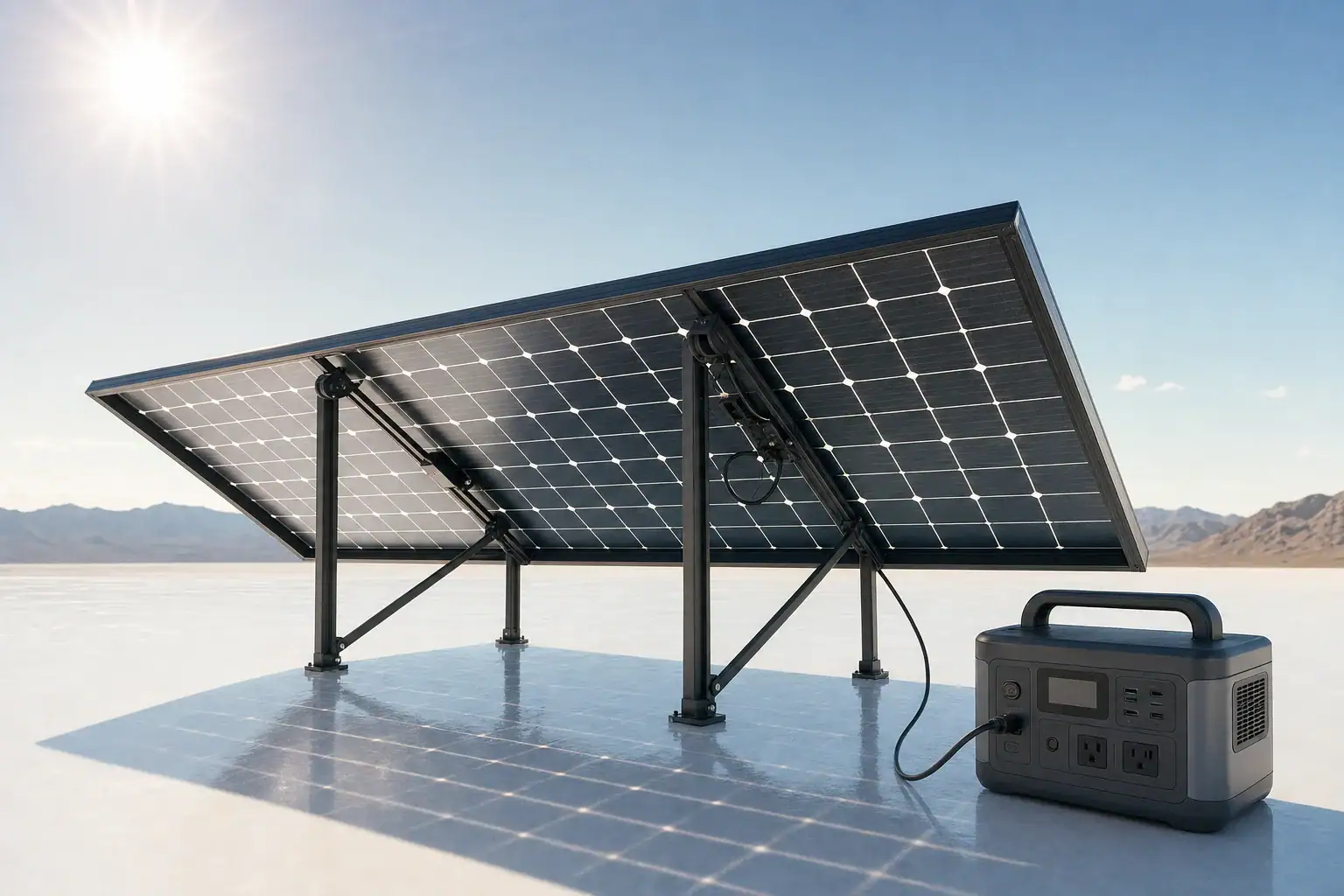
Bifacial solar panels can charge a portable power station faster when their rear side receives substantial reflected or indirect sunlight and the station can accept the additional power. The extra output helps most on bright days when a panel is elevated over snow, pale gravel, sand, concrete, or another reflective surface. It helps less when the panel lies flat, its back is shaded, or the power station has already reached its solar input limit.
Real results depend on rear-side exposure, surface reflectivity, panel angle, temperature, shading, and MPPT controller behavior. Electrical compatibility also matters: the array’s open-circuit voltage, operating voltage, short-circuit current, connector type, and rated watts must fit the portable power station’s solar input specifications. Bifacial gain is therefore not a fixed bonus. It is additional production that may improve charging time, low-light performance, or daily energy harvest under suitable conditions, but only when panel placement and the receiving equipment allow that energy to be used.
1. What bifacial solar panels mean and why they matter
A conventional monofacial panel is designed to generate electricity mainly from sunlight striking its front surface. A bifacial panel uses solar cells and a rear construction that can also convert light reaching the back into electricity. The rear side does not need direct sunlight at the same intensity as the front; reflected and diffuse light can contribute.
The practical benefit is usually described as bifacial gain: the extra energy produced compared with front-side production alone. This gain is not the same as the panel’s bifaciality factor. Bifaciality indicates how effectively the rear side responds relative to the front under standardized testing, while actual gain depends heavily on the installation environment.
For portable power stations, the distinction between momentary watts and total daily watt-hours matters. Rear-side light might raise midday output, extend useful production during morning or afternoon, or soften losses from minor front-side shading. Any of these effects can increase daily energy harvest. However, the station receives no additional benefit when its charge controller is already clipping input at its maximum accepted wattage or current.
Bifacial designs are most useful for portable setups that can leave open space behind the panel. Some rigid panels naturally support this arrangement. Foldable or fabric-backed panels may obtain little rear-side gain if their backing blocks light or if they are placed directly on the ground.
2. How rear-side gain and solar input limits work
Rear-side production starts with albedo, which is the fraction of incoming light reflected by a surface. Fresh snow and some bright roofs can reflect substantial light. Light-colored gravel, sand, and concrete often offer moderate reflection. Dark soil, asphalt, grass, and water generally provide less useful reflection, although conditions and sun angle can change the result.
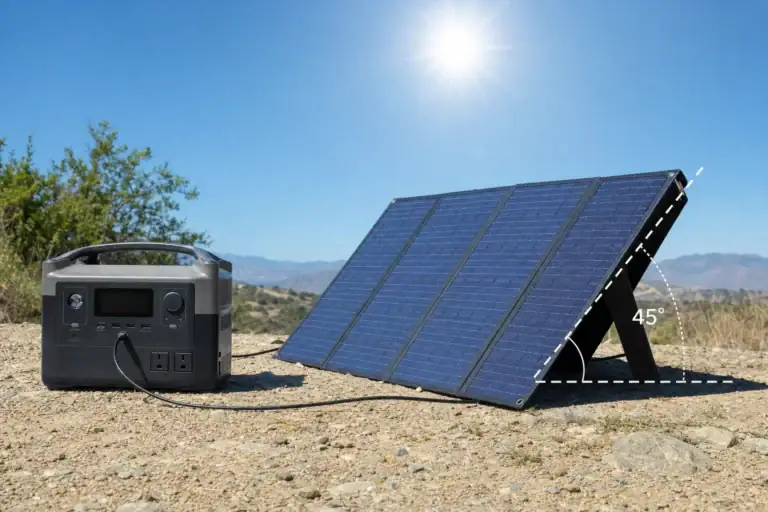
Panel clearance is equally important. A bifacial panel placed flat against a surface cannot receive much rear illumination. Raising it creates an air gap and allows reflected light to spread across more of the back. Tilt can improve front-side solar alignment while also changing which areas of the rear receive reflected light. Wide supports, cables, equipment, and nearby objects may cast rear-side shadows that reduce the gain.
The portable power station’s MPPT solar charge controller then determines how much available power can enter the battery. The panel or array must stay within the controller’s voltage range and maximum open-circuit voltage. It must also respect accepted current and power limits. Extra available wattage above an input-power ceiling may be clipped, while excessive voltage can create a more serious compatibility problem.
Temperature affects these calculations. Solar-panel voltage tends to increase in cold conditions, so an array that appears compatible at a mild temperature could exceed an input voltage ceiling during cold weather. Meanwhile, hot panels usually produce less voltage and power. Manufacturer specifications and an appropriate cold-weather voltage margin should guide array sizing.
| Condition | Likely rear-side contribution | Practical implication |
|---|---|---|
| Panel flat on dark ground | Minimal | Expect performance close to front-side output alone |
| Panel elevated over grass | Low | Clearance may help, but the surface reflects limited light |
| Panel elevated over pale concrete | Moderate | Rear production may provide a useful charging increase |
| Panel elevated over bright snow | Potentially high | Check cold-weather voltage and the station’s input ceiling |
| Array already at input limit | Available but clipped | Rear gain may not increase peak charging watts |
3. Real-world examples of when extra output helps
Camping on a light-colored surface
Consider a 200-watt bifacial panel elevated above pale gravel. If front-side conditions support 150 watts and reflected light adds 15 watts, the panel could deliver about 165 watts before cable and conversion losses. A power station accepting 300 watts of solar input can use the increase, potentially shortening the bulk-charging period. A station limited to 150 watts would probably clip most of the extra peak output.
Winter use over snow
An elevated panel over clean snow can receive strong rear illumination. A nominal 400-watt array might briefly produce more than its expected front-only output under favorable sun, temperature, and reflection. This can be valuable when winter daylight is short. Cold conditions can also raise open-circuit voltage, however, so electrical headroom is more important than pursuing the highest possible wattage.
Partly cloudy charging
Under broken clouds, output may rise and fall quickly. Diffuse and reflected light reaching the rear can improve energy collection during some intervals, but cloud-edge effects may also create brief output spikes. A properly sized MPPT input can manage normal variations without relying on a narrow voltage margin.
Base camp with all-day charging
A small increase sustained for several hours can matter more than a short midday peak. For example, an average gain of 20 watts over five productive hours represents roughly 100 watt-hours before system losses. That may be enough to offset several hours of lighting, device charging, communications equipment, or another modest load.
Hot, dark campsite
A panel resting near dark ground in hot weather may show little bifacial advantage. Rear exposure is poor, and elevated cell temperature reduces output. In this situation, better airflow, front-side orientation, and shade-free placement may improve charging more than the bifacial construction itself.
4. Common mistakes and troubleshooting cues
Expecting the nameplate rating plus a guaranteed bonus: Solar ratings are measured under defined test conditions. Actual front output changes with irradiance, temperature, angle, and cleanliness, while rear gain is site-dependent. Treat advertised bifacial gain percentages as conditional rather than automatic.
Blocking the rear surface: Placing the panel flat on a blanket, vehicle roof, or ground surface largely defeats rear-side collection. If output is no better than expected from a monofacial panel, check for open space, reflected light, rear shading, and opaque panel backing.
Confusing watt limits with voltage limits: A charge controller may safely clip surplus watts under a compatible configuration, but that does not make excess voltage acceptable. Compare the array’s open-circuit voltage with the station’s maximum solar input voltage, including cold-weather effects.
Using incompatible series or parallel arrangements: Series connections increase voltage, while parallel connections increase available current. Either arrangement can exceed an input specification if it is not planned correctly. Mixed panels may also operate below their individual potential because of mismatched electrical characteristics.
Overlooking cable losses: Long, undersized, damaged, or loosely connected cables can reduce power and create heat. If the station reports unexpectedly low input, inspect accessible connectors for secure engagement, visible damage, contamination, and excessive warmth without opening either device.
Testing while the battery is nearly full: A power station often reduces charging power at a high state of charge to protect the battery. Compare panel performance when the battery has room to accept substantial energy. Also disable or account for loads that may make the displayed net charging rate misleading.
Comparing different moments: Solar output can change within seconds. A meaningful comparison uses similar sun angle, cloud cover, panel temperature, orientation, battery state, and loads. An external solar meter can help when it is correctly rated, but the power station’s display is often sufficient for broad comparisons.
5. Safety basics for bifacial solar charging
Electrical ratings remain the primary safety boundary. Never connect an array whose possible open-circuit voltage exceeds the portable power station’s stated solar input maximum. Allow additional voltage margin for low temperatures. Current, power, connector polarity, and cable ratings should also match the equipment documentation.
Use connectors and adapters intended for the expected voltage and current. Similar-looking connectors are not necessarily wired with the same polarity. Confirm compatibility before connection, keep contacts dry and clean, and stop using cables that are cracked, deformed, corroded, or unusually hot.
Secure panels against wind. Elevating a panel can improve rear-side exposure, but it also increases wind loading. Use a stable support appropriate for the panel and terrain, and do not place a panel where it can fall onto people, vehicles, cables, or the power station.
Maintain ventilation around both devices. Do not cover the power station with the panel or place it in standing water to shorten the cable run. Keep the battery unit within its specified operating temperature range and away from concentrated reflected light that could cause excessive heating.
Portable solar equipment should not be improvised into household wiring. Connections involving home circuits, electrical panels, transfer equipment, or permanent building installations require properly listed equipment and a qualified electrician where applicable. Do not open equipment, modify battery packs, bypass protection circuits, or alter connectors without approved instructions.
6. Maintenance, transport, and storage
Clean front and rear panel surfaces as recommended for the panel material. Dust, pollen, mud, snow residue, and salt film can reduce output. Use gentle methods that do not scratch coatings or stress seals, and avoid cleaning a very hot panel with cold water. Inspect edges, junction boxes, supports, and accessible cables for damage.
Transport bifacial panels with protection for both faces. Rear glass or transparent backsheet damage can undermine durability even when the front looks intact. Do not stack sharp hardware against the panel, and avoid bending rigid modules or folding portable modules beyond their designed hinges.
Before storage, dry the panel and connectors completely. Coil cables loosely rather than creating tight bends near strain-relief points. Store panels where they will not be crushed, exposed to persistent moisture, or subjected to extreme heat. Follow the power station’s guidance for storage charge level and periodic battery checks.
Keep simple performance notes if the system is used regularly. Recording weather, surface type, panel angle, peak input, and approximate daily energy can reveal gradual losses or poor placement. A sudden decline may indicate new shading, dirt, connector damage, controller limiting, or a battery that is too full, hot, or cold to accept normal charging power.
| Portable setup | Front-side power | Possible rear gain | Usable station input |
|---|---|---|---|
| 200-watt panel over dark soil | 145 W | 3 W | 148 W if the input limit permits |
| 200-watt panel over pale gravel | 145 W | 18 W | 163 W if the input limit permits |
| 400-watt array over snow | 330 W | 65 W | 300 W with a 300-watt input ceiling |
| 400-watt array with partial rear shade | 330 W | 20 W | 350 W with sufficient controller capacity |
Related guides: How to Read Solar Panel Specs for Power Stations: Voc, Vmp, Imp, and Why It Matters • Solar Input Voltage for Power Stations: How to Stay Inside Voc and Amp Limits • Overpaneling Explained: Can You Connect Bigger Solar Panels Than the Input Limit? • Shading and Angle: How Placement Changes Solar Charging Speed
7. Practical takeaways and specs to look for
Bifacial solar panels provide the clearest advantage when they are elevated, exposed on both sides, and positioned over a reflective surface. The additional output is useful only if the portable power station can accept it. For many users, daily watt-hours and charging reliability matter more than the highest instantaneous reading.
Before buying or combining equipment, compare the complete voltage, current, power, connector, and environmental specifications rather than matching rated watts alone. Plan enough input headroom for rear-side gain and changing weather, especially when using multiple panels.
Specs to look for
- Maximum solar input voltage: Look for a ceiling comfortably above the array’s cold-weather open-circuit voltage; a wider margin reduces the risk that low temperatures push voltage out of range.
- MPPT operating voltage range: Confirm that the array’s normal operating voltage falls inside the range, such as a panel operating near 30 to 40 volts with an input range broad enough to track it efficiently.
- Maximum solar input power: Compare the station’s accepted watts with realistic front output plus possible bifacial gain; for example, a 500-watt input can use more of a 400-watt array’s favorable-condition output than a 300-watt input.
- Maximum input current: Check whether parallel panels or a high-current module could exceed the accepted amperage; current headroom helps prevent avoidable clipping.
- Panel bifaciality rating: Look for a clearly stated rear-to-front response, often expressed as a percentage; it indicates rear sensitivity but does not guarantee the same percentage of real-world gain.
- Front-side rated power: Use the standard front rating as the baseline for array planning, then treat rear production as variable additional energy rather than guaranteed capacity.
- Panel construction and rear transparency: Look for glass-glass construction or a transparent rear layer with minimal obstruction; an opaque backing cannot provide meaningful bifacial collection.
- Connector and cable ratings: Verify polarity, weather resistance, voltage, current, and wire size; correctly rated cables reduce losses, heating, and adapter problems.
- Operating temperature range: Compare both panel and power station ranges with expected conditions, such as freezing winter use or hot summer surfaces, because temperature affects voltage, charging acceptance, and output.
The extra output helps most when it adds usable energy during a limited charging window without violating the station’s input limits. Good placement, adequate rear clearance, reflective surroundings, safe electrical margins, and realistic expectations are more important than the bifacial label by itself.
Frequently asked questions
Do bifacial solar panels charge a portable power station faster?
They can charge faster when reflected or diffuse light reaches the rear surface and the power station has unused solar input capacity. The difference may be small on dark ground or when the rear side is blocked, but it can be more useful over bright, reflective surfaces with adequate panel clearance.
How much extra power can a bifacial solar panel produce?
Extra production is variable rather than guaranteed because it depends on surface reflectivity, panel height, tilt, weather, rear shading, and temperature. A modest gain sustained over several hours can add meaningful daily watt-hours even if the peak-watt increase is limited.
What specs matter when choosing bifacial solar panels for portable power stations?
Compare the panel or array open-circuit voltage, operating voltage, current, rated power, connector type, and polarity with the station’s solar input specifications. Also consider the MPPT operating range, maximum accepted power and current, panel rear transparency, bifaciality rating, and cold-weather voltage margin.
Is it a mistake to place a bifacial solar panel flat on the ground?
Usually, yes, if the goal is to benefit from rear-side generation. A panel placed flat has little space for light to reach the back, especially over dark surfaces; elevating it safely over a brighter surface generally provides a better opportunity for bifacial gain.
Do bifacial solar panels work on cloudy days?
Yes, bifacial panels can produce electricity in cloudy conditions because both diffuse sky light and reflected light can reach the cells. Total output will generally be lower than in direct sun, and the amount of rear-side benefit still depends on panel placement and the surrounding surface.
Are bifacial solar panels safe to use with a portable power station?
They are safe when the complete solar setup stays within the station’s stated voltage, current, power, polarity, and connector limits. Never exceed the maximum solar input voltage, allow for higher panel voltage in cold weather, use correctly rated cables, and secure elevated panels against wind.
Related guides
Browse this topic →
- Beginner-friendly sizing, runtime & specs
- Solar & charging (MPPT, fast charging, cables)
- Batteries (LiFePO4, cycles, care & storage)
- Safety, cold-weather performance, real-world tips
More in Solar
See all →- How to Clean Portable Solar Panels Without Damage
- Solar Charging on Cloudy Days: What Output Can a Portable Power Station Expect?
- How Many Portable Solar Panels Do You Need for a 1,000Wh Power Station?
- Solar Adapter Polarity Mistakes: How to Avoid Reverse-Polarity Charging Problems
- Portable Solar Panel Waterproof Ratings: What Rain, Dew, and Splash Resistance Mean
Keep reading

About this site
Portable Energy Lab publishes practical, independent guides about portable power—clear sizing, safe use, and real-world expectations.
Affiliate disclosure
Some links on this site may be affiliate links. If you buy through these links, we may earn a small commission at no extra cost to you. This helps support our content. Read our affiliate disclosure.