
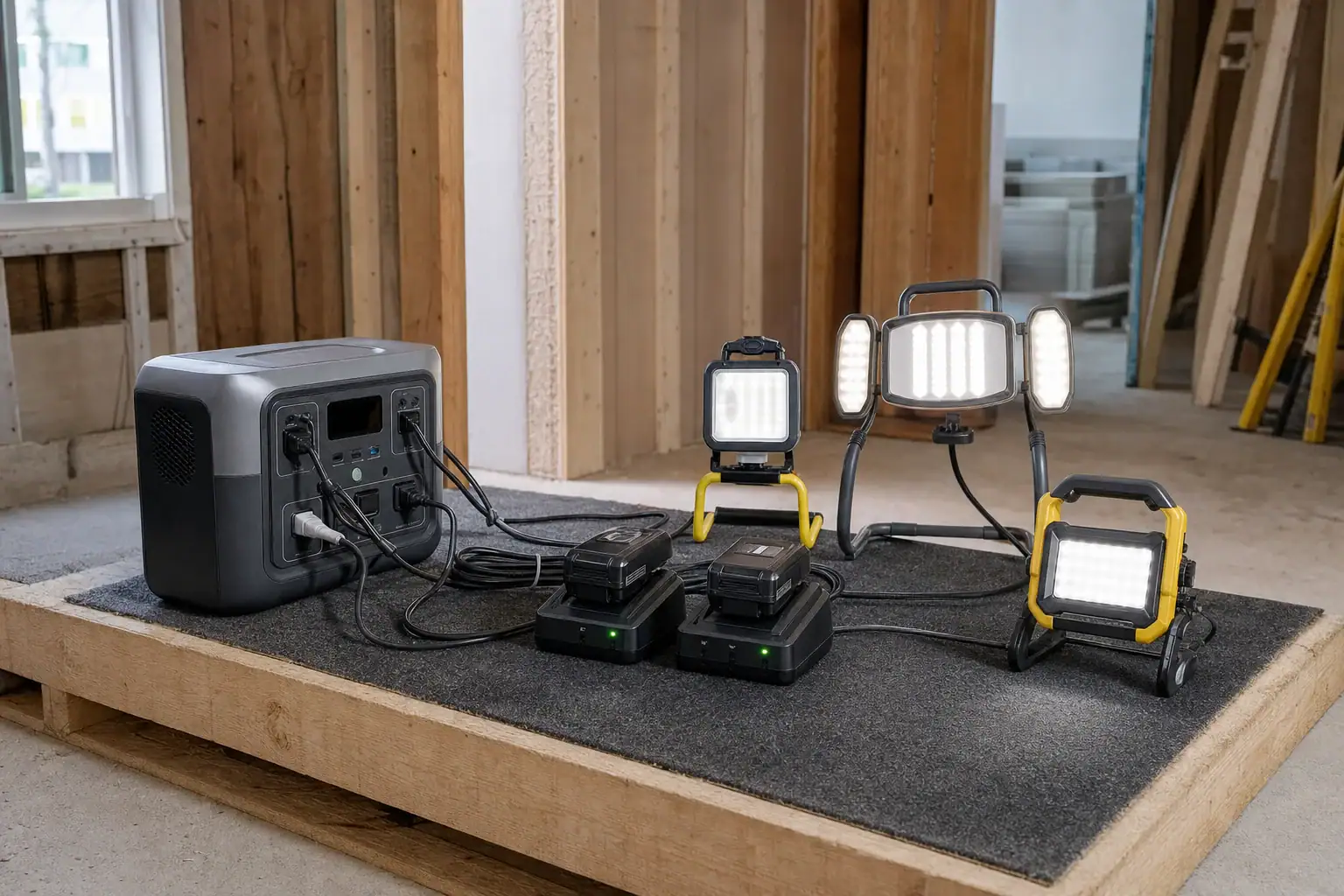
A portable power station for a small jobsite can reliably run cordless tool battery chargers and LED work lights when its continuous output, watt-hour capacity, and outlet configuration match the equipment. For most small crews, the important numbers are charger input watts, lighting watts, total runtime, inverter capacity, and any brief surge watts.
Do not size the station only from the voltage printed on a tool battery. A charger draws AC power, converts it to DC, and loses some energy as heat, so wall-side consumption is higher than the energy ultimately stored in the battery. At the same time, efficient LED work lights usually create a modest load but may operate for many hours. A useful estimate therefore combines every device that may run at once, adds reasonable headroom, and compares the resulting load with both the station’s output rating and usable battery capacity.
This approach helps determine whether a compact unit is sufficient or whether the job requires more inverter power, more watt-hours, or a planned recharge during the workday.
What a Small-Jobsite Portable Power Station Needs to Do
A portable power station combines a rechargeable battery, an inverter, charging electronics, outlets, and protective controls in one enclosure. On a small jobsite, its most practical role is often supporting cordless-tool chargers, task lights, inspection lights, phones, radios, and other relatively low-power equipment where utility power is unavailable or inconvenient.
The station is not automatically a substitute for a jobsite generator. High-draw tools such as large saws, demolition hammers, air compressors, heaters, welders, and dust extractors can demand far more continuous or startup power than a compact battery station can provide. Even when a tool’s running wattage appears acceptable, its startup current may overload the inverter.
For chargers and LED lights, sizing matters for two separate reasons. The inverter must supply enough watts at any moment, while the battery must store enough watt-hours to support the load for the required time. A unit can have adequate inverter output but insufficient runtime, or substantial battery capacity but an inverter too small for several simultaneous fast chargers.
How Watts, Watt-Hours, Chargers, and Inverters Work Together
Watts measure demand. Add the input wattage of every charger, light, and accessory expected to operate simultaneously. Use the charger’s input label or technical documentation when available. If only volts and amps are listed, multiplying them provides a rough upper-bound estimate, although actual AC consumption may differ because of power factor and charger behavior.
Watt-hours measure stored energy. A 1,000-watt-hour battery theoretically contains enough energy to deliver 100 watts for 10 hours. Real runtime is shorter because the inverter, wiring, battery management system, and chargers consume energy. Temperature, battery age, standby draw, and high output levels also affect usable capacity.
A practical planning formula is: runtime in hours equals usable watt-hours divided by total load watts. For initial estimates, assuming roughly 80% to 90% of the listed capacity is available to AC loads provides more realistic results than using the full nameplate figure. Actual usable energy varies by design and operating conditions.
Tool batteries add another conversion step. For example, a battery labeled 18 volts and 5 amp-hours contains about 90 watt-hours nominally. Recharging it may require roughly 105 to 125 watt-hours from the power station after charger losses, with the exact amount depending on battery condition, charger efficiency, temperature, and how fully discharged the pack is.
Continuous output is the inverter power that can be sustained. Surge output is a short-duration allowance for startup peaks. Electronic chargers typically have lower startup demands than large motors, but multiple chargers switched on together can still create a brief peak. Keeping 20% to 30% continuous-output headroom reduces nuisance shutdowns and leaves room for an extra light or accessory.
| Load | Illustrative draw | Planning consideration |
|---|---|---|
| Standard tool battery charger | 80–150 watts | Several chargers can create a meaningful combined load |
| High-rate tool battery charger | 180–350 watts | May run cooling fans and draw heavily during the main charge phase |
| Compact LED task light | 20–50 watts | Low draw, but long operating hours add substantial energy use |
| Large LED work light | 60–150 watts | Check whether brightness settings change consumption |
| Phone or small device charger | 10–30 watts | Usually minor individually but should remain in the load total |
Small-Jobsite Sizing Examples
Two chargers and two work lights
Consider two chargers drawing 120 watts each and two LED lights drawing 50 watts each. The simultaneous load is 340 watts. Adding 25% headroom produces a target continuous inverter rating of about 425 watts or more. Choosing a higher rating may be useful if another charger, radio, or inspection light is likely to be added.
If all four devices run together for four hours, the simple energy calculation is 340 watts multiplied by four hours, or 1,360 watt-hours. Allowing for conversion losses suggests looking beyond 1,500 watt-hours if the full load truly remains constant. In practice, tool chargers usually reduce their draw or stop after packs are full, so measured daily consumption may be lower.
Charging several tool batteries during one shift
Suppose six nominal 90-watt-hour tool batteries need a full recharge. Their combined stored energy is approximately 540 watt-hours. If the charging process requires 20% more energy because of conversion losses, the power station may supply about 650 watt-hours. Add a 40-watt work light operating for six hours, which uses another 240 watt-hours. The estimated requirement becomes about 890 watt-hours before accounting for the station’s own losses and a reserve margin.
Overnight lighting with occasional charging
Three 30-watt lights running for eight hours use 720 watt-hours. Two battery charging sessions that each consume 120 watt-hours add 240 watt-hours, producing a total near 960 watt-hours. In this case, lighting duration drives capacity more than peak output. A modest inverter may handle the load, but adequate battery storage is essential.
These examples are planning tools rather than guarantees. Charger draw changes throughout a charge cycle, lights may have multiple brightness levels, and cold conditions can reduce available battery energy.
Common Sizing Mistakes and Troubleshooting Cues
Using tool battery watt-hours as the only estimate
The energy printed on the removable battery does not include losses in the power station’s inverter or the tool charger. If runtime falls short despite apparently correct arithmetic, conversion losses, partially degraded batteries, or background loads may explain the difference.
Confusing inverter watts with battery watt-hours
A 1,000-watt inverter rating describes output power, not operating duration. A station with a strong inverter and a small battery may run several chargers at once but only briefly. Compare both specifications independently.
Adding equipment after startup
A station may run normally with one charger and then shut down when a second fast charger or work light is connected. This behavior often indicates an overload, a brief startup peak, a low battery state, or thermal protection. Disconnect nonessential loads, allow the unit to cool if indicated, and compare the combined input ratings with the continuous-output limit.
Ignoring outlet and circuit limits
The total inverter rating may not be available through every individual outlet or port. A station can also have enough total watts but too few properly spaced receptacles for bulky charger plugs. Avoid assuming that a power strip increases available power; it only increases the number of connection points.
Expecting identical cold-weather runtime
Low temperatures can reduce battery output and charging performance. If a station shuts down early in cold conditions, move it to a dry operating environment within its specified temperature range rather than applying direct heat. Do not cover cooling vents.
Overlooking idle consumption
An energized AC inverter consumes power even when chargers have finished. If packs charge overnight and the inverter remains on for hours afterward, standby draw can noticeably reduce remaining capacity. Use built-in scheduling or automatic shutdown features when available and appropriate.
Jobsite Safety Basics
Keep the power station dry, stable, and protected from falling materials, metal dust, standing water, and vehicle traffic. It should have open space around its vents and should not be operated inside a closed box, tightly covered enclosure, or other area that traps heat. Follow the operating temperature and environmental limits stated by the equipment manufacturer.
Inspect charger cords, plugs, extension cords, and receptacles before use. Remove damaged components from service rather than taping over exposed conductors or forcing loose plugs to fit. Extension cords should be rated for the environment and expected current. Long, undersized cords create voltage drop and heat.
A pure sine wave inverter is generally the safer compatibility choice for electronic battery chargers, sensitive controls, and LED drivers. Some equipment may buzz, run hotter, behave unpredictably, or refuse to operate on a lower-quality waveform.
Do not connect a portable power station to jobsite building wiring, a panel, or a receptacle intended to backfeed a circuit. Any connection to premises wiring requires appropriate listed equipment and a qualified electrician. Never modify chargers, open battery packs, bypass grounding features, defeat protective controls, or improvise adapters.
Allow hot tool batteries to cool before charging. Stop using a battery that is swollen, cracked, leaking, unusually hot, or producing an abnormal odor. Follow applicable site rules for fire protection, egress, trip hazards, and charging locations.
Maintenance, Charging, and Storage Between Jobs
Recharge the station according to its instructions and avoid leaving it fully depleted for extended periods. If it will be stored, use the recommended storage charge range and check it periodically because internal electronics can slowly consume energy. Many lithium-based units are commonly stored at a partial state of charge, but the correct target and inspection interval depend on the battery chemistry and control system.
Store the unit in a dry, temperate location away from direct sunlight, combustible debris, corrosive materials, and extreme heat or cold. A vehicle or unconditioned trailer can exceed suitable storage temperatures. Before the next job, inspect the case, ports, cord, display, and vents, then confirm that the unit accepts a charge and powers a small test load.
Keep ventilation openings clear using only the cleaning methods allowed by the manufacturer. Construction dust can restrict cooling and contribute to thermal shutdowns. Do not use compressed air if it could force conductive dust or moisture deeper into the enclosure, and never open the case for cleaning.
Battery capacity gradually declines with age and charge cycles. Recording starting charge, loads, operating hours, and ending charge on several typical workdays can reveal the station’s real usable capacity. If runtime declines sharply, eliminate environmental and load-related causes before arranging professional inspection or replacement.
| Maintenance item | Example interval | Purpose |
|---|---|---|
| Inspect case, ports, and cables | Before each job | Identify impact damage, contamination, or loose connections |
| Clear external vents | After dusty work | Support normal cooling and reduce thermal shutdown risk |
| Check stored charge | Every 2–3 months | Prevent prolonged deep discharge during storage |
| Run a controlled load check | Every few months | Track practical capacity and confirm normal inverter operation |
Related guides: Portable Power Station for Power Tools: Drills, Saws, and Battery Chargers • How to Choose the Right Size Portable Power Station • Extension Cords and Power Strips: Safe Practices With Portable Power Stations • How to Maintain a Portable Power Station
Practical Takeaways and Specs to Look For
Start by listing every charger and light, its input wattage, and the hours it will operate. Add simultaneous watts to size the inverter, then multiply watts by operating time to estimate watt-hours. Include conversion losses and reserve capacity rather than planning to drain the station completely every day.
For a charger-and-light setup, battery capacity often determines usefulness over a full shift, while continuous inverter output determines how many devices can run together. The best fit is not necessarily the station with the highest single number; it is the one whose output, usable energy, ports, charging speed, construction, and operating limits match the work pattern.
Specs to look for
- Continuous AC output: Look for a rating at least 20% to 30% above the expected simultaneous load, such as 500 watts for a planned 350- to 400-watt load, to reduce overload shutdowns.
- Battery capacity: Compare watt-hours with daily energy demand; roughly 1,000 to 2,000 watt-hours can suit many charger-and-light combinations, while longer shifts or more batteries require more.
- Usable AC energy: Look for tested or documented AC output rather than relying only on nominal capacity, because inverter and system losses affect runtime.
- Pure sine wave inverter: Choose a clearly identified pure sine wave output for broader compatibility with electronic tool chargers and LED lighting drivers.
- AC outlet count and layout: Confirm that two to four chargers can fit without blocking adjacent receptacles and that the combined outlet load remains within the inverter rating.
- Recharge input: A higher supported charging rate, such as 500 to 1,000 watts on a larger station, can make between-shift recovery practical when an appropriate source is available.
- Cycle-life information: Look for capacity-retention data stated at a specific number of cycles, such as 80% remaining after several thousand cycles, to compare expected long-term service.
- Operating temperature range: Verify that charging and discharging limits fit the site’s seasonal conditions, since charging restrictions are often tighter than discharge limits.
- Weight and handling: Compare total weight, handle design, and wheel options; capacities around 1,000 to 2,000 watt-hours may become difficult for one person to move safely.
- Protection and monitoring: Look for overload, short-circuit, overtemperature, and low-temperature charging protection, plus a display showing watts in, watts out, charge percentage, and estimated runtime.
A final check should compare the planned load with the power station’s documentation and the ratings on every connected device. When actual demand is uncertain, measuring representative chargers and lights during a normal work cycle provides a more reliable basis for sizing than relying on assumptions.
Frequently asked questions
What size portable power station do I need for tool battery chargers and work lights?
Add the input watts of chargers and lights that will run at the same time, then choose continuous AC output with about 20% to 30% headroom. Estimate battery capacity separately by multiplying the expected load by operating hours and allowing for inverter and charging losses.
How long will a portable power station run LED work lights?
Runtime depends on usable battery watt-hours and the lights’ actual wattage. For example, a 1,000-watt-hour station delivering about 850 usable watt-hours could run a combined 100-watt lighting load for roughly 8.5 hours under favorable conditions.
What specs and features matter most for a small-jobsite power station?
Key considerations include continuous AC output, usable AC energy, pure sine wave output, outlet count and spacing, recharge speed, and temperature limits. Overload and thermal protection, clear input/output monitoring, and a durable, well-ventilated enclosure are also useful for jobsite use.
Can a portable power station charge multiple cordless tool batteries at once?
Yes, if the combined charger input wattage remains below the station’s continuous output rating and applicable outlet limits. Multiple fast chargers can create a substantial simultaneous load, so checking charger labels and retaining output headroom helps avoid shutdowns.
What is the most common mistake when sizing a power station for a jobsite?
A common mistake is treating the watt-hours printed on tool batteries as the exact energy the power station must supply. Charger losses, inverter losses, standby consumption, and battery condition mean the station generally needs to provide more energy than the batteries’ nominal stored capacity.
Is it safe to use a portable power station on a construction jobsite?
It can be used safely when it is kept dry, stable, ventilated, and within the manufacturer’s operating limits. Inspect cords and plugs, avoid damaged equipment and improvised adapters, and never connect the station to building wiring or backfeed a receptacle.
Related guides
Browse this topic →
- Beginner-friendly sizing, runtime & specs
- Solar & charging (MPPT, fast charging, cables)
- Batteries (LiFePO4, cycles, care & storage)
- Safety, cold-weather performance, real-world tips
More in Beginners
See all →- Charging an Electric Wheelchair or Mobility Scooter From a Portable Power Station
- Portable Power Station for a Gaming PC: Runtime, Load Spikes, and UPS Considerations
- Portable Power Station for a Pop-Up Camper: Lights, Fans, Fridge, and Recharge Plan
- Portable Power Station for a Shed or Outbuilding: Lights, Chargers, and Security
- Portable Power Station for a Boat: 12V Loads, Salt Air, and Safer Storage
Keep reading
About this site
Portable Energy Lab publishes practical, independent guides about portable power—clear sizing, safe use, and real-world expectations.
Affiliate disclosure
Some links on this site may be affiliate links. If you buy through these links, we may earn a small commission at no extra cost to you. This helps support our content. Read our affiliate disclosure.