
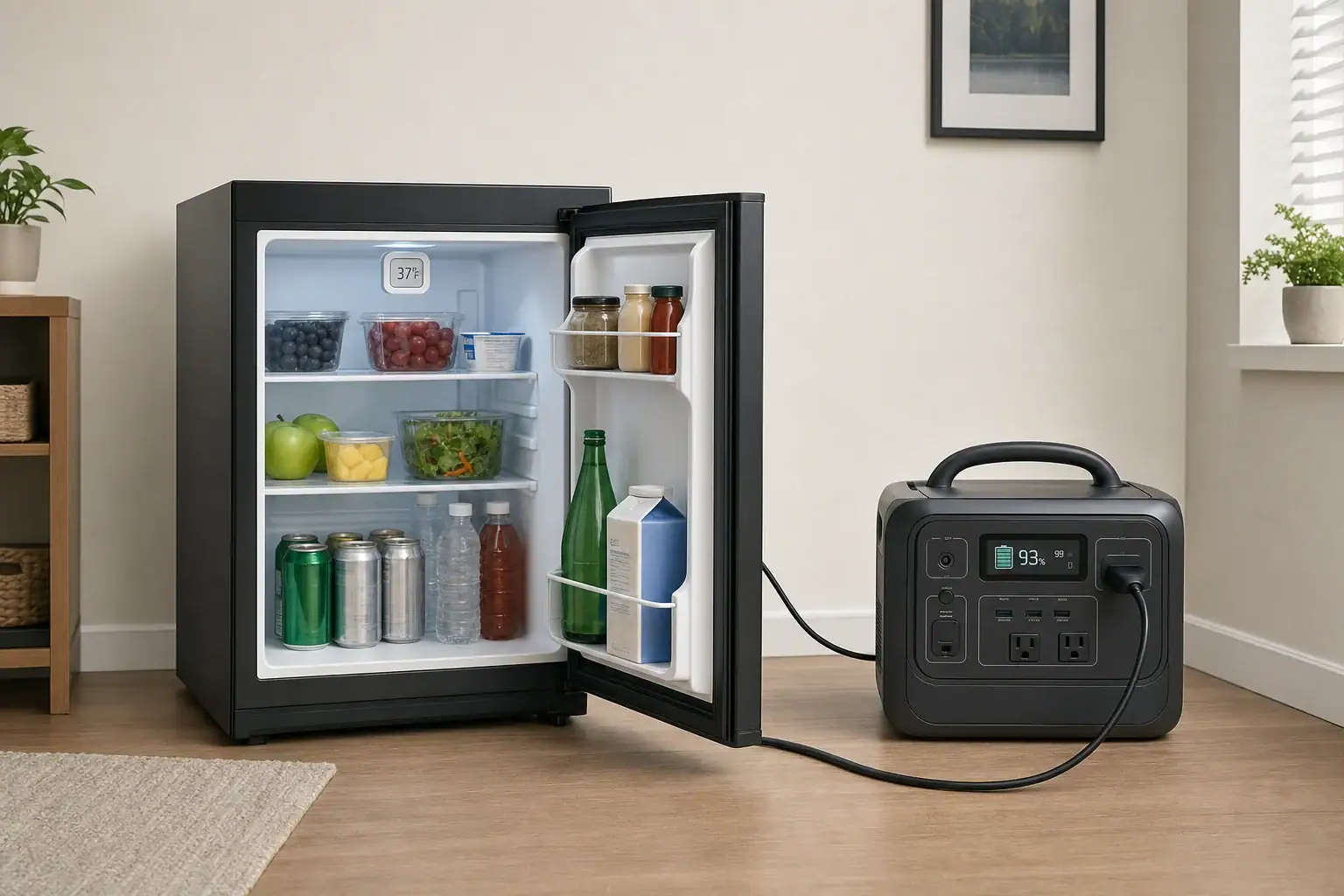
A portable power station can run a mini fridge if its inverter supports both the fridge’s running wattage and its brief compressor-starting surge. Runtime depends mainly on the station’s watt-hour capacity and the fridge’s actual energy consumption—not simply the wattage printed on the fridge label.
For a practical estimate, convert the fridge’s daily energy use to average watts, account for AC conversion losses, and then compare the result with the power station’s usable capacity. Leave additional capacity for hot weather, frequent door opening, battery aging, and other variables.
How to estimate mini-fridge runtime
The most useful input is the refrigerator’s measured or published energy consumption in watt-hours per day or kilowatt-hours per year. A compressor fridge cycles on and off, so its nameplate wattage usually represents power while operating rather than its average draw over a full day.
Using daily energy consumption
Estimate runtime with this formula:
Runtime in hours = usable AC energy ÷ average fridge watts
Calculate the two values as follows:
- Usable AC energy: power-station capacity in watt-hours × assumed AC efficiency.
- Average fridge watts: watt-hours consumed per day ÷ 24.
AC efficiency varies with the inverter, load, temperature, and battery state. For planning purposes, an illustrative assumption of 80% to 90% may be reasonable, but the power-station manufacturer’s data should take priority. Keeping a reserve rather than planning to reach 0% also provides a more conservative result.
For example, suppose a power station is rated at 500 Wh and you assume 85% reaches the fridge through the AC outlet:
500 Wh × 0.85 = 425 Wh of estimated usable AC energy
| Fridge energy use | Average load | Estimated runtime |
|---|---|---|
| 300 Wh/day | 12.5 W | About 34 hours |
| 600 Wh/day | 25 W | About 17 hours |
| 1,000 Wh/day | 41.7 W | About 10 hours |
These are planning estimates, not guaranteed runtimes. A warm fridge that has just been loaded may run continuously for a while, reducing runtime substantially.
Using an annual energy figure
If the refrigerator documentation lists kilowatt-hours per year, convert it to daily use:
Annual kWh × 1,000 ÷ 365 = estimated Wh/day
For example, 220 kWh per year equals about 603 Wh per day under the conditions used for that published estimate. Real consumption can differ because of room temperature, thermostat setting, ventilation, food load, door opening, and frost buildup.
Using running watts when no energy figure is available
Dividing battery capacity by the fridge’s running watts gives a conservative continuous-operation estimate, but it does not account for normal compressor cycling. A plug-in energy meter can provide a more useful 24-hour consumption figure if its ratings and instructions permit use with the refrigerator.
Why compressor surge matters
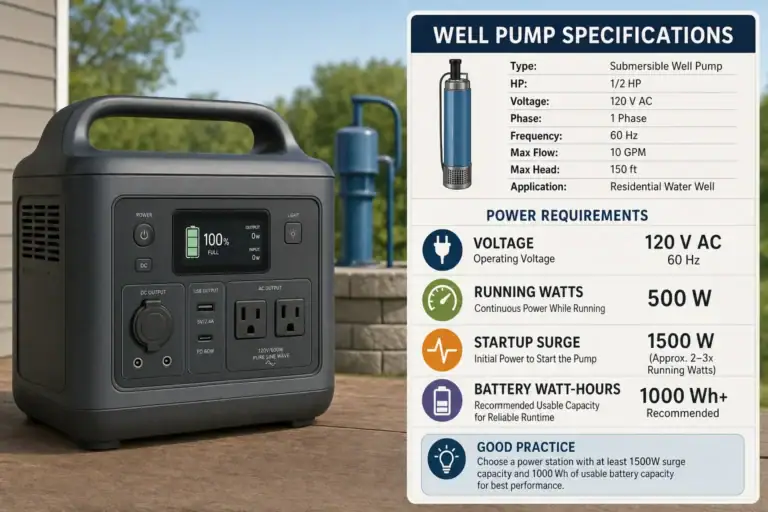
A compressor motor can draw substantially more power for a brief period when it starts than it uses while running. The power station therefore has two relevant inverter ratings:
- Continuous output: the sustained power available while the compressor is running.
- Surge or peak output: the short-duration output available during startup.
The fridge nameplate may show rated current or running watts without identifying the startup peak. Do not assume a universal surge multiplier: compressor design, starting components, voltage, temperature, and restart timing all affect the peak. Check the refrigerator manufacturer’s specifications or obtain appropriate startup-current data when possible.
The station’s continuous rating should exceed the fridge’s running requirement plus any simultaneous loads. Its surge rating and permitted surge duration must also cover the compressor’s startup demand. Two products may advertise the same peak wattage but support that peak for different lengths of time, so consult the current manufacturer documentation.
Thermoelectric mini coolers behave differently because they generally do not have a compressor-starting surge. However, they may run nearly continuously, so a modest wattage can still consume significant energy over a day.
Compatibility checklist
- The power station’s AC voltage and frequency match the refrigerator’s requirements.
- Continuous inverter output exceeds the total sustained load.
- Surge output is adequate for compressor startup.
- The inverter waveform meets the refrigerator manufacturer’s requirements.
- Estimated usable watt-hours provide the needed runtime with a reserve.
- The AC outlet and any permitted cable are rated for the appliance load.
Do not treat a watt-hour rating as an inverter-power rating. Capacity in Wh indicates stored energy; output in W indicates how much power the inverter can deliver at one time. A large-capacity station can still be incompatible if its inverter cannot start the compressor.
Setup tips for longer, more reliable operation
- Pre-chill the refrigerator on normal utility power. Cooling a warm interior requires much more energy than maintaining an already-cold compartment.
- Charge the power station beforehand. Confirm its state of charge and enable its AC output before relying on it.
- Connect the fridge directly when practical. Avoid power strips and daisy-chained cables. If an extension cord is necessary and permitted by both manufacturers, use one properly rated for the appliance and environment.
- Provide ventilation. Keep the fridge’s condenser area and the power station’s air inlets and outlets unobstructed. Do not place either unit in a sealed cabinet.
- Keep equipment dry and stable. Protect the station and connections from liquids, condensation, heat sources, and impact.
- Limit door opening. Organize contents in advance so cold air is not repeatedly lost.
- Check power-saving behavior. Some stations shut off AC output when a cycling appliance draws little or no power. If the manual provides an appropriate always-on or low-load setting, use it as directed.
- Monitor temperature. A refrigerator thermometer helps show whether food remains adequately cold. Follow current public-health guidance for food temperatures and disposal after an outage.
If the fridge will not start or keeps shutting down
An immediate overload warning usually points to startup surge, excessive combined load, or inverter incompatibility. Disconnect other loads and compare the fridge’s requirements with both the continuous and surge specifications. Do not repeatedly force restart attempts if either device reports a fault.
If the fridge starts but the station later turns off, check for a low-load shutdown setting, depleted battery, blocked ventilation, high temperature, or an overloaded outlet. Some compressors also have a protective delay before restarting after power is interrupted; follow the refrigerator manual rather than rapidly switching power off and on.
Pass-through charging does not automatically make a power station an uninterruptible power supply. Transfer behavior, interruption time, output limits, and charging restrictions vary. Use that arrangement only when the current manufacturer instructions explicitly support the intended appliance and configuration.
Bottom line
Size a portable power station from the mini fridge’s daily energy consumption, then separately verify the inverter’s continuous and surge ratings. Include conversion losses and a reserve, start with a cold refrigerator, maintain ventilation, and confirm that low-load power-saving features will not switch off the cycling compressor. Keep the setup isolated from household wiring; never connect a portable power station to a home panel or attempt to backfeed a circuit.
Related guides
Browse this topic →
- Beginner-friendly sizing, runtime & specs
- Solar & charging (MPPT, fast charging, cables)
- Batteries (LiFePO4, cycles, care & storage)
- Safety, cold-weather performance, real-world tips
More in Home / Appliances
See all →Keep reading
About this site
Portable Energy Lab publishes practical, independent guides about portable power—clear sizing, safe use, and real-world expectations.
Affiliate disclosure
Some links on this site may be affiliate links. If you buy through these links, we may earn a small commission at no extra cost to you. This helps support our content. Read our affiliate disclosure.