
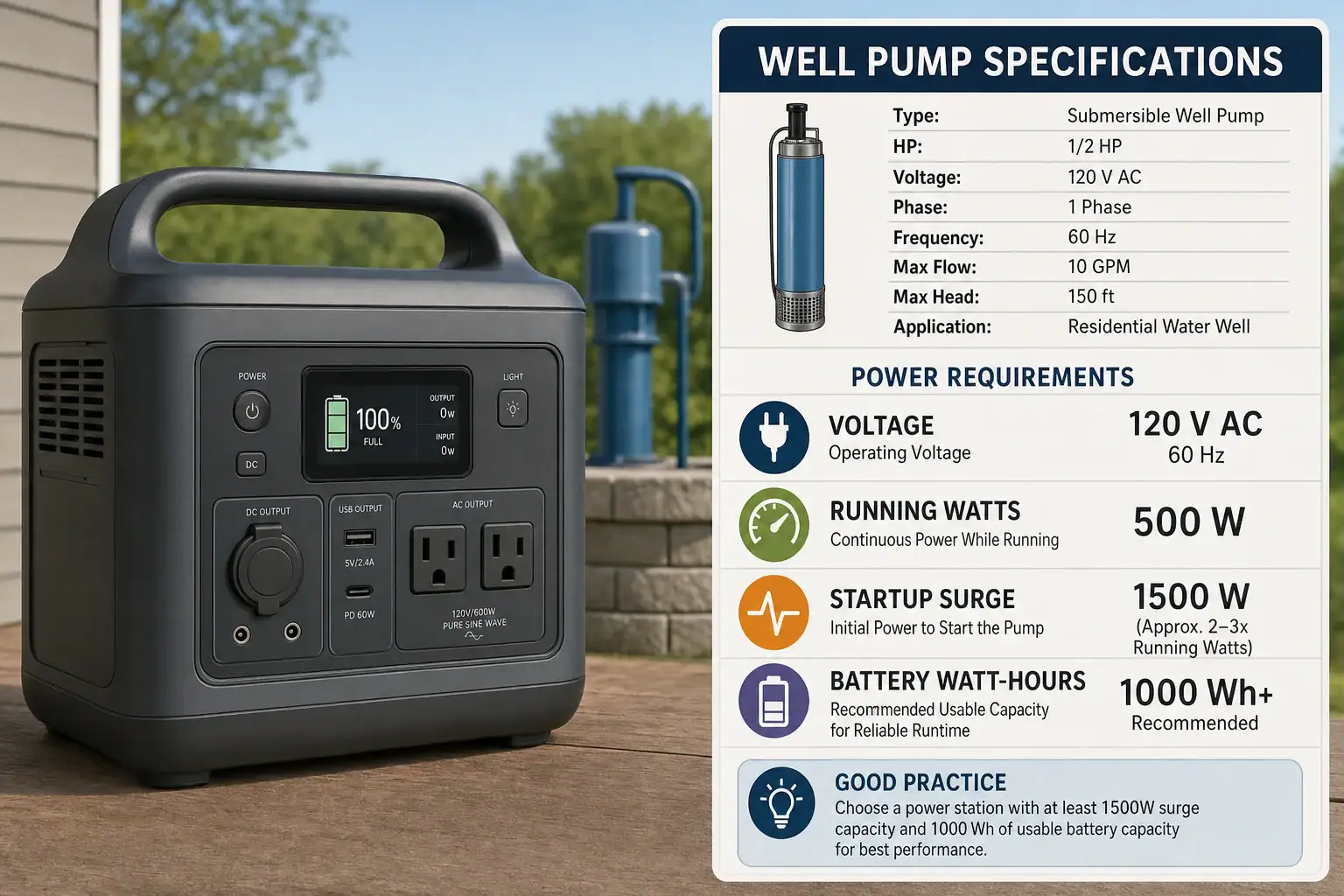
Choose a portable power station that matches the well pump’s voltage and frequency, supplies more than its continuous running load, and can sustain its full startup surge. Battery capacity then determines runtime. A pump that uses 1,000 watts while running and needs 3,000 watts at startup requires an inverter rated above 1,000 watts continuously and at least 3,000 watts for the required starting duration.
For runtime, divide the station’s usable AC energy by the pump’s average load. A 2,000-watt-hour station does not normally deliver all 2,000 Wh through its AC outlets because some capacity may be reserved and some energy is lost in the inverter. Voltage compatibility comes first: a high-capacity 120-volt station cannot operate a 240-volt pump merely because its watt rating appears sufficient.
Start With the Pump’s Electrical Requirements
Do not size from horsepower alone. Horsepower describes mechanical output, while portable power stations must handle the motor’s electrical input and starting current. Pumps with the same horsepower can have different voltage, running-current, and startup requirements.
Use the pump or controller manufacturer’s documentation and an accessible nameplate to identify:
- Required AC voltage, such as 120 or 240 volts
- Frequency, usually stated in hertz
- Single-phase or other phase requirement
- Running watts or full-load current
- Starting watts, starting current, or locked-rotor amps
- Any waveform or power-quality requirements for electronic controls
If starting information is unavailable, contact the pump manufacturer or have a qualified electrician obtain appropriate inrush data without opening or modifying the equipment yourself. Multiplying volts by amps gives volt-amps, not necessarily true watts, because an AC motor’s power factor affects the relationship. Manufacturer-provided running and starting specifications are preferable.
Continuous Output and Startup Surge Are Different
The power station has to meet two separate inverter requirements:
- Continuous output: The power it can supply for the entire time the pump runs.
- Surge output: The short burst available while the motor starts.
Leave continuous-output headroom instead of selecting an inverter whose rating exactly equals the pump’s stated running watts. Account for the pump controller and any other device powered at the same time. Operating pressure, water depth, motor design, supply voltage, and control equipment can all affect demand.
Surge ratings also vary by manufacturer. One station may support its advertised surge for several seconds, while another may allow it only briefly or may use a voltage-reducing mode that is unsuitable for some motors. Confirm that the surge rating applies at the pump’s required voltage and lasts long enough for that specific motor to start. A large watt-hour battery does not compensate for an inverter that trips during startup.
Illustrative Surge Example
Suppose a pump requires 240 volts, draws 1,000 watts while running, and has a 3,000-watt startup requirement. A compatible station would need:
- A genuine 240-volt output with the correct frequency and phase
- Continuous output comfortably above 1,000 watts
- Surge output of at least 3,000 watts for the specified starting interval
- An output receptacle and current rating suitable for the intended direct connection
Two ordinary 120-volt outlets must never be combined to create 240 volts. Likewise, an adapter cannot convert a 120-volt inverter into a proper 240-volt source.
Calculate Battery Capacity and Runtime
For a pump that runs continuously, use this planning formula:
Runtime in hours = rated battery Wh × usable fraction × AC efficiency ÷ running watts
The usable fraction represents capacity the station actually makes available before shutdown. AC efficiency accounts for inverter losses. Use manufacturer-supplied usable AC energy when available; otherwise, any percentages used are planning assumptions rather than guaranteed performance.
Illustrative Continuous-Run Calculation
Assume a 2,000 Wh station, 90% usable capacity, 90% AC conversion efficiency, and a 1,000 W pump:
2,000 Wh × 0.90 × 0.90 ÷ 1,000 W = 1.62 hours
The resulting 1.62 hours is an idealized estimate. Actual runtime can differ because of temperature, battery state, motor load, controller consumption, inverter behavior, and manufacturer-specific capacity reserves.
Account for an Intermittent Pump Duty Cycle
Many pressure-tank systems run only part of the time. Estimate the average load with:
Average pump load = running watts × duty cycle
If the illustrative 1,000 W pump runs 25% of the time, its average pump load is 250 W. Using the same assumed 1,620 Wh of usable AC energy:
1,620 Wh ÷ 250 W = 6.48 elapsed hours
This estimate assumes the 25% duty cycle continues throughout the outage. Actual water use, pressure-tank condition, well recovery, and pump controls can change that percentage. Repeated starts may also cause shutdown even when the average-energy calculation suggests sufficient runtime, so surge compatibility must still be checked separately.
Voltage and Connection Can Rule Out a Power Station
Many submersible well pumps are hardwired, and many operate at 240 volts. This guide applies only when the pump is designed for a direct connection to a compatible portable source under its manufacturer’s instructions. Do not backfeed a receptacle, improvise a cord, combine outputs, or connect a portable power station to a home electrical panel.
A hardwired pump requires a backup arrangement specifically designed for the installation. Any such design should be evaluated by a qualified electrician under the equipment instructions and current local electrical requirements. Do not assume that a station’s outlet, advertised voltage, or grounding arrangement makes it appropriate for permanent wiring.
Practical Compatibility Checklist
- The station’s AC voltage, frequency, and phase exactly match the pump and controller.
- Continuous inverter output exceeds the pump’s maximum running demand with reasonable headroom.
- Surge output meets the motor’s starting requirement for the necessary duration.
- The battery has enough usable AC watt-hours for the expected duty cycle and outage length.
- The waveform and power quality satisfy the pump or electronic controller manufacturer’s instructions.
- The individual receptacle and output circuit can supply the required current; do not rely only on the station’s combined watt rating.
- The proposed connection is explicitly permitted by both equipment manufacturers and does not involve home-panel backfeeding or improvised wiring.
The most reliable sizing process is therefore voltage first, inverter output second, and battery capacity third. If any one of those requirements is missing—especially the correct voltage or adequate startup surge—a larger watt-hour rating alone will not make the station compatible with the well pump.
Frequently asked questions
Can solar charging extend a power station’s well-pump runtime?
Solar charging can replace some energy while the station is operating, but the amount depends on the solar input, weather, panel setup, and the pump’s average energy use. Confirm the station’s supported solar input and charging limits in its current manufacturer instructions.
Should I test the power station with the well pump before an outage?
If the pump is designed for a permitted direct connection, a planned test can reveal whether the station starts and runs the actual load. Follow both manufacturers’ instructions, and use a qualified electrician for any hardwired or permanently installed pump arrangement.
Related guides
Browse this topic →
- Beginner-friendly sizing, runtime & specs
- Solar & charging (MPPT, fast charging, cables)
- Batteries (LiFePO4, cycles, care & storage)
- Safety, cold-weather performance, real-world tips
More in Home / Appliances
See all →Keep reading
About this site
Portable Energy Lab publishes practical, independent guides about portable power—clear sizing, safe use, and real-world expectations.
Affiliate disclosure
Some links on this site may be affiliate links. If you buy through these links, we may earn a small commission at no extra cost to you. This helps support our content. Read our affiliate disclosure.