
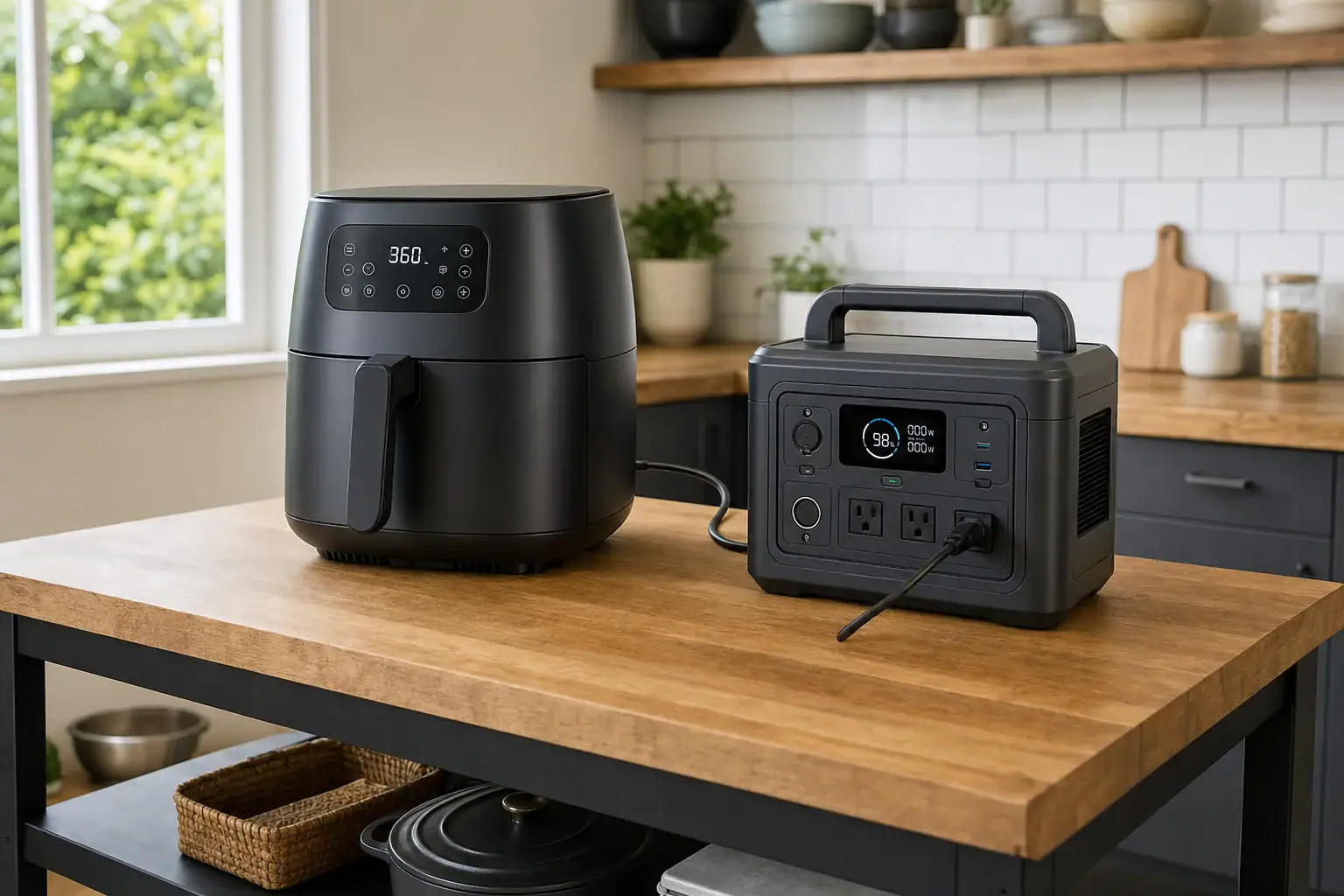
An air fryer can run on a power station if the station’s continuous AC output exceeds the fryer’s maximum input wattage. Many countertop air fryers are rated around 1,200 to 1,800 watts, but the appliance nameplate or manual is the authority. A 1,000-watt power station, for example, cannot reliably operate a 1,500-watt air fryer even if its battery has plenty of watt-hours.
For runtime, divide usable battery energy by the air fryer’s power draw. As a quick example, a 1,000-watt-hour power station running a 1,500-watt fryer may provide roughly 30 to 35 minutes of full-power operation after allowing for inverter losses and the station’s reserve. Actual cooking time can differ because the heating element may cycle on and off.
Match the air fryer to the AC output rating
Check the air fryer’s label or manual for its rated input in watts. If only volts and amps are listed, approximate watts with volts × amps, but use the manufacturer’s stated maximum input when available. Control electronics, the fan and the heating element can make a simple calculation less exact.
Next, compare that figure with the power station’s continuous AC output. The continuous rating—not the battery capacity and not the short-duration surge rating—determines whether the inverter can keep the fryer running.
- Continuous watts: The output the power station is designed to sustain under specified conditions.
- Surge watts: Short-duration capacity intended for startup peaks. It does not make an undersized continuous inverter suitable for a high-wattage fryer.
- Watt-hours: Stored energy used to estimate how long the load can run.
Air fryers are dominated by a resistive heating load, although the fan motor can create a brief startup increase. Choosing an inverter with some capacity above the appliance’s nameplate wattage reduces the chance of an overload shutdown. A margin of about 20% is a practical planning assumption, not a universal manufacturer requirement. Output capability may also be reduced by temperature, battery state of charge or model-specific operating limits.
Calculate estimated runtime
A useful planning formula is:
Runtime in minutes = battery capacity in Wh × usable fraction ÷ air fryer watts × 60
The usable fraction accounts for inverter conversion losses, the power station’s own consumption and any battery reserve enforced by its controls. If no model-specific AC energy figure is available, 0.80 to 0.90 can serve as an illustrative planning range. It is not a guaranteed efficiency rating.
The table below uses an 85% usable-energy assumption and assumes the air fryer draws its listed wattage continuously. Real results can be higher or lower.
| Battery capacity | 1,200 W fryer | 1,500 W fryer | 1,800 W fryer |
|---|---|---|---|
| 500 Wh | About 21 minutes | About 17 minutes | About 14 minutes |
| 1,000 Wh | About 43 minutes | About 34 minutes | About 28 minutes |
| 1,500 Wh | About 64 minutes | About 51 minutes | About 43 minutes |
Capacity alone does not establish compatibility. A 500 Wh power station might have enough energy for a short cooking cycle but still lack the continuous inverter output needed to start or run the fryer.
Estimate energy for one cooking cycle
Multiply watts by operating hours to estimate the AC energy required. A 1,500-watt air fryer used for 15 minutes has a conservative full-power estimate of:
1,500 W × 0.25 hours = 375 Wh of AC energy
With an 85% usable-energy assumption, the battery capacity needed would be approximately:
375 Wh ÷ 0.85 = 441 Wh
This estimate treats the fryer as drawing full rated power for the entire cycle. Thermostat cycling may reduce actual consumption, while preheating, added cooking time, a cold battery or other connected loads can increase the capacity required. For dependable planning, include preheat time and avoid counting on unverified cycling savings.
What to check before cooking
- Confirm the fryer’s maximum input wattage, voltage and frequency from its label or current manufacturer instructions.
- Verify that the station’s continuous AC rating exceeds that input, preferably with reasonable headroom.
- Calculate capacity from the total expected time, including preheating and any second cooking batch.
- Subtract energy reserved for other devices and account for the station’s current state of charge.
- Check the power station display during operation. An overload warning or shutdown indicates that the setup is not compatible under those conditions.
Use both appliances within their operating instructions
Place the air fryer on a stable, heat-resistant surface with the clearances required by its manufacturer. Keep the power station dry, ventilated and away from the fryer’s hot exhaust, grease and steam. Do not cover either device or operate it inside a closed compartment.
If an extension cord or power strip is being considered, follow the appliance and power-station manufacturers’ current instructions and use equipment rated for the full load. Pass-through operation—charging the station while powering the fryer—should be used only when the station manufacturer expressly permits it and its input, output and thermal limits can accommodate the load.
A portable power station should power the appliance through its normal AC receptacle. It is not a reason to modify the fryer, bypass protection features or connect the station to household wiring.
Bottom line
Size the inverter from the air fryer’s maximum watts and size the battery from the planned cooking time. For a 1,500-watt fryer, a station needs more than 1,500 watts of continuous AC output, while a 1,000 Wh battery offers roughly half an hour of conservative full-power runtime after typical conversion losses. The exact result depends on the two manufacturers’ specifications, battery conditions and how often the fryer’s heating element cycles.
Related guides
Browse this topic →
- Beginner-friendly sizing, runtime & specs
- Solar & charging (MPPT, fast charging, cables)
- Batteries (LiFePO4, cycles, care & storage)
- Safety, cold-weather performance, real-world tips
More in Home / Appliances
See all →Keep reading
About this site
Portable Energy Lab publishes practical, independent guides about portable power—clear sizing, safe use, and real-world expectations.
Affiliate disclosure
Some links on this site may be affiliate links. If you buy through these links, we may earn a small commission at no extra cost to you. This helps support our content. Read our affiliate disclosure.