
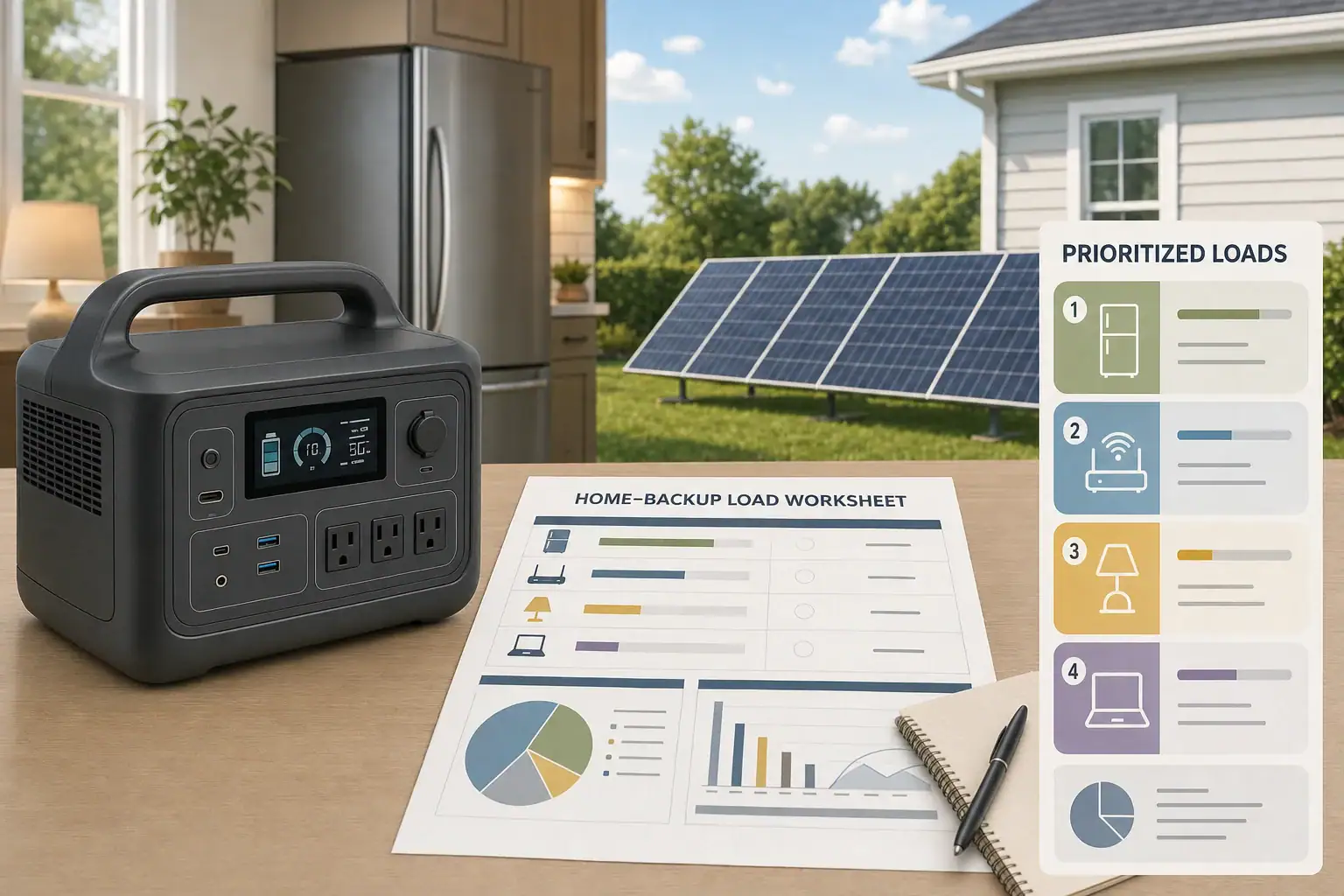
Quick answer: To size a solar generator for home backup, total priority-load watt-hours per day, verify simultaneous running watts and the largest startup event, then compare required usable battery energy with documented specifications. Finally, estimate relevant-season solar production and confirm that the proposed array stays within every PV input limit.
Size the battery, inverter, and solar array separately
A solar generator for home backup is typically a battery power station, inverter, solar charge controller, and compatible solar panels. It must pass three separate checks:
- Inverter power: Can it run the loads that will operate together and handle the largest startup event?
- Battery energy: Can it deliver enough energy for the priority loads during the planned outage period?
- Solar replacement: Can the allowed panel array replace the energy used during the relevant season?
Do not select a system from its rated battery capacity alone. A large battery can be paired with an inverter that cannot start a needed appliance, and a high-output inverter can drain a small battery quickly. Solar input can be the limiting factor even when the battery and inverter are adequate.
The U.S. Energy Information Administration explains that watts (W) measure power at a moment, while watt-hours (Wh) measure energy used over time. Use W for inverter and startup checks; use Wh for runtime and solar-replacement planning.
Build a priority-load worksheet
Plan for outage priorities rather than every electrical load in the home. Common priorities can include refrigeration, communications, lighting, computers, device charging, and selected accessibility equipment. Heating, air conditioning, cooking equipment, pumps, and other high-power loads deserve separate review because they can dominate both power and energy requirements.
Use an appliance label, manufacturer documentation, or a compatible plug-in energy meter where appropriate. For cycling equipment such as a refrigerator, measured Wh over a representative day is generally more useful than multiplying a nameplate maximum by 24 hours. Have a qualified professional assess hardwired equipment; do not open panels or exposed electrical equipment to measure loads.
| Priority load | Data source | Running W | Startup W | Hours/day or measured Wh/day | Priority |
|---|---|---|---|---|---|
| Refrigerator or freezer | Manual / meter | _____ | _____ | _____ | Must run / optional |
| Internet equipment | Label / meter | _____ | _____ | _____ | Must run / optional |
| Lighting | Label / meter | _____ | _____ | _____ | Must run / optional |
| Other priority load | Label / manual / meter | _____ | _____ | _____ | Must run / optional |
For a reasonably steady load, calculate:
Daily energy (Wh) = watts × hours used per day
Use measured daily Wh where practical for equipment whose draw changes during normal operation. Avoid generic appliance-wattage charts when you can obtain data for the actual appliance.
Calculate battery capacity for home backup
Add the daily Wh for all priority loads and multiply by the number of backup days required. This is the energy required at the outlets before accounting for the power station’s delivery characteristics and any reserve you choose to retain.
Rated battery Wh is not automatically the same as usable AC energy. Conversion losses, battery-management limits, inverter standby consumption, temperature, load level, and wiring can affect delivered energy. Prefer a candidate product’s documented usable-energy or runtime information. If it does not provide suitable documentation, clearly identify any planning factor as an assumption and compare more than one scenario.
A transparent planning equation is:
Required rated battery Wh = daily load Wh × backup days ÷ (delivered-energy fraction × usable share after reserve)
Do not apply a separate conversion factor if a manufacturer’s usable-energy figure already incorporates the same losses. For background on this distinction, see usable capacity versus advertised capacity.
Illustrative battery calculation
The following numbers are hypothetical worksheet inputs, not default appliance consumption values:
- Refrigerator measured energy: 1,200 Wh/day
- Router: 15 W × 24 hours = 360 Wh/day
- Four lamps: 4 × 9 W × 5 hours = 180 Wh/day
- Laptop: 60 W × 4 hours = 240 Wh/day
Total daily load: 1,980 Wh/day
Assume, only for this example, an 0.85 delivered-energy fraction and a 10% retained reserve, leaving a usable share of 0.90:
1,980 Wh ÷ (0.85 × 0.90) = 2,588 Wh rated battery target
Under those stated assumptions, a candidate below 2,588 Wh would not meet one day of this load plan. A larger candidate still must pass the inverter and solar checks.
Check continuous output and startup demand
Continuous inverter output must equal or exceed the running watts of every load likely to operate at the same time. Scheduling discretionary loads separately can reduce this requirement only when that schedule is realistic during an outage.
Motors and compressors can need more power while starting than while running. Use manufacturer information or a compatible measurement where available. A useful check is:
Startup requirement = largest documented or measured startup W + running W of other simultaneous loads
For example, suppose a compatible measurement shows a 900 W refrigerator startup event while a 15 W router, four 9 W lamps, and a 60 W laptop are operating:
900 W + 15 W + 36 W + 60 W = 1,011 W
The candidate must support that event under the manufacturer’s stated conditions. Check both the surge wattage and the permitted surge duration; a brief peak rating may not support a longer starting event. The refrigerator’s normal running watts are also needed for the continuous-output calculation. See surge watts versus running watts for a separate explanation.
Capacity and wattage alone do not establish compatibility with 240 V equipment such as some air conditioners, pumps, ranges, or dryers. Confirm voltage, frequency, outlet configuration, neutral requirements, startup behavior, and approved integration requirements in the equipment documentation.
Test whether solar can replace daily use
Solar is the bottleneck when the energy accepted from the array cannot replace the energy used by the priority loads. Test production for the outage season that matters, rather than relying only on an annual average.
- Start with daily priority-load consumption in Wh.
- Add only documented losses or clearly labeled planning assumptions.
- Estimate production for the location and relevant month.
- Confirm panel open-circuit voltage, operating voltage, current, and total wattage against every power-station PV input limit.
- Confirm whether the station supports charging while powering loads if that behavior is part of the backup plan.
NREL’s PVWatts Calculator estimates PV production using inputs such as location, array size, orientation, tilt, and system losses. It is useful for screening seasonal solar resources. However, PVWatts models grid-connected PV, not the specific charging behavior of a portable power station. Its technical documentation describes modeled output as an estimate based on representative weather, not a guarantee for a particular outage day.
Illustrative solar replacement check
Continue the hypothetical 1,980 Wh/day load plan and assume a 600 W panel array. If an 0.85 end-to-end solar-delivery factor is used solely as an illustrative assumption, the array would need to collect:
1,980 Wh ÷ 0.85 = 2,329 Wh/day
The equivalent time at the array’s full 600 W rating would be:
2,329 Wh ÷ 600 W = 3.88 equivalent full-output hours
This is only a screening calculation, not a recharge promise. Weather, shade, panel temperature, orientation, cable losses, charging behavior, and the station’s input limits affect results. Do not duplicate losses already included in a solar-production model. Read the station manual alongside PV voltage, current, and wattage limits before connecting an array.
Use this solar generator decision table
| Check | Your input | Required system value or condition |
|---|---|---|
| Daily energy | _____ Wh/day × _____ days | Enough documented usable energy for the load plan |
| Rated battery target | Delivered-energy factor: _____; usable share after reserve: _____ | Rated capacity at or above calculated target |
| Simultaneous load | _____ W | Continuous AC output at or above _____ W |
| Largest startup event | _____ W for _____ seconds | Surge rating and duration meet the requirement |
| Relevant-month solar | _____ Wh/day estimated | Production meets or exceeds daily replacement target |
| PV interface | Array _____ V / _____ A / _____ W | Within every station input limit |
| Home connection | Direct outlets / approved integration | Correct manufacturer-approved connection method |
Choose a safe way to connect loads
For direct use, connect compatible loads to the power station’s outlets according to its manual. Follow outlet ratings, ventilation clearances, temperature limits, and moisture restrictions. Never use a male-to-male cord or connect a power station to a household receptacle to energize home wiring.
Panel-connected backup requires equipment designed, listed, and approved for that configuration, along with installation that follows applicable requirements. UL states that UL 2743 covers portable power packs, while stationary residential energy-storage systems fall under the different UL 9540 scope. A portable product listing alone does not establish approval for a stationary, panel-connected home system. Use manufacturer-approved integration equipment and a qualified electrician; do not improvise panel wiring. See UL’s portable power pack guidance and this guide to safe transfer-switch alternatives.
Do not assume a general-purpose power station is suitable backup for medical equipment. Obtain device-specific guidance from the medical-device manufacturer and an appropriate medical or electrical professional, including requirements for power quality, alarms, runtime, and redundancy.
Make the decision from the limiting constraint
A solar generator is adequately sized only when it passes all three tests: inverter power, usable battery energy, and seasonal solar replacement. If battery energy is short, reduce the load plan or add compatible capacity. If output is short, reschedule loads or select an appropriate inverter system. If seasonal solar production is short, additional battery can extend runtime but cannot create daily solar energy; the permitted array, solar resource, or load plan must change.
Related guides
Browse this topic →
- Beginner-friendly sizing, runtime & specs
- Solar & charging (MPPT, fast charging, cables)
- Batteries (LiFePO4, cycles, care & storage)
- Safety, cold-weather performance, real-world tips
More in Solar
See all →- Solar Generator With Panels Included: 7 Checks Before Buying
- Solar Panel Rated Watts vs. Real Charging Output
- How to Clean Portable Solar Panels Without Damage
- Solar Charging on Cloudy Days: What Output Can a Portable Power Station Expect?
- How Many Portable Solar Panels Do You Need for a 1,000Wh Power Station?
Keep reading
About this site
Portable Energy Lab publishes practical, independent guides about portable power—clear sizing, safe use, and real-world expectations.
Affiliate disclosure
Some links on this site may be affiliate links. If you buy through these links, we may earn a small commission at no extra cost to you. This helps support our content. Read our affiliate disclosure.