
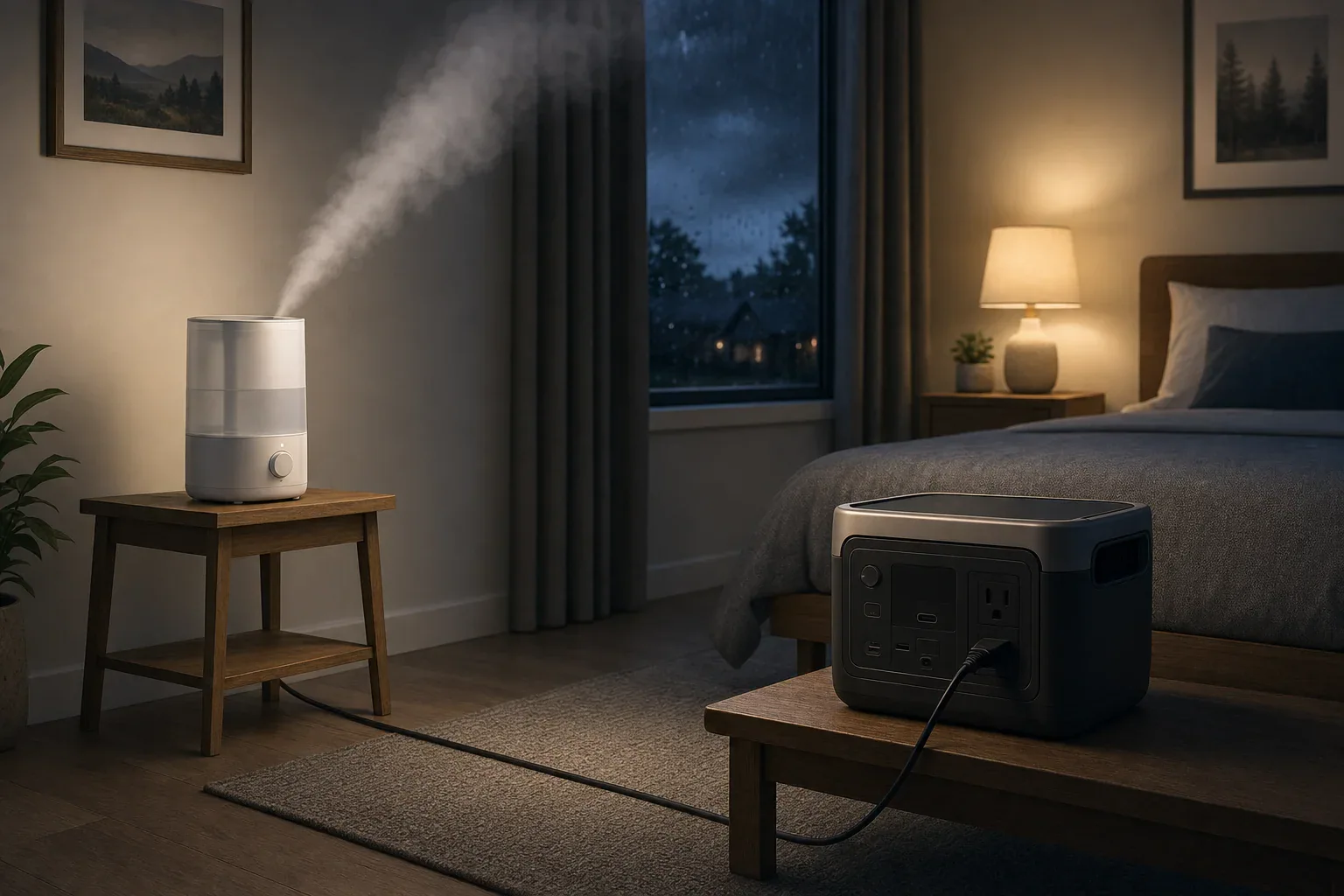
Quick answer: A portable power station can run a room humidifier when the humidifier’s maximum input is within the station’s continuous AC-output rating and its voltage matches. Estimate runtime by dividing usable AC watt-hours by measured average humidifier watts, adding inverter overhead only when that overhead is not already included.
How to size a portable power station for a humidifier
Check power compatibility first, then energy capacity. The humidifier’s maximum input in the intended mode must be within the station’s continuous AC-output rating. Confirm that the station output and appliance nameplate have compatible voltage, frequency, and plug requirements. Then use measured average energy use—not a generic humidifier wattage—to estimate runtime.
- Read the humidifier nameplate and manual for its electrical rating and intended modes.
- Confirm its maximum input is below the station’s continuous AC rating, not just a brief surge rating.
- Measure cumulative energy use over representative conditions and calculate average watts.
- Use manufacturer-provided usable AC watt-hours or relevant runtime data when available.
- Check the station manual for AC auto-shutoff and test whether the humidifier restarts after AC output is interrupted.
Do not assume every humidifier has the same startup behavior. A supervised test with the specific humidifier and power station is the practical compatibility check.
Watts, watt-hours, and runtime
Watts (W) are the power used at a moment. Watt-hours (Wh) are stored or delivered energy. For example, an appliance drawing 25W continuously for 10 hours uses 250Wh at its input.
The capacity printed on a power station is not automatically the energy delivered at its AC outlets. DC-to-AC conversion, operating reserves, and the inverter’s own consumption can reduce delivered energy. Use a manufacturer-provided usable-AC figure or applicable runtime information when available; otherwise, treat any estimated usable-energy percentage as a planning assumption, not a universal efficiency. See usable capacity versus advertised capacity for the distinction.
Portable power station for humidifier runtime formula
For a humidifier that cycles or changes output, calculate average load from cumulative meter data:
Average humidifier W = measured kWh × 1,000 ÷ measurement hours
Then estimate runtime:
Runtime hours = usable AC Wh ÷ total average AC demand in W
Total average demand can include the humidifier and inverter overhead. Add a separate standby or inverter-consumption figure only when the usable-AC-energy figure does not already include it. Adding both to a controlled AC-discharge result can double-count the same loss.
A plug-in meter can help with this measurement. The P3 P4400 manual describes displays for watts, accumulated kWh, and powered duration; use the meter only within the ratings printed on its label. P3 International P4400 manual
Humidifier type affects the power check
| Type or control | Documented example | What to do |
|---|---|---|
| Ultrasonic cool mist | Vicks VUL525/VUL545: 120V, 60Hz, 25W rated. | At a small appliance load, inverter consumption may be a meaningful share of total demand. |
| Warm/cool hybrid | Levoit LV600HH: 120V, 60Hz, 280W rated power, with separate warm- and cool-mist controls. | Check the selected mode and size for the model’s maximum input; do not apply a cool-mist assumption to heated operation. |
| Humidistat or automatic mode | The LV600HH can stop misting at the selected humidity and restart after humidity falls. | Measure cumulative kWh over representative room conditions, including active and idle periods. |
| Variable mist setting | Settings vary by appliance. | Measure the exact setting planned for outage use. |
These are model-specific examples, not universal humidifier wattages. The Vicks manual documents the 25W rating for the named models, while the Levoit manual documents the LV600HH rating and controls. Vicks VUL525/VUL545 manual Levoit LV600HH manual
Why inverter standby draw can change the estimate
With a low-wattage appliance, energy used to keep AC output active can materially affect runtime. That overhead is station-specific. In separate support materials, Jackery describes approximately 12W of inverter consumption in one explanation and lists 25W standby consumption for another model. Those figures show why the manual or product documentation for the exact station matters; neither number should be transferred to another station. Jackery inverter-consumption explanation Jackery Explorer 2000 Plus information
Also check for an energy-saving or auto-shutoff setting. A station can turn off AC output when it treats a small or cycling load as inactive. Test a full humidistat pause-and-restart cycle before depending on the setup. See why power stations turn off automatically for the general issue.
Illustrative runtime calculation
This example is hypothetical and is not a measured result or a runtime promise for any product.
- Nominal station capacity: 512Wh
- Assumed usable AC energy: 85% of nominal capacity
- Humidifier measured average load: 25W
- Assumed station inverter overhead not included in the usable-energy estimate: 12W
First, calculate the assumed usable energy:
512Wh × 0.85 = 435Wh after rounding.
Then calculate total assumed average demand:
25W + 12W = 37W
Estimated runtime:
435Wh ÷ 37W = 11.8 hours
If inverter overhead were ignored, the result would be 435Wh ÷ 25W = 17.4 hours. The difference illustrates why low-load overhead is worth checking. The 85% factor and 12W overhead are assumptions for this example only.
How to measure a cycling humidifier
On normal utility power, connect the humidifier to a suitably rated plug-in energy meter. Set the mist level, heating mode, and humidity target you would use during an outage. Let it run long enough to include the expected cycling behavior, then record cumulative kWh and elapsed hours.
An instantaneous watt reading can identify active modes, but it may not represent long-term demand. Humidistat control can stop mist output, and automatic or heated modes can change consumption. Cumulative energy captures both active and inactive periods.
Measurement and manual-reading checklist
- Humidifier make, model, nameplate rating, and selected mode
- Instantaneous watts for each intended setting
- Cumulative kWh and elapsed time for a representative run
- Evidence of humidistat cycling or changing output
- Station continuous AC-output rating and compatible output specifications
- Station battery capacity, usable AC-energy information, and AC standby specification
- Low-load timeout or energy-saving behavior
- Humidifier behavior after AC output is removed and restored
- Water level and remaining station charge after a supervised trial
Water-tank duration and electrical runtime are separate limits. The humidifier may need a refill before the station is depleted, or the station may deplete while water remains.
Safe outage setup
Place the humidifier and portable power station on separate, stable, dry surfaces. Keep the station, outlets, plugs, and cord connections outside the humidifier’s mist path and away from a possible spill. Route the cord so it is not a trip hazard and follow both manufacturers’ placement instructions.
The U.S. Consumer Product Safety Commission advises keeping cord-connected products away from water, using appropriate GFCI protection where electrical equipment may contact water, avoiding overloaded outlets or power strips, and using undamaged extension cords of an appropriate rating. Its extension-cord guidance also says not to run cords beneath carpets or furniture. CPSC electrical safety guidance CPSC extension-cord safety alert
Before an outage, perform a supervised test. Confirm that the station supports the load without shutting down, the humidifier behaves as expected after an interruption, and the projected battery and water supply meet your intended duration. Stop using the setup if any plug, cable, or adapter is damaged, unusually hot, or wet.
Related guides
Browse this topic →
- Beginner-friendly sizing, runtime & specs
- Solar & charging (MPPT, fast charging, cables)
- Batteries (LiFePO4, cycles, care & storage)
- Safety, cold-weather performance, real-world tips
More in Home / Appliances
See all →Keep reading
About this site
Portable Energy Lab publishes practical, independent guides about portable power—clear sizing, safe use, and real-world expectations.
Affiliate disclosure
Some links on this site may be affiliate links. If you buy through these links, we may earn a small commission at no extra cost to you. This helps support our content. Read our affiliate disclosure.