
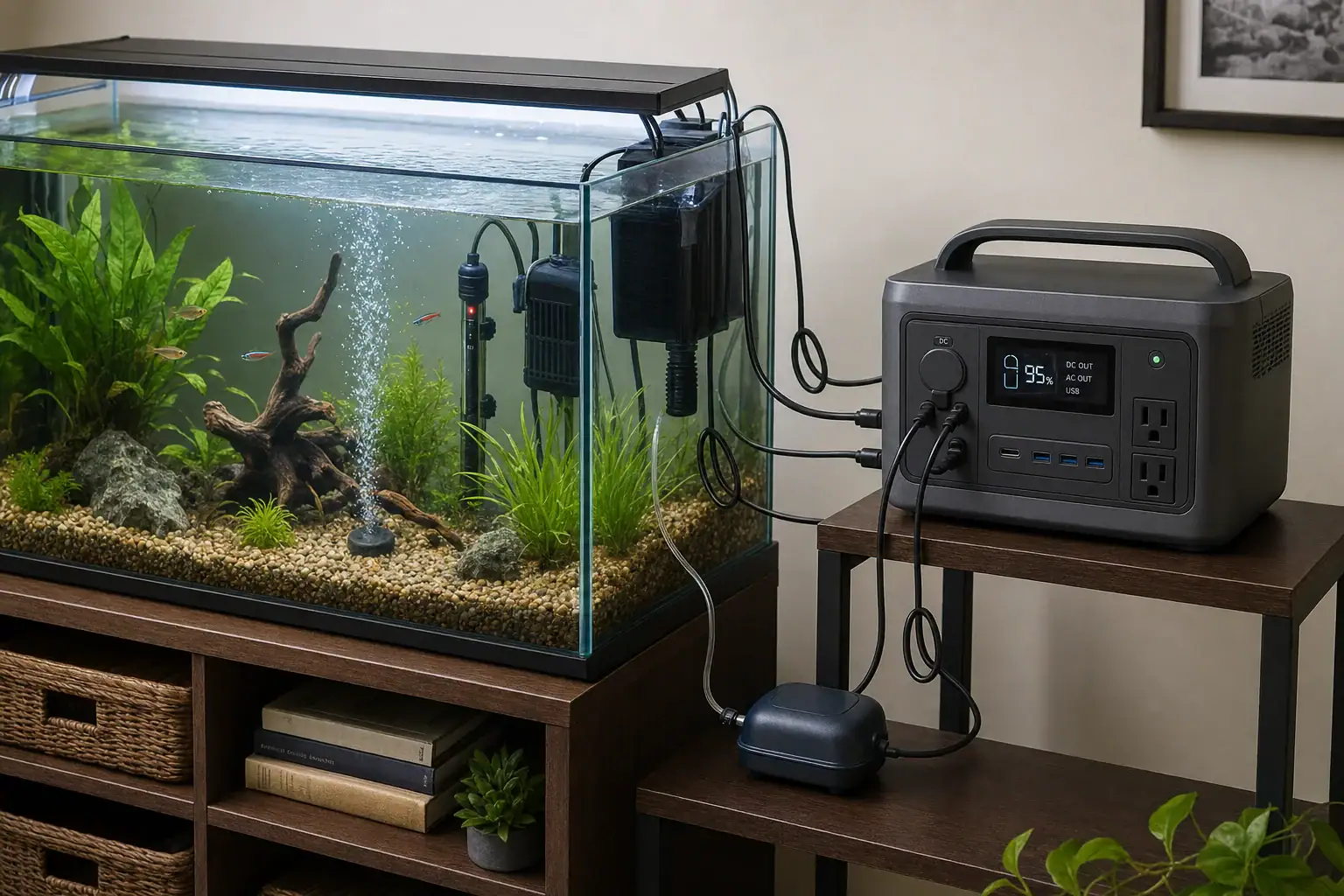
To keep an aquarium heater, filter, and air pump running, choose a portable power station based on both output watts and battery watt-hours. Its continuous output must support all connected equipment at once, while its surge rating must accommodate pump startup. Battery capacity then determines how long the system can run.
For runtime planning, add each device’s energy use over the expected outage and divide by an estimated AC efficiency. Heater cycling is the biggest uncertainty: a heater rated at 100 watts may run intermittently in normal conditions but nearly continuously as the room cools.
Calculate the aquarium’s backup-power requirement
Read the input wattage from the label or manual for the heater, filter pump, and air pump. If a device lists only amps, calculate approximate watts as volts multiplied by amps, but use the manufacturer’s stated input watts when available. Nameplate figures and actual consumption can differ.
Required battery capacity in watt-hours = total load energy ÷ estimated conversion efficiency
For a device that cycles, calculate its load energy as:
Rated watts × duty cycle × outage hours
A 50% heater duty cycle means the heater is assumed to run for half of each hour. This is only a planning assumption, not a guarantee. Tank size, room temperature, insulation, heater controls, livestock requirements, and the length of the outage all affect heater runtime.
Illustrative 10-hour calculation
| Equipment | Rated power | Assumed duty cycle | Energy for 10 hours |
|---|---|---|---|
| Heater | 100 W | 50% | 500 Wh |
| Filter | 15 W | 100% | 150 Wh |
| Air pump | 5 W | 100% | 50 Wh |
| Total delivered to equipment | 120 W maximum | 70 W average | 700 Wh |
Assuming 85% overall AC efficiency, the estimated station capacity is 700 Wh ÷ 0.85 = about 824 Wh. The 85% figure is illustrative. Inverter losses, the station’s own operating consumption, battery temperature, battery age, and manufacturer reserve settings can all change usable runtime.
For a colder worst case in which the 100-watt heater runs continuously, the same setup would consume 1,200 Wh over 10 hours. At 85% efficiency, that would require about 1,412 Wh of nominal capacity. This large difference is why heater duty cycle should not be treated as a fixed specification.
Check continuous output and startup surge
The example system has a maximum running load of 120 watts, so the station’s continuous AC rating must exceed 120 watts. Select additional headroom if other aquarium devices could be connected or equipment labels show higher maximum inputs.
Heaters are generally steady resistive loads, but filter and air-pump motors can draw extra power when starting. The surge magnitude and duration vary by motor design, and power-station manufacturers define surge capability differently. Compare the equipment manufacturer’s available startup information with both the station’s continuous rating and its stated surge conditions. Do not assume a large peak-watt number can be sustained for more than the period specified by the manufacturer.
Equipment may also restart simultaneously when the inverter turns on. Size for that possibility rather than assuming the pumps will start one at a time.
Account for usable capacity and low-power losses
A station’s advertised watt-hours may describe nominal battery capacity rather than energy available from its AC outlets. Battery management reserves and inverter losses reduce the amount delivered to aquarium equipment. If the manufacturer publishes usable AC energy under relevant conditions, use that figure instead of applying a generic efficiency estimate.
Inverter overhead matters especially when powering only a small air pump. A 5-watt load does not necessarily provide the runtime predicted by dividing nominal watt-hours by 5 watts, because the inverter itself also consumes energy. Manufacturer runtime data for comparable low loads can improve the estimate, although actual conditions will still vary.
Native DC operation may avoid some inverter loss, but only use it when the aquarium device is explicitly designed for the station’s output voltage, polarity, connector, and current range. Do not improvise adapters or connect an AC aquarium device directly to a DC port.
Prioritize loads if the outage outlasts the battery
The safest priority depends on the species, water temperature, stocking level, filtration design, and room conditions. In many tanks, aeration and water movement become urgent because dissolved oxygen can decline, while cold-sensitive livestock may also require uninterrupted heat. Seek species-specific guidance rather than relying on a universal order.
- Air pump: Often provides substantial oxygenation for relatively little power, provided the air stone and pump arrangement are appropriate for the tank.
- Filter or circulation pump: Supports water movement and biological filtration, but may consume more power than a small air pump.
- Heater: Usually the largest load. Its importance rises as the room and aquarium cool, particularly for temperature-sensitive livestock.
If capacity is limited, leave nonessential lights, decorative pumps, and unrelated electronics disconnected unless the animals or system specifically require them. Avoid allowing a filter to remain stagnant for a prolonged period and then restarting it without checking the filter manufacturer’s instructions; conditions inside an idle filter can deteriorate.
Aquarium-specific compatibility and safety
- Keep the power station dry, raised above floor-level water risks, and outside the aquarium’s splash zone. Maintain required ventilation clearance.
- Arrange cords with drip loops where appropriate, and never handle plugs, outlets, or the station with wet hands.
- Keep the heater submerged to the depth specified by its manufacturer. Follow its instructions before exposing, moving, or restarting it.
- Confirm that pumps restart and re-prime correctly after power loss. Some filters require manual priming, while sump systems must safely accommodate normal drain-down whenever the return pump stops.
- Do not defeat grounding pins, protective devices, or required ground-fault protection. Outlet and grounding designs vary, so follow the aquarium equipment and power-station manuals along with current local electrical guidance.
- Do not connect a portable power station to home wiring or an electrical panel. Power the aquarium equipment directly from approved station outlets and properly rated accessories.
Do not assume automatic backup operation
A portable power station is not automatically a certified uninterruptible power supply. Pass-through charging, transfer behavior, interruption time, and automatic recovery after depletion vary by model. Some units may turn off after a low-load period, while aquarium controllers or pumps may not restart after even a brief interruption.
For unattended operation, verify in the current manufacturer documentation that the station supports the intended backup mode and that every connected aquarium device automatically resumes safely. Stay within all charging, load, temperature, and placement requirements.
Bottom line
Add the heater’s duty-adjusted energy to the filter and air pump energy, divide by a realistic AC-efficiency assumption, and include capacity headroom for colder conditions and battery variability. Then confirm that the station’s continuous and surge ratings cover all devices starting together. Because the heater can dominate consumption, calculate both a normal cycling scenario and a conservative continuous-heating scenario before choosing capacity.
Related guides
Browse this topic →
- Beginner-friendly sizing, runtime & specs
- Solar & charging (MPPT, fast charging, cables)
- Batteries (LiFePO4, cycles, care & storage)
- Safety, cold-weather performance, real-world tips
More in Home / Appliances
See all →Keep reading
About this site
Portable Energy Lab publishes practical, independent guides about portable power—clear sizing, safe use, and real-world expectations.
Affiliate disclosure
Some links on this site may be affiliate links. If you buy through these links, we may earn a small commission at no extra cost to you. This helps support our content. Read our affiliate disclosure.