
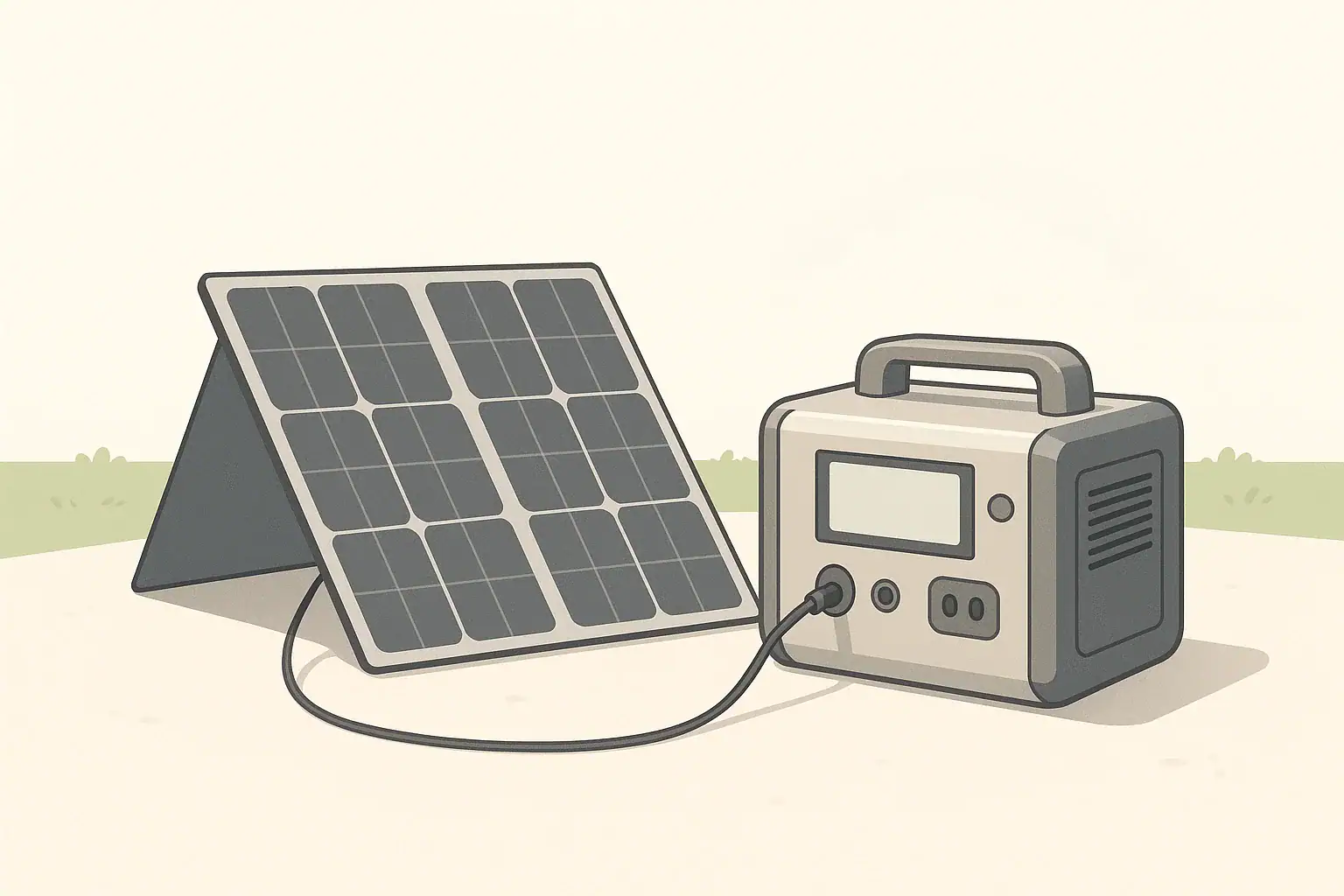
Why Solar Connectors Matter for Portable Power Stations
Portable power stations make it easy to use solar panels for camping, RVs, remote work, and short power outages. But solar panels and power stations do not always share the same plugs. Understanding common connector types and how to use adapters helps you charge safely and get the most from your solar setup.
This guide explains the most common low-voltage solar connectors you will see with portable power stations in the U.S.: MC4, Anderson-style, DC barrel plugs, and a few others. It focuses on how they relate to real-world use cases, not brand-specific systems.
We will cover:
- What MC4, Anderson, and DC barrel connectors are and where they are used
- How to choose compatible panels, cables, and adapters
- Basic safety limits and good practices for low-voltage solar wiring
- How connectors affect charging speed and system planning
Overview of Common Solar Connector Types
Most portable power station solar setups use 12–48 V DC. At these voltages, different connectors are chosen for convenience, current capacity, and weather resistance. Below are the main connector families you will encounter.
MC4 Connectors
MC4 is the de facto standard connector for many rigid and foldable solar panels. MC4 connectors are:
- Weather-resistant: Designed for outdoor use on solar panels.
- Locking: They click together so they do not separate accidentally.
- Polarized: One side is positive and the other negative, helping prevent reverse polarity connections.
Panels with MC4 leads usually connect to a portable power station using an adapter cable, such as MC4 to DC barrel or MC4 to Anderson-style, depending on the power station’s input port.
Anderson-Style Connectors
Anderson-style connectors (often two flat contacts in a colored housing) are common in DC power systems and some higher-current solar connections. For portable power station use, they are typically:
- High-current capable: Suitable for higher wattage inputs where a small barrel connector might be undersized.
- Genderless: Many Anderson housings are mated with identical pieces, simplifying connections.
- Used for modular setups: You may see them between panels, extension cables, or between a combiner and the power station.
Portable power stations that accept Anderson-style inputs often provide a dedicated high-current solar input. Panels may then connect via MC4-to-Anderson or other adapter cables.
DC Barrel Connectors
DC barrel connectors are the round plug-and-sleeve style jacks commonly found on laptop chargers and many portable power stations. Their key traits are:
- Compact size: Convenient for smaller systems and lower solar input power.
- Many sizes: Different inner and outer diameters require the correct matching plug.
- Polarity and voltage sensitive: The center pin is usually positive, but you must confirm with the device documentation.
Solar panels do not usually come with DC barrel plugs directly attached. Instead, an adapter converts from MC4 or another connector type to the barrel size your power station uses.
Other Low-Voltage Solar Connectors You May See
Beyond MC4, Anderson-style, and DC barrel plugs, you may encounter:
- 8 mm or proprietary round ports: Functionally similar to DC barrel but with a brand-specific size or pin layout.
- Automotive 12 V sockets: Panels or charge cables terminating in a plug for an automotive-style 12 V outlet on a power station.
- Terminal blocks or ring terminals: Used on some charge controllers and distribution panels, less common directly on portable power stations.
In most portable use cases, you will be converting from panel MC4 leads into whatever input style your power station accepts.
Example values for illustration.
| What to check | Why it matters | Notes |
|---|---|---|
| Connector type on solar panel (e.g., MC4) | Determines which adapter cable you need | Match panel leads to power station input style |
| Connector type on power station (barrel, Anderson-style) | Prevents incompatible or loose connections | Confirm size and polarity in the manual |
| Maximum input voltage rating of power station | Avoids over-voltage damage to electronics | Example: 12–30 V DC or similar range |
| Maximum input current / watts | Ensures connectors and cables are sized correctly | Choose wiring that comfortably exceeds expected current |
| Cable length and gauge | Long or thin cables cause voltage drop and heat | Shorter, thicker cables generally perform better |
| Weather exposure | Outdoor connectors should resist moisture and UV | MC4-style is common for outdoor panel leads |
| Locking or strain relief features | Reduces accidental unplugging or wire damage | Useful in wind, RV, or mobile setups |
MC4 Connectors in Detail
Because so many solar panels use MC4 leads, understanding their behavior helps you design safer, more reliable setups.
Polarity and Panel Leads
Each panel typically has two MC4 leads:
- One for positive (+)
- One for negative (−)
The connectors are keyed so the positive only mates with the correct counterpart and the negative with its own counterpart. Despite this, you should still verify polarity on adapter cables, particularly if they were assembled by hand.
Series and Parallel Panel Connections
MC4 connectors allow simple series or parallel wiring between compatible panels. However, when working with portable power stations, do not exceed the station’s rated solar input voltage or current.
- Series (voltage adds): Two panels in series roughly double the voltage while current stays similar.
- Parallel (current adds): Two panels in parallel keep the voltage similar while current roughly doubles.
Before combining panels, check the maximum DC input voltage and current limit of your power station. Stay under both limits with some safety margin, and follow the panel and device documentation. If you are unsure how to calculate combined voltage and current safely, seek advice from a qualified solar professional.
Extending MC4 Cables
Extension cables with MC4 ends are widely available. When extending runs between panels and your power station:
- Keep cable runs as short as practical to reduce voltage drop.
- Use appropriate wire gauge for the expected current and length.
- Route cables to avoid trip hazards, sharp edges, and pinching points.
Because MC4 connections are often outdoors, ensure each connection is fully seated and latched to minimize moisture ingress.
Anderson-Style Connectors in Portable Solar Setups
Anderson-style connectors are popular in hobbyist, RV, and off-grid systems, and occasionally appear on portable power stations as a higher-current DC input or output.
Why Anderson-Style Is Common for Higher Power
Compared to many barrel connectors, Anderson-style connectors:
- Offer more robust contact area for higher currents.
- Can be easier to connect and disconnect while wearing gloves.
- Are often used for modular components such as extension leads, distribution blocks, and portable solar combiner boxes.
These traits make them useful when your solar array feeds more than a small trickle charge, such as when using multiple portable panels or operating in an RV where higher power is common.
Using Anderson Inputs on Power Stations
If your power station provides an Anderson-style solar input, it usually operates in the same voltage range as its other DC solar ports. The difference is the connector’s physical capacity and ease of connection.
Typical use cases include:
- Connecting a combiner that joins several MC4-equipped panels.
- Using a single, heavier cable run from panels to the power station to minimize voltage drop.
- Connecting to auxiliary batteries or DC distribution (where supported and documented by the manufacturer).
Always follow the power station’s manual regarding which connectors can be used simultaneously and the total allowable solar input. Do not assume you can exceed the published solar input rating by using more than one connector at once.
DC Barrel and Other Round Power Connectors
Many compact portable power stations use DC barrel or proprietary round ports for solar and car charging. These connectors are familiar from other consumer electronics but must be treated carefully in solar applications.
Matching Size and Polarity
DC barrel connectors vary by:
- Outer diameter (for the jack body)
- Inner diameter (for the center pin)
- Length and pin depth
Using the wrong size can result in:
- Loose connections that overheat or disconnect easily.
- Plugs that do not fully insert, reducing contact area.
Polarity is just as important. The majority of DC barrel ports use center-positive wiring, but you must confirm with the device documentation. An incorrect polarity adapter can immediately damage electronics.
Current Limits and Heating
DC barrel connectors are practical for moderate solar input currents. Pushing them near or beyond their design limit can cause:
- Excessive heating of the plug or jack.
- Intermittent charging as thermal expansion loosens the connection.
- Long-term wear or damage to the port.
To avoid these problems, keep solar input within the power station’s rating and avoid using undersized, thin adapters or long, light-gauge cables.
Choosing and Using Solar Adapter Cables
Because panels and power stations rarely share the same connector type, adapter cables are a key part of most setups. Thoughtful selection improves both safety and convenience.
Common Adapter Paths
Some typical adapter paths for portable power stations include:
- MC4 (panel) → DC barrel (power station)
- MC4 (panel) → Anderson-style (combiner or power station)
- MC4 (panel) → proprietary round solar input
Adapters may be single-piece cables or assembled from individual connectors and extension leads. Fewer connection points usually mean fewer potential failure points.
Verifying Compatibility
Before using an adapter cable, check:
- Voltage range: Panel open-circuit voltage must stay within the power station’s DC input range.
- Polarity: Use markings or a multimeter (if you are qualified and comfortable doing so) to confirm the adapter delivers the correct polarity at the power station plug.
- Connector fit: The plug should insert fully and snugly with no wobble.
- Cable quality: Look for flexible insulation and adequate wire thickness for the current.
When in doubt, seek guidance from documentation or a knowledgeable technician instead of guessing at connector type or pinout.
Avoiding Daisy Chains of Adapters
It is tempting to string multiple adapters together (for example, MC4 to Anderson, Anderson to barrel, barrel to proprietary plug). This can introduce:
- Extra resistance and voltage drop.
- More failure points.
- Greater chance of mixing up polarity or shorting connectors.
Whenever possible, use a single, purpose-built adapter cable or reduce the number of separate adapters between your panel and power station.
Safety Considerations with Solar Connectors
Even though portable solar systems operate at lower voltages than home wiring, they can still produce significant current and energy. Careful handling of connectors and adapters helps prevent damage and reduces risk of fire or injury.
Basic Low-Voltage Solar Safety
General precautions include:
- Do not short the panel leads together; this can create sparks and heat.
- Cover panel faces or disconnect them when connecting or reconfiguring wiring.
- Keep connectors dry and free of debris; moisture can cause corrosion or arcing.
- Do not modify internal wiring of power stations, panels, or charge controllers.
- Use cables and connectors rated for the expected current and environment.
Cable Routing and Strain Relief
Poor cable management can cause invisible damage that shows up later as overheating or intermittent charging. To reduce this risk:
- Avoid tight bends near the connector; use gentle curves.
- Keep cables off sharp edges and away from pinch points such as doors.
- Use strain relief or simple cable ties to prevent tension on connectors.
- Route cables where they will not be tripped over or run over by vehicles.
Working Around RVs, Vehicles, and Buildings
Portable power stations are often used alongside RVs or as temporary backup near a home. Keep these points in mind:
- Do not attempt to wire a portable power station directly into a home electrical panel, generator inlet, or transfer switch unless a qualified electrician designs and installs the system.
- Avoid routing low-voltage solar wiring where it could be confused with or tied into mains-voltage wiring.
- Clearly separate and label DC solar circuits in more permanent RV or off-grid builds.
Connectors, Charging Speed, and System Planning
The connector itself does not increase or decrease power production, but it influences what cable sizes you can use and how easily you can scale your system. That, in turn, affects charging time and practical use during outages or trips.
Solar Input Limits of Portable Power Stations
Each power station has a maximum solar input power, often expressed in watts, along with a voltage and current range. For example, a unit might accept up to a few hundred watts between a certain voltage range. Staying within these limits is essential regardless of connector type.
Connectors matter when you approach these limits:
- For lower solar input (for example, under roughly 150–200 W), DC barrel connectors are often adequate when properly sized.
- For higher input, Anderson-style or specialized high-current connectors may be more suitable.
- MC4 on the panel side remains useful across a wide range of system sizes.
Estimating Charging Time from Solar
To estimate charging time from solar, you can use a simplified approach:
- Battery capacity in watt-hours (Wh) ÷ effective solar charging power in watts (W) ≈ hours of ideal charging.
Real-world conditions (clouds, angle, temperature, and losses in wiring and electronics) often reduce effective power. Planning with a conservative assumption—such as 50–70% of panel nameplate rating over several sun hours—provides more realistic expectations.
Connectors and wiring affect these losses. For instance, long, thin cables with undersized connectors can cause noticeable voltage drop and heat, reducing the power delivered to the power station.
Use Cases and Connector Choices
Different scenarios favor different connector strategies:
- Camping and short trips: One foldable MC4-equipped panel with a single MC4-to-barrel or MC4-to-Anderson adapter is usually sufficient.
- RV and vanlife: Anderson-style connectors and MC4 extensions can simplify plugging and unplugging roof or portable panels.
- Home emergency backup: A small ground-deployed array with MC4 leads, feeding the power station via a robust adapter, can be set up in a safe outdoor spot and run extension cords indoors for critical loads.
In all cases, keep the power station itself in a dry, well-ventilated area and avoid covering it with blankets, clothing, or other items while charging or discharging.
Example values for illustration.
| Panel watts range (nameplate) | Sun hours example per day | Energy per day example (Wh) | Connector and cabling notes |
|---|---|---|---|
| 60–80 W | 4–5 h | ~240–400 Wh | MC4 panel leads to DC barrel often sufficient for small power stations |
| 100–150 W | 4–5 h | ~400–750 Wh | Use short, adequately thick cables to limit voltage drop |
| 200–300 W | 4–5 h | ~800–1500 Wh | Anderson-style inputs or larger barrel ports may be preferable |
| 300–400 W | 4–5 h | ~1200–2000 Wh | Plan for heavier-gauge extension cables and secure connectors |
| 400–600 W | 4–5 h | ~1600–3000 Wh | Check power station max solar input; may need multiple inputs or controller |
| 600–800 W | 4–5 h | ~2400–4000 Wh | More common in RV or semi-permanent systems; professional guidance helpful |
Practical Tips for Reliable Solar Connections
Once you understand MC4, Anderson-style, and DC barrel connectors, a few habits go a long way toward trouble-free operation.
- Label your cables: Simple tags or color coding for panel, extension, and adapter cables reduce confusion when setting up in a hurry.
- Test new adapters in daylight: Verify polarity and fit before relying on a setup during a storm or overnight trip.
- Keep spares: A spare adapter cable or MC4 extension can save a trip if one becomes damaged.
- Inspect periodically: Look for discoloration, melted plastic, or loose housings; retire suspect parts.
- Store dry and coiled: Avoid tight knots and bending cables sharply when packing them away.
With the right connectors and adapters, your portable power station and solar panels can work together efficiently across many scenarios—from weekend camping to short home outages—without complicated wiring or permanent installation.
Frequently asked questions
Can I connect multiple MC4 solar panels in series to charge a portable power station?
Yes — panels can be connected in series to raise voltage, but only if the combined open-circuit voltage stays below the power station’s maximum DC input rating. Series wiring increases voltage while current remains the same, so verify the station’s voltage range and allow a safety margin for cold-weather higher Voc.
Is it safe to use an MC4-to-DC-barrel adapter with high-wattage panels?
It can be safe if the adapter, the barrel connector, and the wiring are all rated for the panel’s current and power and the power station accepts that input. DC barrel ports are often suitable for moderate currents; for higher-wattage arrays prefer larger connectors or heavier-gauge cabling and confirm the power station’s maximum solar input.
How do I verify polarity when using adapter cables between panels and a power station?
Check cable markings and the device manual, then use a multimeter to confirm which conductor is positive and which is negative at the plug before making the connection. Never assume center-positive or center-negative—always verify for each setup to avoid damaging equipment.
What cable gauge should I use for solar runs to minimize voltage drop?
Use thicker conductors for longer runs and higher currents to keep voltage drop low; a common goal is under about 3% drop. Short, low-current setups can use lighter gauge wire, while runs carrying tens of amps typically need 12–10 AWG or thicker depending on length — consult a voltage-drop chart or an electrician for exact sizing.
Can I safely combine multiple adapter types (MC4 → Anderson → barrel) in one solar run?
While possible, chaining several adapters is generally discouraged because each extra connection adds resistance, more potential failure points, and a higher chance of wiring mistakes. Whenever practical, use a single purpose-built adapter or minimize the number of adapters between the panel and power station for a more reliable, lower-loss connection.
Recommended next:
- Are Portable Power Stations the Future of Backup Power?
- Portable Power Stations and Renewable Energy
- Solar Panel Series vs Parallel: Which Is Better for Charging a Power Station?
- How Many Solar Watts Do You Need to Fully Recharge in One Day?
- Overpaneling Explained: Can You Connect Bigger Solar Panels Than the Input Limit?
- Shading and Angle: How Placement Changes Solar Charging Speed
- More in Solar →
Related guides
Browse this topic →
- Beginner-friendly sizing, runtime & specs
- Solar & charging (MPPT, fast charging, cables)
- Batteries (LiFePO4, cycles, care & storage)
- Safety, cold-weather performance, real-world tips
More in Solar
See all →- Solar Charging in Shade: Why Power Collapses and What You Can Do
- Can You Mix Different Solar Panels on One Power Station? A Safe Matching Checklist
- How to Read Solar Panel Specs for Power Stations: Voc, Vmp, Imp, and Why It Matters
- Solar Safety Basics: Cables, Heat, and Preventing Connector Melt
- Balcony Solar + Power Station: A Practical Setup for Apartments
Keep reading
About this site
Portable Energy Lab publishes practical, independent guides about portable power—clear sizing, safe use, and real-world expectations.
Affiliate disclosure
Some links on this site may be affiliate links. If you buy through these links, we may earn a small commission at no extra cost to you. This helps support our content. Learn more.