
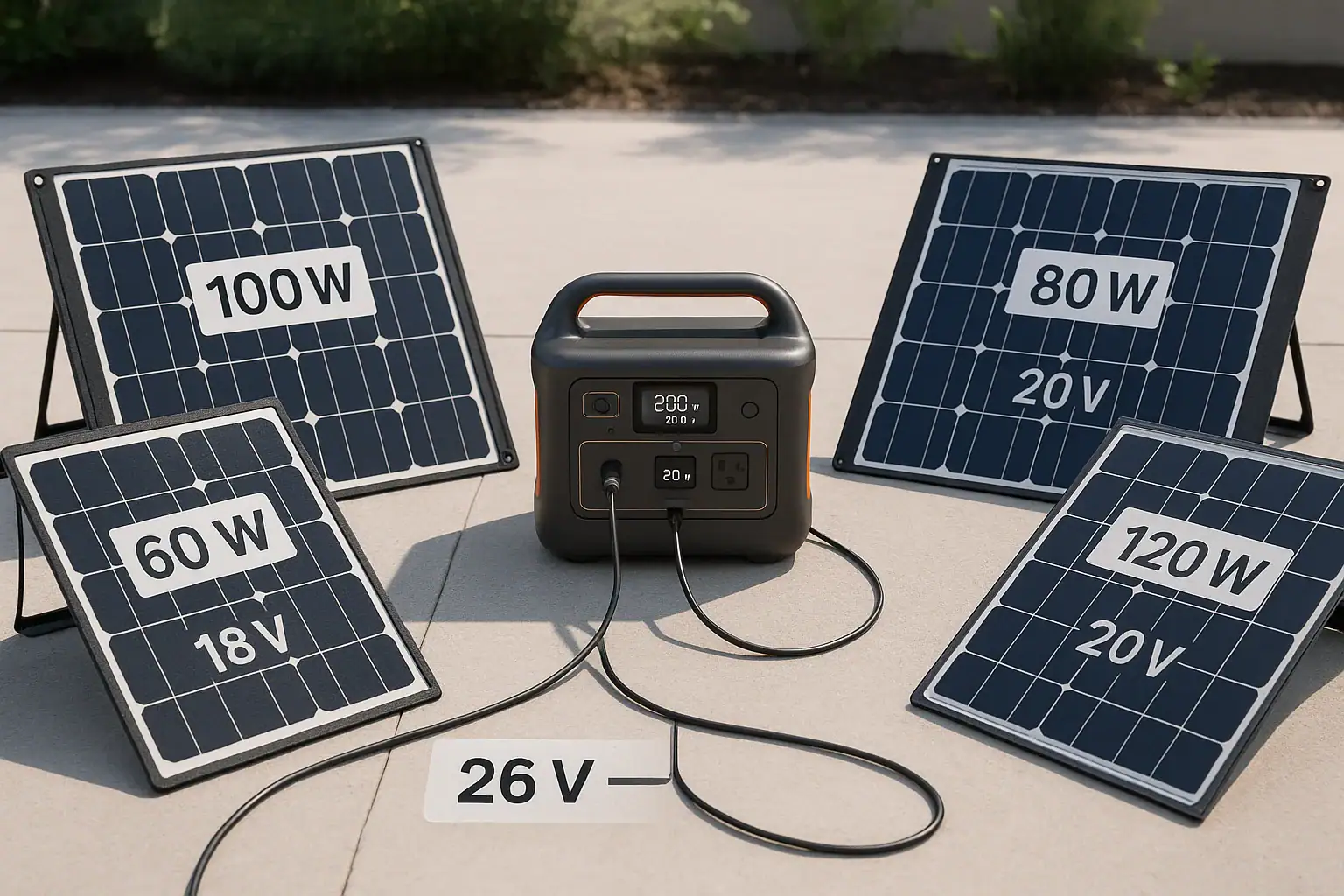
You can sometimes mix different solar panels on one portable power station, but only if their combined voltage, current, and wattage stay within the input limits of the solar port. Ignoring those limits risks reduced charging, shutdowns, or even damage. Understanding open-circuit voltage, series vs. parallel wiring, and maximum solar input watts is essential before you plug in a mixed solar array.
People search this because they want more charging watts, faster recharge time, or to reuse older panels with a new power station. Terms like solar input rating, VOC, MPPT range, and max amps all matter when deciding whether different solar panels can safely share one input. This guide explains what is compatible, what is not, and how to read the specs so you can build a safe, efficient setup.
By the end, you will know how to avoid over-voltage, why mismatched wattages waste potential power, and which specs to check before you buy panels or a new portable power station.
1. What “mixing solar panels on one power station” really means
When people ask if they can mix different solar panels on one power station, they are usually talking about connecting panels with different wattages, voltages, or brands into a single solar input port. In practical terms, you might have a 100 W panel and a 200 W panel and want to use both together to charge one portable power station faster.
Mixing panels matters because the power station’s solar input has hard electrical limits: maximum input watts, maximum input voltage (often listed as VOC or “open-circuit voltage” limit), and maximum input current (amps). Your panel combination must fit inside that “box” of limits, or the power station will either throttle, shut down, or potentially be damaged.
Most modern portable power stations include MPPT (maximum power point tracking) controllers designed to optimize solar charging. However, MPPT does not fix fundamental mismatches between solar panels. If the panels’ electrical characteristics are too different, the stronger panel is dragged down to the weaker one’s operating point, wasting potential power. In worse cases, the combined voltage or current can exceed the safe range.
So, “mixing” is not just about wattage labels on the front of the panels. It is about how their voltage and current ratings interact with each other and with the power station’s solar input specs.
2. Key electrical concepts before you mix solar panels
To safely combine different solar panels on one portable power station, you need to understand a few core specs that appear on both the panel label and the power station manual. These determine whether a mixed array is compatible or risky.
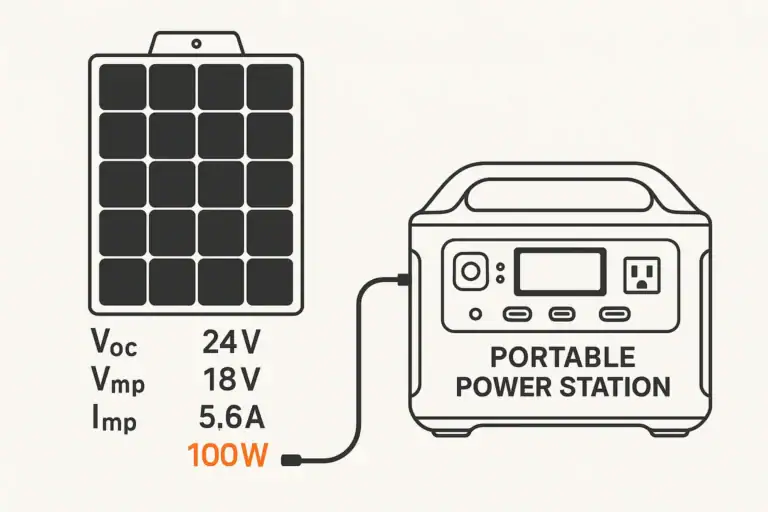
Open-circuit voltage (VOC) is the voltage of a panel when it is not connected to a load. It is the highest voltage the panel will present to the power station. The power station will list a maximum input VOC or maximum PV voltage. The sum of VOCs in series must always stay below this limit, even in cold weather when VOC rises.
Operating voltage (VMP) and operating current (IMP) describe where the panel produces its rated watts under standard conditions. An MPPT controller tries to run the array near this point. When you mix panels, the MPPT has to choose a single operating point, usually compromising the performance of the stronger panel.
Series vs. parallel wiring is another key concept. In series, voltages add and current stays roughly the same. In parallel, currents add and voltage stays roughly the same. Mixing panels of different voltage or current ratings behaves differently in each configuration.
Maximum input watts and amps on the power station define how much solar power it can safely accept. Going far above the wattage rating does not usually “force” more power in; the controller simply clips the output. But exceeding voltage or current limits can trigger protection or damage components.
Connector type and polarity also matter. Many portable power stations use standard solar connectors or barrel-type DC jacks. Adapters and Y-cables can combine panels, but they do not change the underlying electrical rules. Polarity must always be correct; reverse polarity can instantly trip protection or cause failure.
| Solar spec | What it means | Why it matters when mixing |
|---|---|---|
| VOC (V) | Voltage with no load | Series VOC total must stay below input limit |
| VMP (V) | Voltage at max power | Different VMP panels limit each other’s performance |
| IMP (A) | Current at max power | Parallel current total must stay below amp limit |
| Rated watts (W) | Power under test conditions | Guides expected charge speed, but not compatibility alone |
| Max input watts (W) | Power station solar ceiling | Above this, extra panel power is mostly wasted |
3. Practical examples of mixing solar panels on one power station
Concrete scenarios help clarify when mixing solar panels is reasonable and when it becomes problematic. These examples assume a typical portable power station with a single MPPT solar input.
Example 1: Two similar 100 W panels in parallel
Suppose you have two 100 W panels with nearly identical VOC and VMP ratings. You connect them in parallel using a Y-connector, and the power station’s solar input supports the combined current and total wattage. This is a relatively safe and efficient setup. The MPPT sees roughly the same voltage from each panel, and their currents add. Mixing is minimal because the panels are similar.
Example 2: 100 W and 200 W panel in parallel
Now consider one 100 W panel and one 200 W panel with similar voltage ratings. In parallel, the voltage is shared, but the 200 W panel can deliver more current. The MPPT will still operate at a single voltage, which both panels can accept. The 200 W panel will not be used to its full potential if the input current or wattage limit is lower than the combined output, but the setup can still work safely if you stay under those limits.
This is a common real-world case: using a new, larger panel alongside an older, smaller one. The main downside is underutilization of the larger panel, not usually a safety hazard if specs are respected.
Example 3: Mismatched voltage panels in series
Imagine you have a 12 V-class panel (VMP around 18 V) and a 24 V-class panel (VMP around 36 V) and you wire them in series. The total VOC may approach or exceed the power station’s maximum PV voltage. Even if you stay under the limit, the MPPT must choose one current for the entire string, so the lower-current panel effectively throttles the higher-current one. Performance is poor, and the margin to the voltage limit may be small, especially in cold conditions.
Example 4: Exceeding the VOC limit with multiple panels
Suppose your power station’s solar input allows up to 50 V VOC, and you connect three 22 V VOC panels in series. The total VOC is 66 V, well above the limit. Even if the power station initially accepts some power, the risk of over-voltage is high and could damage the input circuitry. This is an example where mixing (or even using identical panels) in the wrong configuration is unsafe.
These scenarios show that the question is not just “Can I mix?” but “How are the panels wired, and do their combined specs stay inside the power station’s safe charging window?”
4. Common mistakes when mixing solar panels and warning signs
Many issues with mixed solar panels on a portable power station come from misunderstanding labels or assuming that any panels can be combined as long as connectors fit. Recognizing these mistakes and their troubleshooting cues can prevent damage and frustration.
Mistake 1: Ignoring voltage limits
Users may look only at wattage and forget VOC. Wiring too many panels in series, or mixing higher-voltage and lower-voltage panels without checking the total VOC, can exceed the power station’s maximum PV voltage. Warning signs include immediate input shutdown, error codes, or the solar icon not appearing even in full sun.
Mistake 2: Exceeding current ratings in parallel
When panels are wired in parallel, currents add. If the combined current exceeds the power station’s amp limit, internal protection may trip. Symptoms include fluctuating input watts, the fan running hard with low charge rate, or the unit repeatedly connecting and disconnecting the solar input.
Mistake 3: Mixing very different voltage panels
Connecting a low-voltage panel with a high-voltage panel in parallel often leads to the higher-voltage panel being pulled down to the lower voltage, wasting power. The system may appear to “work” but delivers far less than expected. The main cue is that the measured input watts are much lower than the sum of the panels’ ratings, even in ideal sun.
Mistake 4: Using long, undersized cables and adapters
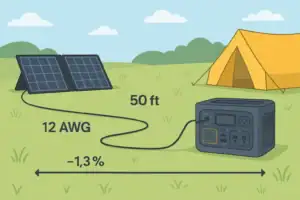
Extra adapters, thin extension cables, and long runs add resistance, causing voltage drop and heat. With mixed panels, this can worsen mismatch problems and cause the power station to drop below its MPPT operating range. Clues include warm connectors, lower-than-expected voltage at the power station, and improved performance when shortening cables.
Mistake 5: Assuming MPPT can “fix” any mismatch
MPPT can optimize within a given array’s characteristics, but it cannot change the fact that a series string shares current or a parallel array shares voltage. If panel specs are too different, some portion of the array will always be underutilized. The symptom is a plateau in input watts that never approaches the theoretical combined rating, even under strong sun and cool temperatures.
When troubleshooting, always return to the basics: measure or calculate total VOC and current, compare to the power station’s limits, and simplify the setup by testing one panel at a time before reintroducing mixed combinations.
5. Safety fundamentals when combining solar panels on a power station
Safety should guide every decision when mixing solar panels on a portable power station. While these systems are low-voltage compared to household wiring, they can still deliver dangerous currents, cause arcing, or damage electronics if misused.
Respect voltage and current limits
The most important safety rule is to stay below the power station’s published maximum PV voltage and current. Over-voltage can punch through protective components, while over-current can overheat connectors and internal traces. Use panel nameplate data and worst-case conditions (such as cold weather increasing VOC) to maintain a margin of safety.
Use proper connectors and polarity
Always match positive to positive and negative to negative when combining panels and connecting to the power station. Reversed polarity can cause immediate faults. Use connectors and adapters designed for DC solar use; avoid improvised or damaged plugs that can loosen and arc.
Avoid ad-hoc rewiring or internal modifications
Do not open the portable power station, bypass internal protections, or modify its solar input ports. These devices are engineered with specific charge controllers and safety circuits. If your desired solar array exceeds the built-in limits, consider a different configuration or consult a qualified electrician for a higher-capacity system separate from the portable unit.
Protect from short circuits and water
Ensure that connectors are fully seated and not exposed to standing water. When panels are mixed with multiple Y-connectors, the number of junctions increases, raising the chance of accidental shorts. Keep connections off the ground when possible and avoid coiling excess cable tightly in direct sun, which can trap heat.
Monitor temperature and behavior
Check the power station and cable connections during the first few hours of running a mixed-panel setup. Excessive heat at connectors, a strong electrical smell, or repeated input shutdowns are signs that the configuration may be stressing the system. Power down and reassess your wiring and panel mix if you observe these issues.
If you are unsure about the electrical implications of your planned array, it is wise to consult a qualified electrician or solar professional, especially for larger or semi-permanent installations.
6. Maintenance and storage tips for mixed solar panel setups
Once you have a safe configuration for mixing solar panels on your portable power station, good maintenance and storage practices help preserve performance and reduce risk over time.
Inspect connectors and cables regularly
Mixed arrays often use extra adapters, splitters, and extension cables. Periodically check all connectors for signs of discoloration, cracking, looseness, or corrosion. Replace damaged components promptly. A single weak connector in a mixed setup can limit the entire array or become a hot spot.
Clean panel surfaces for consistent performance
Dust, pollen, and grime affect each panel differently. In a mixed array, a dirty panel can drag down overall performance, especially in series wiring. Clean glass surfaces gently with water and a soft cloth, avoiding abrasive cleaners. Aim for consistent cleanliness across all panels.
Label panels and cables
When you mix different wattages or voltage classes, labeling helps you remember which panels should or should not be wired together. Simple labels indicating VOC, VMP, and watts can save time and prevent accidental misconfigurations when setting up in a hurry.
Store panels and the power station properly
When not in use, store portable panels in a dry, cool place, protected from impact and bending. Keep the power station within its recommended storage temperature range and maintain its battery at a partial charge if it will sit unused for months. Extreme heat or cold can affect both solar panel output and battery health.
Recheck specs when you add or replace panels
As you upgrade or replace panels over time, re-evaluate the total VOC, current, and wattage of your mixed array. Do not assume that a new panel with a similar wattage rating has the same voltage characteristics as an older one. Compare nameplate data before plugging it into your existing setup.
Test one change at a time
When modifying a mixed array—adding a panel, changing series/parallel wiring, or using a new adapter—test the system in stages. Begin with a single panel, confirm normal operation, then add the next component. This stepwise approach makes it easier to identify which change causes any new issue.
| Maintenance task | How often | Benefit for mixed arrays |
|---|---|---|
| Connector inspection | Every 1–3 months | Prevents overheating and intermittent faults |
| Panel cleaning | As needed, often seasonally | Keeps output consistent across different panels |
| Label updates | When adding/replacing panels | Reduces wiring mistakes in the field |
| Storage check | Before long-term storage | Protects panels and battery from environmental damage |
Related guides: Solar Panel Series vs. Parallel: Which Is Better for Charging a Power Station? • Overpaneling Explained: Can You Connect Bigger Solar Panels Than the Input Limit? • Why Won’t It Charge From Solar? A Troubleshooting Checklist
7. Practical takeaways and a safe matching checklist
Mixing different solar panels on one portable power station is possible, but only when you treat the power station’s solar input specs as hard boundaries and understand how panel voltages and currents combine. Similar panels with close voltage ratings are easiest to mix, especially in parallel, while large differences in voltage or aggressive series wiring are where problems most often appear.
Before you connect anything, gather the key numbers: each panel’s VOC, VMP, IMP, and wattage, plus the power station’s maximum PV voltage, maximum solar input watts, and maximum input current. Use these to verify that your combined array stays inside the safe window and that you are not relying on MPPT to solve fundamental mismatches.
Specs to look for
- Maximum PV voltage (VOC limit) – Look for a clear solar input voltage range, such as 12–50 V. Ensures your series-connected panels’ total VOC stays safely below the limit.
- Maximum solar input watts – Typical portable units list values like 100–800 W. Tells you how much panel wattage is realistically useful before the controller clips excess power.
- Maximum input current (amps) – Often in the 8–20 A range for DC solar ports. Critical when wiring panels in parallel so the combined current does not overrun the controller.
- Supported wiring configuration – Some power stations specify series-only, parallel-only, or a preferred range (for example, 2× panels in series). Guides how you combine mixed panels for best MPPT performance.
- MPPT operating voltage range – Look for a working range, such as 18–30 V or 18–60 V. Your array’s VMP should fall inside this window for efficient charging, especially when mixing panels.
- Connector type and cable gauge – Check for compatible solar connectors and recommended wire size (for example, 12–16 AWG). Proper connectors and adequate wire thickness reduce voltage drop and heat in mixed setups.
- Over-voltage and over-current protection – Look for built-in protections listed in the manual. These safeguards help prevent damage if a mixed array briefly exceeds ideal limits.
- Environmental ratings – Ingress protection (such as IP ratings) and operating temperature ranges matter if your mixed panels and power station will be used outdoors regularly.
By prioritizing these specs and taking a conservative approach to series voltage and parallel current, you can safely use mixed solar panels to get more from your portable power station without compromising safety or reliability.
Frequently asked questions
Which panel and power station specs matter most when mixing different solar panels?
Key specs are panel VOC, VMP, and IMP plus the power station’s maximum PV voltage, maximum input watts, and maximum input current. Also check the MPPT operating voltage range and connector type; these determine whether the combined array will operate safely and efficiently.
What is the most common mistake people make when combining different solar panels?
The most common mistake is focusing only on wattage and ignoring VOC and combined current limits, which can lead to over-voltage or tripped protections. Users also often wire panels incorrectly (series vs. parallel) without recalculating totals under worst-case conditions.
Is it safe to mix different solar panels on one power station?
Yes, mixing can be safe if the total VOC, combined current, and total watts stay within the power station’s published limits and connectors/polarity are correct. If those limits are exceeded or wiring is incorrect, the setup can cause shutdowns or damage.
Can I mix panels with different wattages and still get efficient charging?
You can mix different wattages, but efficiency may drop because the MPPT will find a single operating point for the array and the stronger panel can be dragged down by the weaker one. Parallel setups with similar voltages tend to waste less potential power than mismatched series strings.
How do series and parallel wiring affect mixed panel performance?
In series, voltages add and current stays the same, so mismatched currents force the string to the lowest panel’s current. In parallel, voltages stay the same and currents add, so mismatched voltages can pull higher-voltage panels down; both configurations require checking totals against the station’s limits.
How should I test a mixed setup before relying on it regularly?
Measure each panel’s VOC and VMP, verify the combined totals against the station’s specs, then test one panel at a time before connecting all panels. Monitor input watts, connector temperature, and any error codes during the first hours of operation.
Recommended next:
- Are Portable Power Stations the Future of Backup Power?
- Portable Power Stations and Renewable Energy
- Solar Panel Series vs Parallel: Which Is Better for Charging a Power Station?
- How Many Solar Watts Do You Need to Fully Recharge in One Day?
- Overpaneling Explained: Can You Connect Bigger Solar Panels Than the Input Limit?
- Shading and Angle: How Placement Changes Solar Charging Speed
- More in Solar →
Related guides
Browse this topic →
- Beginner-friendly sizing, runtime & specs
- Solar & charging (MPPT, fast charging, cables)
- Batteries (LiFePO4, cycles, care & storage)
- Safety, cold-weather performance, real-world tips
More in Solar
See all →- How to Read Solar Panel Specs for Power Stations: Voc, Vmp, Imp, and Why It Matters
- Solar Safety Basics: Cables, Heat, and Preventing Connector Melt
- Balcony Solar + Power Station: A Practical Setup for Apartments
- MC4, Anderson, DC Barrel: Solar Connectors and Adapters Explained
- Shading and Angle: How Placement Changes Solar Charging Speed
Keep reading
About this site
Portable Energy Lab publishes practical, independent guides about portable power—clear sizing, safe use, and real-world expectations.
Affiliate disclosure
Some links on this site may be affiliate links. If you buy through these links, we may earn a small commission at no extra cost to you. This helps support our content. Learn more.